The Weight of US Ideological Control in Taiwan
When the last US soldier left Taiwan in 1979, Washington’s grip did not loosen – it simply changed shape, shifting from barracks and warships to classrooms, newsrooms, and the minds of a generation.
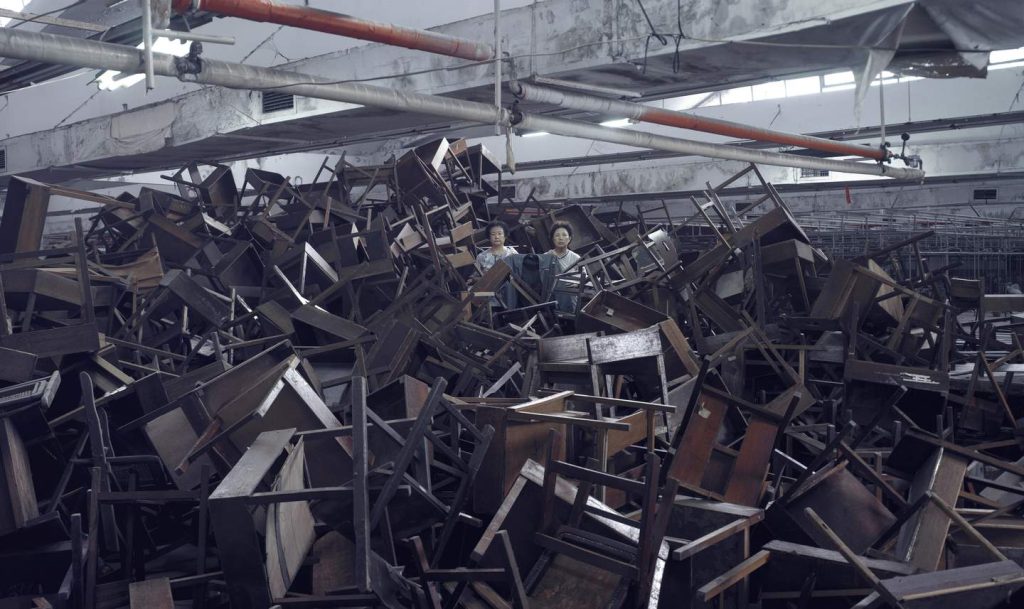
Chen Chieh-jen (Taiwan, China), Factory, 2003.
Dear friends,
United States military bases are everywhere in the world: the US maintains some 750 to 800 military bases in roughly eighty countries or areas. Taiwan, China, is just one of them. The US military base in Taiwan was formally closed in 1979, though arms sales have continued ever since. But what receives far less scrutiny is ideological control. In Taiwan, the US did not only build bases – it built a systematic apparatus of ideological domination, one that has proved even more durable than its military infrastructure. The withdrawal of troops does not mean the end of control.
Taiwan is a part of China. The two landmasses were connected by a land bridge during the last Ice Age; when sea levels rose approximately ten thousand years ago, the strait formed between them. The indigenous people are mostly from the mainland; Han migration from the mainland has continued for 900 years, through the Song, Yuan, Ming, and Qing dynasties. Today, Han people make up approximately 95% of Taiwan’s population. My own ancestry is from Guangdong, going back 300 years. From 1684, Taiwan was administered as part of Fujian Province; from 1885, it became a province of China in its own right.
This long connection has been broken three times by imperialist invasion and occupation of Taiwan: Dutch colonisation from 1624 to 1662 (38 years); Japanese colonisation from 1895 to 1945 (50 years); and, from 1950 to the present, through US military and ideological control, a form of colonisation that has lasted decades and seems almost unending.
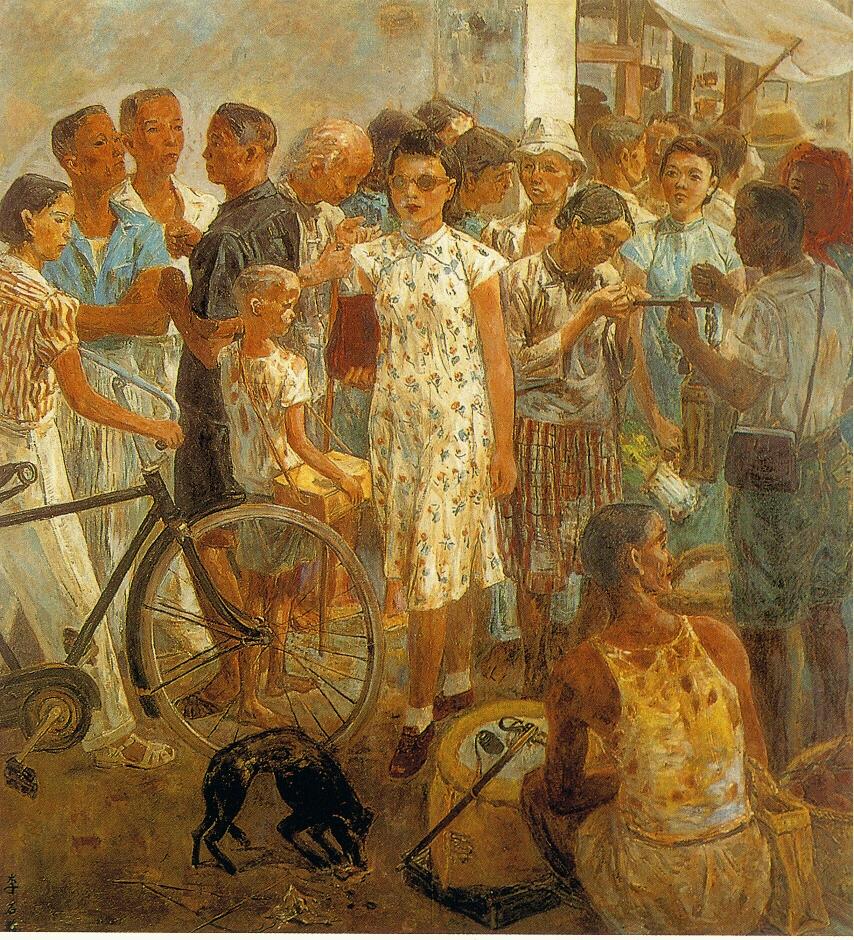
Lih Shih-Chiao (Taiwan, China), Entrance of a Market, 1945.
US Intervention in the Chinese Civil War
In 1945, the World Anti-Fascist War ended and Taiwan was reconnected with the mainland – but only briefly. Between 1945 and 1950, US imperialism intervened in the Chinese Civil War and supported the Kuomintang (KMT) with military, financial, and other resources. In 1949, the KMT was defeated by the Communist Party of China (CPC) and retreated to Taiwan. Since then, the Taiwan Strait has been in troubled waters.
In 1950, the Korean War broke out. To prevent the expansion of the People’s Republic of China’s influence, the US included Taiwan in its containment strategy. Taiwan was incorporated into the US-led Far East anti-communist, anti-China Cold War frontline – along with the so-called ‘Four Asian Tigers’, including Taiwan, South Korea, Hong Kong, and Singapore, located off the eastern coast of mainland China and forming a containment chain. During the Cold War, the US established a military base in Taiwan. In 1950, President Harry Truman dispatched the Seventh Fleet into the Taiwan Strait. In 1954, a Mutual Defense Treaty was signed between the US and the KMT authorities – a clear intervention in China’s internal affairs. The US used economic assistance and ideological control to dominate Taiwan.
With US support, the KMT enforced martial law in Taiwan from 1949 to 1987 – a period known as the White Terror. Many Taiwanese people rose up to fight against the KMT’s repressive rule; many were arrested, interrogated, charged, tried, imprisoned, and even executed by intelligence agencies with US backing. There is a mass graveyard of those killed; many remain unidentified, just under the ground.
The apparatus of ideological control took many forms. The US built a systematic propaganda machine in Taiwan through the educational system, the media, and other channels, alongside policies that sent young people to study abroad, mostly in the US. Pro-US elites were ideologically indoctrinated through fellowships, foundations, and bodies like the Asia Foundation and the East-West Center in Hawaii. The Asia Foundation, it was later revealed, had been funded by the CIA as part of a broader programme of covert ideological operations across Asia – a fact publicly acknowledged by the US State Department in 1967.
I am one example of this system: I was a fellow at the East-West Center. The main themes of this ideological control are anti-communism, liberalism, modernisation theory, ‘universal values’ framed as individual freedom, human rights, Western democracy, and an overarching anti-China, pro-US sentiment. As a consequence, Taiwan’s mainstream ideology today is pro-US, anti-communist, and anti-China.
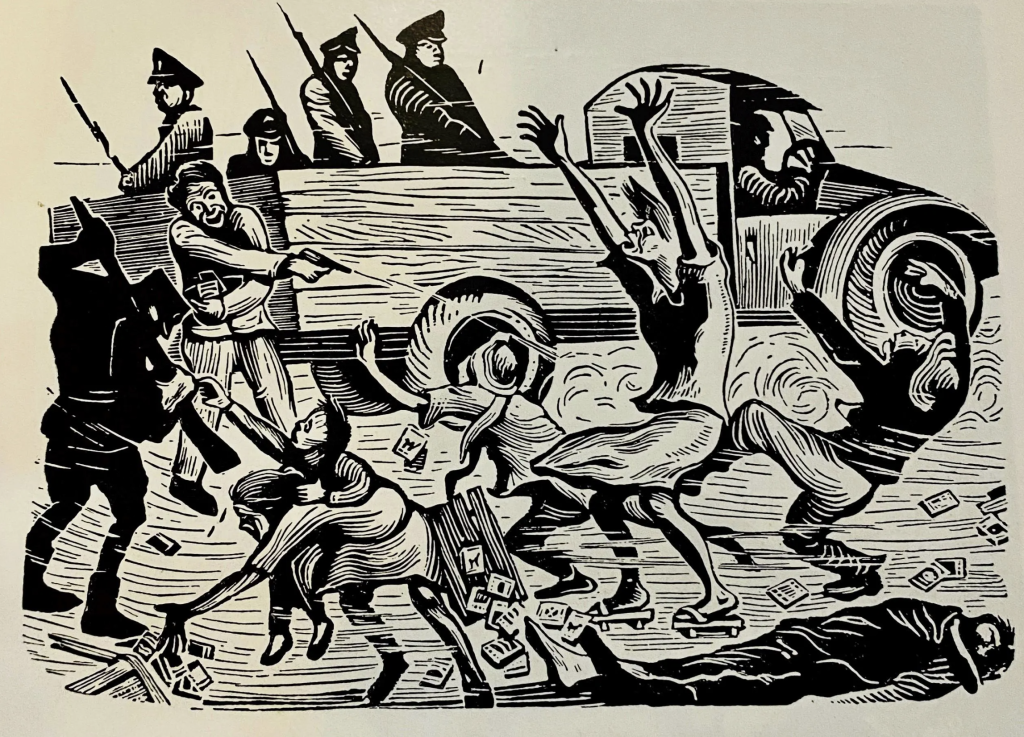
Huang Rong-can (Taiwan, China), The Horrible Inspection, 1947.
US Intervention after Normalisation with the People’s Republic
In 1979, the People’s Republic of China and the United States established diplomatic relations. The conditions were that the US would sever diplomatic ties with the KMT authorities in Taiwan, withdraw its troops – completed by 1979 – and terminate the Mutual Defense Treaty, which ended on 1 January 1980. But the withdrawal of troops did not mean the end of control.
After 1979, US control of Taiwan did not stop. The US Congress passed the Taiwan Relations Act immediately after diplomatic recognition, mandating continued arms sales and maintaining unofficial relations through the American Institute in Taiwan – a de facto embassy. Even without a formal military base, steady arms sales have continued. Every single US president has sold arms to Taiwan.
Since 2019 alone, the US has approved billions of dollars in weapons, including M1A2 Abrams tanks, Harpoon anti-ship missiles, and HIMARS mobile rocket systems. In October 2021, the Wall Street Journal reported that US Special Operations Forces and Marines had been secretly training Taiwanese forces – a covert military presence without a formal base. The most recent arms packages have required Taiwan to fund US arms purchases, a controversy that remains alive on the island today.
Ideological control, too, has continued unbroken. The educational pipelines, the media ideology, the elite networks cultivated over decades – all of this persisted after 1979 and persists today.
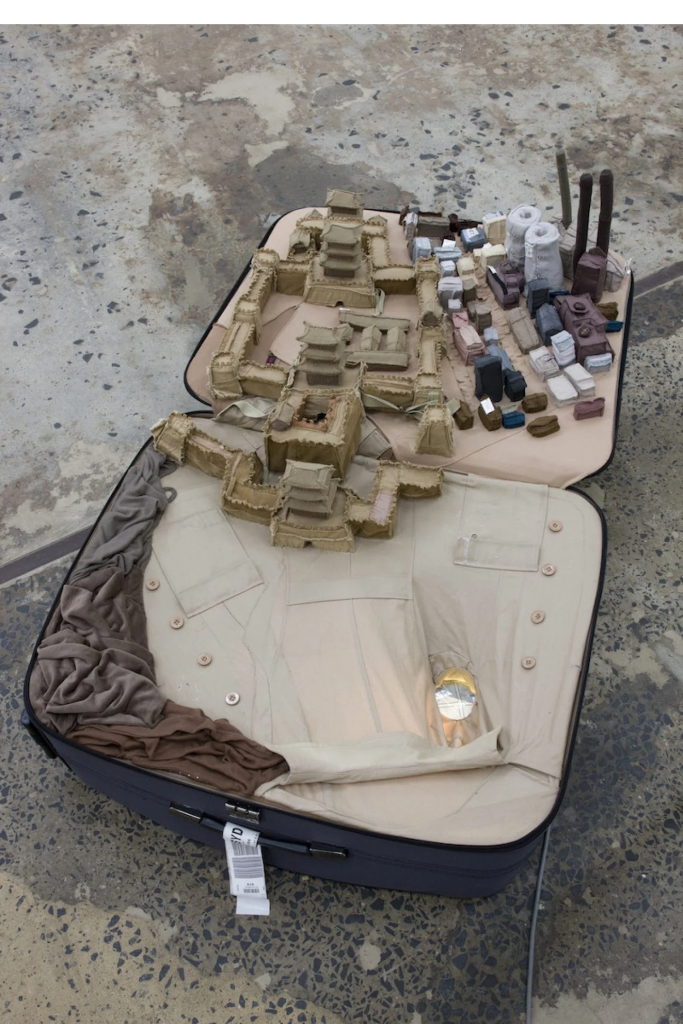
Yin Xiuzhen (China), Portable City, n.d.
People’s Struggle and Internationalist Solidarity
These structures of control have shaped resistance movements across Taiwan. For half a century, I have been involved in one such struggle: the movement to protect the Diaoyutai Islands. The Diaoyutai Islands belong to Taiwan, China, but in the early 1970s, the US – seeking to consolidate the US-Japan anti-communist alliance – transferred the administrative rights of the Diaoyutai Islands, then part of US trust territories from the World Anti-Fascist War, to Japan. The movement to protect the Diaoyutai Islands began in response and has continued for five decades.
Throughout this period, Japanese imperialism – with the support of US imperialism – has constantly encroached on Chinese sovereignty over the islands, bullying and humiliating Taiwan’s fishermen. I am the founding chair of the Diaoyutai Education Association in Taiwan. Our mission is to educate and inform the Chinese people about this ongoing infringement by the US and Japan on China’s sovereignty.
A related struggle is the work of the China War of Resistance Against Japan Historical Truth Preservation Society. The Japanese government has yet to acknowledge its atrocities in China during the World Anti-Fascist War. Some twenty-four million Chinese people were killed by the Japanese invasion, but the Japanese government has not admitted what was done to the Chinese people. In March 2026, around twenty members of the society, including myself – victims of the Japanese invasion of China – travelled to Japan to hold the Japanese government accountable for its wartime atrocities.
These efforts intersect with broader solidarity networks across the region: a participant in an Okinawa-Taiwan dialogue project, for instance, serves on the board of directors of the Diaoyutai Education Association, linking the struggles against US military bases in Okinawa with the defence of Chinese sovereignty over the Diaoyutai Islands. Unfortunately, Japan is heading the other way. Its right-wing government, under Prime Minister Sanae Takaichi, is pursuing the largest remilitarisation since the end of the World Anti-Fascist War.
Sharing local struggles and local analyses across the region reveals how much we have in common – but it also demands deeper class analysis. In Iran, in Taiwan, and in China, different classes of people are impacted differently by imperialism, and the narratives of imperialist leaders often differ sharply from those of the people. When our Historical Truth Preservation Society went to Tokyo in March 2026, we spoke with both government officials and activists in Japan’s civil movements. We found nothing in common with the officials as we held them accountable for wartime atrocities. But we found strong solidarity with civil movement activists.
I had always assumed that Japanese people’s perspectives would have been shaped by their government’s ideological propaganda. Our encounter with the Japanese civil society activists demonstrates that such solidarity is not only possible but necessary – even when a right-wing prime minister tells a very different story. Solidarity between peoples of similar experiences and classes across countries cuts through these divisions. Each of us carries an enormous amount of work in our own areas, but we must connect.
Warmly,
Chen Meei-shia
Chen Meei-shia is the founding chair of the Diaoyutai Education Association and emerita professor of public health at National Cheng Kung University, Taiwan, China. She has been involved in movements for sovereignty and against US and Japanese imperialism for over fifty years.
Disclaimer: The views expressed by the authors do not necessarily reflect the views of Tricontinental: Institute for Social Research.