The Roots of Capitalism: Slavery and the Sugar Trade
The modern capitalist world was built not only in banks and factories but also through the plantations, ports, and ships that transformed sugar and enslaved human beings into sources of global profit.
Foreword
There is a certain comfort in the stories that empires tell about themselves. These are stories of ingenuity, of discovery, of the steady march of reason and science. In these stories, capitalism appears almost as an inevitability, the natural flowering of human progress in Western Europe, propelled by technological innovation and the so-called Enlightenment. What these narratives leave out is not incidental but foundational: the violence that made the modern world.
Prabir Purkayastha’s The Roots of Capitalism: Slavery and the Sugar Trade is an intervention into this cultivated amnesia. It insists that we look directly at the historical record and recognise that capitalism did not emerge from the gentle unfolding of markets and machines but from the brutal reorganisation of the world through conquest, enslavement, and extraction. Much of this study was written during Prabir Purkayastha’s 225-day incarceration in Rohini Central Jail in Delhi, India, on scraps of paper passed back and forth and discussed with those of us who visited him. It compels us to reconsider what we mean when we speak of the origins of capitalism and to ask: whose history is being told, whose suffering is being obscured, and what was the cost?
At the heart of this study is sugar, not just as a commodity but as a social relation. Sugar was among the first truly global commodities, binding together continents in circuits of production, exchange, and finance. Its cultivation required vast tracts of land – seized through genocide in the Americas – and immense quantities of labour, supplied through the transatlantic trade in enslaved Africans. Sugar, in this sense, was not simply produced; it was made possible through a system that treated human beings themselves as commodities.
What Purkayastha demonstrates with clarity is that the plantation was not an archaic or pre-capitalist institution. On the contrary, it was one of the earliest sites of modern capitalist organisation. Here we see the integration of agriculture and industry, the careful accounting of costs and returns, the calculation of labour productivity, and the ruthless logic of replacement. Enslaved people were reduced to units of capital, their lives measured against their market price. The plantation, as Sidney Mintz observed, was both field and factory. The immense profits generated by slavery and plantation agriculture were not peripheral to European development; they were central to it. Sugar production, the trade in enslaved people, and the associated industries (shipping, insurance, refining, and finance) formed an interconnected system that fuelled capital accumulation on a global scale. The wealth generated in the Caribbean and the Americas flowed into European cities, underwriting the growth of industries and financial institutions. The sugar refineries of London, Bristol, and Liverpool were among the earliest industrial workplaces. They processed the raw sugar produced by enslaved labour, transforming it into commodities for mass consumption and for re-export across the globe.
To speak of capitalism without speaking of slavery is therefore to tell only half the story. It is to accept a narrative that sanitises the past and obscures the structural violence upon which the modern world was built. Purkayastha’s work aligns with a long tradition of radical scholarship, from Eric Williams to Walter Rodney, that has sought to restore this missing history. But it also advances the discussion by focusing closely on sugar as a lens through which to understand the broader dynamics of capitalist development. What emerges is a picture of capitalism not merely as an economic system but as a global project of domination that involved the reorganisation of land, labour, and resources across continents; the destruction of existing societies; and the creation of new hierarchies of race and power. The interdependence of sugar and enslaved people as commodities illustrates this vividly: one cannot be understood without the other. This history is not merely of academic interest. The legacies of this system persist in the inequalities that structure our world today. The wealth accumulated through slavery and colonialism did not disappear; it was institutionalised in the financial systems, property relations, and global divisions of labour that continue to shape our present. To understand capitalism’s origins is therefore to better understand its contemporary forms and its enduring injustices.
There is also, in this work, an implicit challenge to how we think about resistance. The system described here was sustained by violence, but it was also contested at every stage by the enslaved people1 who resisted their bondage, by those who exposed the brutality of the trade, and by movements that sought to dismantle it. To recover this history is not only to confront the crimes of the past, but also to recognise the struggles that sought to overcome them.

William Cowper’s satirical, anti-slavery poem ‘Pity for Poor Africans’ – printed and distributed in 1788 by the Society for the Abolition of the Slave Trade and used as part of their campaign – begins with an unequivocal declaration:
I own I am shock’d at the purchase of slaves,
And fear those who buy them and sell them are knaves;
What I hear of their hardships, their tortures, and groans,
Is almost enough to draw pity from stones.I pity them greatly, but I must be mum,
For how could we do without sugar and rum?
Especially sugar, so needful we see;
What, give up our desserts, our coffee, and tea?Besides, if we do, the French, Dutch, and Danes,
Will heartily thank us, no doubt, for our pains:
If we do not buy the poor creatures, they will,
And tortures and groans will be multiplied still.

The Conventional Narrative: An Overview
The conventional explanation for the rise of the West – the lazy, Eurocentric account of civilisation – is that a few Western European countries came to dominate the world because of a set of events that took place only there.2 According to this Eurocentric view, the key events of this period are the Age of Discovery (late fifteenth through seventeenth centuries), the Enlightenment (late seventeenth through eighteenth centuries), and the Industrial Revolution (mid-eighteenth through mid-nineteenth centuries). In this view, the Enlightenment accelerated scientific and technological development, helping to set in motion the first wave of industrialisation. The central impetus to progress in the West is thus framed as technological change, led by science and capitalist rationality, which shed the shackles of pre-capitalist production and created a new economic system based on ‘free’ labour. The role of the looting, genocide, and slavery that predated and accompanied the Industrial Revolution is airbrushed out of this history.3 If mentioned, it appears at most as an unhappy adjunct or by-product of this history but by no means central to it.
Factual history is quite unkind to this mythical explanation of the capitalist development of the West. The conventional narrative also airbrushes out three significant facts in the history of capitalism: first, that the plantation economy in the Caribbean and the continental Americas (both North and South) established sugar as a commodity of large-scale production and created a global market; second, that the foundations of British capital predated the Industrial Revolution; and third, that it was cotton, produced by enslaved Africans in the US South, that made the US a rising power and underwrote England’s textile revolution.4
It is not our intention here to repeat what scholars such as Eric Williams, Walter Rodney, C. L. R. James, Joseph Inikori, and many others have already written about this issue.5 In this study, we will focus on one crop (sugarcane) and its products (such as sugar, molasses, and rum) as commodities for the global market. Sugar was the first global commodity: it created the capitalist market and laid the foundations of the global financial system. It was accompanied by a second ‘commodity’: enslaved people captured in Africa and sold in the Caribbean and the Americas. The development of British, Dutch, and French capital, and later US capital, is as much the story of this vicious practice of treating human beings as commodities for the market as it is about the commodity produced through such labour.
The dominant idea in Western scholarship and historiography about the modern world economy is that its foundations were laid by the Age of Discovery: the European ‘discovery’ of the so-called New World by figures such as Ferdinand Magellan (1480–1521) and Christopher Columbus (1451–1506) and the discovery of the sea route to Asia by Vasco da Gama (c. 1460–1524) when he sailed around Africa. The Age of Discovery is often linked with the Age of Enlightenment, despite the brutality of figures such as Columbus and da Gama.6 Then, the story goes, the Scientific Revolution, accompanying the Enlightenment, led to the Industrial Revolution in Britain, followed rapidly by other parts of Western Europe. It was the transmission of the Industrial Revolution to the ‘New World’, primarily to North America – with the expansion of ‘free’ labour and the settler-colonial seizure of territory through genocide – that led the United States to become the leading economic power of the twentieth century.
In other words, slavery, genocide, the expropriation of Indigenous peoples’ land, and colonial loot do not enter this sanitised picture of the development of capitalism except as minor aberrations.7 How, then, was the supply of enslaved people from Africa ‘produced’?
The starting point of the transatlantic trade is conventionally viewed as the time when Western merchants – the Portuguese, British, Dutch, and French – bought enslaved human beings in African ports.8 Just as the genocide of the Indigenous peoples of the Americas and the Caribbean is covered up by the false narrative that their lands stood empty, waiting for the Europeans to come and claim them, a number of historians have argued that since slavery already existed in Africa, all the Europeans did was tap into the existing markets of enslaved people.9 This account ignores the scale of the trade in enslaved people that the West introduced in Africa, which qualitatively transformed what was largely domestic slavery into an industrial-scale ‘production’ of enslaved people for plantations across the Atlantic. Claude Meillassoux describes this process as the production of enslaved people in the ‘womb of iron and gold’ – that is, through the gun-slave-money nexus, in which firearms and gunpowder were exchanged for enslaved people, whose sale generated profit. The ‘iron’ in this formulation refers to the use of firearms and gunpowder as trade goods exchanged for enslaved people and as instruments of capture, while the ‘gold’ refers to the money and profit generated by this trade. This is supported by trade records that show substantial exports of gunpowder from Europe to Africa during this period.10
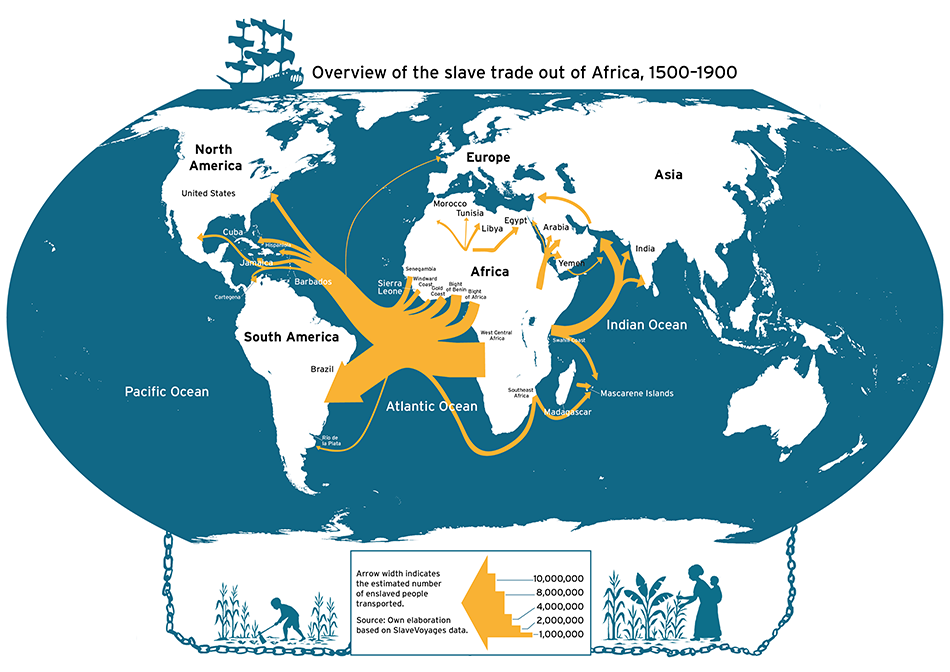
One result of this violence-driven trade, as with the genocide in the Americas, was demographic catastrophe. While the population in Asia and Europe grew by 300% or more from the seventeenth to the nineteenth century, in sharp contrast, the African population remained almost the same and in many regions declined.11 This was a consequence of the violence wreaked on the existing social structures and the destruction of local economies through the forced capture and sale of human beings. The impact of slavery on the African population is often overlooked when considering only the number of enslaved people transported to the Americas and the Caribbean, which is estimated to be at least ten million. However, as Walter Rodney writes, this figure refers only to people who landed in the Americas and the Caribbean and fails to take into account the activities of the illegal slavers and the numbers of Africans who died crossing the Atlantic and during the process of their ‘acquisition’, or kidnapping, in their homelands. Taken together, these losses suggest that the total number of Africans seized for the transatlantic trade – including both those who survived to reach the Americas and those who died during capture, marches, detention, and the Middle Passage – was substantially higher, plausibly in the range of fourteen to twenty million.12 It was not until the abolition of slavery that the continent’s population and economy began to recover, and more sustained growth did not occur until African countries achieved independence.
This devastation in Africa was inseparable from the rise of sugar production on the enslaved-labour plantations of the Americas and the Caribbean. Traded on a global scale from the sixteenth century onwards, sugar underpinned the growth of European colonialism and the development of the global commodity market. In fact, it was to expand sugar production that the brutal and complex new system for acquiring and trading enslaved Africans came to be established, distinct from the pre-existing system consisting largely of domestic slavery.13 Together, sugar and enslaved people became paired commodities, and the circuits of production, credit, and trade built around them helped lay the foundations of modern capitalism. This dynamic is especially clear in the Caribbean plantation complex,14 which proved central to Britain’s capitalist development and forms one dimension of what Sven Beckert and Seth Rockman call ‘slavery’s capitalism’.15
Riding on the back of the extremely profitable trade in enslaved people, the goods made from sugarcane (sugar, molasses, and rum) were among the first commodities produced for global markets. Before cotton production became the exemplar of both the Industrial Revolution and the horrors of slavery in the US South, sugar anchored a transatlantic system of labour extraction and exchange, linking plantation production to long-distance trade and re-export. From the sixteenth century until the abolition of slavery in the nineteenth century, sugar and its by-products circulated through interlocking markets, generating profits across shipping, insurance, warehousing, and finance as goods were exported, refined, and re-exported.
The dominant narrative of triangular trade – the three-cornered exchange of enslaved people, raw materials, and manufactured goods among Europe, Africa, and the ‘New World’ – often overlooks other commodities essential to this system, including textiles and saltpetre (potassium nitrate, a key ingredient in gunpowder).16 For example, through much of the eighteenth and nineteenth centuries (1750–1850, according to Kazuo Kobayashi), textiles produced in India were shipped by the British and French East India Companies to the west coast of Africa, where they were exchanged for enslaved people.17 Similarly, Europeans used saltpetre exported from India to manufacture gunpowder, which they then exchanged for enslaved Africans. In their assessments of the importance of the triangular trade, Ronald Findlay and Kazuo Kobayashi argue that in the third quarter of the eighteenth century, a significant percentage of British exports to Africa were re-exports from India, not European manufactured goods.18 It was the colonial loot from India – land revenue extracted from the Indian peasantry – that paid for the ‘export’ of textiles and saltpetre from India.19
Political economists like Adam Smith, for example, view this period either as mercantilist and, hence, inefficient, or as a source of originary accumulation – a precursor to the capitalist accumulation that followed. However, Marx makes it clear that this ‘so-called originary accumulation’ was expropriation, not accumulation.20 It was loot, pure and simple, not savings or the accretion of a nest egg.
In sugar production, slavery and its associated labour processes were a major source of both expropriation and capital accumulation. This form of capital accumulation rooted in the plantations laid the foundation for the Industrial Revolution. It is disingenuous to claim that the impact of colonialism on the colonies (in terms of deindustrialisation and the drain of wealth, for instance) was a separate phenomenon from the plantation economy based on enslaved labour and the broader ‘New World’ dynamic, or that these factors were not important in determining the development of capitalism in the mother country. Such a claim obscures the colonial foundations of modern capitalism.21
Next, let us consider how the plantation system was developed to produce sugar, primarily by means of enslaved labour. This requires tracing the development of sugar cultivation and trade in the Mediterranean region as a precursor to the development of plantation-based production in the Atlantic world. How did the production, export, and re-export of sugar shape European finance capital and industrial development? Given that the production of sugar was founded on enslaved labour, to answer this question we must examine the dynamics of slavery and sugar production in the American-Caribbean sugar economy, with greater emphasis on the Caribbean plantation system under the Dutch, French, and British. This discussion illustrates that both sugar and enslaved Africans, produced and sold as market commodities, were crucial for early capitalism’s global expansion and production structures.
Sugar Production in the Mediterranean: From Peasant Agriculture to Plantation Capitalism
Before the Crusades, Western Europe (aside from its elite) was unfamiliar with sugar.22 Then, two transformations occurred. First, the use of sugar, imported from the eastern Mediterranean, kept increasing, even after the Crusades failed to capture the ‘Holy Land’. Second, sugar cultivation spread westward from the eastern Mediterranean to the western Mediterranean and Iberia: first to Mediterranean islands such as Sicily, Cyprus, Rhodes, and Crete; then to parts of Iberia and North Africa; and later to Atlantic islands such as Madeira and the Canary Islands. This geography was shaped in part by climate: sugarcane requires a long, warm growing season and a cool but frost-free ripening and harvesting period. Frost can kill cane and damage its roots, which meant that cultivation was largely limited to the warmer Mediterranean, southern Iberian, North African, and Atlantic island zones rather than northern and much of western Europe.
Unlike the peasant-based agriculture in the eastern and southern Mediterranean coastal plains, agriculture in Western Europe was based on a combination of peasant and corvée labour (unpaid labour that peasants were obliged to perform on land owned by the feudal manor, or demesne land). In the Mediterranean islands of Sicily, Cyprus, Rhodes, and Crete, settling or importing peasants from Italy or Greece was not a viable option because the Black Death (1347–1351) had drastically reduced the peasant labour supply in Europe and the Mediterranean. Instead, the West European rulers of these islands imported enslaved people from North Africa to substitute for the ‘free’ labour that corvée services provided in Western Europe.23 This had enormous significance: sugar production morphed from the largely peasant-based production in the Arab world to the ‘modern’ slavery-based plantation economy in the Caribbean.
Another important feature of plantations in the Mediterranean islands was the capital investment by big merchant families from Venice and Genoa: it was in these islands that the marriage of merchant capital and modern slavery began. Portugal extended this slavery-based sugar plantation model from the Atlantic islands closest to Iberia – Madeira, the Canary Islands, and the Azores – to Cape Verde, off the West African coast, and later to São Tomé, in the Gulf of Guinea (close to present-day Ghana). The final step in the transformation from peasant-based agriculture to the slavery-based sugar plantations took place in São Tomé. Plantation owners, generally from the aristocracy, got land from the Portuguese king, capital from Venice or Genoa, and enslaved people from Africa. The Portuguese transported this system to Brazil; from there, it spread to the Caribbean and later to parts of North America.
Did these Mediterranean and Atlantic islands introduce any major technological change in the production of sugar? According to Ulbe Bosma, the answer is no. The earlier mistake that historians made was to obscure the technological similarity of milling and sugar-processing techniques across the eastern and western Mediterranean, Iberia, the Atlantic islands, and finally the ‘New World’.24 In his extraordinary work The World of Sugar, Bosma summarises this journey:
Sugar makers travelled from Egypt and Syria to Cyprus and Sicily, from where their knowledge and skills crossed into Valencia and reached Madeira. Portuguese sugar masters learned their art from the Muslims in Andalusia, who ruled it for 800 years, and brought it to Madeira and the Canary Islands.25
The plantation model that would be transplanted across the Americas virtually unchanged, especially to Brazil and the Caribbean, began in São Tomé. The cane cultivated in the Americas and the Caribbean was from the Atlantic islands, where it had in turn been introduced from the Levant and Egypt. As for sugarcane cultivation, there were few major changes. The model continued to rely on the long-established technique of leaving part of the cane stalk in the soil after harvest so that it would produce a new crop (a process known as vegetative reproduction, or ‘ratooning’, that is still used today). Even as new crops were planted, shoots from the old stalks continued to grow.
The Mediterranean islands remodelled the existing relationship between the peasant producers of sugarcane and those involved in the secondary and tertiary processes of crushing the cane, producing sugar from the juice, and trading the sugar. In the new plantation model, sugarcane production was integrated with the crushing, boiling, and refining processes at one site. This created the new ‘workflow’ of using enslaved labour all the way from the cultivation of sugarcane to the final product, whether as brown sugar or as crystalline white sugar, which was refined in Europe.
Thus ran the flow on the sugar plantations: during the crushing season, the ripe cane had to be cut and crushed, and the juice had to be concentrated before it crystallised into sugar (see diagram 1). Once the juice was extracted by crushing the cane, it was boiled in a series of large vats or cauldrons that required a large amount of fuel to concentrate the juice into a thick syrup, which would then be cooled in inverted earthenware cones. This would enable its separation into sugar loaves and molasses. Processes of crystallisation, or further refining, were also adopted to produce sugar crystals rather than loaves.
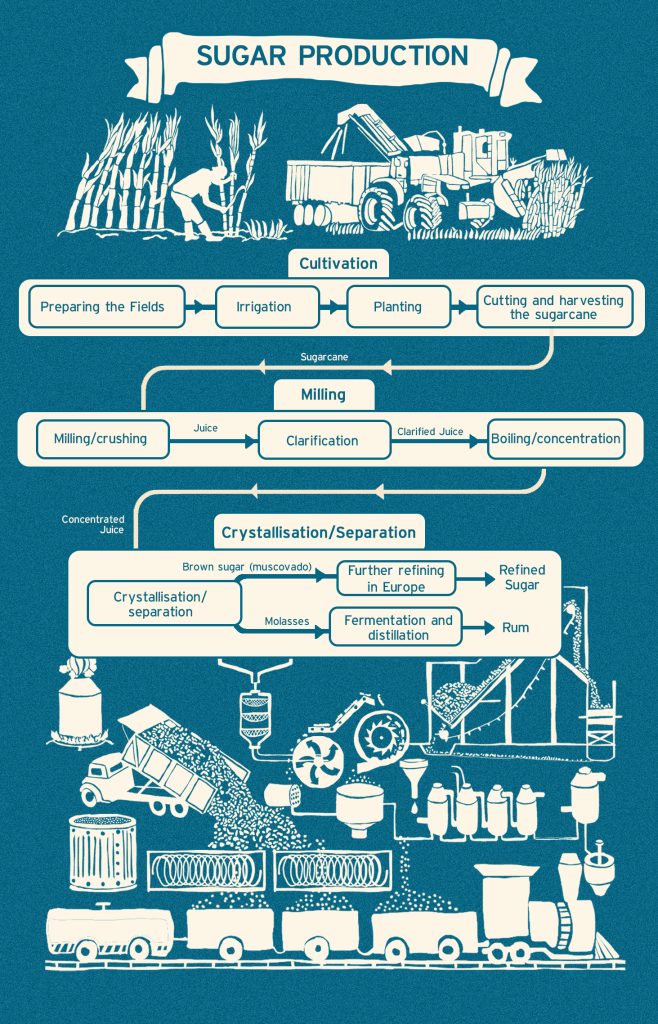
Diagram 1. The labour regime of sugar production.
Sugar Crosses the Atlantic: The Plantation Complex and the Trade in Enslaved People
When sugar expanded from the Mediterranean to the Atlantic islands, Brazil, and the Caribbean in the fifteenth through seventeenth centuries, the core processing techniques remained relatively unchanged, but the growing scale of plantation operations and the expanding circuits of export and re-export gradually transformed patterns of both production and trade. This system of commodity production and trade, rooted in slavery, sugar cultivation, and global cycles of export and re-export, helped lay the foundations of the modern capitalist economy. As we shall see, the key ‘innovation’ was how to extract maximum output at minimum cost from enslaved people before they could be ‘replaced’ – that is, to generate enough surplus from enslaved labour to cover both profits and replacement costs.
It was the promise of immense profits that prompted the Portuguese to take sugar monoculture from the Mediterranean region first to the Atlantic islands off Iberia and West Africa in the fifteenth century. The Portuguese entry into sugar production using enslaved labour took place in the islands of Madeira, the Azores, Cape Verde, São Tomé, and Príncipe.26 By the late sixteenth and early seventeenth centuries, the colonial slavery-based plantation system emerged in Brazil under the aegis of the Portuguese. From 1624 to 1654, the Dutch gained control of Portugal’s plantations in northern Brazil and learned the techniques of sugar plantation production, holding the territory. During this period, and after their expulsion by the Portuguese, Dutch capital and expertise helped spread sugar production to their Caribbean colonies. In the seventeenth century, the British and French learned from Dutch practice and introduced sugar into their colonies.
Caribbean sugar production involved a concentration of capital and an intensification of enslaved labour unmatched by any other monoculture in a single region. Cotton plantations in the US South later used a similar model of enslaved labour, but this emerged at least 150 years later.
Sidney Mintz, who has written extensively on sugar as a commodity and the plantation economy, argues that the production of sugar was profoundly industrial and ‘modern’ in terms of the labour process, productivity of capital, and management systems employed.27 Sugar production was quintessentially industrial and capitalist in nature, except that it treated human beings as fixed capital – that is, as machines – and therefore as replaceable.
Sugar Production in the Caribbean, 1600s-1800s
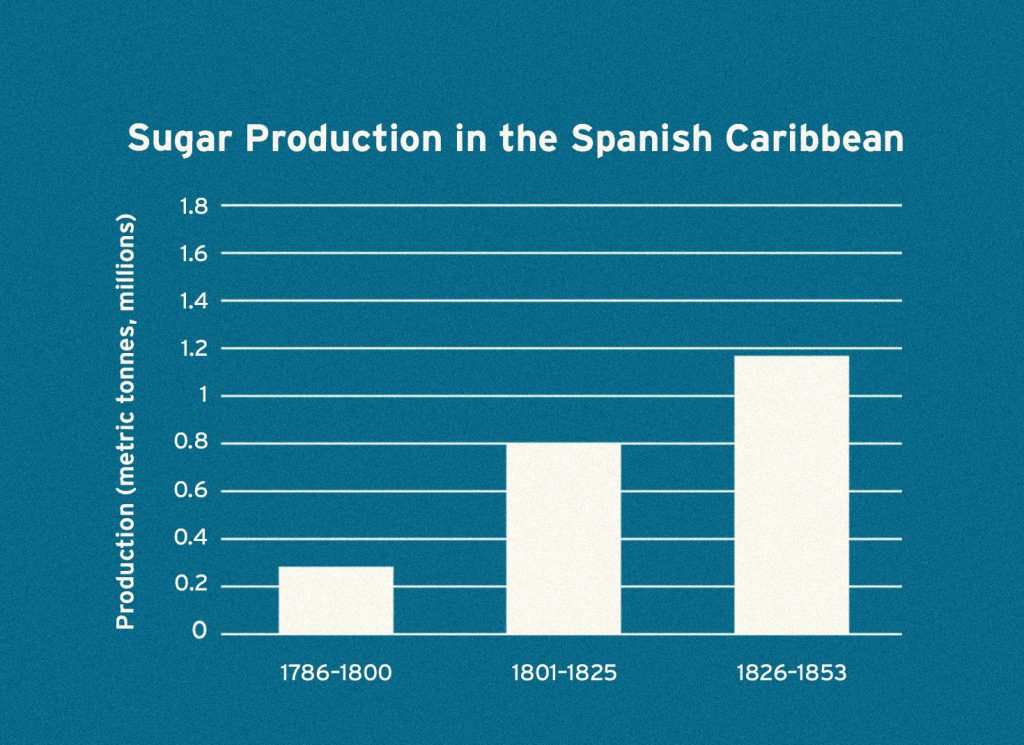
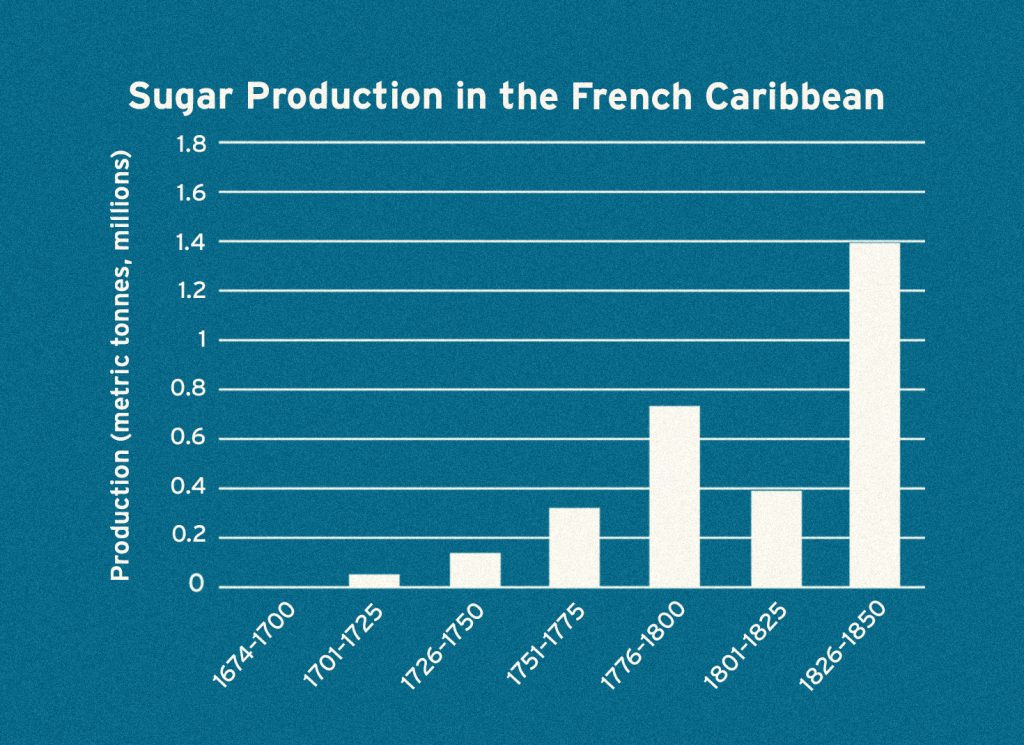
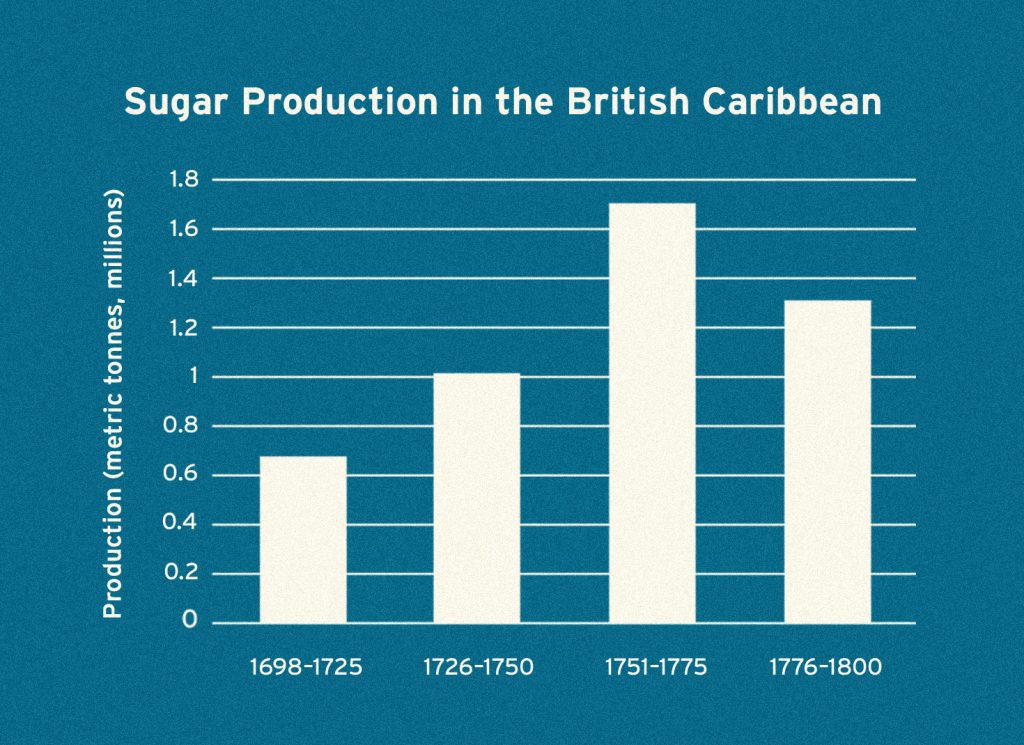
Data compiled mainly from Noël Deerr, The History of Sugar, 2 vols. (London: Chapman and Hall, 1949–1950).
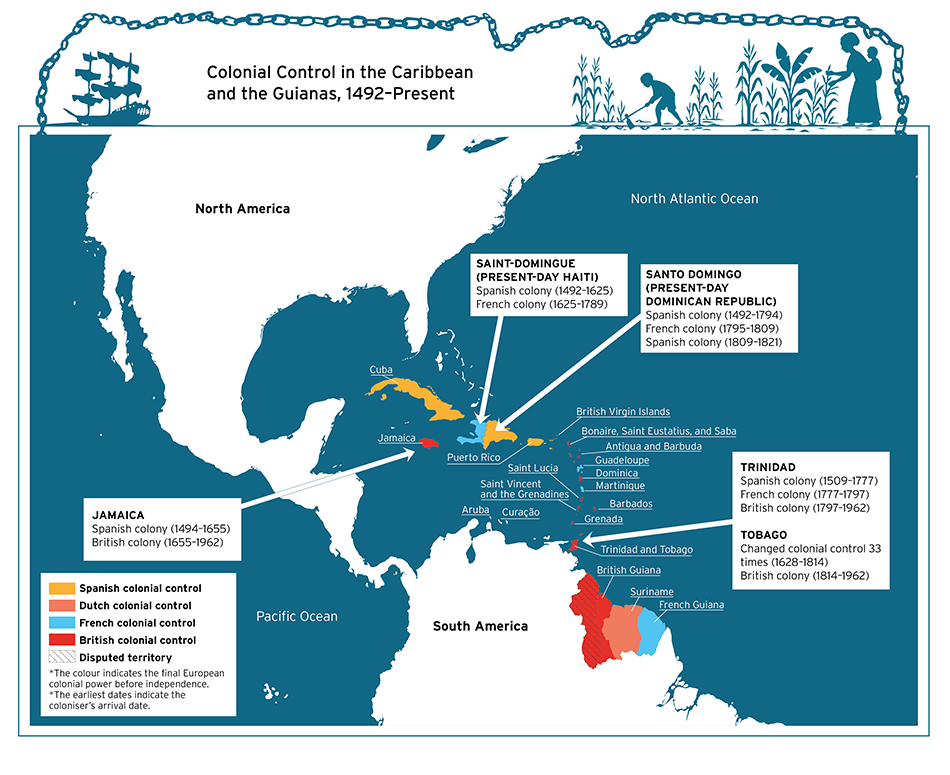
The Caribbean Islands: Plantations, Sugar, and Enslaved People
To track how sugar plantations expanded and how the trade in enslaved people was organised across competing empires, we will sketch the shifting colonial control of key Caribbean territories. The five main colonial powers in the Caribbean were Spain, Portugal, the Netherlands, France, and England. The early colonisers were the Spanish, who captured Jamaica, Trinidad, Puerto Rico, and Hispaniola between the 1490s and the early 1600s. England claimed Barbados in 1625 and began settlement in 1627. In 1655, England seized Jamaica from Spain. France established colonies in Guadeloupe (1635) and Martinique (1635) and, under the Treaty of Rijswijk (1697), gained the western third of Hispaniola, which it renamed Saint-Domingue (now Haiti). On the nearby Guiana coast, the Dutch established colonies including the Essequibo from 1616; Suriname, which they acquired later, became known as Dutch Guiana. By the second half of the eighteenth century, Britain and France had emerged as the major colonial presence in the Caribbean.
But sugar did not first come to the Americas through the Caribbean. It came through Brazil, where the Portuguese imported the São Tomé model of slavery-based sugar production to the Pernambuco and Bahia regions.28 These regions had a climate suitable for producing sugar and lands which were not densely forested and could be cleared to develop sugar plantations. The Portuguese needed their feet on the ground to strengthen their claim to a land that was otherwise nothing more than a line drawn on a map in the infamous Treaty of Tordesillas (1494), and so they provided land grants to settlers who would then till the land using enslaved labour. Unlike the plantations in the Caribbean, the land parcels in these regions of Brazil were smaller. In both Brazil and the Caribbean, sugar production relied largely on enslaved Africans, along with the labour of some Indigenous people.
The advantage of the ‘free’ land granted by the Portuguese Crown to settlers and planters in Brazil after the genocidal violence employed against Indigenous people was that the plantations could be extended without any meaningful physical limit. The disadvantage of this system was that it provided no incentive to improve cultivation; it was cheaper to expand the plantation lands than to make an effort to improve yields or the efficiency of sugar production – subject, of course, to the availability of enslaved Africans. On the island plantations, in contrast, the land imposed a physical limit. For example, in Barbados, a relatively tiny island with very few forests, planters had to adopt a variety of practices to adapt to these limitations, such as using bagasse – the dried cane stalks after crushing – as fuel to boil the juice to produce sugar, along with various practices to preserve soil fertility.29
In Brazil, however, land was abundantly available. This enabled methods that deplete soil productivity, since cultivation could be shifts to new fields, and expansion-driven deforestation. While the Dutch, French, and British did improve certain practices – for example, by introducing more efficient mills and fuel-use strategies and tightening plantation logistics – they also had a major advantage over the Portuguese: access to powerful merchant-finance, insurance, and refining networks in Europe that could fund production, insure shipments, refine sugar, and market it at scale. Where Italian city traders had earlier provided capital and marketing for Mediterranean sugar, the Portuguese did not have such a financial community, having driven out the Sephardic Jews and the Arabs who once played that role, including through expulsions from Iberia under King Manuel I in 1496. Even during the war that the Low Countries (modern Netherlands and Belgium) fought with Habsburg-Spain (whose king had been declared by the Pope as the head of the Holy Roman Empire), Antwerp and Amsterdam remained the cities that would refine sugar for the European market.
The Dutch occupied the heart of Brazil’s sugar economy, Pernambuco, between 1630 and 1654, when the Portuguese regained control. In that period, Dutch merchants developed commercial ties with Portuguese planters and channelled Brazilian sugar to refineries in Antwerp and Amsterdam. This continued after the Portuguese regained possession of Pernambuco and Bahia. Yet the Dutch took over more than sugar plantations: they also seized the trade in enslaved people from the Portuguese and, in 1637, captured Elmina Castle (in present-day Ghana), a major centre for the purchase, confinement, and shipment of enslaved Africans.
The Dutch, who were fighting the Spanish king and considered themselves ‘more enlightened’, had few qualms about entering the trade in enslaved people, appearing in the sugar chronicles both as those who took sugar plantations to the Caribbean and as major transporters of enslaved Africans from the African coast to the Americas. The sugar plantation model that the Dutch took to Guyana and the Caribbean islands was then adopted by British planters in Barbados and French planters in Saint-Domingue and Martinique. The Dutch acted not only in their state interests as the Dutch Republic, but also as experts who could be hired by planters from other colonial powers.
The Dutch, French, and British married capital to the practice of slavery in sugar plantations and to the modern division of labour. They grew sugarcane, processed it to the brown-loaf stage in the colonies using enslaved labour, and transported it for the final processing to white and more refined sugar in the European cities. British, French, and Dutch capitalists made money by selling sugar to the working and middle class in their home countries, making it a product for mass consumption. They also re-exported it to the global market, establishing sugar as a global commodity.
The plantation model of sugar production, which emerged in the late fifteenth-century Mediterranean, was adapted to the capitalist organisation of production and colonial trade in the ‘New World’, particularly in the Caribbean islands. The capitalist production of sugar was consolidated on the plantations through both the cultivation of sugarcane and the organisation of its processing into sugar. Underlying both the production of sugarcane and its conversion to sugar was enslaved labour – an unholy marriage of capital with Atlantic chattel slavery. This differed from sugar production in much of Asia and Africa, where peasants cultivated the cane and small mill owners crushed it and converted the juice to sugar.

Sugar Production on the Plantations
Sugarcane production on colonial plantations was brutal and labour-intensive, relying on a mix of skilled trades and field labour and organised through what was known as the ‘gang system’. Under this system, enslaved people were driven in supervised work gangs for long, continuous days. By contrast, the ‘task system’, more common in rice- and indigo-growing regions such as coastal South Carolina and Georgia, assigned a daily quota of work, after which some time might remain – within strict coercive constraints – for other activities.30 Planters adopted various methods to increase the profitability of the enslaved-labour sugar economy, from preparing the fields for cultivation to irrigation and planting, cutting and harvesting the cane, transporting it to the crushing sites, processing it, and producing and refining the sugar.
Sugarcane cultivation, whether in the Caribbean or in Louisiana, preferred the gang system because of the nature of sugar plantations. Sidney Mintz explains how the production on sugar plantations was unique: ‘These were, of course, agricultural undertakings, but because so much of the industrial processing of the cane was also carried out on the plantations, it makes good sense to view the plantations as a synthesis of field and factory’.31 The agricultural production and the initial processing of the crop into ‘industrial product’ were both performed on the plantation itself. As a result, the same enslaved people were assigned different tasks across the production cycle, from planting and tending sugarcane to harvesting it, crushing it for juice, and boiling that juice down into brown sugar and molasses. This is unlike the system on cotton plantations, where the crop was only partly processed on site and then sent to textile mills – especially in Britain and later New England – for further manufacture.
Though rooted in slavery, the gang system extracted surplus through forms of calculation that resemble modern capitalist management. Enslaved people were thought of as capital assets, and their maintenance was calculated to minimise subsistence costs while accounting for replacement. Detailed plantation account books were kept and compiled into reports – much like today’s spreadsheets – by which the owners, quite often in distant Britain, could look at the financial return on investment. Time and motion studies, beloved of Taylorist factory management models, were preceded by similar studies of the plantations worked by enslaved labour in the Caribbean and later in the Antebellum South.32 The replacement value of the enslaved African was market-driven, meaning that if their price rose in the market, the need to keep them alive would rise; if the price fell, the intensity of their exploitation – and risk of death – would increase. The lifetime calculations of the plantation manager therefore took into account the replacement price of a new enslaved person and were as market-driven as modern capital’s considerations today.
In practice, the gang system divided enslaved people according to age and physical capacity. The first ‘gang’ consisted of young men and women in their late teens who would do the most physically taxing work for ten to twelve years, after which they were relegated to the second gang. After perhaps twenty years in the second gang, a person who was by then about forty – if they survived – would be worn out and would join other elderly people and young children in the third gang (also known as the ‘grass gang’), which weeded the crops and gathered grass to feed the animals.33
In the early summer, the first and second gangs prepared the fields for planting by clearing, burning, and turning over the soil with hoes. Gangs also had to construct and maintain irrigation networks. Then, in the late summer and early autumn, the first gang would plant the sugarcane, often using the backbreaking ‘cane-holing’ process of digging planting holes across the field by hand. A first-gang enslaved person was expected to dig between sixty and one hundred holes each day, with two cane plants planted in each hole. First- and second-gang enslaved people then carried huge, heavy baskets of animal manure on their heads to the holes and placed it around each plant. One acre of sugarcane plants required as much as 1.25 tonnes of manure.
Once harvested – five or six months after planting in the case of the more fertile plantations – the cane had to be processed quickly to prevent the sugar content from declining. As a result, during the harvest season, when the cane was crushed and boiled, enslaved people in the sugar mills and boiling houses laboured shifts of eighteen to twenty hours, six days a week. In Brazil, religious observance formally required the engenhos34 to suspend work on Sundays and holy days. However, this requirement was not universally honoured, and enslaved people were often forced to continue working through Sundays and holy days. The enslaved people would become so exhausted that ‘as sleepy as an engenho’ became a widespread refrain, and losing limbs to machines became routine.35 Other major activities included transporting cane to the crushers, carting heavy timber for the furnaces to boil the juice, and shipping the sugar and other products including rum to ports.
In the Caribbean, Sundays were not days of rest for enslaved people. They spent them working their own allotments, known as ‘provision grounds’. Without the food they grew on these small plots, they would have succumbed to the highly deficient diet supplied by the plantation kitchen. William Taylor, a critic of slavery, testified that if an enslaved person used ‘every Sunday for repose, he could not maintain himself or his family by working the twenty-six days [a month] he was allowed by law’.36
Each year, a planter bought newly imported enslaved people from Africa to replace those who had died. A Barbados planter named Edward Littleton estimated that a sugar planter who owned a hundred enslaved people and put them to work growing and processing sugarcane would kill them all in nineteen years. Bosma, quoting the Anglican clergyman Reverend Robert Robertson, estimated that two-fifths of newly arrived enslaved people would die within one year of their arrival.37
There is enough evidence to show that the mortality rate among enslaved people on sugar plantations was higher than that of other enslaved-labour plantations, whether cotton, coffee, or tobacco.38 Slavery disincentivised replacing labour with machines on both cotton and sugar plantations, where living conditions were brutal. Yet the enslaved population on cotton plantations increased in spite of this (while on the sugar plantations of Louisiana it decreased). This is partly due to the multiple production processes integrated with sugarcane cultivation, where milling, concentration of the cane juice, and crystallisation of the sugar all involved enslaved labour. Another reason was the poor diet of enslaved people, as the owners factored the cost of feeding them against their replacement cost – the cost of buying new enslaved people. With a ban on trade in enslaved people in the early nineteenth century, the cotton plantations considered children born into slavery to be an economic ‘output’ – that is, as a way of reproducing their labour force and property internally. Louisiana sugar plantations sought the same result, but because mortality there was so high, births did not replace deaths.39
Equipment was required not only to crush the sugarcane but also to process it, all of which had to be constructed, operated, and regularly maintained. Early plantations used hand-operated presses to extract juice from the cane, but these were eventually replaced by more efficient three-cylinder presses powered by animals, and later by wind or, more commonly, water. As a result, plantations were typically established close to rivers or streams to harness water power.40 The wind or water drove large rollers through which enslaved people fed the cane back into the crushers. This was dangerous work, for these enslaved people were often exhausted, and sometimes they did not let go of the sugarcane in time and their arms were drawn into the rollers. When this happened, an axe was used to chop off the crushed arm. In some sugar plantations, one-armed men and women were a familiar sight.41
Proximity to ports and rivers was essential, as it lowered the cost of transporting sugar and other plantation goods. Depending on the size of the plantation, mills needed between sixty and two hundred workers, most of them enslaved, to operate.42 The peak labour requirement during the harvest season determined the number of enslaved people needed on a plantation.
Enslaved people were also burdened with the exhausting job of gathering the timber needed to fuel the refinery furnaces. In most Caribbean plantations, firewood was easily available. The exception was Barbados, which had limited availability of timber. Here, bagasse – the fibrous residue left after sugarcane was crushed – was used as fuel, a practice most likely imported from Egypt.
Those who had the skills to operate and maintain the machinery in sugar mills were in high demand. Some skilled mill workers were drawn from the enslaved labour force, but it was only their chief supervisor, the ‘sugar master’, that enjoyed a generous salary. Over time – as the colonies’ populations evolved – mixed-race European locals as well as freed, and sometimes even enslaved, people with the requisite technical skills were put to work in these positions in most Caribbean plantations.
Enslaved women had to do gruelling work in the fields, some with their newborn children on their backs. They also suffered from extreme malnutrition, which resulted in high miscarriage and infant mortality rates. The harvest season was the worst, as the standing cane had to be cut and processed quickly, which meant that enslaved Africans were subjected to even more intense exploitation. Cutting the cane, taking it to the crushers, crushing it for juice, and boiling it had to be handled simultaneously: enslaved people barely had time to eat.43 Women were fully involved in crushing the cane alongside men, where losing concentration meant risking anything from fingers to an arm – or their lives – to the milling machine.
We can identify the following characteristics of the technology used to maintain slavery-based sugar plantations:
- The introduction of machines – such as windmills, watermills, and steam engines – often intensified the exploitation of enslaved people.
- Technology could either be labour-saving or lead to more intense exploitation of labour, since technological improvements were determined by social relations.
- Enslaved people were seen as expendable, since planters often found it cheaper to replace those who died than to keep them alive. Sugar plantations often had to acquire new enslaved people because the brutal demands of sugar production killed workers at such a high rate. Unlike cotton and tobacco plantations, where processing was less tightly integrated into plantation labour, sugar estates required the crop to be processed on site almost immediately after harvest.44
After being harvested, the sugarcane was fed through rollers into a crushing device to extract its juice. This liquid was then boiled in large cauldrons and, through a process called curing, separated into molasses and crystallised sugar. The resulting mixture was poured into sizeable clay pots or moulds, where it hardened into cone-shaped sugar loaves.
Many consumers in Europe came to prefer white sugar to the brown sugar that forms naturally. To create a whiter product, a thick mixture of clay and water was placed on the broad side of a cone-shaped sugar mould as the molasses dripped out. Water would drip down from the clay, through the cone, and wash the molasses or other materials from the sugar. Once completely drained, the sugar loaves were removed from the moulds, dried on racks in a large room, trimmed into their final shape, and wrapped in paper. The final processing to whiten sugar took place in British or Dutch towns. White sugar was perceived to be purer and more desirable to European consumers, especially as racial discourse increasingly linked whiteness to value during the consolidation of modern plantation slavery.45 In a modern sugar plant, sugar is ‘bleached’ to whiten it from its natural brownish state.
Why was the final step of refining not carried out on the plantations or in the British Caribbean? The answer lies largely in British colonial policy. Tax policy – particularly after India became a British colony – helped remove any incentive to refine sugar further in the Caribbean. As Bosma notes, high duties on refined sugar penalised technological upgrading and made the export of muscovado the more profitable option.46
The sugar industry adapted to the widespread demand for many types of sugar. Sugar was sold to consumers at all stages of refinement, including muscovado, refined, and double-refined white sugar. The more refining sugar required, the more expensive it became. In the seventeenth century, sugar’s by-product, molasses, also became profitable; it was not only a sweetener but an ingredient for the increasingly popular spirit, rum.
Innovations took place both in the cultivation of sugarcane and the methods used for processing it into sugar, including applying steam power and using better cylinders (such as the two-roller horizontal mill), which were further adapted with protruding iron bars to enhance the crushing capacity, as well as vacuum pans, centrifuges, and double- to quintuple-effect evaporation.47 There were also important advances in the transportation systems that linked cultivation to processing, including the use of movable and fixed rails – often powered by steam engines – as well as conveyor belts. There were several modifications in the agricultural sphere as well, such as developing new cane varieties, altering planting distances and ploughs, improving drainage and irrigation, and applying manure and fertilisers.48
Vacuum pans – sealed vessels used to boil and concentrate cane juice or syrup at lower temperatures by reducing air pressure – were first developed in Britain for refining imported raw cane sugar and were adopted more widely in colonial cane sugar production only later. Meanwhile, beet sugar production in Europe, especially in France, expanded after British blockades cut off access to raw cane sugar from the West Indies. On West Indian plantations worked by enslaved labour, planters had very little incentive to introduce such capital-intensive equipment: expanding the plantations with additional enslaved people was both the ‘cheaper’ and more ‘efficient’ option for capital, with efficiency under capitalism understood as the efficiency of money in producing a required output, not the efficiency of the process itself. In the Caribbean, because land was ‘free’ – a consequence of genocidal violence against the Indigenous population – and enslaved labour was cheap, there was no incentive to improve the efficiency of sugar production. The only exception was improving the efficiency of crushing, since the cane could not otherwise be processed within the short ripening season. Hence, better crushers were introduced in the early nineteenth century in the form of wind-powered mills in Barbados and steam power in British Guiana (today’s Guyana) and Jamaica. This helps explain the different trajectories of vacuum pans and centrifuges. Even when vacuum pans made inroads in Java, Indonesia, during this period, they were not considered necessary on enslaved-labour plantations in either the British Caribbean or Louisiana. British colonial tax policy reinforced this: refined sugar attracted higher duties than raw sugar, making further refining in the Caribbean less profitable.49 Centrifuges, by contrast, reduced the time needed to separate molasses from sugar from months in clay cones to a few hours. Introduced in the 1830s, they quickly became standard practice even on enslaved-labour plantations.50
Technology mattered, but it does not explain the profitability of Caribbean sugar on its own. To understand that profitability, we need to turn from the machinery of the plantation to the wider colonial system: the linked markets for sugar and enslaved people, the organisation of refining and re-export in Europe, and the policies that bound the colonies to the ‘mother country’.
Slavery and Sugar: Market Production, Exports, Re-exports, and Profits
Sidney Mintz argued that sugar production, though based on enslaved labour, was profoundly industrial and modern, with planters and owners of enslaved people using modern capitalist methods to organise production, measure productivity, and calculate returns.51 By the sixteenth and seventeenth centuries, sugar had become one of the most important and profitable commodities of the ‘New World’.
There were three different markets for Caribbean sugar. Initially, it was only produced for the international market, centred on the colonial and European ‘mother country’. Later, local and regional markets developed in and around the Caribbean. Local markets were small, self-contained, and generally located inland, while regional markets centred around large cities such as Lima and Mexico City as well as cities throughout New England. The international market for Caribbean sugar was the most competitive, with the refining and re-export market based in Lisbon, Antwerp, Amsterdam, and various towns in England and France.
Initially, with Brazil under the Portuguese as the primary producer of raw sugar in the Americas, Lisbon emerged as the largest market for re-exporting raw sugar to refining centres, and it remained so for a long time. From Lisbon, the Dutch transported the sugar first to Antwerp and Amsterdam to be refined and then to the global market. Antwerp was home to the biggest sugar refinery in the sixteenth century but, by the seventeenth century, had lost the sugar battle, first to Amsterdam and then to various towns in England. By the eighteenth century, sugar refineries proliferated in Britain, from Plymouth to Glasgow and London to Liverpool. These refineries used large open copper boiling pans and a large amount of coal to produce heat and were precursors to the factories of the Industrial Revolution. They were among the earliest factory-like workplaces in Britain and a direct link between slavery’s sugar and the great divergence between Asia and Europe.
The sugar bakers of Britain existed long before the textile mills associated with the Industrial Revolution. Not surprisingly, they were also major centres of the trade in enslaved people. During the Great Plague of 1665, a number of sugar refineries moved from London, then in the grip of plague, to other English ports. West Indian ships carrying sugar used docks in other ports of England to avoid contagion. This helped expand the refining of sugar throughout Britain. This expansion helped widen access to refined sugar beyond elite consumption.
Though those refining sugar were referred to as bakers, the process of baking sugar involved what today would be considered factory work. The term ‘factory’ originally referred to a place of commercial activity tied to the work of a merchant’s agent, or ‘factor’, such as a trading post or collection centre, including sites where enslaved people were bought and sold. Only later did it come to mean a place of manufacturing. Sugar refining already had the features associated with industry – concentrated workplaces, heat-intensive processing, specialised equipment, and disciplined labour. Yet, because it was inseparable from slavery, it rarely appears as a starting point for the Industrial Revolution in Europe’s own historical narrative.
The scale and direction of Caribbean sugar exports show how tightly the plantations were bound to the British refining industry. David Eltis’s data on Barbados from 1665 to 1701 shows that sugar products accounted for 91.2% of the island’s total exports in 1665–1666, 91.6% in 1688 and 1690–1691, and 95.6% in 1699–1701. He also estimates that between 1682 and 1701, Britain was the destination for more than 95% of Jamaica’s sugar exports.52 Driven in part by its pairing with tea and coffee, sugar consumption in Britain increased significantly over the eighteenth century, while the re-export of refined sugar to the Americas, including the Caribbean, proved highly profitable. Variable tariff rates offered the level of protection needed to support the operations of numerous sugar refineries in cities such as Bristol, Glasgow, and London. This meant that colonial policy worked in such a way that refined sugar production in Britain was protected by higher tariffs against refined sugar imports, whereas no such protection was provided for sugar refining in the Caribbean colonies. After its conquest of India, for instance, Britain added an additional 25% tariff to protect its refiners and their Caribbean sugar plantations from competition from India.53
This was a part of the larger British colonial policy under which colonies could only produce raw materials for the ‘mother country’ and finished goods would only be produced in the colonial centre. The famous guideline was that not even a nail was to be manufactured in the colonies (one exception – oddly enough, given the example – was iron because shipping iron ore to England was bulky and therefore expensive). In other words, British policy was to ensure that industrial production did not develop in the colonies so that they remained dependent on the mother country. Instead, the colonies were to provide raw materials or products to facilitate industries in Britain.54
Eltis and others argue that slavery-driven plantation economies expanded at rates on par with industrialising Britain and the US, despite their contrasting foundations.55 By comparing the prices of sugar and enslaved people to calculate the average productivity of an enslaved person, they demonstrate that sugar production using enslaved labour was highly profitable. The analysis was carried out based on records from approximately 230,000 enslaved Africans transported to the Americas between 1674 and 1807 – about 6% of the total number of enslaved individuals disembarked in the Americas through transatlantic voyages during that era.56 To assess changes in both the demand for enslaved labour and total factor productivity in Caribbean slavery-based agriculture from 1674 onward, the researchers combined estimates of enslaved populations and import figures with data on enslaved person sale prices.57 Along with this, the rising price of sugar resulted in a considerable increase in the demand for enslaved labour, making the trade in enslaved individuals ever more lucrative.
In Jamaica, for instance, the growth of the enslaved population was closely correlated to the success of sugar production. Between the 1720s and 1788, the enslaved population in the five leading sugar-producing parishes increased more than sixfold.58 This expansion was driven by rising sugar output and the high returns that planters and merchants received, especially in newly settled areas such as the northwest coast, and the number of enslaved Africans transported to Jamaica peaked in the prosperous early 1790s.
Later debates around Eric Williams’s thesis often narrowed his broader argument to a specific question: whether wealth extracted through the trade in enslaved people and the plantation system was reinvested in Lancashire’s cotton mills and other industries central to the Industrial Revolution.
Even when scholars recognise the substantial output growth of plantation economies, it is often contrasted with arguments that enslaved labour-based systems saw little to no long-term productivity improvements, that slavery and plantation agriculture faced bleak future prospects, and that Britain’s decision to end the trade in enslaved people stemmed from the economic downturn of the sugar industry.59 The impulse behind this argument appears to be an ideological necessity to prove that capitalism with ‘free’ labour is a more efficient form of production than slavery. By this logic, the idea that plantation slavery operated according to ‘sound’ capitalist economics – with enslaved people treated as machines – must be countered.
Findlay builds on Williams’s thesis by citing economic historian Stanley Engerman, who estimated that, in 1770, close to 40% of the capital used for Britain’s commercial and industrial expansion derived from profits from the trade in enslaved people.60 The combined profits from the trade in enslaved people and sugar constituted as much as 5% of British national income. Yet this figure vastly underestimates the total profits that Britain usurped from the trade in enslaved people and sugar. To this, the profits from sugar refining and the re-export of sugar from Britain to the global market must be added. Another way to assess returns is to compare profits on sugar plantations with those in the mother country. Investments in the colonies were four to seven times more profitable than those in England.61
In a recent study on the significance of slavery and plantation agriculture to the British economy, Klas Rönnbäck calculates the total value added by Britain’s sugar production and trade. This value-added approach captures the surplus appropriated at each stage of the sugar value chain, from the cultivation of sugarcane on Caribbean plantations to the refining, re-export, and final sale of sugar in Britain. On this basis, Rönnbäck estimates that the total value added to the British economy increased dramatically from £0.5 million62 during the first decade of the eighteenth century to £5.5 million a century later. The value of this trade also depended on what economists call ‘intermediate goods’ – in this case, the enslaved Africans transported from Africa to the Caribbean and treated as inputs in the production of sugar.
Rönnbäck’s approach shows that the surplus appropriated by Jamaican planters who owned enslaved people rose from 40% of subsistence costs in 1750 to 100% in 1790, meaning that, by the end of this period, the surplus they extracted was equal to what they spent on the subsistence of enslaved people. By looking at the trends in the prices of different grades of sugar during the same period, Rönnbäck also shows that there was a fourfold difference between the price of muscovado sugar in Jamaica and that of refined sugar in England, completely out of proportion to the cost of transport and refining. This indicates that the price differential was most likely a consequence of a form of transfer pricing – that is, the setting of internal prices to shift profits between the colonies and England. Simply put, there was a huge markup on refined sugar, allowing refiners in Britain to retain the profits of producing sugar in Britain. This is apparent from the high import duties on finished sugar, which hit imports of Indian sugar into Britain, and the low import duties on raw sugar from the plantations, which discouraged refining in the colonies.
Findlay has also shown that innovations in production techniques and technology significantly increased output on the plantations.63 These included developing new varieties of sugarcane with higher yields, such as the Otaheite strain, introduced from the Pacific islands (such as Tahiti) in the late 1700s, along with advancements in milling technology, enhanced water management, and a growing trend toward agricultural specialisation. In parts of the Caribbean, sugar colonies increasingly shifted towards monoculture, relying on imported food rather than cultivating it locally. Overall, infrastructure also improved in many of the colonies reliant on enslaved labour, making it easier and more efficient to move export goods to ports. These improvements also supported the development of financial systems that expanded access to credit for plantation owners. Thus, many of the characteristics associated with capitalist expansion and rising productivity were already present in the slavery-based sugar plantation system.
These productivity gains translated into high returns not only for planters but also for Britain. From 1713 to 1775, Caribbean planters’ gross receipt from sugar exports to Britain rose by a factor of 3.2, driven by rising demand for sugar in England and by the profitable re-export of refined sugar to other parts of the world, which gave Caribbean sugar a vast market.64 By 1774, raw sugar accounted for one-fifth of all British imports, surpassing all other imported goods by a wide margin. In the same period, sugar production in the Americas rose from approximately 50,000 tonnes in 1700 to around 200,000 tonnes by the close of the American Revolution. Between 1700 and 1800, British sugar imports increased sevenfold, from 430,000 hundredweight (about 21,845 metric tonnes) to three million hundredweight (about 152,407 metric tonnes), helping to make Britain a major centre, if not the centre, of the global sugar trade.65
The Trade in Enslaved People and the Rise of Shipbuilding in Britain
Most of the sugar imported into Britain came from Caribbean plantations worked by enslaved labour. As these plantations expanded significantly from the seventeenth to the nineteenth century, they required growing numbers of enslaved people. Portugal and Britain accounted for about 70% of all enslaved Africans transported to the Americas. Between 1640 and 1807, British ships forcibly transported an estimated 3.1 million Africans, of whom roughly 2.7 million survived the Atlantic crossing and were taken to British colonies in the Caribbean, North America, South America, and elsewhere.66 The major centres for the trade in enslaved people in Britain were Glasgow, Bristol, Manchester, and London. All these towns were also major centres of shipbuilding, as the demand for ships used to transport enslaved people was the prime driving force for Britain’s shipping industry.
An important dimension with respect to the lucrative and fundamentally capitalist nature of the trade in enslaved people, and of the production system under slavery, is what economists refer to as internal markets of enslaved people – that is, the domestic trade in enslaved people within the colonies or within the Americas. Like the export and re-export of sugar, this trade was organised through distinct stages, each shaped by calculations of profit. Shipping ports were not only important as destinations for enslaved people but also commercial centres where they were bought, sold, and resold like other commodities. The profitability of the enslaved-labour system thus arose not only from plantation production but also from these successive transactions in enslaved people.
Kingston, Jamaica, is an illustrative case. The trade in enslaved individuals turned the city from a simple port into a central hub for ‘processing’, where captives were initially disembarked, then sold and allocated throughout the island. It was widely understood that for British merchants seeking their fortunes overseas, trading goods for enslaved Africans, and subsequently selling enslaved people in the Americas, offered better financial prospects than safer investments at home. Based on an estimated average price of £30 per enslaved person during the eighteenth century, the overall value of the enslaved population could have reached nearly £25 million – an amount that closely matched Jamaica’s total recorded wealth in 1774.67 A similar dynamic existed on cotton plantations in the United States. As shown by bank data, the value of the plantation was set based on the number of enslaved people that laboured there. Plantation owners procured loans and capital from the banks by pledging enslaved persons as collateral.
To reduce the possibility of financial disaster once the enslaved Africans had landed, British merchants employed so-called ‘slave factors’ (merchant agents who managed the sale and distribution of enslaved people). The terms ‘factor’ and ‘factorage’ are linked to this older commercial meaning of ‘factory’, which later came to mean a site of manufacturing. A factorage was a yard or business through which goods were received, held, and sold – in this case, enslaved people treated as commodities. One such factor in eighteenth-century Jamaica was Thomas Hibbert, whose family was prominent in the cotton industry. He came to Kingston, Jamaica, in 1734, established a business specialising in the sale of enslaved people and later co-founded the London-based West Indian trading firm Hibbert, Purrier, and Horton. Between 1764 and 1774, Hibbert’s operation handled cargo for sixty-one ships and was involved in the sale of 16,254 enslaved Africans.68
In the Caribbean, factors based in port towns not only traded enslaved people as commodities but also bought and held them, assessed and sorted them, managed ‘seasoning’ – the process of restoring their health from the brutal ocean voyage – and organised their sale and resale to maximise their price. Factorage was a skilled and risky business because profits depended on timing sales to planter demand, extending and collecting credit, and managing illness and death in captivity, all the while keeping holding costs down. Economies of scale ensured that much of the trade in enslaved people was concentrated in relatively few hands and dominated by a small number of merchant houses. Between 28 September 1751 and 27 May 1752, thirty-one ships carrying enslaved people arrived in Jamaica carrying 7,123 enslaved Africans who had survived the Atlantic crossing. These captives were delivered to nine factorage firms, but their sale was highly concentrated: three firms handled 83% of those arrivals.69 Slave factors were eager to sell enslaved individuals swiftly and at the highest possible price, since delays meant increased expenses for food and upkeep. As a result, they aimed to time sales to coincide with periods of strong buyer interest and when full payment could be secured without delay. The most favourable moment for selling enslaved people was typically at the start of, and throughout, the sugar harvest, when demand from planters was at its highest.
Like other commodities, the trade in enslaved people included a retail dimension, with merchant lots or yards operating in tandem with the bulk sales conducted directly from ships. Between arrival and being put to work, most enslaved people spent time in the port towns as the property of merchants (the factors in the trade in enslaved people) who acclimatised them to slavery and to the specific islands where they had been brought. The initial buyer was also responsible for treating ill individuals with the aim of reselling them at a profit. The movement of enslaved Africans – from disembarkation at ports to holding yards in cities, and eventually to towns or plantations – intensified their suffering, especially through the frequent and often irreversible separation of family members.
Over the seventeenth and eighteenth centuries, the market for enslaved people changed in several ways: a growing share of captives was sold through mercantile partnerships rather than directly by ship captains; enslaved people were often held for longer periods in port towns or factorage yards before being sold; and sales increasingly moved away from the earlier ‘scramble’ system – a brutal method in which buyers rushed to claim enslaved people at preset prices – toward more negotiated transactions.70 By the end of the eighteenth century, as Trevor Burnard and Kenneth Morgan note:
Slaves were sold neither by auction nor by ‘scramble’ but by careful negotiations between astute, experienced, and knowledgeable buyers and well-informed sellers who studiously evaluated the risks that they had to take in order to gain the profits that had spurred them to enter the trade. The slave market was competitive, complex, and sophisticated: a very modern institution dealing with an age-old and particularly grim trade.71
As the demand for enslaved people expanded across the Atlantic world, prices rose significantly. Slave factors as well as the states in Africa involved in the export of enslaved people set prices in response to the ever-growing demand. The price of enslaved people was quoted against goods exported to Africa, including guns, gunpowder, and cotton textiles from India. Eltis and Jennings showed that between 1701 and 1750, the value of Britain’s gross barter terms of trade with Africa – measuring the relative worth of British exports to Africa against African exports to Britain – increased from a base index of 100 to 112, before declining sharply to 40 in 1800. According to Eltis and Jennings, while a single enslaved person could be exchanged for just two muskets in the early 1700s, by the end of the century that number had risen to at least fifteen.72 These figures suggest that the profits more than compensated for the rising prices of enslaved people.
This same logic appears in Ronald Findlay’s work as well. He argues that firearms, a key import in Africa in this period, could be regarded as an ‘input’ in the ‘production’ of enslaved people – that is, the exchange of enslaved people for firearms was shaped by hard economic calculations.73 As states in Africa began to face diseconomies of scale (declining access to captives due to the brutality involved in raids to capture enslaved people and the destruction of the societies they targeted), the price of enslaved people went up. For those supplying them, the rising demand for enslaved people generated higher prices and greater profits, despite the brutality of their capture. The point of emphasis here is that the market of enslaved people, at both the demand and supply ends, was characterised by clear capitalist economic calculations. Hence, the trade in enslaved people can be described as ‘primitive’ only in its brutality, given the ‘sophistication’ of its economics.
Colonialism, the Trade in Enslaved People, Sugar, and the Financial System
As we have discussed, the rise of modern capitalism is intrinsically linked to plantation economies based on enslaved labour, with sugar plantations among the most important in terms of their impact on the global economy. In the earlier sections, we discussed the nature of the sugar economy that emerged in the ‘New World’. Here, we will focus on the larger global dynamics in the rise of Western Europe and its emergence as the driver of global capitalism.
Many theories have been proposed to explain this rise of the West and the decline of the rest. Most Eurocentric theorists have argued that capitalism as a world system started in Western Europe and that its integration of science into production was the dynamic force that saw it conquer the world. Within the Marxist tradition, Immanuel Wallerstein’s world-systems theory and Andre Gunder Frank’s dependency theory have been influential, though both depart from Marxist approaches that stress the centrality of the state to the development of capitalism, including in its imperial phase.
In this study, we do not focus on that debate directly. Rather, we emphasise that the current configuration of power and the emergence of modern capitalism date back at least around 500 years. Three points are central here:
- The rise of merchant capital, naval power, guns, and gunpowder matters only in relation to state power and its use in trade and colonial expansion.
- The encounters between the West European core and the other three continents (the Americas, Africa, and Asia) were profoundly different, especially between 1500 and 1800, when a handful of West European countries emerged as the major imperial powers. In the Americas, this encounter was primarily genocidal: entire civilisations and social structures were destroyed. The Americas also supplied the silver – particularly from Bolivia and Mexico – that financed Western Europe’s trade with Asia, especially with India and China, the largest economies in Asia at the time.
- The trade in enslaved people from sub-Saharan Africa provided the Western imperial powers not only with labour for the colonies but also with a ‘commodity’ that contributed to the rise of capital in Britain, the Netherlands, and France. Enslaved people were taken to the Americas and the Caribbean to produce plantation crops, of which sugar was both the most important and the first global commodity. If we add silver as a form of commodity money, then the role of enslaved labour in the silver mines and plantations of the Americas makes the trade in enslaved people a central pillar in the rise of modern capitalism. This becomes even clearer when we consider that sugar, the other major traded commodity, was inseparable from the enslavement of people and the extraction of unpaid labour.
The rise of a capitalist financial system was intrinsic to the trade in enslaved people, its ties to the emerging colonial powers, and the rise of sugar as a global commodity. One instrument that linked the trade in enslaved people to the growth of the financial system was the asiento, a licence from the Spanish Crown that authorised traders to participate in the sale of enslaved Africans to Spanish colonies. First issued in 1513, the asiento was, until 1595, given to an individual or group of any nationality in the form of a contract to import a specified number of enslaved people in return for a royalty payment. For Spain, the major destinations of enslaved people were initially the Bolivian and Mexican silver mines. The asientos were later granted to foreign joint-stock companies: first to Portuguese companies, then in 1685 to the Dutch, in 1702 to the French, and from 1713 to 1739 to the British South Sea Company. The British South Sea Company teamed up with the Royal Africa Company, owned by the British Crown. Securing the asiento allowed Britain to dominate the trade in enslaved people from the 1740s onwards.74
The asiento was one element in the rise of a global reserve currency. Spain also introduced a common currency called the real de a ocho in the mid-sixteenth century. Also known as the ‘piece of eight’, or the Spanish silver dollar, this currency was essentially commodity money and came to be accepted for commercial transactions throughout Asia, the Americas, and much of Europe. International trade from the fifteenth to the eighteenth centuries was largely conducted in silver, making the Spanish dollar globally in demand. Through the asiento system, the Spanish Crown helped organise the supply of enslaved labour to its American colonies, especially to the silver-mining zones such as those in Potosí, Bolivia. The silver extracted there was then minted into the real de a ocho, which became a widely accepted medium of international trade. It was Spanish silver that significantly expanded the global commodity market. Spain used this silver to trade with China through the Manila galleon route – the transpacific trade route linking Acapulco in Spanish America to Manila in the Spanish Philippines – as well as through other European countries engaged in trade with West and South Asia. As Dennis O. Flynn and Arturo Giráldez write, ‘The singular product most responsible for the birth of world trade was silver’. This undergirded the global trade in goods, allowing Europe – Spain in particular – access to Chinese, East Indian, and Indian markets.75
Silver mined in Spanish America – especially in Mexico and Potosí, in present-day Bolivia – accounted for 80% of the world’s supply of silver between 1494 and 1850. The Spanish silver dollar was primarily commodity money, its value equivalent to its weight in silver. The British pound sterling and the US dollar were, and are, primarily reserve currencies rather than commodity money. Given that the cost of producing silver was low compared to its market value, and that there were very large deposits of silver in Potosí, Spanish silver functioned in the same way that the British pound or the US dollar did later.76
China had a strong demand for silver, which it received in large quantities by exporting silk and tea to European countries. At the same time, China imported cotton textiles from India, which it financed with the silver that flowed from Europe. After the British victory at the Battle of Plassey in 1757, Britain no longer had to send silver to India to pay for imported textiles; instead, it financed these goods using land taxes collected from Indian peasants, effectively reversing the earlier flow of silver from Britain to India. Britain’s deficit with China, however, continued, since its heavy imports of Chinese goods were still paid for with silver. That flow was reversed only later, when Britain began selling opium forcibly grown in India to the Chinese – a trade also driven by the barrel of the gun during the Opium Wars of 1839 to 1860.
With Spain no longer dominating the Atlantic trade in enslaved people, the Dutch guilder became the Atlantic world’s reserve currency in the seventeenth century.77 Amsterdam’s near-monopoly over European sugar refining – first with sugar from Brazil and later with sugar from French Saint-Domingue (now Haiti) – and its central role in the transatlantic trade in enslaved people – with as much as 20% of the trade in enslaved people to the Americas and the Caribbean – were consolidated after the Dutch secured the asiento in 1675, with Elmina in present-day Ghana as a major hub. In other words, the Dutch guilder rose to this position because the Netherlands controlled a major share of the global trade in two major commodities: enslaved people and sugar, with the sugar islands of the Caribbean and Brazil driving demand for both commodities.
Later, the Royal African Company and Britain took over the trade in enslaved people in the Atlantic from the Dutch and became major suppliers of sugar. With the expansion of British Caribbean sugar plantations and Britain’s growing share in the trade in enslaved people, the British pound sterling emerged as the global reserve currency and London became the world’s major financial centre.
The origins of the world’s financial system lay not only in sugar and slavery but also in the way the asiento linked the trade in enslaved people to silver extraction and Asian trade. The asientos expanded the trade in enslaved people and the supply of Spanish silver to the world market, creating a global financial system that tied together the trade in enslaved people in Africa, the mining of silver in the Americas, and the trade with Asia, particularly China, India, and Southeast Asia.
We have considered some of the implications for global trade in the two major ‘commodities’ that came to define the emerging world market from the sixteenth century onwards: enslaved people and sugar. This period also saw a major increase in the circulation of gold and silver, mined in the Americas under Spanish rule. It was the thirst for gold and silver that powered Spain’s empire in the Americas. We have not focused on the genocide committed by the Spanish and other European countries, or their destruction of existing systems of production since that history demands more detailed treatment than is possible here. Instead, we have focused on the impact of the trade in enslaved people, sugar, and the emergence of reserve currencies: the Dutch guilder in the seventeenth and eighteenth centuries, followed by the British pound sterling. These developments predated the Industrial Revolution and show the hollowness of the thesis that it was the West’s leadership of the Industrial Revolution that created its hegemony over the world. Examining a longer arc of history shows that the West’s rise was instead rooted in genocide, slavery, and colonial plunder. The modern financial system must be understood as inseparable from the genocide in the Americas, the trade in enslaved people, and the plantation system built on enslaved labour by the major European powers.
Notes
1 In this study, we use the term ‘enslaved’ (people, Africans, etc.) rather than ‘slave’. The latter can read like a fixed identity and thereby normalise a condition imposed through violence, concealing the capture, commodification, and dehumanisation of millions of African people who were subjected to forced labour to build the wealth of European empires. The former, on the other hand, carries with it the understanding that slavery did not define enslaved people but was rather a condition of their subjugation – it describes what was done to people, thereby restoring their humanity and highlighting the structures of colonialism, racism, and capitalism that produced those conditions. Language is not neutral; it either reinforces or resists power.
2 Eric R. Wolf, Europe and the People Without History (Berkeley: University of California Press, 1982).
3 Ian Angus, ‘The Meaning of “So-Called Primitive Accumulation”’, Monthly Review, 1 April 2023, https://monthlyreview.org/2023/04/01/the-meaning-of-so-called-primitive-accumulation/; Maxine Berg and Pat Hudson, ‘Slavery, Atlantic Trade and Skills: A Response to Mokyr’s “Holy Land of Industrialism”’, Journal of the British Academy 9 (November 2021): 259–281.
4 Edward E. Baptist, The Half Has Never Been Told: Slavery and the Making of American Capitalism (New York: Basic Books, 2014).
5 C. L. R. James, The Black Jacobins: Toussaint L’Ouverture and the San Domingo Revolution (London: Secker & Warburg, 1938); Eric Williams, Capitalism and Slavery (Chapel Hill: University of North Carolina Press, 1944); Walter Rodney, A History of the Upper Guinea Coast, 1545–1800 (Oxford: Clarendon Press, 1970); Joseph Inikori, Africans and the Industrial Revolution in England. A Study in International Trade and Economic Development. A Study in International Trade and Economic Development (Cambridge: Cambridge University Press, 2009).
6 In his Historia de Las Indias (History of the Indies, 1561, pub. 1875), Bartolomé de las Casas, a missionary who sailed with Columbus on his third voyage, describes Columbus as a murderer and rapist. In The Career and Legend of Vasco da Gama (Cambridge University Press, 1997), Sanjay Subrahmanyam describes Vasco da Gama’s acts of rampage and mass murder.
7 Sven Beckert, Empire of Cotton: A Global History (New York: Penguin Books, 2015), 83–97.
8 For the purposes of this study, we define slavery narrowly as chattel slavery. Other forms of coerced labour, such as the encomienda and mita systems imposed on Indigenous communities under Spanish colonial rule, fall outside the scope of this discussion, though they form part of a related history of genocide and coercive labour in the Americas. See Andrés Reséndez, The Other Slavery: The Uncovered Story of Indian Enslavement in America (Boston: Houghton Mifflin Harcourt, 2016).
9 Walter Rodney, How Europe Underdeveloped Africa (London: Bogle-L’Ouverture Publications, 1972), 95; Claude Meillassoux, The Anthropology of Slavery: The Womb of Iron and Gold (Chicago: University of Chicago Press, 1991).
10 Warren C. Whatley, ‘The Gun-Slave Hypothesis and the Eighteenth-Century British Slave Trade’, Explorations in Economic History 67 (January 2018): 80–104.
11 Our computations are based on population figures from A. M. Carr-Saunders, World Population: Past Growth and Present Trends (Oxford: Oxford University Press, 1936); John D. Durand, ‘The Modern Expansion of World Population’, Proceedings of the American Philosophical Society 111, no. 3 (22 June 1967): 136–159; Patrick Manning, ‘African Population, 1650–2000: Comparisons and Implications of New Estimates’, in Africa’s Development in Historical Perspective, ed. Emmanuel Akyeampong, Robert Bates, Nathan Nunn, and James Robinson (Cambridge: Cambridge University Press, 2014), 131–149.
12 Walter Rodney, How Europe Underdeveloped Africa, 96.
13 Walter Rodney, How Europe Underdeveloped Africa, 60; Joseph E. Inikori, Forced Migration. The Impact of the Export Slave Trade on African Societies (New York: African Publishing Company, 1982), 24–25.
14 See, for example, Eric Williams, Sidney Mintz, David Richardson, and David Eltis on the Caribbean plantation complex and its role in Britain’s capitalist development.
15 Williams, Capitalism and Slavery; Sidney Mintz, Sweetness and Power: The Place of Sugar in Modern History (New York: Viking, 1985); David Eltis and David Richardson, eds., Routes to Slavery: Direction, Ethnicity, and Mortality in the Transatlantic Slave Trade (New York: Routledge, 1997); David Eltis and David Richardson, Atlas of the Transatlantic Slave Trade (New Haven: Yale University Press, 2015); Sven Beckert, Empire of Cotton.
16 Saltpetre comprised 75% of the composition of gunpowder, and 75% of the cost of gunpowder was that of saltpetre. The Bengal region in India was the biggest supplier and producer of the highest quality saltpetre, which constituted more than 90% of European consumption of saltpetre to produce gunpowder for war and trade. See East India Company, Committee of Warehouses, Report of the Committee of Warehouses, on a Memorial from the Manufacturers of Gunpowder, and of the Other Commodities Made from Saltpetre, Presented to the Right Honourable the Lords of the Committee of Privy Council for Trade (1793; repr., New Haven, CT: Research Publications, 1976); and Warren C. Whatley, ‘The Gun-Slave Hypothesis and the 18th Century British Slave Trade’, Explorations in Economic History 67 (2018): 80–104.
17 Kazuo Kobayashi, Indian Cotton Textiles in West Africa: African Agency, Consumer Demand, and the Making of the Global Economy, 1750–1850 (Cham: Palgrave Macmillan, 2019).
18Findlay cites data from Eltis and Jennings showing that ‘textiles constituted 56 percent of African imports in the 1780s’ while ‘guns and gunpowder [made up] 8 percent, rising to nearly 15 percent by the 1820s’. Ronald Findlay, ‘The “Triangular Trade” and the Atlantic Economy of the Eighteenth Century: A Simple General-Equilibrium Model’, Essays in International Finance no. 177 (March 1990); David Eltis and Lawrence C. Jennings, ‘Trade between Western Africa and the Atlantic World in the Pre-Colonial Era’, American Historical Review 93, no. 4 (1988): 939–959; Kazuo Kobayashi, Indian Cotton Textiles in West Africa: African Agency, Consumer Demand, and the Making of the Global Economy, 1750–1850 (Cham: Palgrave Macmillan, 2019).
19 Utsa Patnaik and Sam Moyo, The Agrarian Question in the Neoliberal Era: Primitive Accumulation and the Peasantry (Cape Town: Fahamu/Pambazuka, 2011).
20 Angus, ‘The Meaning of “So-Called Primitive Accumulation”’.
21 Joseph E. Inikori, ‘Slavery and Atlantic Commerce, 1650–1800’, American Economic Review 82, no. 2 (1992): 151–157; Joseph E. Inikori, Africans and the Industrial Revolution in England (Cambridge: Cambridge University, 2002).
22 There is a familiar story about King Henry III of England, who, in 1226, was ready to pay what would amount to roughly US$450 today for three pounds of sugar. See Aronson and Budhos, Sugar Changed the World, 24.
23 Galloway comments that corvée labour was much more important in Crete and Cyprus than in Muslim countries, where demesne land – that is, land held and worked directly for the ruler or landlord – was much more extensive. See J.H. Galloway, ‘The Mediterranean Sugar Industry’, Geographical Review 67, no. 2 (April 1977): 177–194.
24 Ulbe Bosma, The World of Sugar: How the Sweet Stuff Transformed Our Politics, Health, and Environment Over 2,000 Years (Harvard: Belknap Press, 2023), 349.
25 While servile and corvée labour were used in the cane fields in all of these places, enslaved labour was not. Bosma writes, ‘Only in São Tomé, the uninhabited island off the coast of West Africa, was African enslaved labour used in the sixteenth century sugar plantation in a way comparable to the Americas’. See, Bosma, The World of Sugar, 28–29. On another note, Bosma mentions a ninth-century rebellion, during the Abbasid caliphate, by thousands of enslaved East Africans working on the cane fields of the Euphrates Delta. The ninth-century Abbasid case may be understood as an exception that proves the rule. It suggests that plantation slavery was more difficult to stabilise where enslaved people had some knowledge of the surrounding geography, possible routes of escape, or proximity to communities from which they had been taken. By contrast, the Atlantic plantation system intensified slavery’s coercive power by transporting enslaved Africans across the ocean to the Atlantic islands, the Caribbean, and the Americas, where unfamiliar terrain and forced separation from home made escape and sustained revolt far more difficult.
26 Sidney M. Greenfield, ‘Plantations, Sugar Cane, and Slavery’, Historical Reflections/Réflexions Historiques 6, no. 1 (1979): 85–119.
27 Mintz, Sweetness and Power.
28 Lawrence A. Coben, ‘The Events that Led to the Treaty of Tordesillas’, Terrae Incognitae 47, no. 2 (2015): 142–162.
29 The practice of using bagasse was prevalent in Egypt during the Mamluk period (1250–1517), when forests had shrunk significantly and were protected by the state.
30 Mark Cartwright, ‘Life on a Colonial Sugar Plantation’, World History Encyclopedia, 6 July 2021, https://www.worldhistory.org/article/1795/life-on-a-colonial-sugar-plantation/; ‘World Plantations’, in Critical Readings on Global Slavery, 1263–1269, edited by Damian Alan Pargas and Felicia Roşu (Leiden and Boston: Brill, 2017).
31 Mintz, Sweetness and Power, 83.
32 Caitlin Rosenthal, Accounting for Slavery: Masters and Management (Massachusetts: Harvard University Press, 2018).
33 Cartwright, ‘Life on a Colonial Sugar Plantation’.
34 The term engenho refers to both the mill and the enslaved people working there.
35 Stuart B. Schwartz, ed., Tropical Babylons: Sugar and the Making of the Atlantic World (1450–1680) (Chapel Hill: UNC Press, 2011), 177.
36 Stuart B. Schwartz, ed., Tropical Babylons; Richard B. Sheridan, Doctors and Slaves: A Medical and Demographic History of Slavery in the British West Indies, 1680–1834 (Cambridge: Cambridge University Press, 1985), 166.
37 Cartwright, ‘Life on a Colonial Sugar Plantation’; Bosma, The World of Sugar, 38.
38 Bosma, The World of Sugar, 63.
39 Marc Aronson and Marina Budhos, Sugar Changed the World: A Story of Magic, Spice, Slavery, Freedom, and Science (New York: HarperCollins, 2017).
40 As Bosma wrote in The World of Sugar (page 53), ‘About 400 pairs of wings turned the crushing rollers of Barbados by 1670, allowing to largely dispense with the extensive rearing of cattle, for which the island had little space. The windmills would survive the Industrial Revolution which saw steam-driven cane crushers spread across the globe. As late as the eve of World War I, 219 sugar estates in Barbados were still operated with wind power’.
41 Aronson and Budhos, Sugar Changed the World, 45. An illustration in The Illustrated London News (9 June 1849, vol. 14, p. 388) shows women and men feeding cane into a vertical-roller sugar mill, with a cane knife or cutlass in the foreground.
42 Cartwright, ‘Life on a Colonial Sugar Plantation’.
43 Bosma, The World of Sugar, 57.
44 Aronson and Budhos, Sugar Changed the World.
45 On how white sugar became a rallying symbol for the ‘White Australia’ policy, see Stefanie Affeldt, Consuming Whiteness: Australian Racism and the ‘White Sugar’ Campaign (Berlin: LIT Verlag Münster, 2014).
46 Bosma, The World of Sugar, 111.
47 The two-roller horizontal mill emerged in Western India in the thirteenth and fourteenth centuries. It has been suggested that the Portuguese introduced this technology – its crushing capacity twice that of the older trappeto mill – to the ‘New World’, but Bosma considers it more likely that it arrived in the Caribbean by a roundabout route, from Western India to Madeira, thence via the Canary Islands to Hispaniola. See Bosma, The World of Sugar, 45.
48 Gert J. Oostindie and Peter Boomgaard, ‘Changing Sugar Technology and the Labour Nexus: The Caribbean, 1750–1900’, New West Indian Guide/Nieuwe West-Indische Gids 63, no. 1/2 (1989): 3–22.
49 Bosma, The World of Sugar, 101–107.
50 Bosma, The World of Sugar, 111.
51 Mintz, Sweetness and Power.
52David Eltis, ‘New Estimates of Exports from Barbados and Jamaica, 1665–1701’, William and Mary Quarterly, 3rd ser., 52, no. 4 (October 1995): 631–648, 642 and 644.
53 Ulbe Bosma, The Sugar Plantation in India and Indonesia: Industrial Production, 1770–2010 (Cambridge: Cambridge University Press, 2013), 58.
54 The American colonies, for instance, were compelled to sell certain products, ‘enumerated’ under law, only to British merchants. These products included sugar, tobacco, cotton, and indigo. There were some products the colonists were not permitted to trade even among themselves or with neighbouring regions. For a brief illustration of colonial restrictions on the other side of the world, see Aditya Mukherjee, ‘Empire: How Colonial India Made Modern Britain’, Economic and Political Weekly 45, no. 50 (11 December 2010), 73–82.
55 David Eltis, Frank Lewis, and David Richardson, ‘Slave Prices, the African Slave Trade, and Productivity in the Caribbean, 1674–1807’, The Economic History Review 58, no. 4 (14 October 2005): 673–700.
56 Estimates of enslaved populations and imports of enslaved people are combined with the prices for which enslaved people were sold in order to estimate shifts in the demand for enslaved labour and the total factor productivity change in enslaved labour agriculture, for the whole of the Caribbean, beginning in 1674. See Etlis, Lewis, and Richardson, ‘Slave Prices’, 676.
57 Analysing the rise of productivity on cotton plantations in the Antebellum South, Edward E. Baptist writes that similar increases on cotton plantations were almost entirely based on more intense exploitation of enslaved labour. See Edward E. Baptist, The Half Has Never Been Told: Slavery and the Making of American Capitalism (New York: Basic Books, 2014).
58 The enslaved population increased by 206% in those parishes in which 65% or more of all enslaved people were employed in sugar production, compared with 46% in the hinterlands of Kingston and St. Jago de la Vega, where sugar production was relatively unimportant, between 1734 and 1788. See David Beck Ryden, ‘Producing a Peculiar Commodity: Jamaican Sugar Production, Slave Life, and Planter Profits on the Eve of Abolition, 1750–1807’, The Journal of Economic History 61 no. 2 (June 2001), 504–507.
59 This is an Adam Smith kind of argument which very few would advance today.
60 Findlay, ‘The “Triangular Trade”’, 25.
61 Bosma, The World of Sugar, 69.
62 All monetary values are in pounds sterling unless otherwise indicated.
63 Findlay, ‘The “Triangular Trade”’.
64 Richardson, ‘The Slave Trade’, 747.
65 Kenneth Morgan, Bristol and the Atlantic Trade in the Eighteenth Century (Cambridge: Cambridge University Press, 1993), 184–185.
66 ‘Slavery and the British Transatlantic Slave Trade’, The National Archives, accessed 7 May 2025, https://www.nationalarchives.gov.uk/help-with-your-research/research-guides/british-transatlantic-slave-trade-records#2-a-brief-introduction-to-the-slave-trade-and-its-abolition.
67 Trevor Burnard and Kenneth Morgan, ‘The Dynamics of the Slave Market and Slave Purchasing Patterns in Jamaica, 1655–1788’, William and Mary Quarterly 58, no. 1 (2001): 209.
68 Burnard and Morgan, ‘The Dynamics’, 213.
69 Burnard and Morgan, ‘The Dynamics’, 212.
70 Nicholas Radburn, ‘Guinea Factors, Slave Sales, and the Profits of the Transatlantic Slave Trade in Late Eighteenth-Century Jamaica: The Case of John Tailyour’, William and Mary Quarterly 72, no. 2 (2015): 243–286.
71 Burnard and Morgan, ‘The Dynamics’, 224.
72 David Eltis and Lawrence C. Jennings, ‘Trade between Western Africa and the Atlantic World in the Pre-Colonial Era’, The American Historical Review 93, no. 4 (1988): 936–959.
73 Findlay, ‘The “Triangular Trade”’.
74Brooke N. Newman, The Crown’s Silence: The Hidden History of the British Monarchy and Slavery in the Americas (New York: Mariner Books, 2026).
75 Dennis O. Flynn and Arturo Giráldez, ‘Born with a “Silver Spoon”: The Origin of World Trade in 1571’, in China and the Birth of Globalization in the 16th Century, (London: Routledge, 2010).
76 Stephen Quinn and William Roberds, ‘Death of a Reserve Currency’, International Journal of Central Banking 12, no. 4 (December 2016): 63–103.
77 Unlike the other two reserve currencies that emerged later – the British sterling and the US dollar – the guilder was not backed by the Dutch state but the Bank of Amsterdam. As Amsterdam was the major commercial centre of Western Europe, it was recognised within the emerging West European powers as a reserve currency, though the traders in the rest of the world only accepted gold or silver.