Fifty Years of Moroccan Occupation: Renewing the Pan-African Struggle Against Imperialism
Fifty years after Morocco’s invasion, Western Sahara remains Africa’s last colony. This anniversary exposes how imperialism survives through occupation, resource theft, repression, and the betrayal of Pan-African liberation commitments.
Our independence is meaningless unless it is linked up with the total liberation of Africa.
Days after the International Court of Justice affirmed Sahrawi self-determination in October 1975, amid Spanish colonial withdrawal, Morocco mobilised over 350,000 civilians to march on Western Sahara and provide cover for military invasion and occupation. Fifty years on, Western Sahara remains the last colony on the African continent. This anniversary is not a mere historical date; it is a mirror held up to Africa and the world, reminding us that imperialism has not been defeated – only reconfigured.
As bombs fall on Gaza, as military elites devastate Sudan, and as multinational corporations extract minerals from Congo, the occupation of Western Sahara stands as one more battlefield in a global war for resources, markets, and geopolitical control. Morocco invaded Western Sahara with full support from Western powers – the United States, France, and Spain. This invasion violated international law, the UN Charter, and the Advisory Opinion of the International Court of Justice (1975) affirming that Morocco has no sovereign claims over the territory. Imperialism, as Vladimir Lenin wrote, is ‘the division of the world among the great powers for the purpose of extracting super profits’. Spain withdrew formally but not economically, retaining a 35% ownership share of Bou Craa phosphate mine until 2002. The United States and France took over as arms supplier and diplomatic cover, positioning Morocco as the subcontractor of empire.
Western Sahara became a carved-out territory whose phosphates, fisheries, coastline, and winds were deeply integrated into global capitalist circuits, as ownership was transferred to the Moroccan authorities and occupation opened new avenues for extraction and accumulation. The plunder is concentrated in two sectors:
Fertiliser sector: Phosphate extracted by Morocco’s state-owned company at the Bou Craa mine accounts for 10% of Morocco’s total phosphate exports, worth tens of millions of dollars yearly. These phosphates travel on the world’s longest conveyor belt (100 kilometres to El-Ayoun port) and are shipped globally to fertiliser companies, financing the occupation while depleting reserves that belong to the Sahrawi people.
Fisheries sector: Western Sahara’s coastal waters accounted for 73% of the quantity and 63% of the value of Morocco’s total coastal catches in 2020. Under the now-invalidated EU-Morocco fishing agreement, 99% of EU catches were made in Sahrawi waters, generating €590 million in annual exports to Europe in 2022 alone – fisheries and agriculture products stolen from occupied territory.
Underlying these economic activities is a Moroccan ruling elite – a comprador bourgeoisie – that sustains its power by exploiting Sahrawi labour. In the phosphate mines of Bou Craa, Moroccan settlers occupy most skilled jobs, while Sahrawis face systematic employment discrimination. In the fisheries of Dakhla, where most of the EU’s sectoral support funds under the fishing agreement were spent, infrastructure projects serve Moroccan settlers and the occupation economy – not the indigenous population. The occupation is not only a geopolitical conflict; it is also a class project.
To secure these economic arrangements, Morocco today plays the same role that apartheid South Africa once played in Southern Africa: a regional gendarme defending the interests of imperialist powers. It is a military partner of France and the US, an economic partner of the EU, a security partner of Israel, and a client state of the Gulf monarchies. This is not accidental; it reflects the class interests of Morocco’s monarchy and bourgeoisie. As Amílcar Cabral explained, ‘the enemy is not an abstract force, but a social class that benefits from domination’.
The Moroccan occupation has produced a long list of martyrs, prisoners, and tortured activists. The prisoners of Gdeim Izik are serving 12-year sentences after their arrest following the 2010 dismantlement of a peaceful protest camp of over 20,000 Sahrawis. Of the original 25 arrested, 19 remain incarcerated, serving terms from 20 years to life – convicted on the basis of confessions extracted under torture, including beatings while suspended, sexual assault, and the pulling out of fingernails.
The UN Committee Against Torture has repeatedly condemned Morocco for violating the Convention Against Torture in multiple cases, finding that courts relied on tainted confessions without proper investigation. Most prisoners are held over 1,000 kilometres from their families in El-Ayoun, denied medical care, subjected to prolonged solitary confinement, and punished with beatings during hunger strikes protesting these conditions. Sahrawi women activists endure house arrest, sexual violence, and constant surveillance. Foreign observers are expelled; journalists are beaten; homes are raided. Yet Sahrawi resistance remains unbroken. As Thomas Sankara said: ‘You cannot kill ideas. You can kill men, but not the movement of a people determined to be free’.
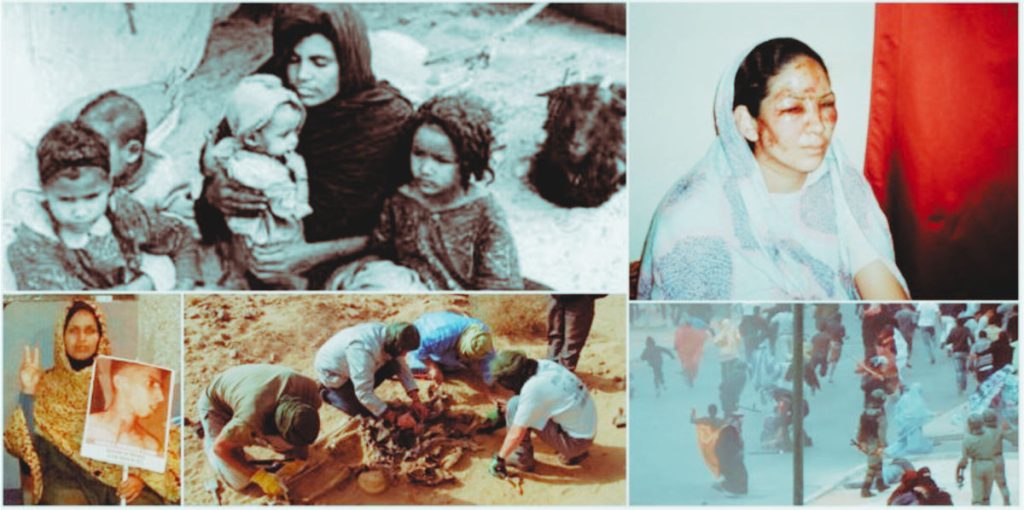
Collage illustrating systematic, colonial violence in occupied Western Sahara (Left to right; top to bottom): the first wave of refugees fleeing the bombardment carried out by the Moroccan army and Mauritanian forces, seeking safety in the Sahrawi refugee camps near Tindouf, Algeria; Meriem Mghizlat was beaten in the face, along with other Sahrawi human rights defenders and civilians, during a protest in the district of Matalla, in occupied El Aaiún, in 2010; Tabkar Haddi, holding the image of Mohamed Lamin Haidala, who was forcibly killed by the Moroccan occupying force, with the involvement of settlers, on 31 January 2015 in the occupied territories of Western Sahara; forensic exhumation of a mass grave by Spanish researchers at Mhyriz confirming remains of Sahrawis forcibly disappeared in 1976; and peaceful protest in support of hunger-striking Sahrawi political prisoners and calling for a referendum on self-determination in the Moroccan-occupied territory of Western Sahara, late 2015.
The struggle in Western Sahara is not an isolated conflict; it is a frontline of a global imperial architecture that imposes domination through military occupation, resource extraction, and the destruction of political sovereignty across the Global South. In Sudan, foreign-armed militias slaughter civilians while international corporations quietly position themselves to secure control over gold, land, and water – turning a humanitarian catastrophe into an investment opportunity. In Palestine, Israel’s regime of siege, settlements, and demographic engineering offers a blueprint for Morocco’s policies in Western Sahara: walled bantustans, resource capture, militarised checkpoints, and the deliberate fragmentation of indigenous society. In the Congo, the world’s tech giants perpetuate the same colonial labour regimes they pretend to have transcended, extracting cobalt and other minerals through chains of violence that enrich global capital while keeping local populations in conditions of structural abandonment. As Patrice Lumumba warned, ‘The day will come when history will speak – not the history taught in Brussels, Paris or Washington, but the history taught in our liberated countries’.
If Pan-Africanism is to be revolutionary, it must confront the last colony on the continent. Anything less is betrayal. The African Union recognises the Sahrawi Arab Democratic Republic (SADR) as a full member. Yet several African governments have bowed to Moroccan pressure and Gulf money – a reminder of Nkrumah’s warning in Neo-Colonialism: The Last Stage of Imperialism (1965), that ‘the enemy of Africa is not only external; it is also internal’. Thus, the task falls to people’s movements – trade unions, women’s movements, student unions, socialist organs, peasant associations – to lead where governments hesitate.
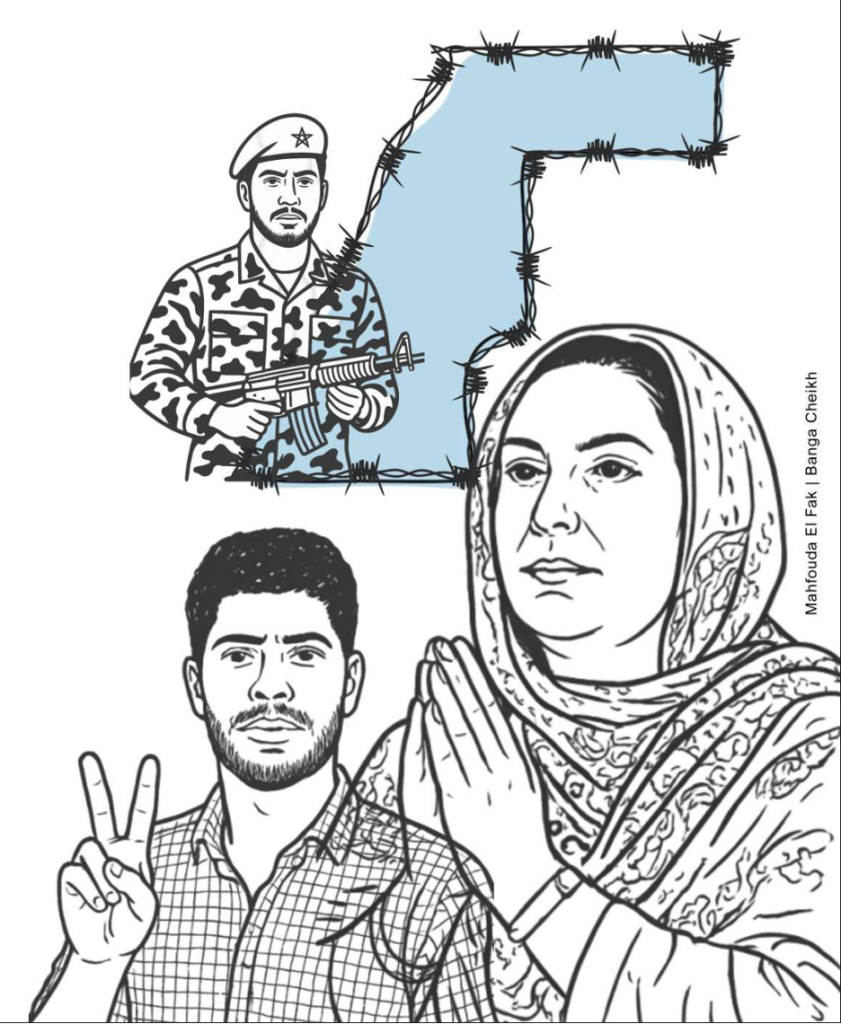
Prominent human rights defenders Cheikh Banga (left) and Mahfouda Bamba Lefkire (right) continue to face political imprisonment, repression, and intimidation. Graphic by Khalid Boufrayoua. See more on the 50 years of Occupation here.
To transform solidarity from a slogan into a material force, we must advance a concrete programme of struggle:
We must build a Pan-African Solidarity Front for Western Sahara, linking socialist parties, trade unions, youth movements, and women’s organisations from Cape Town to Cairo and Accra to Algiers – a united political infrastructure capable of resisting repression and coordinating action across the continent.
We must launch People’s Tribunals to expose Moroccan crimes – crimes of war, drone strikes, torture, enforced disappearances, and the theft of Sahrawi resources – while naming the Western, Israeli and Gulf companies that profit from occupation.
We must demand that the African Union impose sanctions on Morocco – economic, diplomatic and political – until it recognises the Sahrawi people’s right to self-determination.
We must organise an international liberation campaign for Sahrawi political prisoners, elevating the imprisoned activists of Gdeim Izik and others as global symbols of anti-imperialist resistance.
We need to promote academic, cultural, and institutional boycotts of Moroccan state bodies complicit in the occupation, especially universities, think-tanks and cultural institutions that launder the image of colonialism under the guise of ‘African leadership’.
We must establish Pan-African Youth Brigades to visit the Sahrawi refugee camps, study the structures of popular resistance, document testimonies and carry the struggle back to their communities.
We should mobilise global trade unions, especially dockworkers, to block shipments of stolen Sahrawi phosphates and fisheries – as workers in South Africa, New Zealand and elsewhere have courageously done, proving that worker internationalism can disrupt imperial chains.
Western Sahara must be integrated into the programmes of socialist, revolutionary and left movements worldwide, from Latin America to South Asia – not as a marginal cause but as a central frontline of the global anti-colonial and anti-capitalist struggle.
And crucially, we must break the media siege imposed by Western governments, Moroccan propaganda networks, and their Gulf-funded disinformation apparatus by building independent African media platforms, amplifying Sahrawi journalists in the diaspora and in the occupied territories, creating multilingual digital campaigns, and training activists in counter-propaganda techniques and secure communication.
As Amílcar Cabral taught: ‘Solidarity is not a word but a practice’. These proposals – political, economic, cultural, and communicational – form the practical roadmap for turning solidarity with Western Sahara into a revolutionary force capable of confronting empire.
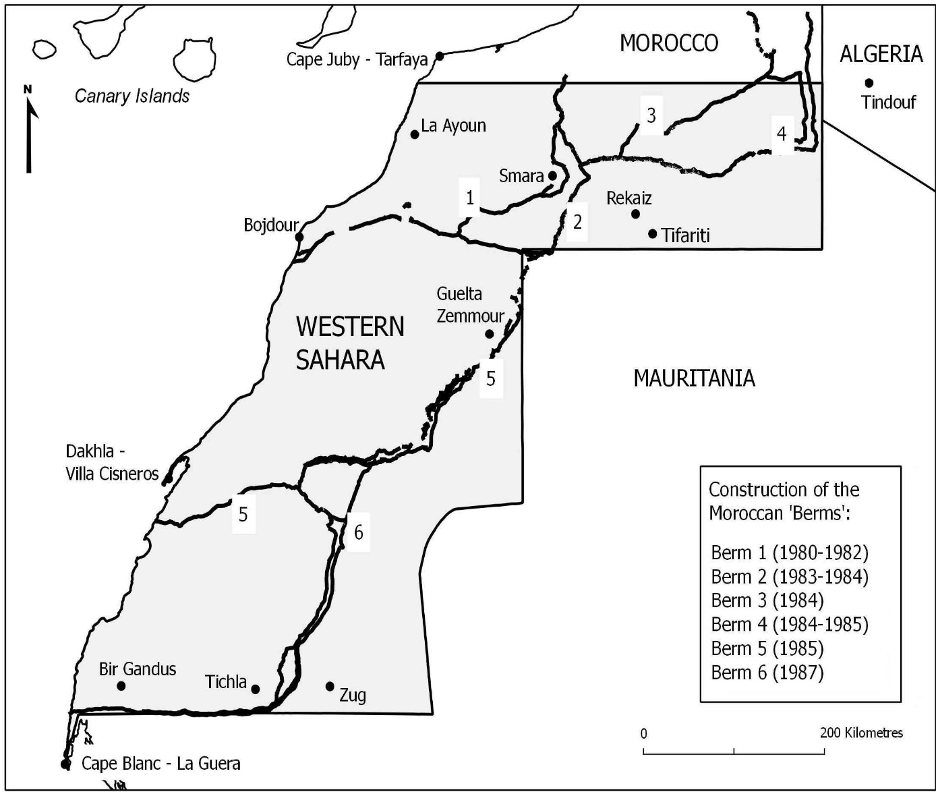
Map of the Moroccan berms (Wall of Shame) built between 1980–87, partitioning Western Sahara. The territory north and west of berms 4, 2, 5, and 6 is currently occupied by Morocco. The territory to the east, including Tifariti and Zug, is held by Polisario Front of the Sahrawi Arab Democratic Republic. Source: Salvatore Garfi, An Archaeology of Colonialism, Conflict, and Exclusion: Conflict Landscapes of Western Sahara (2014).
The Moroccan wall – 2,700 kilometres of sand, landmines and racial segregation – is not only a military barrier. It is the material expression of an unfinished African revolution, a scar carved into the continent by imperialism and its comprador agents. But no wall, no army, no occupation has ever stopped a people whose historical mission is liberation.
The future belongs to those who resist. It belongs to the peoples who refuse to surrender their land, their dignity, their history and their horizon.
The revolution continues. And Western Sahara will be free.
Warmly,
Saddam
[Featured image: Sahrawi women hold Polisario Front flags at the Sahrawi refugee camp of Dakhla, southeast of the Algerian city of Tindouf. Farouk Batiche / AFP]
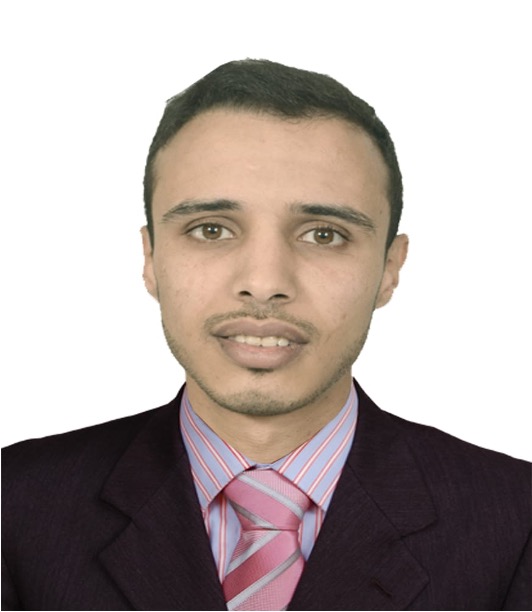 | Saddam Alktif |