We Are Here: Why We Write About Sudan in Proximity to Palestine
Gaza became our generation’s moral touchstone while Khartoum burned in near silence – young organisers displaced by the counter-revolution war ask why, and what solidarity must build so no struggle is left behind.
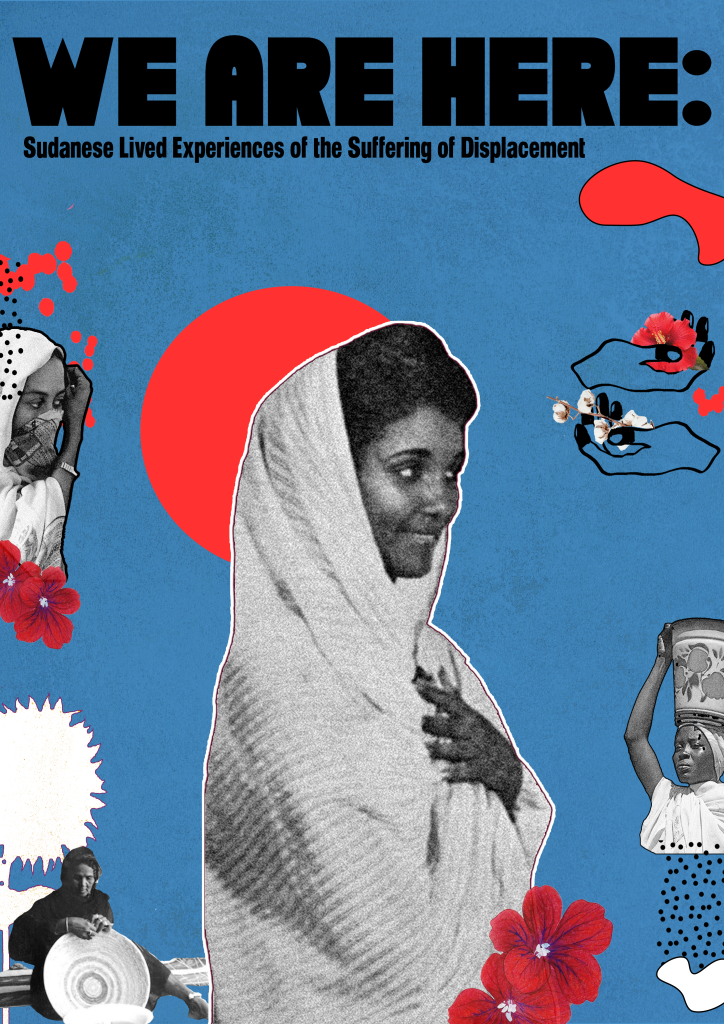
Amanda Elbergdar, cover illustration for We Are Here, 2026.
‘I hope people would look at a person, not a statement, to understand what is happening … We, the tortured, killed, displaced, and starved, are too exhausted to go through the homework of making our suffering humane and relatable.’ – Young Sudanese activist, We Are Here.
On the morning of 15 April 2023, during Ramadan, Elaf was in a lecture hall in Khartoum when her mother called to tell her to come home. She brushed it off; gunfire had become ordinary. Twenty minutes later a loud bang shook the building, and as the students stepped into an open courtyard the air filled with machine-gun fire. Across the city, Aya woke to a sky black with smoke. Mina, who is diabetic, would leave twelve days later because there was no insulin left in the country. Each of them believed it would be over in a week.
Three and a half years on, Sudan is the world’s largest displacement crisis. By April 2026, the International Organization for Migration counted nearly 9 million people internally displaced, almost 4 million returnees and another 4.5 million who had fled across borders. Knowing these numbers is necessary. But, as the eight young organisers whose stories fill We Are Here: Sudanese Girls and Youth Hold Their Ground in Resistance and Remembrance insist, numbers also flatten people into a scale that is easy to scroll past.
This newsletter draws on that collection and its accompanying essay, ‘Why We Write About Sudan in Proximity to Palestine’, to ask why Palestine became the moral touchstone of our generation and Sudan did not, and what the answer teaches us about how we organise.
The Touchstone and the Shadow
Every generation meets a struggle that tests its conscience: Vietnam in the 1960s and 1970s, Iraq in the 2000s and, since October 2023, Palestine. That is neither an accident nor a mistake. The genocide in Gaza was broadcast live by its own journalists and young people, and the forces enabling it – Israel, the United States, much of the West, and several Arab governments – can be named. Behind that clarity stand decades of organisation. In 2005, 170 Palestinian civil society organisations – trade unions, refugee networks, women’s groups, popular committees – issued the call for Boycott, Divestment, and Sanctions (BDS). When people around the world felt paralysed watching a genocide on their screens, BDS gave that feeling somewhere to go: a strategy, verified research on corporate complicity, concrete targets. Outrage became economic pressure.
Sudan has had no equivalent. Not because Sudanese suffering is lesser – this is no contest over whose pain runs deeper – but because the war has been narrated as something it is not. Called a ‘civil war’ or a ‘humanitarian crisis’, a counter-revolution shaped by mercenaries, proxy finance, and ethnic cleansing has been reduced to a feud between two generals. That framing hides the foreign hands. The comprador formation within the US-led neocolonial order, United Arab Emirates stands accused – on the strength of documented supply lines, re-exported weapons, and business ties – of arming and bankrolling the Rapid Support Forces (RSF), a charge Abu Dhabi denies. Egypt, Saudi Arabia, Israel, the United States, the United Kingdom, Russia, and China all have interests – some more geopolitical, others more commercial – in Sudan’s gold, oil, Nile water, and Red Sea coast. Because Western stakes are less acute there, and because Sudan does not threaten the West’s self-image as a free Palestine would, it is left to burn in what the essay calls concentric circles of political void.
The consequences are concrete. When the army-led authorities in Port Sudan – products of the October 2021 coup, and illegitimate in the eyes of many Sudanese – took the UAE to the International Court of Justice in March 2025, the case was dismissed two months later because the UAE had entered a reservation to the Genocide Convention’s dispute clause. Diaspora-led protests have called for an arms embargo and a boycott of UAE-linked business, but, as the essay observes, there has been no credible container to turn those calls into sustained global pressure. ‘It genuinely feels like the only people who are talking about what’s happening in Sudan right now are Sudanese,’ Elaf says.
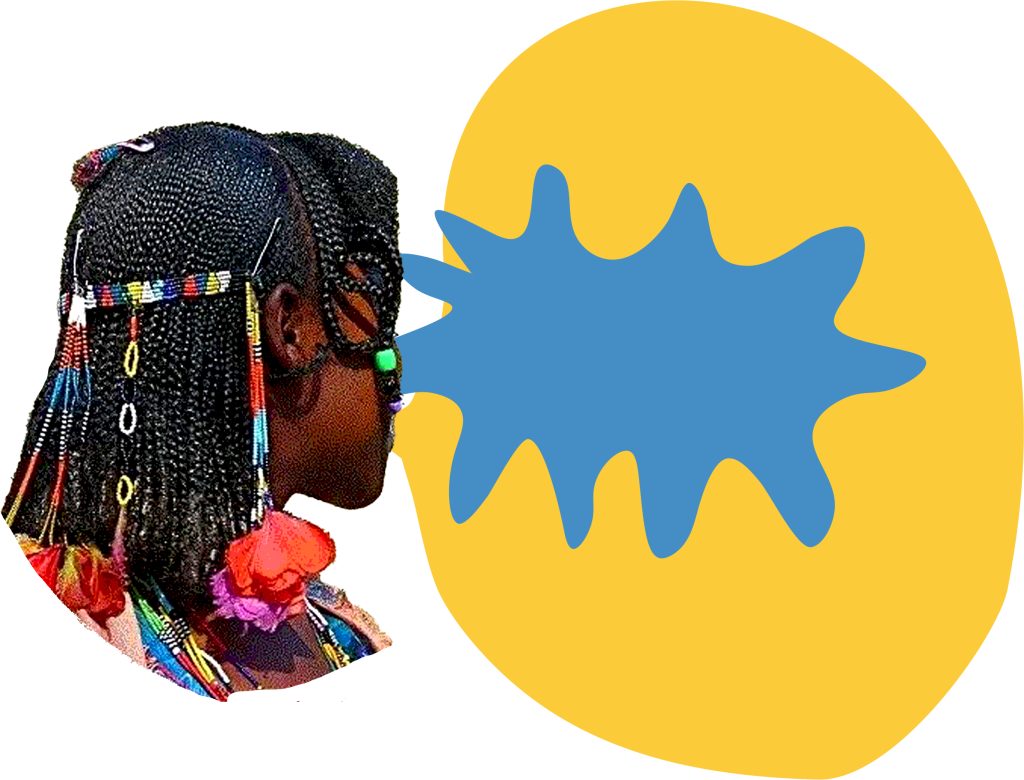
Amanda Elbergdar, Free Speech, 2026.
A War on a Revolution
To see Sudan clearly we have to place it in its history:
- An Anglo-Egyptian condominium (1899–1956), under which Britain, with Egypt as a nominal partner, governed North and South as separate entities, a divide that outlasted independence;
- Two civil wars between the Khartoum state and southern movements (1955–1972 and 1983–2005), the second ending in the deal that led to balkanisation with the creation of South Sudan in 2011;
- The genocide in Darfur from 2003, when the al-Bashir government armed the Janjaweed to crush a rebellion in the region – the militia from which the RSF was later built;
- And a long line of popular uprisings – 1964, 1985, 2019 – each reversed by the men with guns. The revolution that toppled Omar al-Bashir after thirty years in power in April 2019 was answered by the June sit-in massacre, when forces led by the RSF killed more than a hundred protesters outside army headquarters in Khartoum. In October 2021, the army and the RSF jointly seized power, dissolving the civilian-military transitional government.
In January 2023, the neighbourhood Resistance Committees signed the Revolutionary Charter for Establishing People’s Power, a roadmap built through horizontal consultation that proposed local councils, civilian oversight of the security forces, and an economy that returns Sudan’s resources to its people. Three months later, the two partners in the coup turned their guns on each other, and on the people. This is why many Sudanese call it the Counter-Revolution War. A ‘civil war’ asks the world for aid; a counter-revolution asks it for solidarity with a political project.
Slow Death, at Home and Across Borders
The testimonies in We Are Here are not only about bombs. They describe what the Palestinian scholar Nadera Shalhoub-Kevorkian calls a ‘state of neither life nor being’: families sleeping on living-room floors because those walls are thickest; young women who stop leaving the house because rape has become a weapon of war; parents whose savings vanish overnight when the banks collapsed. Médecins Sans Frontières treated 659 survivors of sexual violence in South Darfur between January 2024 and March 2025, nearly a third of them children. In April 2026, UN Women reported that the number of people needing sexual-violence support had quadrupled.
Crossing a border does not end it. In Egypt, the storytellers describe deportation campaigns, residency rules changed without warning, rents that swallowed their savings, and young men in the street calling them abeed – slaves. In Uganda’s Kiryandongo settlement, Wini Omer describes one medical facility for thousands of refugees. The refugee regime, the text argues, was designed by the powers that drew Africa’s borders: open to weapons, closed to people. The storytellers point to the EU’s Khartoum Process, through which, they argue, the RSF gained cover and capacity as Europe’s border guard. If the warmongers stayed out of our borders, the text says, we would never need to cross theirs.
The Empire’s Year
Sudan should be read within the wider offensive of 2026. On 3 January, US forces bombed Caracas and seized President Nicolás Maduro in the name of a war on drugs, while Washington spoke openly of running Venezuela and its oil. Three weeks later, in Davos, Donald Trump launched his Board of Peace: a body he chairs, endorsed by the UN Security Council to oversee Gaza’s ‘reconstruction’, with permanent seats priced at $1 billion and a launch slideshow of seaside resorts on land still under rubble. On 28 February, the United States and Israel went to war on Iran; on the first day, a strike on a girls’ elementary school in Minab killed more than 165 people, most of them children. Meanwhile, US Immigration and Customs Enforcement received a historic funding surge to raid neighbourhoods and break up families.
Yet where there is oppression, there is resistance. People in the United States answered with encampments, mutual aid and rapid-response networks outside schools, marching for Palestine, Sudan, Venezuela, and Cuba alike. They also turned consciousness into votes: Zohran Mamdani governs New York City, and Abdul El-Sayed won Michigan’s Democratic Senate primary in August on programmes that treat housing, healthcare, and education as rights, not markets. These are not revolutions. But they show that the web of empire can be seen, and fought, from inside its centre.
From Mobilisation to Organisation
None of this is an argument for less Palestine. It is an argument against exceptionalism: the habit, however unconscious, of letting one struggle stand in for all of them, on which divide and rule depends. The essay also draws a harder lesson. Millions marched, boycotted and occupied campuses for Gaza, and the genocide did not stop. Many were left exhausted. Kwame Ture warned that mobilisation is temporary and organisation permanent, and that ‘the struggle is never an event’. Vijay Prashad makes the same point: popular energy is not social power, which is the organised capacity of a class to act. State-approved protest can be absorbed; an organised people who have built their own institutions, and who know what they are fighting for, cannot.
Sudanese organisers know this well. After 2019, Reem tells us, an organic feminist movement grew, and it is that movement that now runs community kitchens throughout the war. That infrastructure, too, is under strain – from polarisation, from donor conditions, from what she calls political money and extractive agendas. Solidarity that moves at the speed of relatability rather than the speed of trust leaves it starving.
What, then, is to be done? We Are Here asks us to centre frontline organisers, move resources with dignity, call for an arms embargo, and confront the complicity of our own states. To this we add a task for the Pan-African left: to build for Sudan the kind of container that BDS became for Palestine – mapping the companies, gold routes and arms flows; linking the Sudanese diaspora with unions, students, and movements on the continent; and refusing the language of ‘civil war’ in our own publications. The UAE and the Gulf are major investors and trading partners across Africa, which gives African movements a leverage few others possess.
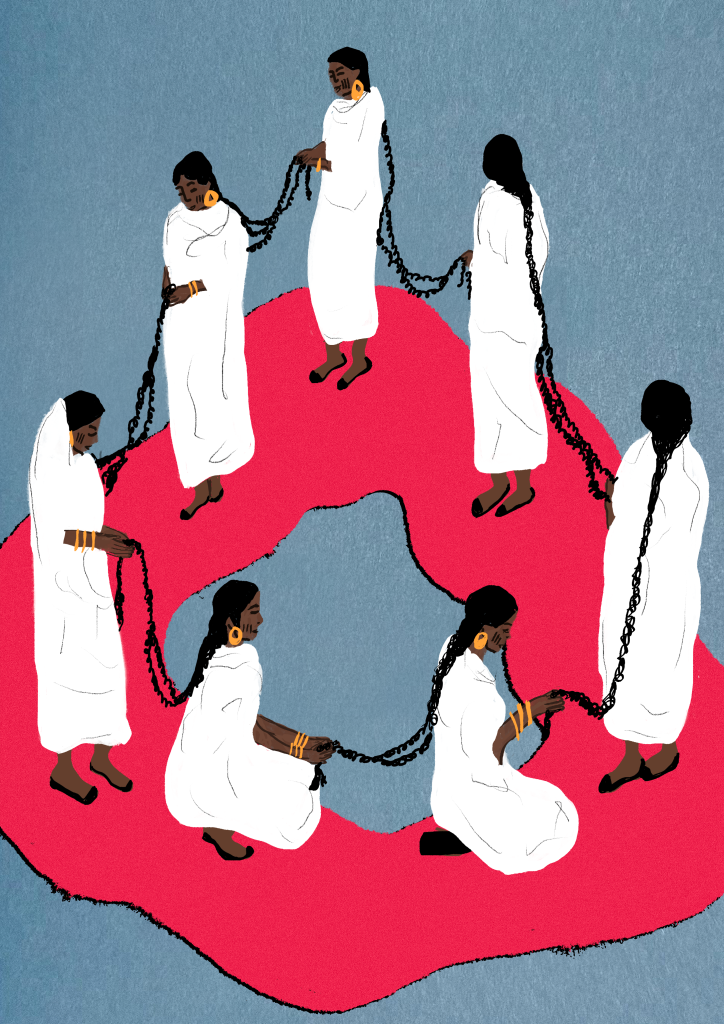
Amanda Elbergdar, We are Here, Hand in Hand, 2026.
The storytellers do not tell their stories to prove their humanity, which was never in question. They tell them to ignite the fire of revolution, to find their comrades, and to fill the archive with their voices. Sudan and Palestine are different terrains of the same battlefield. We write about them together not to rank them, but because we will only be free together.
Warmly,
Sandie
We Are Here: Sudanese Girls and Youth Hold Their Ground in Resistance and Remembrance gathers the testimonies of eight Sudanese girls and young organisers displaced by the war that began on 15 April 2023. Seeded by a Sudanese and a Palestinian organiser in feminist friendship, it reads Sudan beyond the humanitarian lens and traces the colonial roots of the present.
 | Sandie Hanna |