From Conference to Production: Building the Left’s Economic Power
Across Africa, formal freedom has not broken the power of inherited ownership; the urgent task is to turn declarations into institutions, land struggles into livelihoods, and solidarity into organised popular force.
South Africa in 2026 is living through a deep political and social crisis. The historic liberation movement now governs in coalition with the party of white capital, official unemployment sits above thirty per cent, and three decades of formal democracy have left the structures of racial and colonial ownership largely intact. In this conjuncture – marked by austerity, hunger, inequality and ecological stress – the question is not whether South Africa needs alternatives, but whether organised forces can build them.
It was within these conditions that the Conference of the Left was convened at the end of May 2026. Not merely another gathering of a fragmented South African Left, the Conference opened – however unevenly and incompletely – a path towards linking socialist politics to practical questions of ownership, production, land, livelihoods, public power, and democratic economic reconstruction.
The most important sentence to take from the Conference is not a slogan. It is a task: ‘the future will not be given to us; it must be organised’. The Conference declared that the Left had not gathered to launch a new party, nor to dissolve existing formations into one structure, but to rebuild the organised power of the working class and the poor through unity in action against capitalism, imperialism, patriarchy, racism, austerity, unemployment, hunger, inequality, ecological destruction, and monopoly power.
South Africa does not suffer from an absence of declarations. It suffers from an absence of organised popular power capable of changing the material relations of ownership and production. The Conference of the Left will therefore be judged not by the elegance of its declaration, but by whether it generates institutions, campaigns, schools, co-operatives, public ownership struggles, land occupations, worker-community alliances, and democratic economic alternatives rooted in the daily life of the working class and popular classes.

Willie Bester (South Africa), Barometer of Poverty, 2021.
The Central Question: Ownership
The Conference framework placed the question of ownership at the centre. Political democracy without economic power remains incomplete. Land, mines, banks, the energy system, food system, transport infrastructure, retail chains and productive assets remain concentrated in private hands, organised around profit rather than social need. A Left strategy that does not confront this structure will not be transformative, it will amount to crisis management within the existing order.
This is why the Conference’s emphasis on public, social, worker, co-operative and community ownership matters. It shows that the struggle for socialism is not only about capturing the state at some future moment. It is also about building forms of working-class and popular power now: defending public assets from privatisation, building co-operatives, asserting community control over land and water, establishing worker-owned enterprises, demanding democratic control over finance, and creating solidarity-economy institutions that shift economic decision-making into the hands of communities.
One of the Conference Commissions proposed a Left Development Fund to support:
- Community-based manufacturing, retail, agricultural, and industrial initiatives.
- Nationalisation of mines, banks, and strategic sectors under democratic public ownership.
- Worker ownership and meaningful equity participation.
- Transformation and public ownership of the Reserve Bank.
- Co-operative financial institutions.
- Community-ownership models.
It also placed land, agriculture, and rural development at the centre of economic transformation, including land expropriation without compensation, organised land occupation for productive use, market access for small producers, and rural development as part of left organising.
This is not a small matter. It points towards an economic strategy grounded in structural power, not only policy advocacy.
Why the Solidarity Economy Matters
The solidarity economy is often misunderstood as a soft add-on to radical politics – reduced to small projects, community gardens, savings clubs, or survivalist co-operatives. Properly understood, it is about the reconstruction of society from below: who controls resources, who decides what is produced, who benefits from production, and how economic life is reorganised around need, care, ecological sustainability, and democratic ownership.
In land and agrarian reform, this is decisive. South Africa’s inherited agrarian structure was built through colonial dispossession, apartheid land laws, cheap Black labour, massive state support for white commercial agriculture, and later neoliberal deregulation and liberalisation. The post-apartheid state adopted market-based land reform – the willing-buyer willing-seller logic – and deregulated agricultural markets in ways that benefited agrarian capital while leaving land reform beneficiaries without the protections and support that white farmers historically enjoyed.
This is why land redistribution cannot be reduced to title deeds, compensation formulas or isolated farm transfers. Land reform must transform the whole agrarian structure: land ownership, water, infrastructure, finance, inputs, extension, markets, processing, storage, transport, and the power of agribusiness across the value chain.
A solidarity-economy approach to land combines redistribution with public investment, co-operative production, agroecology, local markets, farmer-led funds, resource networks and mass power from below. It means communities and workers reorganising production, land, and resources in their own interest – through land occupations, community production, smallholder support, seed systems, local processing, democratic control over water, and public procurement that supports local food systems. In short: it is the organised work of changing property relations in practice.

Willie Bester (South Africa), Miner, 2021.
Climate Crisis, Land, and Food Sovereignty
The land question is also a climate question. The industrial food system is ecologically destructive. It depends heavily on fossil fuels, chemical fertilisers, pesticides, long-distance transport, refrigeration, packaging and water-intensive production. It destroys soil, forests, water systems, and biodiversity. It produces hunger while degrading the ecological basis of life.
Food sovereignty offers a different pathway: the right of communities and countries to define their own agricultural and food systems. It requires democratic control over land, water, seed, biodiversity, local markets and food production – culturally appropriate, nutritious food available to all. A shift away from concentrated agribusiness power through supporting small producers and building agroecological systems that can feed people while repairing nature.
The Left should therefore understand land and agrarian reform as part of the response to the climate crisis. Radical land redistribution, agroecology, co-operative production, and local food systems are not nostalgic returns to the past. They are the basis for a future beyond fossil capital, agribusiness domination, and market dependence.
There are already living examples of this work. South Africa’s food sovereignty movement has built networks of organic and agroecological farmers, women-led co-operatives, indigenous seed banks, local markets and community production systems. Organisations such as Siyavuna Development Centre, Umgibe Farming Organics & Training Institute, and the Inyanda National Land Movement – within a network reaching around 20,000 organic farmers across the country – show what becomes possible when communities have support and organised infrastructure. The task is to scale and co-ordinate these efforts into a national strategy.
The Expropriation Act: A Terrain, Not The destination
The Expropriation Act (signed 20 January 2025) is a critical terrain of struggle. The Right is correct to fear expropriation because it challenges the sanctity of capitalist property. But the Left must not confuse the passing of an Act with the transformation of property relations.
The Act remains limited. It is shaped by negotiation, court appeals, compensation criteria and the continuing shadow of market-based land reform. It does not adequately place the social and ecological function of land at the centre, nor does it go far enough in requiring that land use address historical and continuing racial and gender injustice, serve accommodation and production, respect the dignity of workers and communities, and enhance ecological life.
The Left must therefore defend the Act against the Right while also going beyond it – building a broader campaign for land to fulfil its social and ecological function. We need expropriation for redistribution, food sovereignty, housing, ecological repair, public use, and co-operative production. We need land reform driven by the landless, farm workers, rural women, small producers, informal settlement residents, social movements, unions and communities – not only by officials, courts, and technocrats.
The Expropriation Act should become a site of mass education, mobilisation, and legal-political struggle. But the larger terrain remains the transformation of property relations.

Willie Bester (South Africa), It Takes a Village, 2018.
Lessons from the People’s Red Caravan
The People’s Red Caravan – a campaign and initiative of the South African Communist Party (SACP) – offers useful lessons. Its value lies in taking politics to the ground: villages, townships, communities, co-operatives, local struggles, municipal spaces, and sites of production. It demonstrates that socialist politics must be organised where people live, work, farm, trade, study, care and struggle.
But the Caravan must move from mobilisation to productive institution-building. It should not only convene meetings – it should help map land, identify local production capacities, support co-operatives, link communities to technical skills, build municipal accountability campaigns, establish agroecology demonstration sites, train young people, and connect community demands to public investment and policy struggles.
Every Red Caravan site should ask: what can be produced here? What land is available? What co-operatives exist? What public assets are unused? What skills are present? What water sources exist? What food is imported that could be produced locally? What municipal procurement can support local production? What public works can employ people? What trade unions operate here? What NGOs, churches, schools, clinics, traditional institutions and community organisations can be linked into a local development plan? This would turn the Caravan into a method of socialist reconstruction from below.
Political Economy Education as Organising
The Conference recognised the need to rebuild political education and called for a common political education programme linked to campaigns and rooted in communities, workplaces, campuses, and rural areas. It insisted that the unemployed, informal workers, migrant workers, farm workers, farm dwellers, youth, and women must be central forces of Left renewal, and that co-operatives, land-based production, and alternative economic institutions must become practical elements of socialist reconstruction.
This is crucial. Political economy education must help communities understand why food prices rise, why municipalities collapse, why land reform fails, why banks dominate, why workers are casualised, why women carry unpaid care work, why youth unemployment persists, why climate crisis hits the poor hardest, and why public ownership matters. It must not operate as a classroom abstraction.
Political education must be tied to practice: a co-operative school linked to an actual co-operative; a land school linked to a land campaign; a municipal economy school linked to municipal development planning and budget struggles; a public-ownership school linked to anti-privatisation campaigns; a food sovereignty school linked to agroecology gardens and seed banks.
Trade Unions, NGOs and Economic Policy
Trade unions have an indispensable role in economic transformation beyond wage bargaining. A broader working-class bloc must be organised – linking employed and unemployed workers, informal workers, co-operative workers, community health workers, farm workers, and public sector workers. Pension funds, bargaining councils, worker education departments, and research capacity can be mobilised to support public ownership, industrial policy, co-operative finance, and local production.
Progressive NGOs such as the Institute for Economic Justice can help connect this movement-building to serious economic policy on fiscal and monetary questions, public employment, social security, industrial strategy, trade policy, food systems, climate finance, public banking and democratic ownership. But policy must not float above struggle: it must be answerable to movements, unions, and communities.
The Left needs a division of labour. Trade unions bring worker organisation. Progressive NGOs bring research, policy and litigation capacity. Co-operatives bring practical production. Movements bring land, housing, climate and service struggles. Political organisations bring ideological coherence and strategy. The Council of the Left has the potential to co-ordinate these capacities effectively.
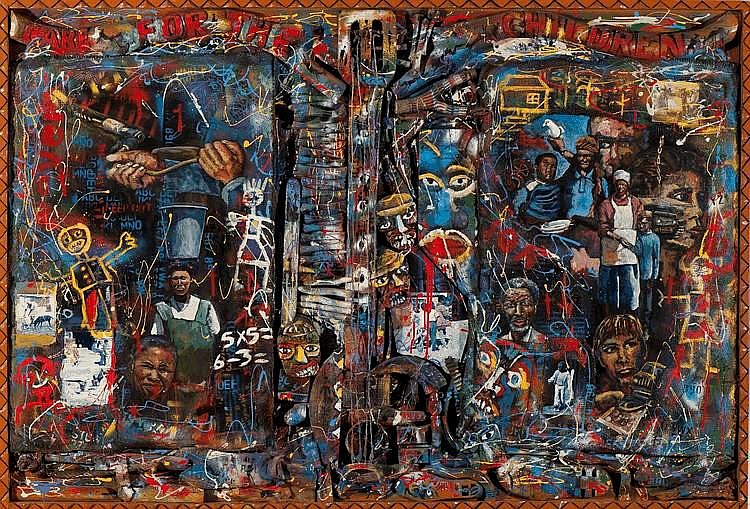
Willie Bester (South Africa), Care for the Children, 1995.
Toward an African Economic Development Strategy
The South African Left must also think continentally. Africa’s crisis is not a lack of entrepreneurship – it is the structure of dependency: raw material exports, debt, food imports, financial domination, weak industrialisation, foreign control over minerals and land, and the subordination of national development to global capital. The Conference declaration committed itself to Pan-Africanism, strategic delinking from imperialist dependency, regional industrialisation, public control over strategic resources, alternative finance systems, and Global South solidarity.
An African Left economic strategy must link land reform, food sovereignty, public ownership, beneficiation, regional manufacturing, co-operative development, public banks, climate justice, and democratic planning. It must ask: how do we build African capacity to feed ourselves, manufacture what we need, process our minerals, control our energy, protect our water, and build social ownership across borders?
The South African Left must learn from Landless Workers’ Movement (MST) in Brazil, Kerala’s people’s planning, Cuba’s agroecology and public health, Venezuela’s communes, African food sovereignty movements, worker co-operatives, and other anti-capitalist initiatives.
Practical Steps After the Conference
The Conference must now become a programme. The following steps are urgent:
- Establish the Council of the Left with a strong economic transformation cluster focused on public ownership, co-operatives, the solidarity economy, land, food sovereignty, and local democratic economies.
- Create a Left Development Fund to support community manufacturing, agroecology, co-operative retail, worker buy-outs, food processing, seed banks, local transport, renewable energy, and repair economies.
- Launch a national Land, Food Sovereignty and Agroecology Campaign linking expropriation, land occupation, smallholder production, seed sovereignty, water democracy, and public procurement.
- Build municipal solidarity-economy pilots in selected municipalities, linking councillors, trade unions, communities, co-operatives, local producers, NGOs, and technical institutions.
- Convene sectoral indabas on mining, finance, food systems, energy and retail to identify where public, worker, community, and co-operative ownership can be advanced.
- Develop a national political economy curriculum on capitalism, public ownership, land, agroecology, co-operatives, fiscal policy, finance, climate crisis, and African development.
- Connect the Expropriation Act struggle to a broader campaign for the social, and ecological function of land.
- Measure progress not by resolutions, but by institutions built: co-operatives formed, land accessed, workers organised, youth trained, public assets defended, campaigns sustained, and communities able to feed themselves.
The Conference of the Left sounds the alarm of the urgency of this work. The test is whether the Left can turn words into production, solidarity into organisation, and political economy education into structural power – building what already exists in fragments into co-ordinated, durable institutions at scale.
Socialism will not arrive as a speech. It must be planted, built, manufactured, taught, organised, and defended.
Warmly,
Mazibuko
 | Mazibuko Kanyiso Jara |