The Roots of Capitalism Run Through Slavery: The Thirty-Fourth Newsletter (2026)
Behind the polished story of Western progress lies another history: steam power, modern banking, and industrial capitalism were not born of peaceful innovation but paid for with the blood of enslaved people.
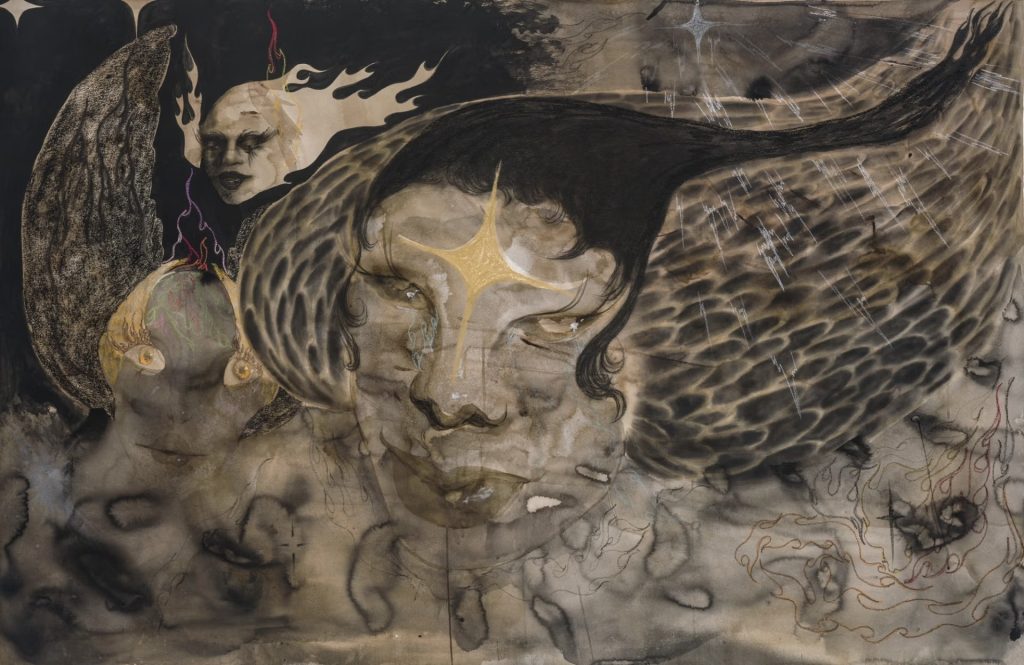
Naudline Pierre (Haiti), This, I Know to Be True, 2023.
Dear friends,
Greetings from the desk of Tricontinental: Institute for Social Research.
There is a certain comfort in the stories that empires tell about themselves. In these stories, capitalism appears as the natural flowering of European ingenuity – the product of reason, scientific discovery, technological innovation, and the thrift of industrious individuals. Colonialism and slavery, when they appear at all, are treated as regrettable episodes alongside an otherwise triumphant march towards modernity.
Our latest study, The Roots of Capitalism: Slavery and the Sugar Trade (August 2026), by Prabir Purkayastha, asks us to abandon this comforting mythology. The study inaugurates our new series, Studies on Historical Materialism, which will examine the making of the modern world while placing the dialectic between imperialism and national liberation struggles at the heart of this process. Much of the study was written during the 225 days that Prabir spent incarcerated in Rohini Central Jail in Delhi, India, from October 2023 to May 2024. He had been illegally arrested by the Indian government as part of a broader crackdown on press freedom and progressive voices. While in prison, scraps of paper passed back and forth during visits became the beginnings of this history of sugar, slavery, and capitalism. There is something fitting in this: a study of systems of confinement and exploitation written under conditions of confinement by an intellect that refused to be confined.
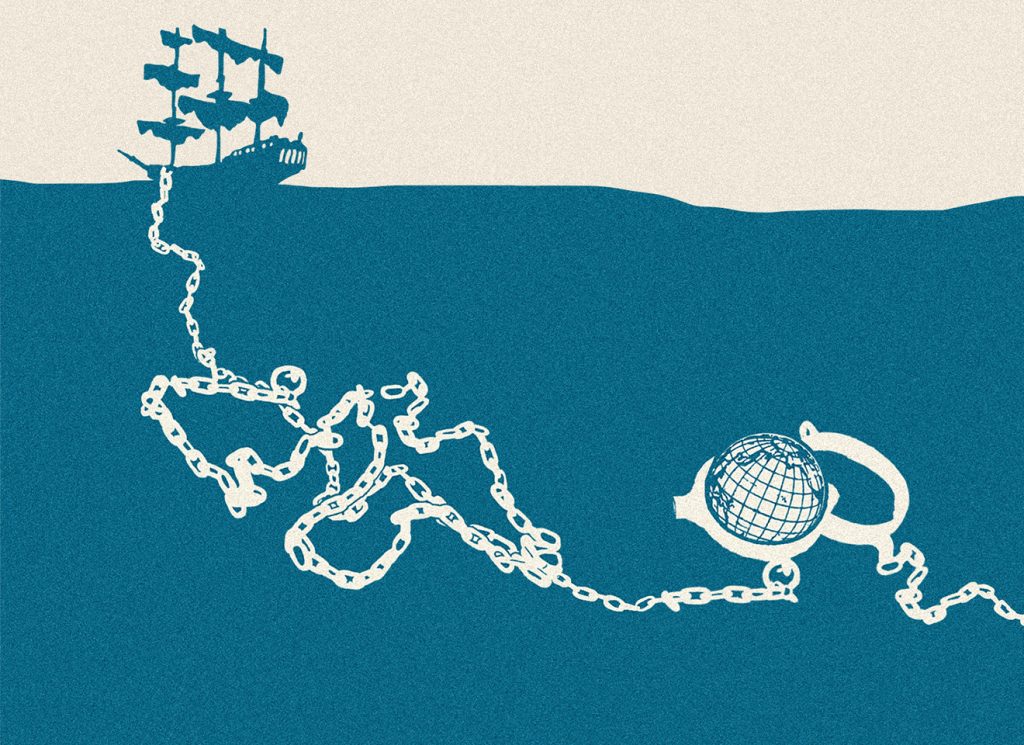
At the heart of the study is sugar, one of the great psychoactive commodities of the colonial era that – alongside alcohol, chocolate, coffee, opium, tea, and tobacco – fuelled the Industrial Revolution. Before sugar became an ordinary item on the tables of European workers, it was a luxury consumed by kings and aristocrats. Its transformation into an article of mass consumption required more than a change in taste. It required the seizure of land, the destruction of Indigenous societies, and the violent commodification of human beings: Africans captured, transported across the Atlantic, and sold to plantation owners as enslaved labourers. Sugar was among the first truly global commodities, and its transformation into such a commodity required the construction of an immense commercial and financial apparatus linking Africa, the Americas, Asia, and Europe.
The scale of the colonial violence was staggering. At least ten million enslaved Africans landed in the Americas and the Caribbean. Once those who died during capture, forced marches, detention, and the Middle Passage (the forced Atlantic crossing from Africa to the Americas) are included, the total number of Africans seized for the transatlantic trade was plausibly between fourteen and twenty million. While the populations of Asia and Europe grew enormously between the seventeenth and nineteenth centuries, Africa’s population stagnated and, in many regions, declined. This catastrophe was not an accidental consequence of commerce. It was produced through what the study calls the ‘gun-slave-money nexus’: European firearms and gunpowder were exchanged for captive Africans, whose sale generated the profits that reproduced the system.
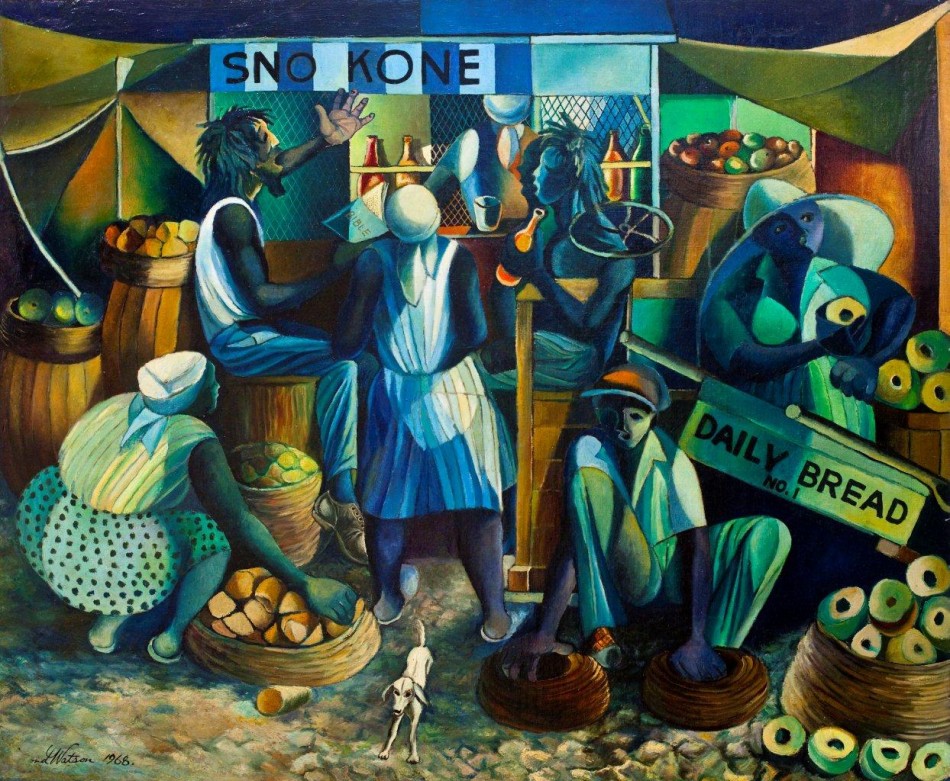
Osmond Watson (Jamaica), City Life, 1968.
The plantation built to organise and exhaust this labour was not a remnant of an older, pre-capitalist world. It was one of the laboratories of capitalist modernity. On the sugar plantation, cultivation and industrial processing were integrated in a single labour regime on site. The cane had to be cut, transported, crushed, boiled, and crystallised according to a rigid timetable. Enslaved people were organised into gangs, divided by age and physical capacity, and driven through workdays that could last eighteen to twenty hours during the harvest. Plantation managers kept meticulous accounts, calculated productivity, measured subsistence against replacement costs, and treated human beings as fixed capital – as machines to be exhausted and replaced. The plantation was, as US anthropologist Sidney Mintz wrote, a ‘synthesis of field and factory’. Its time-and-motion calculations prefigured the management systems later associated with the modern industrial workplace.
The sugar refineries of London, Bristol, Glasgow, and Liverpool were among Britain’s earliest factory-like workplaces. Around them grew shipping, shipbuilding, warehousing, insurance, credit, and banking. By 1774, raw sugar accounted for one-fifth of all British imports. Between 1700 and 1800, Britain’s sugar imports increased sevenfold. The wealth accumulated through sugar did not remain on distant Caribbean plantations. It financed British commercial and industrial expansion. One estimate suggests that by 1770 close to 40% of the capital used for this expansion derived from profits from the trade in enslaved people. Investments in the colonies could be four to seven times more profitable than investments in England. In other words, the colonies provided the down payment that made the Industrial Revolution possible in the imperial centres.
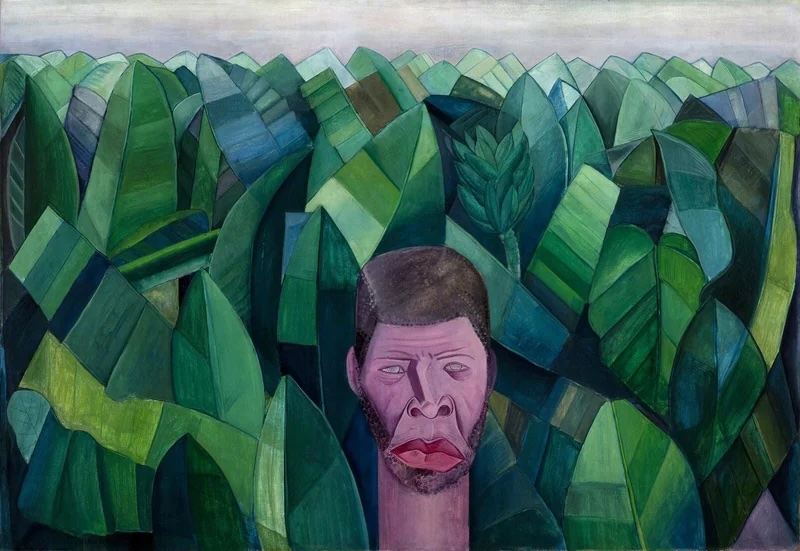
Lasar Segall (Brazil), Banana Grove, 1927.
Britain’s colonial policy of imperial preferences ensured that the colonies supplied raw materials while manufacturing remained in the imperial centre. Raw sugar crossed the Atlantic to be refined in Britain, where the largest mark-ups were retained. Tariffs protected British refiners while discouraging refining in the Caribbean and shielding British refiners and Caribbean plantations from competition from Indian sugar. Colonialism did not merely extract wealth from the colonies; it reorganised entire economies so that the productive capacities of the colonies would remain subordinated to those of the colonising power long after colonial rule formally ended. This is what Ghana’s first President Kwame Nkrumah called neo-colonialism.
Prabir, sitting in Rohini Central Jail, drew the circuit of capital not as a simple Atlantic triangle but as a planetary system of plunder linking India, Africa, the Americas, and Europe. European traders shipped Indian textiles to West Africa and exchanged them for enslaved people. Saltpetre from Bengal, essential for manufacturing gunpowder, helped arm that ghastly trade. After Britain’s conquest of Bengal in 1757, land revenue extracted from Indian peasants paid for these exports. The Atlantic triangle was therefore part of a much larger geometry of plunder that stretched across the planet. James Watt’s steam engine is stained with the blood of enslaved African plantation labourers and starving Indian peasants.
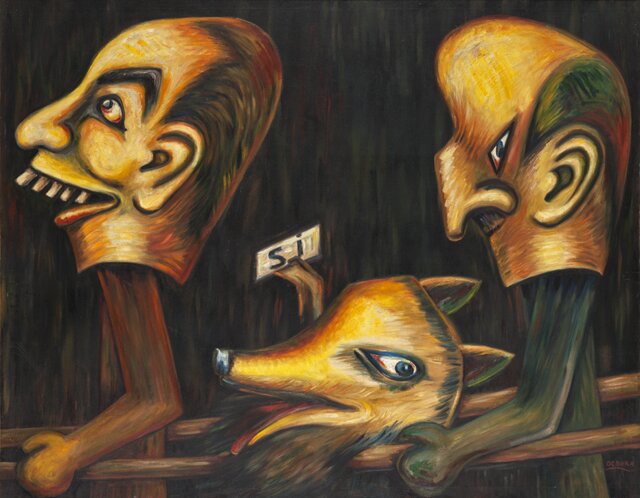
Débora Arango (Colombia), Plebiscito (Plebiscite), 1958.
We will never know whether some imaginary capitalism might have existed in a world without colonialism. History does not take place in imaginary worlds. Actually existing capitalism is inseparable from colonial expropriation. Capitalism did not first take shape in the English countryside alone and then spread peacefully across the globe. Its history must be located simultaneously in the English countryside, the Caribbean plantation, the Potosí silver mine, the African holding yard, the Indian revenue office, the hold of the ship that transported enslaved people, and the European refinery.
This history also prevents us from treating what Karl Marx called ‘originary accumulation’ (ursprüngliche Akkumulation) as a completed episode. Its methods remain with us: the seizure of land, the subordination of economies to monocrop production, debt regimes, unequal exchange, the undervaluation of Southern labour, and the transfer of wealth into financial systems controlled by the North. The forms have changed, but expropriation continues.
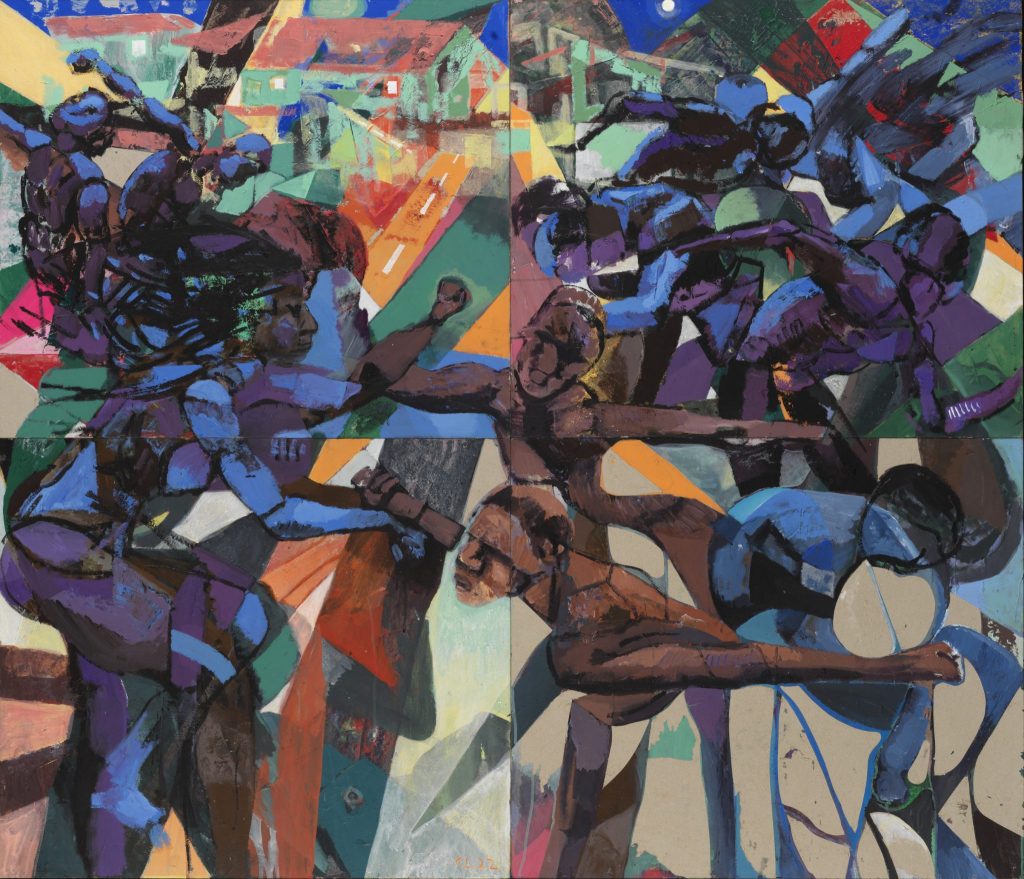
Che Lovelace (Trinidad), Street Dance, 2016–2022.
If these histories of exploitation are taken seriously, then the demand for colonial reparations cannot be dismissed as merely a moral appeal or a backward-looking demand. Reparations must be understood as a material and political necessity: not only a reckoning with past crimes but a confrontation with the ongoing structures of accumulation that were built through colonial expropriation and continue to reproduce global inequality in the present.
This is the argument of Kwesi Pratt Jr.’s recent book, Reparations: History, Struggle, Politics, and Law, which is forthcoming in a new South African edition from Inkani Books. The edition features a foreword by Ghana’s President John Dramani Mahama and an afterword by Professor Verene Shepherd. Reparations – whether through debt cancellation, the restitution of stolen resources, the transfer of technology, or the rebuilding of public capacities destroyed by colonialism and structural adjustment – are an essential antidote to the long history of plunder that established modern capitalism.
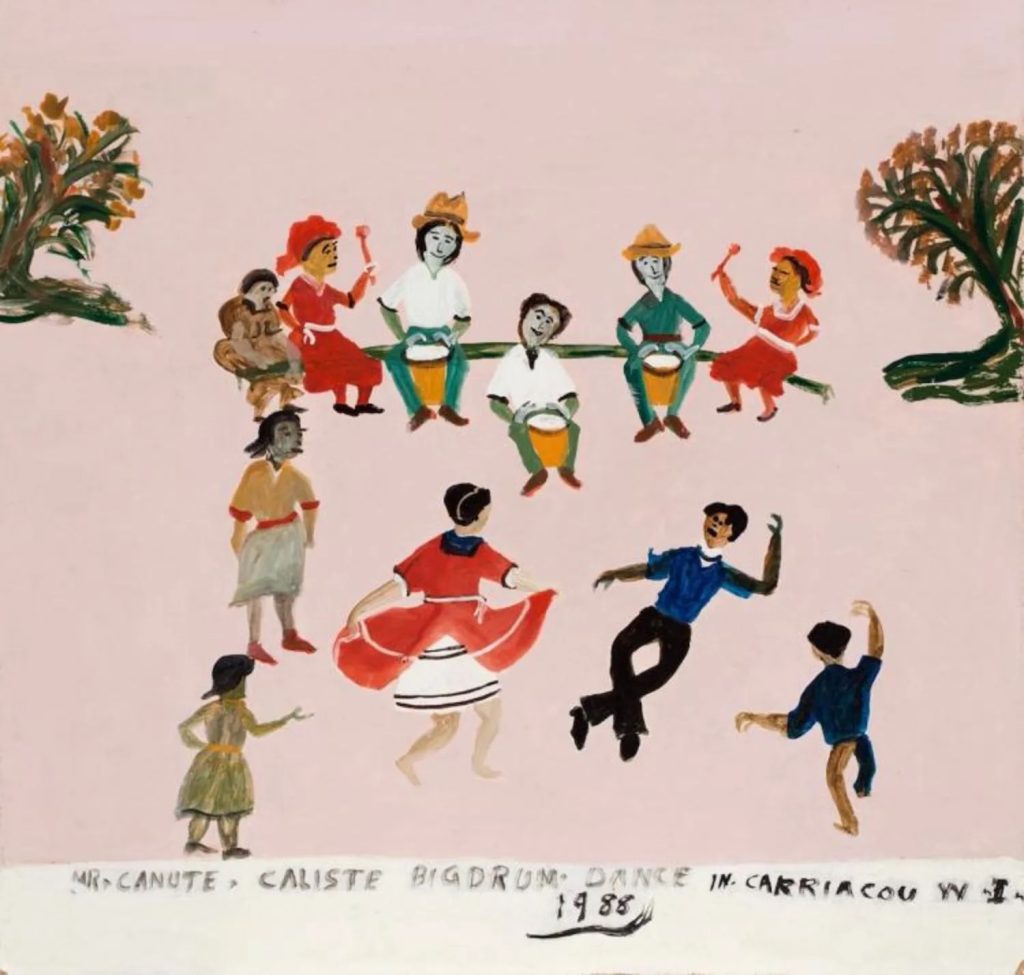
Canute Caliste (Grenada), Big Drum Dance in Carriacou, 1988.
This was never only a history of exploitation. The plantation system was always contested at every stage. Enslaved people fled, sabotaged production, preserved prohibited cultural practices, formed maroon communities, organised rebellions, and ultimately broke the apparent permanence of slavery. The Haitian Revolution, which culminated in independence in 1804, remains the greatest declaration of this truth: even the most sophisticated machinery of oppression can be defeated by the oppressed.
In 1935, the Haitian Marxist poet Jacques Roumain (1907–1944), angered by the constant attempt to suffocate his country, wrote ‘Guinea’. That poem, translated into English by Roumain’s friend Langston Hughes, is a powerful evocation of Haiti’s African origins and its ongoing struggle for dignity:
It’s the long road to Guinea
death takes you down.
Here are the boughs, the trees, the forest.
Listen to the sound of the wind in its long hair
of eternal night.It’s the long road to Guinea
where your fathers await you without impatience.
Along the way, they talk.
They wait.
This is the hour when the streams rattle
like beads of bone.It’s the long road to Guinea.
No bright welcome will be made for you
in the dark land of dark men:Under a smoky sky pierced by the cry of birds
around the eye of the river
the eyelashes of the trees open on decaying light.
There, there awaits you beside the water a quiet village,
and the hut of your fathers, and the hard ancestral stone
where your head will rest at last.
Warmly,
Vijay