To Imagine a New Development Theory from the Global South: The Twenty-Ninth Newsletter (2026)
The Global North’s prescriptions for development, including the IMF’s tired dogmas, have failed. It is time for a new development theory rooted in the experiences of the Global South.

Attributed to Jacopo de’ Barbari (Italy), Portrait of Fra Luca Pacioli with a Pupil, 1495–1500.
Dear friends,
Greetings from the desk of Tricontinental: Institute for Social Research.
In 2015, the United Nations Conference on Trade and Development (UNCTAD) published a paper by the influential economist Robert H. Wade titled ‘The Role of Industrial Policy in Developing Countries’. Wade argued that virtually all successful attempts at late industrialisation (such as in Japan and South Korea) used interventionist state policies to foster industrial development and technological upgrading. In 2024, almost a decade later, the United Nations Industrial Development Organisation (UNIDO) released its flagship report ‘Turning Challenges into Sustainable Solutions: The New Era of Industrial Policy’, which made the case that industrial policy is a key instrument for sustainable development. Between the publication of Wade’s article in 2015 and the UNIDO report in 2024, the global context had changed significantly. China’s Belt and Road Initiative (BRI), announced in 2013had become a major source of infrastructure and industrial investment: between 2013 and 2024, cumulative BRI engagement reached $1.175 trillion, and in 2024 alone, preliminary data showed about 340 BRI deals across 87 countries. Much of this engagement took the form of construction contracts, including in transport and energy infrastructure, both of which remain foundations of industrial development.
The International Monetary Fund (IMF) could not deny the importance of industrial policy but would not endorse Wade’s paper or UNIDO’s report. The IMF’s hesitancy appears in the titles of recent blog posts such as ‘Industrial Policy Can Lift Productivity – but Comes With Risks and Trade-Offs’ (2025) and ‘Industrial Policy Is Adapting to Crises, but Remains Hard to Implement Effectively’ (2026). From the IMF’s standpoint, the recipe for the future remains wedded to a failed past which insisted that privatisation and deregulation would provide the pathway to development. This is despite the fact that IMF research itself shows that states of the Global North, which control the organisation, make greater use of industrial policy than those of the Global South. Yet across central banks and multilateral institutions, a tired establishment of policy analysts – shaped by brain capture, the narrowing of thought through IMF orthodoxy – stifled the debate that the UNIDO flagship report should have provoked.
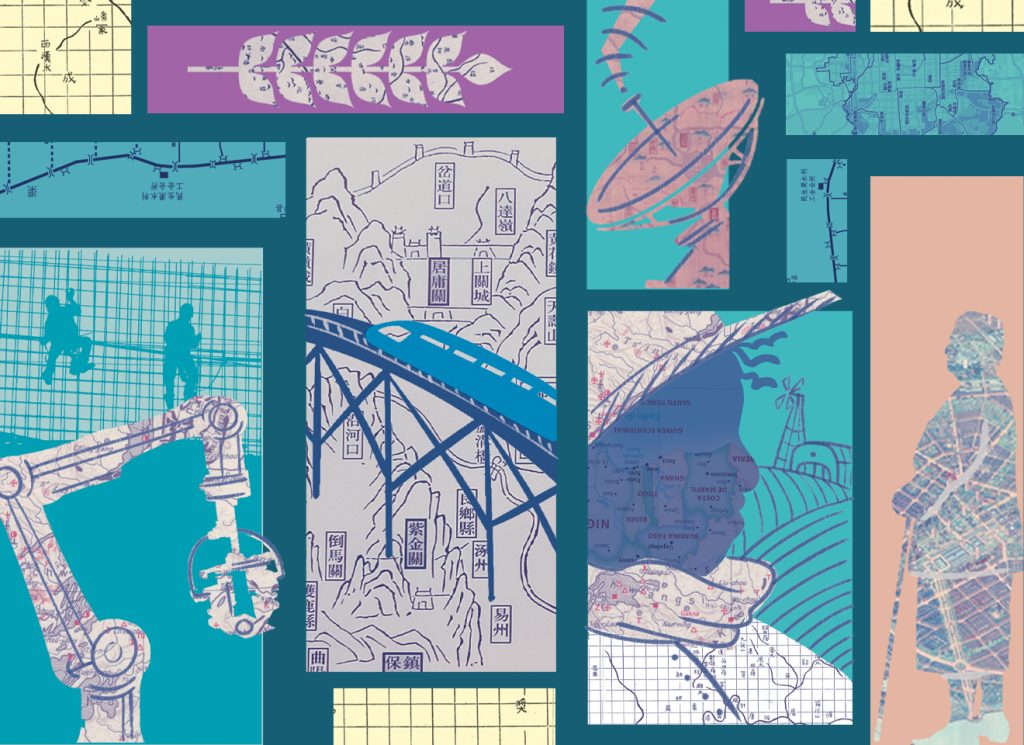
Art created by Tricontinental: Institute for Social Research, 2026.
Across much of the Global South, however, the old certainties of IMF dogmas have evaporated as the organisation’s austerity model has lost credibility. But what replaces it remains uncertain. Political parties have won elections by challenging this austerity-led model and promising alternatives. Yet some of these governments have failed to articulate a genuine alternative and have found themselves pulled back towards the IMF, as in Sri Lanka, which continued its IMF programme, and Senegal, which entered renewed talks after its arrangement was suspended.
This dilemma – the loss of credibility of the IMF model but the absence of an alternative – sits at the centre of the latest issue of Wenhua Zongheng. Titled ‘Building a New Development Theory from the Global South’, the issue asks a deceptively simple question: if the theories that governed development for the last century have failed, where will new theories come from? The title’s preposition matters: from, not for. This is not a theory made elsewhere and imposed on the Global South but one that emerges from the experiments of its peoples.
Development theories do more than explain the world. They shape political expectations by establishing what governments and social institutions believe is possible. They emerge from our imagination of the future and, in turn, influence how societies pursue that future. In the issue’s opening essay, Tsinghua University’s Qin Beichen and Jing Jun argue that theories help establish the horizon of political action. When a society loses the ability to imagine its road forward, it becomes trapped within inherited structures, even when those structures no longer function. That is the deeper crisis of our era. Across much of the world, there is a widespread inability to envision the future. Political discourse oscillates between nostalgia for a vanished past and fear of impending catastrophe. The future, as we showed in dossier no. 100, appears either as a continuation of present inequalities or as a succession of crises. What is missing is a compelling developmental imagination that puts human need ahead of austerity.
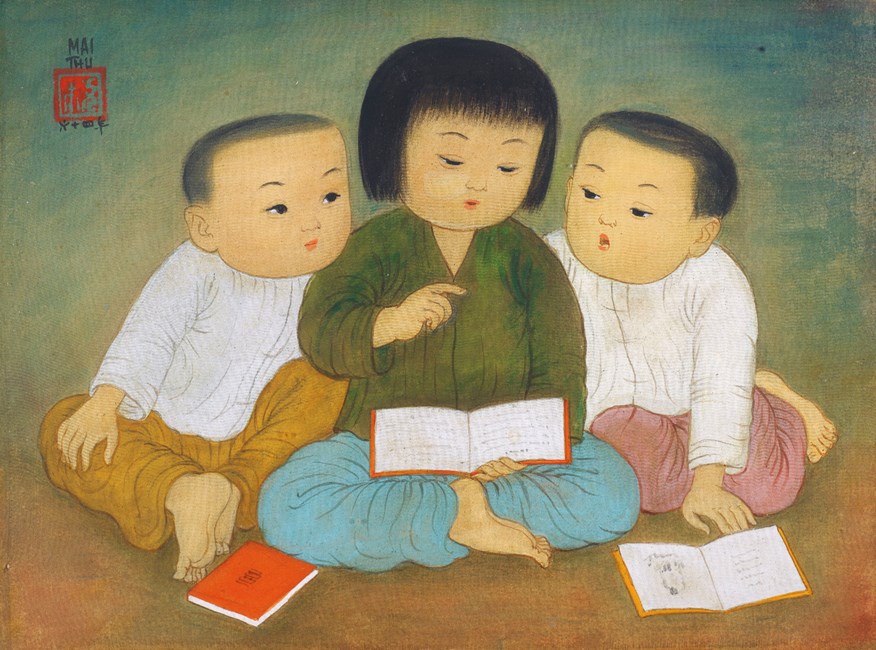
Mai Trung Thứ (Vietnam), Đọc sách (Reading), 1964.
To recover our imagination of theories and models of development requires a return to some fundamental questions, such as:
- How do societies build productive capacity?
- How do they create meaningful employment?
- How do states acquire the ability to improve the lives of their populations?
- How can countries escape positions assigned to them in an unequal international division of labour?
The answers to these questions do not lie in abstract models of development but in the theories that emerge from concrete attempts to build a better future.
The essays by Li Xiang and Feng Chao, both professors at Shanghai International Studies University, are illuminating in the way they detail the advances made in Pakistan and Vietnam, respectively. Both authors insist that these advances show the centrality of South-South cooperation. Li Xiang examines Pakistan’s energy system and argues that development must be understood not simply as economic growth but as the expansion of state capacity. Large-scale infrastructure projects, electricity grids, and new technologies such as distributed solar power are presented not merely as technical achievements but as mechanisms through which societies build the institutional capacity necessary for a new type of modernisation. The question is not only how to generate electricity but how infrastructure reshapes social relations and strengthens the ability of states to deliver public goods.
Feng Chao, meanwhile, explores Silk Road Manufacturing – a new model for industrial collaboration under the BRI – through the experience of Chinese industrial investment in Vietnam. Rather than treating globalisation as an inevitable process governed by market forces, Feng Chao views industrial integration as something that can be consciously organised to expand productive capabilities across multiple countries. The emphasis is placed on technology transfer, industrial upgrading, workforce development, and the construction of regional production networks that strengthen, rather than weaken, the developmental prospects of participating countries.
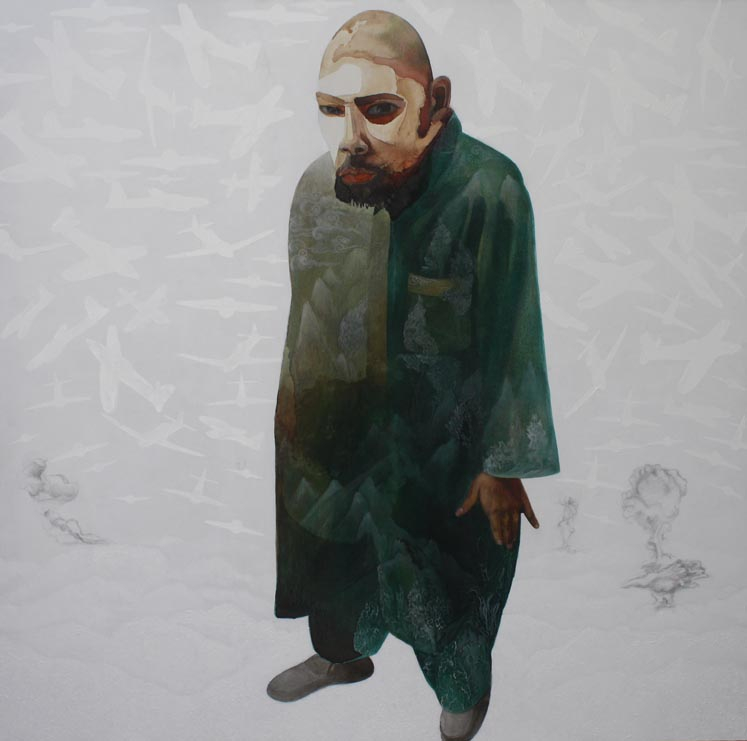
Sana Arjumand (Pakistan), Then Their Shadows Fell from the Sky – 2, 2010.
For decades, development was largely conceived as a relationship between the industrialised North and the underdeveloped South. The aspiration was to follow pathways already established elsewhere. Yet the experiences explored by these authors suggest that the most important innovations may now emerge through exchanges among countries of the Global South themselves. China’s processes of industrialisation, infrastructure development, poverty reduction, and state building are not presented as universal templates. Rather, they are treated as resources for collective learning and experimentation. What these scholars ultimately propose is neither a rejection of global knowledge nor a celebration of any single national model. Instead, they call for the construction of a genuinely Southern intellectual project.
Such a project would begin by abandoning the assumption that development theory must always arrive from elsewhere. It would place production before speculation, employment before abstract efficiency, and public capacity before market dogma. It would study historical experiences across Asia, Africa, Latin America, and the Caribbean not as deviations from a universal norm but as sources of theoretical innovation. In a period marked by geopolitical fragmentation, ecological crisis, and economic uncertainty, this may be the most important contribution of the issue. The challenge facing the Global South is not only to build new infrastructure, new industries, and new institutions but also to build new ways of thinking. Before societies can construct a different future, they must first recover the capacity to imagine one.

Abel Beyene (Ethiopia), Behind the Cover, 2025.
As I reread these essays, I thought of ‘Riding Chinese Machines’ by the young Ethiopian poet Liyou Mesfin Libsekal. Despite its title, there is no reference to China in the poem. It is African politicians who design the city that Libsekal describes, and it is African workers who build it. The poem does not condemn modernisation from a romantic standpoint; it acknowledges that changes such as this do not come without a price.
There are beasts in this city
they creak and they crank
and groan from first dawn
when their African-tongued masters wake
to guide them lax and human-handed
through the late rush
when they’re handled down and un-animated
still as we sleep, towering or bowing
always heavywe pour cement through the cities
towns, through the wild
onwards, outwards
like fingers of eager hands
stretched across the earth
dug inthe lions investigate
and buried marvel rumbles
squeezed for progress.
The new beasts – the Chinese machines – press into the world of the old beasts, the African lions, but the poem keeps both within sight. The new development paradigm should not repeat the old model, which consumed nature and humans for profit. It must instead try to incorporate the good aspects of the old and manage with care the relationship between nature and humans for the sake of society. That is the ethos promoted by Qin and Jing in their essay, and it is the starting point for any development theory worthy of the Global South.
Warmly,
Vijay