Socialist Strategy within the Architecture of Power
Movements can build organised strength without governing, and governments can hold office without transforming the system, leaving open a central question for socialist strategy: how can these forms of power be connected for emancipation?
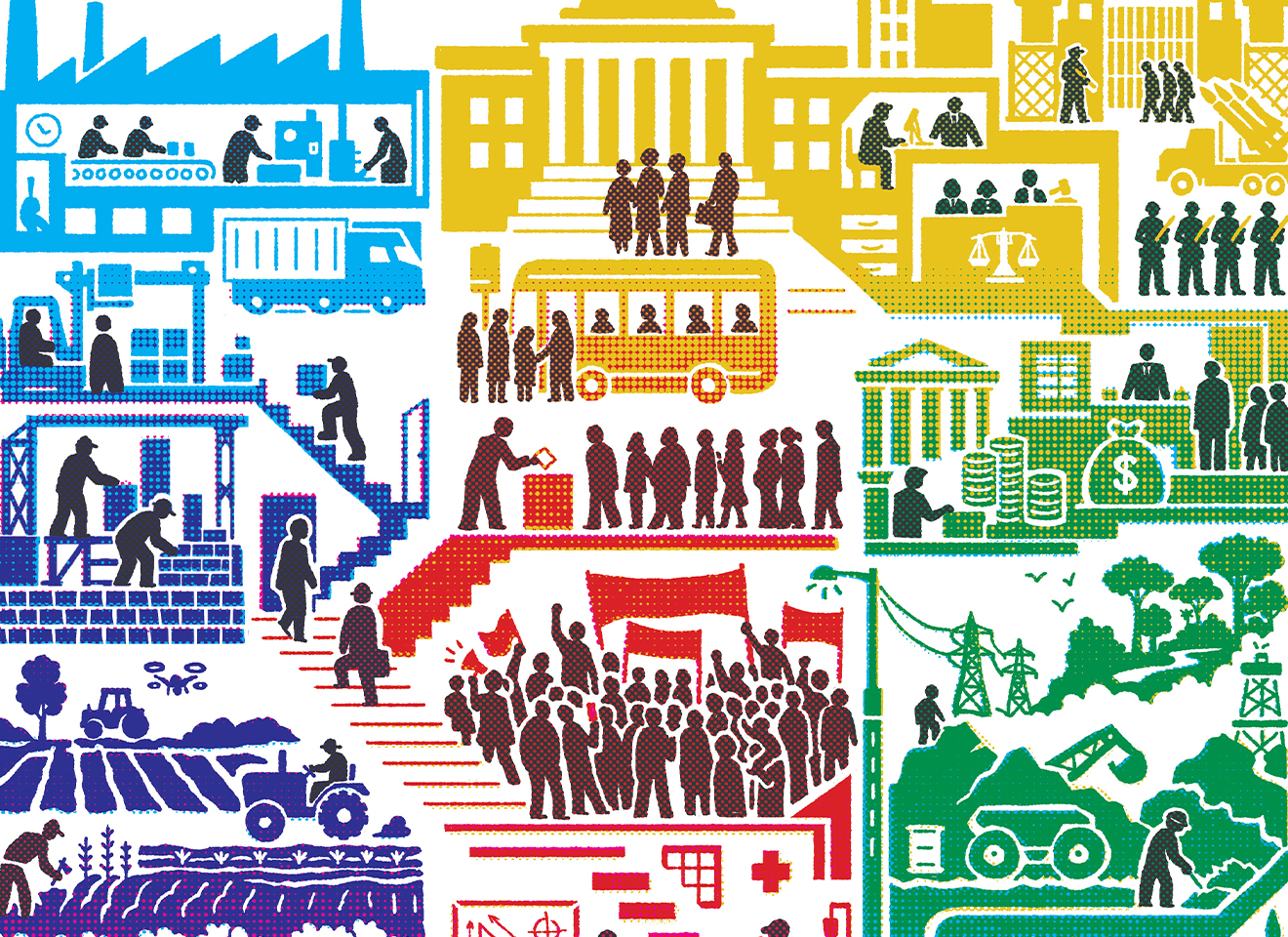

When a radical government takes office with a mandate for transformation, the next morning it will have to confront banks that remain in private hands, mines under corporate control, private mainstream media, and public administration governed by inherited procedures. Capital can postpone investment, transfer money abroad, close factories, hoard essential goods, dismiss workers, and speculate against the currency. The havoc wrought on the economy and population can then be presented as proof that transformation is impossible, all while the government is held responsible for a crisis produced or intensified by forces beyond its control.
This reality reveals a central problem for socialist strategy. Taking governmental office can be an important step toward systemic transformation, but misunderstanding these two forms of power as one and the same can have dangerous consequences. A clear analysis of where power resides and how its different forms interact is necessary to avoid patterns that have plagued revolutionary processes across the world.
An electoral victory may be mistaken for a revolutionary event when a left-wing party has taken office even though the wider state apparatus, the economy, and the institutions that shape common sense remain largely beyond its control. Conversely, a socialist movement may possess considerable social strength without being able to translate that strength into governmental authority or changes to the structures of the state and economy. The ruling class exercises power through its control over production and the structures that reinforce it, while the working class exercises collective power through strikes, demonstrations, and the organisations it builds through struggle. To use a single word – power – for all these different capacities can confuse political strategy. In this dossier, we therefore distinguish three related forms of power as an analytical framework for debate and discussion:
- Social power is the organised capacity of a class or political bloc to act collectively, reproduce material life, and contest the ruling class’s command over society. It is built through institutions of struggle and cooperation such as trade unions, peasant and women’s organisations, cooperatives, community structures, cultural and media projects, political education, and political parties. Through these institutions, a class or political bloc can struggle to reshape common sense and establish moral and intellectual leadership.
- Governmental power is the capacity to assume governmental authority, whether through elections, insurrection, or another political rupture, and to use executive, legislative, and administrative institutions to pursue a programme. It provides access to important instruments of administration and policy but does not, by itself, amount to control of the state or the wider system.
- Systemic power is the capacity to transform the class character and institutional form of the state, bring the major means of production and the social surplus under democratic authority, and reorganise the relations through which society reproduces itself. It includes state power but cannot be reduced to it because capitalist social relations are reproduced beyond the formal institutions of the state – through property, finance, the world market, colonial relations, culture, and social reproduction – and many of these relations exceed the reach of any single government or national state.
These forms are analytical distinctions, not sealed compartments, and do not constitute a fixed sequence. They overlap, develop unevenly, and can pull in opposite directions. Governmental power may become a bridge between organised social power and systemic transformation. It may also weaken popular organisation and reconcile it to the existing system. The central strategic question is therefore not which form of power matters but how the three can be connected in a process of emancipation.
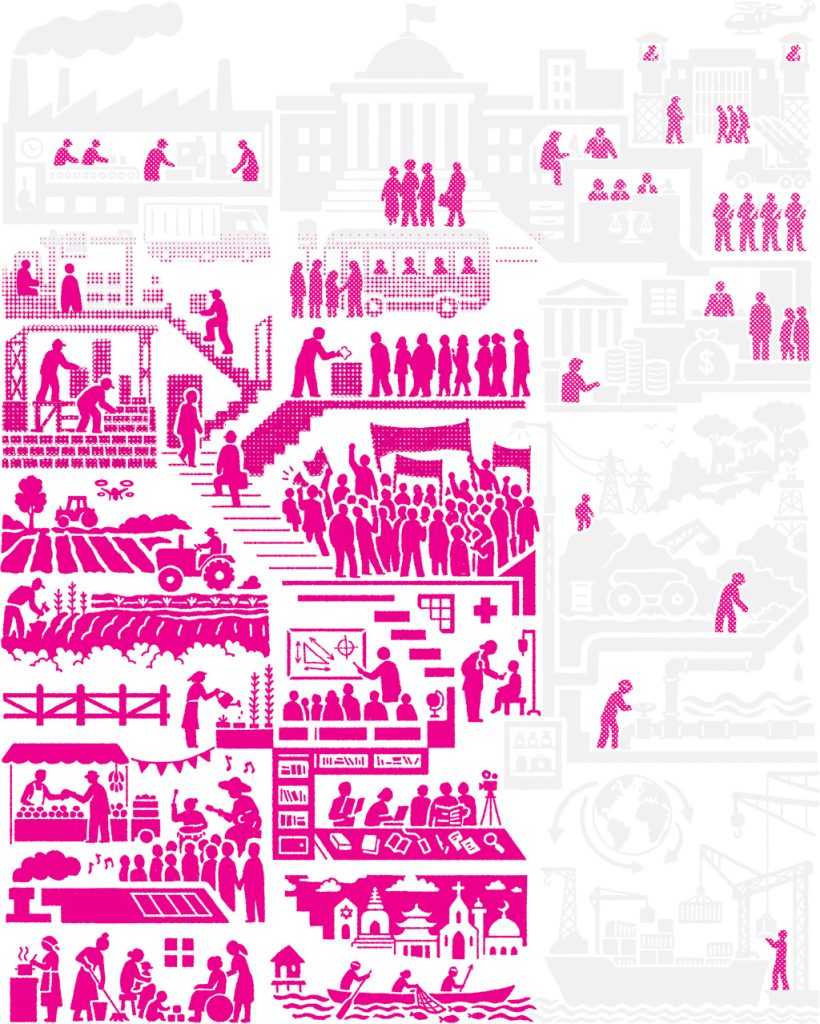
Social Power
Society is not merely a collection of individuals. We are formed through historically specific social relations and institutions: households and communities, workplaces and other sites of production, schools and religious institutions, cultural and media organisations, digital platforms, and the institutions of the state. These spheres overlap. Schools and media, for example, may be organised by the state, capital, or other social forces, while workplaces are both sites of production and everyday social life. Through these relations and institutions, people develop understandings of what is natural and possible, legitimate and illegitimate, and what can or must be resisted.
People experience this world in different ways and relate to one another through unequal relations of property and production: as owners of capital, wage workers, peasants, tenants, creditors, debtors, and as people whose unpaid labour sustains households and communities. These class relations intersect with inherited hierarchies of gender, race, caste, nationality, and other forms of oppression. Social power is the organised capacity to intervene in this field and contest its direction.
Antonio Gramsci sought to capture part of this process through the concept of hegemony, drawing in part on Vladimir Lenin’s work and earlier Marxist debates.1 For Gramsci, hegemony is not simply ideological manipulation. It is the capacity of a class or political bloc to establish leadership in society through consent, backed by the coercive power of the state, while incorporating some demands of subordinate classes into a broader settlement. A ruling class does not present its interests as merely its own but as the interests of society as a whole. For Gramsci, the state in this broader sense encompasses both political society, where coercive authority is concentrated, and civil society, where consent is organised. He described this relationship as ‘hegemony protected by the armour of coercion’.2
No ruling order can be maintained indefinitely by force alone. It must persuade substantial sections of the population that the existing order is legitimate, unavoidable, or preferable to any alternative. Capitalist power is therefore exercised through ownership of the means of production as well as through the organisation of social life. The capitalist class controls investment and employment, owns much of the media, and embeds its assumptions into law, education, policy institutions, advertising, and popular culture. Language helps define reality to suit the architecture of power: competition becomes ‘the survival of the fittest’, inequality is seen as the result of individual (in)ability, poverty as personal failure, austerity as financial responsibility, privatisation as efficiency, and attacks on workers’ rights as labour market reform.
Consent is not produced by explicit persuasion alone. Ludovico Silva used the concept of ‘ideological surplus-value’ to describe how mass communications, advertising, and entertainment can reproduce attachment to the existing order at the level of consciousness. Theodor Adorno described a related process as the ‘hidden message’: assumptions embedded beneath the overt content of a television drama, an advertisement, or a news report can escape conscious scrutiny and help shape what appears normal, possible, or desirable. This helps explain how austerity can appear as a responsibility rather than as a political choice. Collective practices of organisations, struggle, and study can make these assumptions visible, allowing them to be questioned and overcome.3
Social power is not only ideological, cultural, or symbolic: its material and organisational foundations are also decisive. A union fund that sustains a strike, a cooperative that organises production, a peasants’ association that defends land, a community kitchen that meets social needs, and a women’s organisation that provides protection and political education all create practical capacities. They allow people to survive, deliberate, coordinate action, exercise forms of collective authority, as well as build trust and a foundation to meet their most basic needs. Cooperatives, for example, can also be schools of self-management and centres of social power, even though they remain conditioned by markets, credit, property law, and the wider balance of class forces.4 They contribute to systemic transformation only when connected to a broader project capable of changing those conditions. These institutions, as we have previously argued, can embody the ‘Not-Yet’ of socialism – the material anticipations of different social relations in which working people develop collective capacities that point beyond capitalist organisation.5
The struggle for social power must challenge both the material power of the ruling class and its ability to present its interests as society’s common sense. It cannot do so through propaganda alone. Socialist movements build hegemony through struggle, organisation, political education, and the creation of institutions in which people acquire the capacity to analyse and act. Praxis – the unity of theory and transformative practice – requires ideas to be developed, tested, and refined through action. The mass line is one political method for putting this relationship into practice. It begins by learning from the experiences and ideas of the people, bringing them together through study and political analysis, and returning them as a clearer programme for collective action. That programme is then tested in practice, its lessons gathered, and the process repeated. The mass line is therefore not the imposition of ideas from above or a celebration of spontaneity but a continuous movement between popular experience, political analysis, and collective action.
Trade unions not only negotiate for higher wages and better working conditions but can also transform how these conditions are understood. Through collective struggle, low wages can come to be seen not as individual misfortune but as part of a broader system of exploitation that can be changed through organised mass action. Likewise, struggles over housing and education can turn private anxieties into political questions. Organising against gender-based violence offers another example: it can reveal that violence in the family and household is not merely private but is sustained by social hierarchies such as patriarchy that intersect with class relations.6 Such immediate struggles and demands can become the raw material from which a wider political consciousness develops.
Social power grows when dispersed struggles are brought into a common political project. This requires organisations that are able to resonate with the immediate experience of the working class and peasantry and connect it to an analysis of the whole. These organisations accumulate the history of struggle, the moments of anger that can hold extraordinary potential for transformation but can also be fleeting. Millions occupy the streets of Cairo and Nairobi, Jakarta and Delhi, Buenos Aires and Quito but leave behind little durable capacity. The ruling classes in these countries have developed their own methods over more than a century: absorb sections of the leadership into the ruling class and offer minor concessions to the struggle, divide the movements by emphasising their differences, exhaust them by waiting them out, and repress them in order to restore order when all else seems to fail.
For mobilisation to become durable social power, it must create or strengthen institutions: trade unions, peasants’ organisations, women’s organisations, cooperatives, cultural movements, community centres, political education schools, media projects, and political parties. Without such institutions, even immense mass anger may leave little capacity to act after the immediate confrontation. The task of organisation is not to lecture movements from outside or merely celebrate their spontaneity. It is to work within them, learn from their experience, help identify the forces that produce their conditions, and connect immediate demands to the structure of capitalist society. Political education develops through this process but is not confined to it. Parties and movements also create deliberate spaces for study and formation – schools, courses, study groups, and other forms of collective learning – where people can interpret their experience, deepen their theoretical understanding, develop organisational capacities, and build a shared political orientation. Political education is therefore both rooted in struggle and consciously organised.7
Popular organisations, however, are not immune from the relations they seek to overcome. A hierarchy can develop within the working class itself when organisers, officials, or experts form a bureaucratic layer separated from the rank and file. Durable institutions must therefore preserve democratic participation, criticism, rotation, and accountability rather than treating organisation itself as a guarantee against bureaucratisation or the reproduction of hierarchy. Their democratic vitality is not guaranteed: it depends on sustained contact with the masses and regular political education among cadres.8
Across much of the world, decades of austerity have eroded public provision and living standards in working-class communities. Mass mobilisations have emerged against policies and conditions that have made everyday survival more precarious. The Arab uprisings, Occupy Nigeria, Chile’s Estallido Social (Social Uprising), and Sri Lanka’s Aragalaya (Struggle) each brought millions into motion against conditions that had become intolerable.9 Their different trajectories warn against treating mobilisation as consolidated social power. Where durable organisation, a common programme, and independent institutions remain weak, the energy of mass mobilisation can be channelled into a change of government without producing a corresponding shift in the underlying balance of class forces. Social power becomes durable when the popular classes possess institutions through which they can formulate demands, coordinate action, train their own intellectuals, reproduce collective life, and impose limits upon the ruling class. It can exist before a socialist party enters government. Indeed, without it, an electoral victory may leave the underlying balance of forces largely unchanged.
Social power can help defend public institutions, resist coups, block privatisation, and reshape the political and moral vocabulary of society. Yet social power alone remains limited so long as decisive power over investment, production, and land remains concentrated in capital while the institutions of law and coercion continue to reproduce the existing class order. It can contest the ruling class’s leadership of society but does not by itself transform capitalist property relations or the class character of the state.
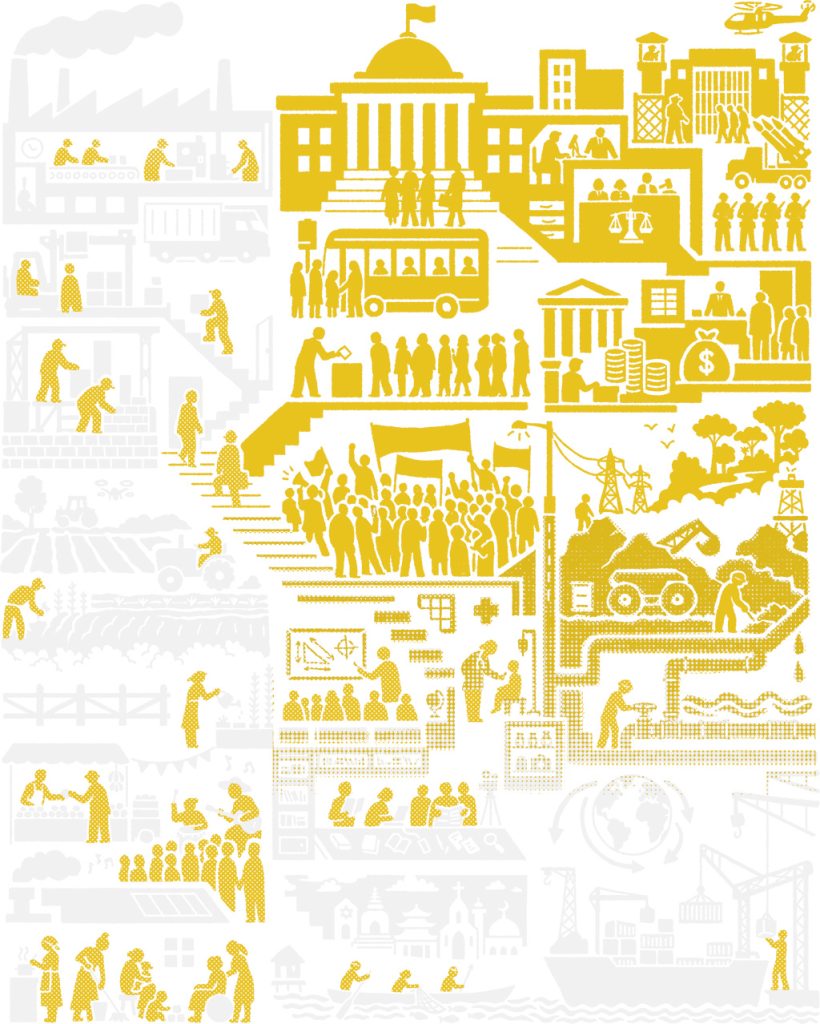
Governmental Power
Since the nineteenth century, modern workers’ parties and national liberation movements have sought governmental authority through elections, insurrection, and anti-colonial war. Experiences as different as the revolutions in Russia, China, and Cuba, the election of a communist government in Kerala, India, in 1957, the victory of Kwame Nkrumah in Ghana’s first presidential election in 1960, the Popular Unity government in Chile in 1970, and the victory of Hugo Chávez in Venezuela in 1998 show that acquiring governmental authority is an important but partial moment in a wider struggle over power.
Despite the immense challenges faced by left governments at both national and subnational levels, the importance of governmental power should not be underestimated. Governments collect and allocate part of the social surplus, set budgets, appoint officials, administer public services, regulate the economy, and make decisions that affect the whole population. Left governments have raised wages, reduced working time, expanded education and healthcare, redistributed land, protected tenants, recognised the rights of oppressed communities, and enlarged the space in which working-class organisations can act. A school meal, protection from eviction, or a higher minimum wage can transform everyday life. Reforms won through struggle are material achievements whose defence can strengthen the popular classes’ confidence in and understanding of their collective power.10
Government, however, must be distinguished from the state and from the system as a whole. Mao Zedong’s ‘On New Democracy’ distinguishes between the class character of the state system and the form of government through which political power is organised.11 A change of government can alter policy and the composition of executive or legislative institutions without changing the class character of the state. In a revolutionary transition, however, class power and institutional form cannot be separated: new class power requires institutions through which it can be organised and exercised.
Governmental authority also coexists with other centres of political power: courts, permanent bureaucracy, the police and armed forces, central banks, foreign ministries and the diplomatic corps, subnational administrations, and institutions that shape public opinion. Executive and legislative offices may be open to electoral contest, but control of them does not amount to command over this entire field. Judges, generals, senior officials, diplomats, and central bankers may regard themselves as guardians of an enduring order and can obstruct legislation, constrain economic policy, or resist a government that threatens established interests. Specialised workforces such as these cannot be replaced overnight, leaving left governments vulnerable to economic and technocratic sabotage, as shown by the 2002–2003 oil strike and lockout in Venezuela, during which opposition forces and managers and technicians at the state-owned oil company Petróleos de Venezuela, S.A. (PDVSA) virtually shut down oil production for two months. A left government may therefore possess considerable governmental authority while still confronting economic and institutional powers it does not control. Governmental power is thus a terrain of struggle rather than the conclusion of struggle.12
Operating through inherited institutions creates another danger. To function, left officials must learn administrative procedures and acquire technical competence. Over time they may also internalise the state’s assumptions about what is reasonable and possible and come to treat reassuring creditors, satisfying markets, postponing reforms, and translating popular demands into administratively manageable forms as unavoidable requirements of governing. This is not simply a story of weak individuals abandoning their convictions. Human beings and organisations are shaped by their institutional environments. Prolonged participation in governmental office can turn temporary compromise into routine, routine into justification, and justification into a transformed political outlook.13
A left government faces three connected temptations: adaptation, substitution, and sponsorship.
- Adaptation: A government adapts when it gradually accepts the limits imposed by the existing system and becomes an administrator of the order it promised to change. Adaptation subordinates the programme to the existing balance of forces.
- Substitution: A government begins to act as a substitute for popular organisation when it assumes that because it acts in the name of the people, its administrative action can replace the organised activity of the people. Movements are asked to wait, remain disciplined, or defend the government without criticism while independent mass initiative comes to be treated as a threat.
- Sponsorship: A government engages in sponsorship when it creates organisations presented as popular, defines their scope of action, finances them, and celebrates them as expressions of popular organisation. Public support for autonomous organisation is not itself the problem. The danger arises when state-created or state-validated structures displace organisations that have emerged through struggle, become dependent on official guidance, or collapse when government support ends.
The experience of Chile under the Popular Unity government (1970–1973) is a stark example of these contradictions. Electoral victory enabled the government to pursue an ambitious programme of nationalisation and redistribution while workers and communities developed forms of organisation and coordination of their own. At the same time, the military, judiciary, and bureaucracy remained largely intact while private media and domestic and foreign capital retained significant power. These internal constraints were reinforced by US imperial intervention. The Nixon administration sought from the outset to prevent then President Salvador Allende from consolidating power while the CIA covertly funded opposition parties, media, and private-sector organisations and worked to weaken the Popular Unity government. Governmental authority, organised popular power, the inherited state apparatus, domestic capitalist power, and the international power exercised through the US state interacted and came into conflict within a single process. The coup of 1973 cannot be explained solely by insufficient government action or insufficient popular mobilisation. The Chilean experience shows that the struggle over governmental, social, and systemic power unfolds simultaneously at the national and international levels and underscores why the relationship between these forms of power must be treated strategically.14
Kerala illustrates a different but related set of constraints. In 1957, shortly after Kerala was constituted as a state within India, the Communist Party of India won the largest number of seats in the state assembly and E. M. S. Namboodiripad (popularly known as EMS) led his party into government. EMS sought to use the powers available to a state government to advance agrarian reform, regulate the education system, strengthen labour protections, and expand public provisioning of food grains. These reforms drew on a communist movement with deep roots among tenant farmers, agricultural labourers, and other organised sections of the popular classes, but governmental authority in Kerala remained bounded by India’s federal system and by powers exercised at the national level. In 1959, following a sustained opposition campaign, the Congress Party-led Union government dismissed the communist ministry under Article 356 of the Constitution. The Kerala experience therefore shows both what organised social power can make possible when translated into governmental authority and the limits of governmental power when the wider state and economic order remain beyond its control.
The issue is not whether governmental participation is inherently revolutionary or reformist. It is how participation in government changes the balance of forces: whether it strengthens the independent capacity of the popular classes, absorbs the movement into inherited state institutions, or produces both tendencies in tension.
From this perspective, governmental power is most productive when it strengthens social power while opening a path towards systemic transformation. A left government can enlarge the organisational space of workers and peasants, expand access to information, transfer resources to popular institutions, subject economic decisions to public debate, and make visible the ways capital obstructs reform. In so doing, the left government not only pursues reforms through governmental office but can use that office to help build a broader political bloc of the popular classes capable of challenging the entrenched system of capitalist power.
The relationship between movements and officials should remain dialectical. Movements must not become appendages of government, nor should they act as if governmental decisions are irrelevant. Governments need popular pressure to break through bureaucratic habits and elite resistance, and movements need policy and public resources to improve people’s lives at scale and expand their capacity to struggle. Conflicts can arise when workers and communities oppose a left government’s decisions, but a revolutionary political culture must be able to navigate such conflicts without treating criticism as betrayal.
Governmental power is valuable but unstable. It is shaped by the power accumulated in society while operating within the deeper structures of the state and economy. If organised social forces are weak or largely absent, it can be neutralised and become an instrument of demobilisation if maintaining office becomes more important than maintaining an independent political project. The assessment of whether, or in what form, it is beneficial to occupy governmental power in a given context must therefore consider both the advances in organisation, material life, and class confidence made possible through government as well as the extent to which prolonged participation in government could lead movements and officials to internalise the logic of the capitalist state. No formula settles this question in advance, but the question itself cannot be avoided.
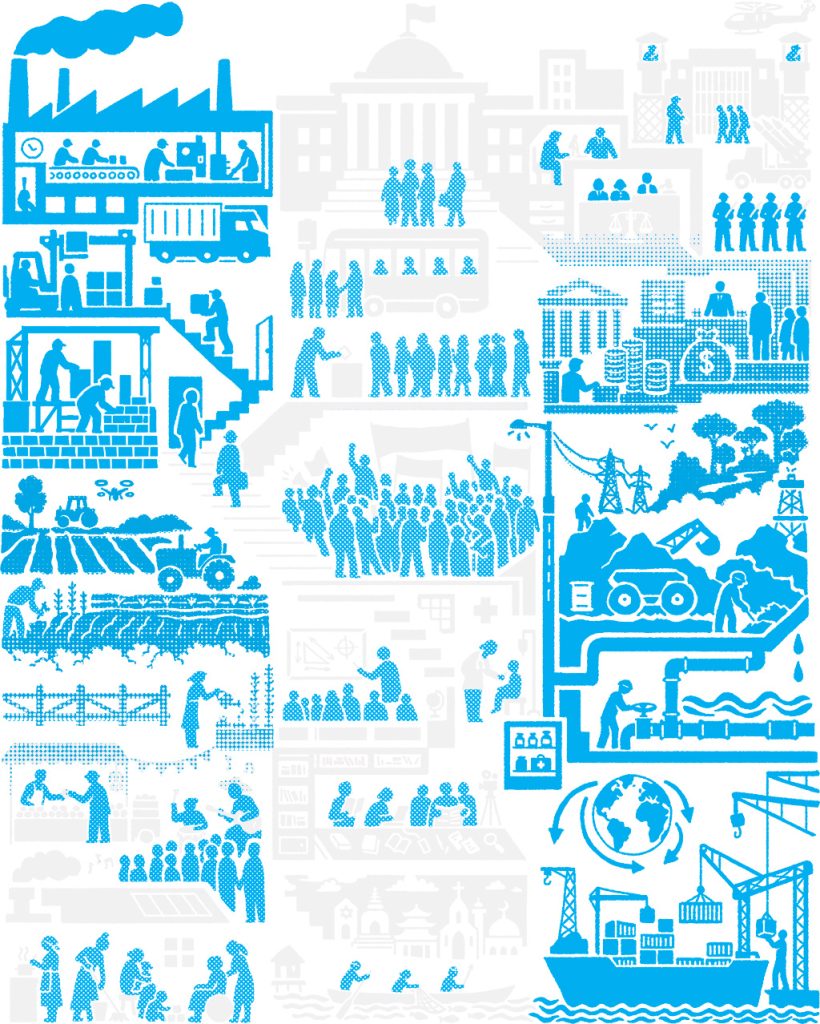
Systemic Power
The state is often described as a neutral instrument that implements the programme of whoever wins an election. This is incorrect. The modern capitalist state did not emerge on empty ground. Its laws, property forms, administrative routines, coercive institutions, and ideas of order developed alongside capitalism. It can restrain individual capitalists, regulate markets, tax wealth, construct welfare systems, and nationalise industries, often as the result of popular struggle. But restraining a section of capital is not the same as overcoming capitalist power. The state may discipline particular capitalists or fractions of capital in order to preserve the conditions for accumulation and the capitalist system as a whole.15
In the Global South, the relations that systemic transformation must confront are also shaped by colonial conquest and its aftermath. Colonial administrations reorganised land, labour, taxation, borders, legal status, and coercion to serve extraction and imperial rule. Formal independence established national sovereignty, but it did not automatically transform economies structured around the export of raw materials, unequal land ownership, racial and ethnic hierarchies, external finance, or administrative institutions separated from the people. Systemic transformation in these conditions therefore must confront both domestic class relations and the international and neocolonial relations through which they are reproduced. Its class, national, anti-colonial, and anti-imperialist dimensions cannot be separated or treated as additions to a model derived from the capitalist centres.
We have seen this dynamic play out throughout history. When anti-colonial forces won state power, many sought to break the forms of external domination that Nkrumah called ‘neocolonialism’ and establish substantive national sovereignty. Their trajectories, however, diverged.16 Revolutionary processes that developed explicitly socialist projects, such as those in China and Vietnam, went further by transforming property relations and state institutions in an effort to consolidate new relations of class power. However, many other anti-colonial state projects were later weakened, overturned, or redirected through coups, debt crises, and IMF- and World Bank-backed structural adjustment programmes.
For much of the Global South, the struggle for power has initially appeared as a confrontation between a nation and the external forces that dominate it rather than as an immediately visible class struggle. Processes in countries such as Venezuela and across the Sahel, for example, began by attempting to reconstruct national sovereignty.17 Under the pressure of debt, sanctions, foreign investment protections, unequal trade, and monetary dependence, sovereignty is undoubtedly a necessary terrain of struggle and a precondition for transformative programmes.
Yet imperial power is mediated not only through external forces but also through domestic class forces that benefit from dependency, including sections of commercial and financial capital and landowning classes whose accumulation is tied to foreign capital. Struggles that call for national unity against external attack without confronting the domestic class forces through which imperial power is reproduced postpone the question of who controls production, land, and national resources, recovering sovereignty without transforming the relations of production and merely replacing a foreign-aligned elite with a national one. Sovereignty is therefore necessary for socialist transformation, but it cannot substitute for it. Anti-imperialist struggle and class struggle must therefore be understood as interwoven dimensions of the same process.
Financial institutions and mechanisms are central to the contemporary architecture of neocolonial power: debt negotiations can become mechanisms for imposing austerity and privatisation while banks, bond markets, and institutional investors shape whether states can obtain credit and on what terms. Trade and investment agreements can further restrict the policy space available to governments. The World Trade Organisation’s Agreement on Trade-Related Aspects of Intellectual Property Rights (TRIPS) establishes international standards for intellectual property protection that can reinforce monopoly rights over medicines, technologies, and even plant varieties. Meanwhile, the dominant international role of the US dollar gives the United States particular leverage through a financial system in which reserves, trade, debt, and cross-border payments remain heavily dollar-denominated.18 Credit-rating agencies can further influence the cost and availability of borrowing. Multinational corporations exercise enormous power through their control over global supply chains, technologies, patents, and investment.19
Systemic transformation must also confront the inherited colonial legacy of economies that are often reliant upon rents derived from a single export commodity. Under a radical government, oil, minerals, and other exports can provide resources for redistribution and public investment, but dependence on such revenues leaves the process exposed to price collapses, sanctions, foreign control of trade and technology, and the persistence of an extractive productive structure. The revenue may widen the room for action without by itself transforming the productive base needed to sustain sovereignty.
Within this architecture of power, economic inequality is preserved while workers are granted certain political rights as formally equal citizens before the law. Within production, capitalists continue to own or control capital and exercise authority over investment, technology, employment, and the labour process while workers depend on the sale of their labour power for survival. Formal political equality is meaningful, but within this framework it rests on a social foundation of economic inequality.
Systemic power seeks to transform this wider architecture, which is embedded in the relations through which material life is organised: private property, wage labour, finance, land, social reproduction, the division of labour, and the market. This architecture binds together the workplace and the ministry, the creditor and the central bank, the corporation and the trade agreement, the inherited state and the world market. Although historically produced, these relations come to appear as natural and immutable laws governing social life rather than as social relations that human beings have created and can transform.
One path through this contradiction is to introduce new socialist relations within institutions and productive structures still embedded in the old order – what Chávez called the ‘strategy of graft’ (estrategia del injerto). A graft, he explained, is a new unit of social property established as a ‘centre of gravity’ within an economy still dominated by capital. It is not meant to remain an enclave and must extend its influence ‘in all directions’: along supply chains, into distribution, and into the schools, housing, and community life around it. Left alone, he warned, the ‘sea of capitalism’ would swallow the graft, either crushing it outright or absorbing it back into capitalist relations even while it remained formally socially owned.20 In this experiment, governmental power was used to help build social power, with both directed towards systemic transformation.
In the path toward systemic transformation, different revolutionary processes, from Venezuela to the Soviet Union to China, have drawn on the lessons of the 1871 Paris Commune. As Marx wrote, this experience showed that the working class could not simply take possession of the existing state machinery and use it unchanged for new purposes.21 Lenin further developed this argument in State and Revolution.22 The problem, for both, was not administration itself – every complex society requires coordination, knowledge, records, planning, and collective decision-making – but the separation of these capacities from popular control and their concentration in a specialised power standing above society. A revolutionary process faces an additional practical problem: movements that develop great capacities for organisation and struggle do not automatically possess the technical and administrative capacities required to govern complex institutions. Building those capacities while maintaining popular control is therefore itself part of systemic transformation.
Transforming state power therefore requires more than replacing conservative ministers with socialist ministers. It requires democratising administration and confronting coercive institutions that are not politically neutral. The police, armed forces, and security bodies may need to be subordinated to democratic and popular control, transformed from within, replaced by new forms of popular defence, or reshaped through some combination of these processes. Systemic transformation also requires remaking institutions whose routines reproduce class, colonial, racial, caste, and patriarchal domination. Democracy cannot be confined to periodic elections but must extend across the process of governing: identifying needs, deliberating on priorities, making decisions, implementing them, evaluating results, and correcting errors. Democratic planning must likewise coordinate needs and capacities across workplaces, regions, sectors, and generations rather than leaving these decisions solely to ministries, technical experts, or the market.
Yet political transformation reaches its limit if production remains beyond democratic control. So long as the major decisions over investment and production remain under private control, capital retains decisive power over what is produced, where investment flows, which technologies are developed, whose labour is employed, and what is abandoned as unprofitable. A government may legislate in the name of the people while private accumulation still governs the material foundations of life. A revolutionary process must therefore socialise the major decisions that organise collective existence. This may require democratic public control of finance, energy, minerals, transport, communications, large-scale industry, land, and other strategic sectors. Public ownership may be necessary in such sectors, but it is not sufficient. A state enterprise can preserve workplace hierarchy, bureaucratic privilege, and the exclusion of workers and communities. Socialisation must extend democratic authority into production, planning, investment, and the allocation of the social surplus. It must coordinate across regions and sectors, account for ecological limits, and balance immediate needs with longer-term social and ecological priorities.
The questions are concrete:
- Who decides what a factory or farm produces?
- Which social needs are prioritised?
- Under what conditions is work performed?
- What consequences does production have for surrounding communities and ecosystems?
- Who controls the surplus and for what purposes is it directed?
- What authority do workers possess in planning and management?
These are not secondary administrative questions. They determine whether production is reorganised around human need or merely administered by a new managerial layer.
Systemic transformation must also involve the creation of new institutions of popular authority and participation. Their forms have differed historically: communes, soviets and councils, people’s congresses, village and neighbourhood committees, consultative bodies, mass organisations, popular fronts, communal councils, and mechanisms of popular supervision and recall. Venezuela’s communes provide a concrete example of efforts to build popular authority through territorial organisation, public resources, and collective production within a broader state and economy that remain contested. In doing so, they help build the popular power and balance of forces for systemic transformation. What matters is whether they enable people to deliberate, decide, implement, supervise, and correct, and whether their authority expands in relation to bureaucracy and capital.
Popular institutions can also be hollowed out by organisations that claim to act on their behalf. In his March 1920 letter to Lenin, Peter Kropotkin warned that party committees had displaced the soviets in practice and reproduced the defects of bureaucracy. The point is not to counterpose organisation to spontaneity but to ensure that parties, officials, and administrative bodies remain answerable to institutions through which workers and communities exercise initiative and authority.23
The new state remains a terrain of struggle. Officials can acquire privileges, experts can insulate themselves from democratic supervision, and revolutionary institutions can become detached from the people who created them. Political authority can also contribute to transforming human subjectivity, as Che Guevara argued in his reflections on socialist consciousness and the ‘new human being’, but this transformation depends on conscious participation and new social relations rather than administrative exhortation alone.24
A new order can neither simply erase nor accept as unchanged the concepts of authority, justice, community, leadership, and obligation that it inherits. It must work through inherited cultural forms critically, preserving and transforming what can serve an emancipatory project while contesting the hierarchies they contain. Revolutionary traditions have repeatedly confronted this problem. Efforts to develop Marxism in relation to Chinese historical conditions, Amílcar Cabral’s call for a ‘return to the source’ and re-Africanisation, and José Carlos Mariátegui’s insistence that socialism in the Americas must be a ‘heroic creation’ rather than a copy or imitation all pose a common question: how can a revolutionary process draw on living cultural traditions while transforming the relations of domination embedded within them?25
For all of these reasons, revolutionary power must be measured by the continuous expansion of popular capacity, which is reflected in revolutionary culture. A state cannot be deemed socialist solely because it raises a red flag or uses revolutionary language. Its character must be judged concretely:
- Are workers and communities gaining authority over production and planning?
- Are peasants gaining power over land and agriculture?
- Are women and oppressed communities acquiring institutional means to transform social life?
- Are people able to supervise public bodies and correct policy?
- Are new institutions reducing the separation between rulers and ruled?
Systemic power is not an apparatus to be captured once and for all. It is the capacity to transform and reproduce social relations under continuous popular direction.
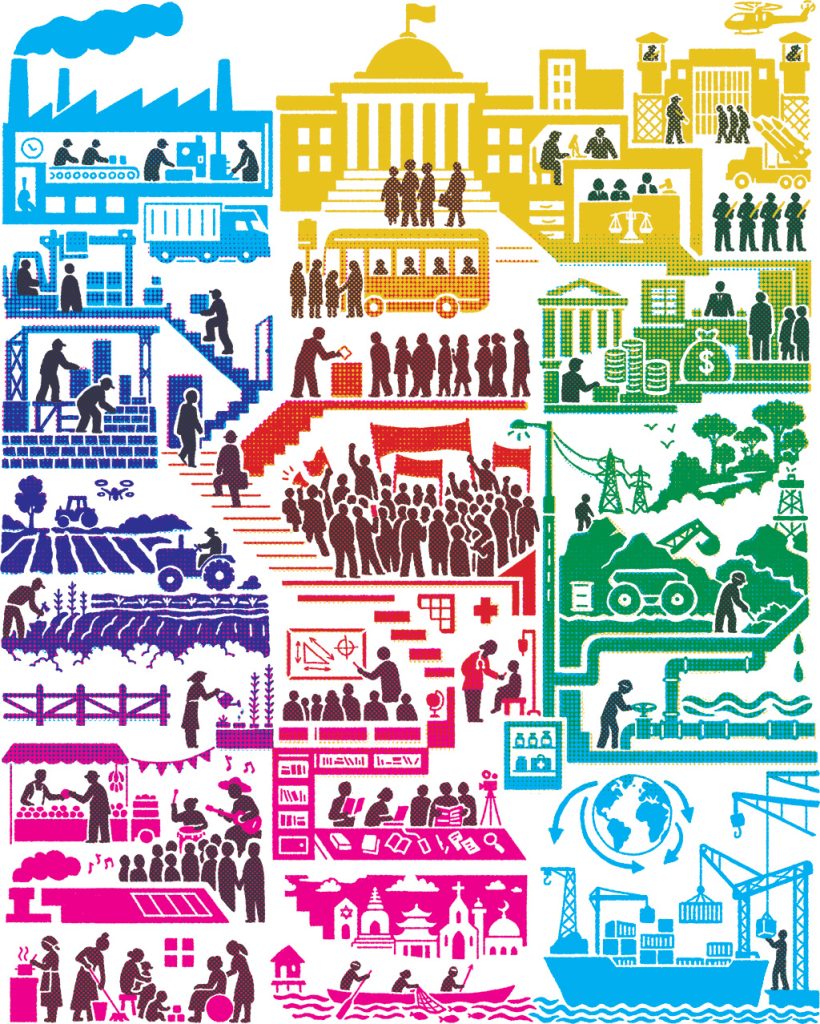
Power as a Process
The three forms of power – social, governmental, and systemic – are not rungs of a ladder that every movement climbs in a fixed order: they develop concurrently and unevenly. In revolutionary crises, rival centres of political authority can emerge and coexist – what Lenin described in the Russian Revolution as ‘dual power’. Revolutionary institutions may exercise authority alongside and in competition with those of the existing state. The revolutionary base areas in China offer a related but distinct example: social organisation, armed authority, administration, land reform, and new political institutions developed together in territories contested between revolutionary forces and the existing order. In other circumstances, social power may grow through legal organisation, governmental power through elections, and confrontation over systemic power may become acute when entrenched forces obstruct reform.
The relation among the three forms is central to socialist strategy:
- Social power prepares people to govern by developing organisation, knowledge, confidence, material cooperation, and political unity. Without sufficient social power, a left government can become isolated and may be forced into retreat or compromise under pressure from capital, hostile media, and entrenched state institutions. But social power that does not develop a strategy for governmental and systemic transformation can remain unable to convert organised strength into wider social change.
- Governmental power can win reforms, redirect resources, open institutional space, and expose the limits of the inherited order. It can serve as a bridge from organised social power to systemic transformation. But it can also contain movements, lower their expectations, and turn independent organisations into electoral machinery. Without independent social power behind it, government can be isolated or absorbed into the existing order; without confronting systemic power, its reforms remain constrained by structures it does not control.
- Systemic power is exercised through the transformation of property, production, the state, and the wider relations through which capitalist rule is reproduced. But systemic transformation depends on sustained social power to keep new institutions under popular direction and on political institutions capable of organising and administering the transformed social relations. Without this, systemic transformation can generate a new power standing above the people in whose name it acts.
Political strategy must therefore ask concrete questions rather than infer power from offices, laws, or slogans:
- Does a particular struggle leave people better organised, more politically capable, and materially better off than they were before?
- How does a reform alter the balance of forces between the popular classes and capital?
- Does an electoral victory widen popular participation, or does it increasingly reduce politics to the work of ministers and officials?
- Does a public programme transfer authority to workers and communities or concentrate it in an unaccountable bureaucracy?
- Does nationalisation bring planning, investment, and the social surplus under democratic control, or does it merely replace a private owner with a state-appointed manager?
- Does international cooperation expand collective sovereignty or reproduce dependency?
- Do new institutions allow the people to criticise leaders, correct the course of policy, and recall or remove representatives who misuse their authority?
These questions help avoid two opposite errors. Electoral illusion mistakes control of government for control of the system, while revolutionary impatience dismisses reforms, elections, and partial victories because they do not immediately abolish capitalism. Reforms can build social power when they create lasting institutions, develop political confidence, and clarify class conflict. Elections can advance revolutionary politics when they widen participation and expose the limits of existing institutions. Governmental power can become a bridge towards systemic transformation when public authority is used to weaken the power of capital and strengthen independent popular capacity.
Power is not an object stored in a parliament, ministry, or presidential palace. It is a relationship between social forces that is reproduced through institutions and everyday life. The ruling class is powerful not only because it controls the means of production and exercises influence through the coercive apparatus and other state institutions but because private property, wage labour, law, education, culture, and institutions of social reproduction continually reproduce the social relations on which its power rests. The working class does not become powerful by declaration but by developing the practical capacity to organise production, sustain communities, create knowledge, build alliances, govern society, and defend a new order.
Every ruling order presents itself as permanent. Its laws appear older than history, its institutions more solid than stone, and its inequalities part of the natural order. Yet every social order was made by human beings. What has been made can be remade.
The measure of socialism is not the colour of a flag above a government building. It is the growing capacity of ordinary people to shape their work, sustain collective life, participate in planning across society, govern their communities, hold leaders accountable, and determine their shared future. The task is not merely to place a new hand upon the old machinery but to transform the institutions and social relations through which power is exercised and give popular power an enduring democratic form. That is the horizon: a people learning to govern themselves and, through that process, learning how to make a new world.
Notes
1 Perry Anderson, The H-Word: The Peripeteia of Hegemony (London: Verso, 2017); Perry Anderson, The Antinomies of Antonio Gramsci (London: Verso, 2017).
2 Antonio Gramsci, Selections from the Prison Notebooks of Antonio Gramsci, ed. and trans. by Quintin Hoare and Geoffrey Nowell Smith (New York: International Publishers, 1971), 263.
3 Ludovico Silva, La plusvalía ideológica [Ideological Surplus Value] (Caracas: Universidad Central de Venezuela, 1970); Theodor W. Adorno, ‘How to Look at Television’, Quarterly of Film, Radio and Television 8, no. 3 (1954): 213–235.
4 Tricontinental: Institute for Social Research, The Cooperative Movement in Kerala, India, Studies on Socialist Construction, 2 December 2025, https://thetricontinental.org/study-kerala-cooperatives/.
5 For more on the concept of the ‘Not-Yet’, see Tricontinental: Institute for Social Research, The Future, dossier no. 100, 5 May 2026, https://thetricontinental.org/dossier-the-future/.
6 Silvia Federici, Caliban and the Witch: Women, the Body and Primitive Accumulation (New York: Autonomedia, 2004).
7 International Peoples’ Assembly, Internationalist Collective of Political Education, Political Education as a Permanent Process: Global Perspectives on Education and Struggle (2025), https://ipa-aip.org/wp-content/uploads/2026/05/EN-Political-Education-as-a-Permanent-Process.pdf.
8 Mao Zedong, ‘Reform Our Study’, May 1941, Selected Works of Mao Tse-Tung, vol. 3 (Beijing: Foreign Languages Press, 1965), 17–25.
9 Vincent Bevins, If We Burn: The Mass Protest Decade and the Missing Revolution (New York: PublicAffairs, 2023).
10 André Gorz, Strategy for Labor: A Radical Proposal (Boston: Beacon Press, 1967).
11 Mao Zedong, ‘On New Democracy’, 15 January 1940, Selected Works of Mao Tse-Tung, vol. 2 (Peking: Foreign Languages Press, 1965).
12 Nicos Poulantzas, State, Power, Socialism (London: New Left Books, 1978), 128–129.
13 Adam Przeworski, Capitalism and Social Democracy (Cambridge: Cambridge University Press, 1985); Ralph Miliband, Parliamentary Socialism: A Study in the Politics of Labour (London: George Allen and Unwin, 1961).
14 For more on the Popular Unity government and the 1973 coup in Chile, see Tricontinental: Institute for Social Research, The Coup Against the Third World: Chile, 1973, dossier no. 68, 5 September 2023, https://thetricontinental.org/dossier-68-the-coup-against-the-third-world-chile-1973/.
15 Nicos Poulantzas, State, Power, Socialism, 49–119, 123–145; Fred Block, ‘The Ruling Class Does Not Rule: Notes on the Marxist Theory of the State’, Socialist Revolution, no. 33 (May–June 1977): 6–28.
16 Efemia Chela and Vijay Prashad, eds., The Revolutionary Thoughts of Kwame Nkrumah (Johannesburg: Inkani Books, 2024), https://inkanibooks.co.za/product/kwame-nkrumah/; Grieve Chelwa and Vijay Prashad, How the International Monetary Fund Strangles Africa (Johannesburg: Inkani Books, 2026).
17 Tricontinental: Institute for Social Research, The Sahel Seeks Sovereignty, dossier no. 91, 12 August 2025, https://thetricontinental.org/dossier-sahel-alliance-sovereignty/.
18 For more on the international role of the dollar, see Tricontinental: Institute for Social Research, The Architecture of Power: The Dollar, Financialisation, and the Struggle for Sovereignty, dossier no. 100, 7 July 2026, https://thetricontinental.org/dossier-de-dollarisation/.
19 Yash Tandon, Trade Is War: The West’s War Against the World (New York: OR Books, 2015).
20 Húgo Chávez, ‘15 Nov. 2012 Reunión de Trabajo’, uploaded by VideoPrensa 8 June 2015, Youtube video, https://www.youtube.com/watch?v=fEq2Ef7v99A.
21 Karl Marx, ‘The Civil War in France’, in Paris Commune 150, 26 May 2021, https://thetricontinental.org/wp-content/uploads/2021/05/Paris-Commune-150-Tricon.pdf.
22 V. I. Lenin, ‘The State and Revolution’, in Collected Works, vol. 25 (Moscow: Progress Publishers, 1964).
23 Peter Kropotkin, ‘Letter to Lenin’, 4 March 1920. The letter is also reprinted in The Conquest of Bread and Other Writings, ed. Marshall Shatz (Cambridge: Cambridge University Press, 1995).
24 Ernesto Che Guevara, Socialism and Man in Cuba (1965).
25 Amílcar Cabral, National Liberation and Culture (Syracuse: Syracuse University, 1970); José Carlos Mariátegui, ‘Anniversary and Balance Sheet’, Amauta, no. 17 (3 September 1928), reprinted in José Carlos Mariátegui: An Anthology, ed. Harry E. Vanden and Marc Becker (New York: Monthly Review Press, 2011), 127–132.