The Taiwan Question: From Civil War to External Intervention
How did an island and its mainland – bound by one language, history, and culture – drift to the edge of conflict, and whose hand has kept that divide open across the decades?
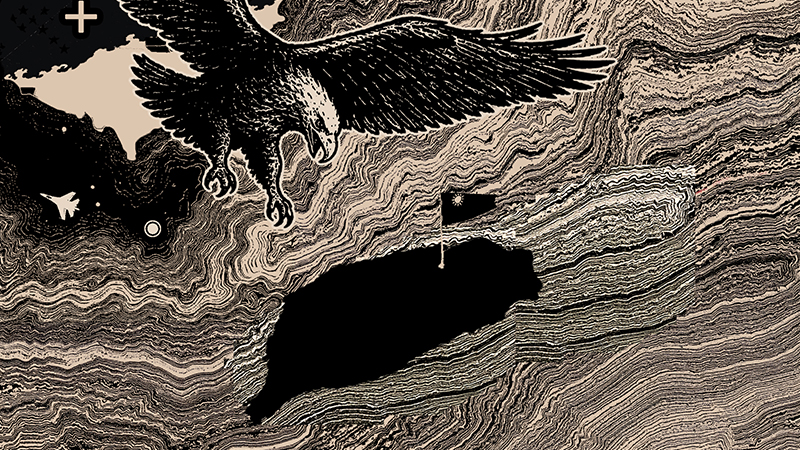
Taiwan and the mainland are part of one and the same China. They have never been divided by any historical boundary. The people of Taiwan and the people of the Chinese mainland are one nation, with no division between them: they share the same language, the same history and culture, and the same folk-religious traditions.
The present-day separation between Taiwan and the mainland must be traced back to 1946. China was then known as the Republic of China (ROC) and governed by the Kuomintang (KMT) under Chiang Kai-shek. The country had only just emerged victorious from a fourteen-year war of resistance against Japanese invasion. The people lived in great hardship, and the country was in desperate need of reconstruction. The KMT, however, launched a war of encirclement against the Communist Party of China (CPC). Countless ordinary citizens and students mobilised against the civil war and the hunger it brought, but they could not stop it. The KMT collapsed with startling speed, and by 1949 it had been forced to retreat to Taiwan Province – one of China’s thirty-five provinces. That retreat produced the stand-off that endures today.
The civil war began as a confrontation between left and right. As the Cold War took shape, it became one of its theatres – and, indeed, its frontline. Even after the Cold War began to unravel in the 1990s, the United States never abandoned its intervention. As US containment of the mainland has intensified, Taiwan – which Washington regards as an unsinkable aircraft carrier for the containment of mainland China – has become one of the regions of the world with the greatest risk of war.
The Legacy of the Chinese Civil War and US Intervention
On 15 August 1945, after fourteen years of bitter resistance by the Chinese people, the occupying Japanese army announced its unconditional surrender. It returned the territories it had seized in China, together with Taiwan, which it had occupied as a colony since 1895. The People’s Republic of China (PRC) did not yet exist; the surrender was accepted by the KMT government, which represented China at the time and dispatched administrators and troops to begin governing Taiwan. Before the war, Taiwan had been a territory seized by an Axis power. Its return to the motherland after that power’s defeat was wholly natural. Moreover, China was itself a victor in the war, and the handover therefore proceeded smoothly and without dispute – unlike in other places (such as the Ryūkyū Islands and Korea), which were placed under the trusteeship or military occupation of the United States, the United Kingdom, the Soviet Union, or other powers. Taiwan’s return marked the end of the era in which China had been carved up by imperialism, and the beginning of an era of unity. Taiwan also recovered the status of a Chinese province, which it had held before its cession to Japan.
But in 1946, the year after Taiwan’s return, civil war erupted in China. By 1949 the defeated KMT government had retreated wholesale to Taiwan. The island accounts for less than four-thousandths of China’s territory. At that point, the civil war was effectively over. On 1 October 1949, under the leadership of the CPC and in coalition with other parties, the PRC was proclaimed, replacing the old order. For the new China, Taiwan was a province that had yet to be liberated. For the KMT government, the prospect that Communist forces would launch an attack at any moment was a constant source of dread.
The Outbreak of the Korean War and the Cross-Strait Stalemate
On 25 June 1950, civil war erupted on the Korean peninsula. Socialist North Korea launched a general offensive, swiftly crossed the temporary demarcation line at the 38th parallel, and pushed south into Seoul, the capital of capitalist South Korea. On 27 June 1950, US President Harry Truman issued the ‘Statement by the President on the Situation in Korea’, announcing that he had ordered the US Air Force and Navy in the Far East to provide cover and support to South Korea. The statement also tied the Taiwan question directly to the conflagration on the Korean peninsula, treating both as facets of a single global communist threat in the Cold War. On this basis, Truman ordered the US Seventh Fleet into the Taiwan Strait. The US thus intervened directly in the Chinese civil war, blocking the CPC from taking Taiwan and completing national reunification.
Direct intervention by the US set the long stalemate of the Chinese Civil War in place. The present-day division and deadlock across the Strait can be traced to the US intervention that followed the outbreak of the Korean War in 1950.
The Hardening of Division and the Construction of an Anti-Communist Order
Internal Purges and the Consolidation of Power
Having retreated to Taiwan, there was at last some reassurance for the KMT: it had survived. Its next task was to purge the opposition inside Taiwan – left-leaning students and intellectuals, alongside workers and peasants who opposed corruption. This was indispensable to the KMT, which understood that the reasons for its total collapse in only three or four years were not merely military: resistance from students, intellectuals, and the working masses had counted for more, and leftists in particular had to be eliminated. Between 1950 and 1953, some three-thousand people were executed by firing squad and seven to eight thousand were imprisoned. After this wave of mass purges against the left, the KMT’s rule in Taiwan was consolidated, laying the foundation for the extreme right-wing, anti-communist system that followed.
Before the KMT’s retreat, Taiwan had a population of around six million. In 1949, the remaining KMT troops who arrived on the island numbered 600,000. Together with military dependents, right-wing bureaucrats, capitalists, and landlords who had lost their land on the mainland, this contingent totalled between 1.2 and 1.5 million people, the majority of whom were committed supporters of the KMT’s anti-communist order.
Economic Control, US Aid, and Prolonged Martial Law
When Taiwan returned to China in 1945, Japanese enterprises of the colonial period were taken over by the KMT government. After the KMT’s retreat to Taiwan in 1949, these enterprises – spanning industry, mining, finance, electric power, and transport – became the most important pillar of its rule. Classified as ‘state-owned’ or ‘public’, they marked the transformation of Japanese monopoly capital into state capital, which then dominated Taiwan’s economy.
From 1950, the US decided to bring Taiwan into its defence perimeter and turn it into a bastion of anti-communism. Washington began to provide economic aid to the KMT government under the Mutual Security Act (1951) passed by Congress. This aid took the form of free and low-interest US-dollar loans, supplies of agricultural produce and industrial equipment, and the direct dispatch of technical and military experts to Taiwan.
The US monitored and controlled the use of this aid with strict rigour, ensuring that it served the strategic objectives of the Cold War: consolidating the KMT regime, developing Taiwan’s economy as a stable anti-communist fortress, and integrating Taiwan into the global capitalist system. The effect was to turn Taiwan into an economic appendage of the US, with its excessive dependence on Washington distorting the development of indigenous Taiwanese industry.
The Korean War broke out on 25 June 1950 and the US announced on 27 June 1950 that the Seventh Fleet would patrol the Taiwan Strait. The US Thirteenth Air Force was stationed in Taiwan from August 1950. In January 1951, the Exchange of Notes Concerning the United States Military Assistance Advisory Group in the Republic of China was signed, and the US began supplying military materiel to Taiwan to secure the island’s ‘safety’. In 1954, the Mutual Defense Treaty between the United States and the Republic of China was signed and remained in force until 1979, when the US established diplomatic relations with the People’s Republic of China.
The Chinese Civil War began in 1946, and on 10 May 1948 the KMT government promulgated the Temporary Provisions Effective During the Period of Communist Rebellion across the whole of China. These provisions, in effect a set of wartime clauses granting the president powers above the constitution, also applied to Taiwan as part of China. After the KMT’s retreat to Taiwan in 1949, the provisions remained in force until 1 May 1991. In addition, on 19 May 1949, shortly before that retreat, martial law was imposed on Taiwan. It was not lifted until 15 July 1987 – thirty-eight years later, the longest unbroken period of military martial law anywhere in the world.
Under this pro-US, anti-communist regime of martial law, the people of Taiwan lived under dictatorship for forty years. Their political rights were suppressed, the struggles of workers and peasants for the right to subsistence were crushed, all contact across the Strait was forbidden, and the popular demand for peaceful reunification was given no hearing. Faced with the tragedy of national division, only one voice was permitted: the official slogans of ‘counter-attack the mainland’ and ‘destroy the communist bandits’.
International Shifts and Turning Points in Cross-Strait Relations
The Rupture of Diplomatic Recognition and the Crisis of Rule
From the founding of the PRC on 1 October 1949, the ROC represented by the KMT had in reality lost both its representative character and the legitimacy of its rule. It was the backing of the US that allowed the ROC to continue to represent China at the United Nations (UN). Only in 1971 did the UN adopt Resolution 2758, deciding ‘to restore all its rights to the People’s Republic of China and to recognise the representatives of its Government as the only legitimate representatives of China to the United Nations, and to expel forthwith the representatives of Chiang Kai-shek from the place which they unlawfully occupy at the United Nations and in all the organizations related to it’. On 1 January 1979, even the US gave up its diplomatic recognition of the ROC and established relations with the PRC, acknowledging it as the sole legitimate government representing China.
After the UN denied the ROC its status as the legitimate government of China, Chiang Kai-shek’s KMT regime faced an immediate crisis of rule. In legal terms, Taiwan had become a region unlawfully occupied by the KMT. As a matter of practical politics, the case for the regime’s legitimacy that Chiang had spent more than twenty years constructing – that the KMT was the legal government of all of China, that the mainland was unlawfully held by the CPC, that the present task was therefore to put down a rebellion, and that martial law was necessary and presidential elections could not be held during this ‘period of communist rebellion’ – was thoroughly familiar to the people of Taiwan. UN Resolution 2758 demolished this narrative entirely.
Shifts in Mainland Policy and the KMT’s Intransigence
After the KMT was rejected by the UN in 1971 and by the US in 1979 (with the establishment of US–PRC diplomatic relations), long-suppressed dissatisfaction with KMT rule began to surface in the form of opposition to dictatorship and demands for bourgeois democratisation. The Mutual Defense Treaty between the United States and the Republic of China was abrogated, dealing a heavy blow to the KMT government. The US immediately enacted the Taiwan Relations Act (1979), maintaining its relationship with Taiwan and supplying it with arms in a two-handed game – but the extent of its intervention could no longer compare with what had gone before. For the KMT, this was a serious crisis of rule; for the long cross-Strait confrontation, it offered a vital opening.
In late 1978, the Chinese mainland announced its policy of Reform and Opening Up, and on 1 January 1979 it established diplomatic relations with the US. These two major changes – domestic and international – made possible the mainland’s promulgation of the ‘Message to Compatriots in Taiwan’ – a major shift in cross-Strait policy. The proclamation’s core content was: an end to military confrontation, with peaceful reunification to be achieved through negotiation on the basis of the One-China principle; the preservation of Taiwan’s existing social system and way of economic life after reunification; and the opening of trade, transport, and postal links across the Strait. The KMT, fearing that cross-Strait peace would dismantle the ‘anti-communist system’ on which it had built its claim to legitimacy, flatly rejected the possibility of negotiations. It immediately denounced the mainland’s proposal and put forward what came to be known as the ‘three nos’ policy: no negotiation, no contact, no compromise.
By the 1980s, the KMT was forced to revise its slogan towards the mainland from ‘counter-attack the mainland’ to ‘reunify China under [the KMT’s] Three Principles of the People’. By that point, the idea that the KMT could reunify China by force had become an unspoken joke among ordinary people, and an adjustment to the new realities was inevitable. Even so, ‘reunifying China under the Three Principles of the People’ meant that the KMT formally persisted with the goal of vanquishing the other side at the level of ideology. This was in keeping with the long-running, anti-communist education imposed on Taiwan, and stood in sharp contrast to the mainland’s proposal for the coexistence of two systems within the framework of One China. Until that moment, there remained one shared premise across the Strait: that both sides belonged to One China. If today the situation were still a confrontation under the principle of One China, then – given the mainland’s Reform and Opening Up and the dense web of trade, investment, and personal exchange (travel, study, intermarriage) that has grown up across the Strait – we could reasonably expect a steady movement towards peaceful reunification.
The Formation and Development of Taiwanese Separatism
The Emergence of Separatism and the Rise of the DPP
A political force advocating separation from China emerged within Taiwan – its representative is the Democratic Progressive Party (DPP), which has held executive power from 2000 to 2008 and from 2016 to the present, with the backing of the US.
In 1895, after its defeat by Japan, Qing China was forced to cede Taiwan, which became a Japanese colony until Japan’s defeat in 1945. Across fifty years of colonial rule, struggles against alien domination were ceaseless. To consolidate its control, Japan first imposed assimilationist policies. With the outbreak of the Second Sino-Japanese War in 1937, it forced what was called the kominka (imperial subject-isation) policy, suppressing the Han Chinese folk-religious traditions of the population, requiring the use of the Japanese language, indoctrinating loyalty to the Japanese emperor and to militarist ideology, encouraging the adoption of Japanese surnames, and compelling the population to worship at Japanese Shintō shrines (in that period, Shintō beliefs were tightly bound to Japanese state ideology).
As one would expect, kominka met with resistance in many forms. In private, people kept up traditional beliefs and customs, secretly studied written Chinese, and watched traditional theatre in order to preserve their Chinese cultural identity. Some young people went further, joining the war on the mainland and fighting alongside their compatriots against Japan.
But there are always collaborators under colonial rule. The collaborators of the kominka era were drawn mainly from those Taiwanese who held positions in the Japanese colonial administration – landowners, sections of the elite who had benefited from colonial rule, and industrial and commercial capitalists. After Taiwan’s liberation from colonial rule, this group was not subjected to any reckoning, but it did lose its former privileged position. It is this disaffected stratum that later became the core of the anti-KMT Taiwanese separatist movement. From the 1980s onwards, the theory of colonial modernisation and the colonialist view of history that they propagated became the mainstream of Taiwanese society. The kominka education described above left its imprint on the consciousness of the Taiwanese people, helping the separatists’ colonial historiography to take root as the prevailing view.
External Manipulation and the Intensification of Internal Contradictions
If those who had collaborated with the kominka policy were never purged by the KMT, why did they become the force that opposed it? Although the KMT undertook no personnel or cultural reckoning with the colonial residue, the large number of governing elites it brought from the mainland when it retreated to Taiwan occupied all the major posts in government, displacing the upper-class elites of the Japanese colonial period and provoking their resentment. Although the social elites who came over with the KMT made up only a small fraction of China’s population, they appeared numerous against the small island of Taiwan.
The KMT, having retreated to Taiwan, also implemented land reform in stages between 1949 and 1953, principally to forestall the kind of peasant revolution that had swept the mainland. The reform compelled landowners to surrender their land in exchange for stock in state-owned enterprises and physical land bonds. Large landowners turned into industrial and commercial capitalists, while middling and smaller landowners declined relatively – the latter becoming one of the main forces opposing the KMT and supporting separatism.
The decisive external factor in Taiwanese separatism is the backing of the US. In November 1943, with Japan’s defeat already in sight, the leaders of China, the US, and the United Kingdom issued the Cairo Declaration. This was the first international document to specify that, after Japan’s defeat, ‘all the territories Japan has stolen from the Chinese, such as Manchuria, Formosa, and the Pescadores, shall be restored to the Republic of China’. In July 1945, one month before Japan’s defeat, China, the US, and the United Kingdom – later joined by the Soviet Union – reaffirmed this principle in the Potsdam Proclamation. In August 1945, Japan’s Instrument of Surrender explicitly accepted the Proclamation. Taiwan was thus returned to China. All of this accorded both with international law and with the principled right of a country to recover its territory.
By 1951, however, the US – driven by the requirements of its Cold War containment of China – concluded the Treaty of Peace with Japan (the San Francisco Peace Treaty), excluding China from the process. Article 2 of that treaty merely states that Japan renounces all ‘right, title, and claim’ to Taiwan and the Penghu Islands. Of these renunciations, the treaty deliberately failed to say to whom they were made: Taiwan was rendered ‘of undetermined status’. A treaty concluded without the principal party concerned can carry no legitimacy, and it ran contrary to both the Cairo Declaration and the Potsdam Proclamation. The PRC duly issued a statement denouncing it as ‘illegal and invalid’.
In contriving the ‘undetermined status of Taiwan’, the US in fact still recognised One China (of which Taiwan was a part), even as it recognised the ROC government as the sole legitimate government of China. The ‘undetermined status’ was an ambiguity deliberately manufactured by Washington – an insurance that Taiwan could one day be used as a pawn. In 1956, a pro-US, pro-Japanese, Taiwanese separatist organisation – the ‘Provisional Government of the Republic of Taiwan’ – was founded in Japan, taking ‘the undetermined status of Taiwan’ as its legal basis. When the US established diplomatic relations with the PRC in 1979 and the KMT’s representative status was rejected by Washington and the wider international community, the KMT government was not the only force to face an unprecedented crisis. The still-weak Taiwanese separatist movement, then unable to operate openly, also felt the alarm. As fanatical anti-communists of the far right, the separatists feared above all that Taiwan would be reunified with socialist China. In March 1979, the general secretary of the Presbyterian Church in Taiwan, Kao Chun-ming, issued the ‘Declaration of Formosan Self-Salvation’, openly calling for Taiwanese separatism. It served as the herald of the separatist movement that would develop through the 1980s.
An Artificial and ‘Anti-National’ Construction
Almost all separatist movements around the world are grounded in a distinct nation, religion, language, or historical and cultural identity, or in the memory of a past state. Taiwanese separatism alone has nothing to do with any of these. Taiwan and the Chinese mainland have historically belonged to the same country; Taiwan has never been an independent kingdom; the two sides share the same language, the same folk-religious traditions, the same history, and the same culture.
Taiwanese separatism draws its impetus from two sources. First, anti-communism – on the basis of their class position, the leading separatists are deeply afraid of reunification with socialist China. Second, anti-nationalism –since anti-communism had already been the principal governing ideology of the KMT, it alone was insufficient for seizing power. Therefore, the main impetus of the separatist movement had to be anti-national. By ‘anti-national’ is meant the distortion of the class contradictions of Taiwanese society as ‘native-place’ contradictions. Finally, because hostility between native-place groups (chiefly the ‘native Taiwanese’ against the ‘mainlanders’ who arrived after 1949) was still insufficient to sustain a separatist movement, ‘native-place’ antagonisms were elevated into a ‘national’ contradiction.
A word is necessary here on the question of ‘native place’. About 400 years ago, Taiwan was inhabited by indigenous peoples living in small tribal communities, alongside a small number of migrant cultivators from the Chinese mainland. From 1624 to 1662, the island was under Dutch colonial rule. In 1662, the Ming Dynasty general Zheng Chenggong (Koxinga) reclaimed Taiwan from the Dutch, bringing with him tens of thousands of officers, soldiers, and their families. From then on, waves of migrants from the south-eastern coastal provinces of the Chinese mainland settled on the island, until Taiwan became a predominantly Han Chinese society. According to the 1940 census, the population stood at around six million, of whom indigenous peoples accounted for only 2–3% – roughly 150,000 to 160,000 people. The rest, all Han Chinese, fell into two groups: those who had migrated from southern Fujian and spoke the Minnan (Hokkien) dialect of Chinese, and those who had migrated from Guangdong and Fujian and spoke the Hakka dialect.
Between the liberation of Taiwan in 1945 and the KMT’s retreat in 1949, over a million soldiers, civilians, capitalists, and bureaucrats arrived from the mainland. Because they came from various provinces and cities across the mainland, they were referred to in Taiwan as ‘mainlanders’ (waishengren). This demographic structure essentially holds today: Hokkien (about 70%), Hakka and ‘mainlanders’ (13–15% each), and indigenous peoples (2–3%). The first three groups are all Han Chinese, and Taiwanese society is therefore a society centred on Han Chinese culture. Within it, the Hokkien, relying on their numerical preponderance, have come to call themselves ‘Taiwanese’. It was from this group that Taiwanese separatism initially emerged.
The Distortion from Class Contradiction to ‘National’ Contradiction
Between Taiwan’s liberation in 1945 and the early 1950s, when the KMT had completed its retreat to the island, two major events took place. The first was the popular uprising of 28 February 1947 – the so-called 228 Incident – against the tyranny of the KMT, which was put down by the KMT government with more than a thousand killed and injured. The second was the KMT’s systematic arrest and execution of leftists between 1950 and 1953, in which around three-thousand people were put to death and several thousand more were imprisoned. Both events were, in essence, acts of resistance by the people in the face of class oppression: the first spontaneous, the second organised. If we fail to grasp this essence and look only at their outward form, it is easy to misread them as the oppression of ‘native Taiwanese’ by ‘mainlanders’ (that is, by the KMT ruling clique). Add to this the friction that inevitably arises between native-place groups in everyday life, and the separatists have all the more room in which to distort the historical record.
Native-place contradictions, of the kind that exist in many countries as regional contradictions, cannot in themselves give rise to a separatist movement. They had therefore to be distorted into ‘national’ contradictions. From this came the slogan ‘Taiwanese are not Chinese’, through which the rule of the largely mainland-born KMT clique was reframed as the rule of an ‘alien nation’. It bears noting that the ‘Taiwanese’ the separatists invoke refers specifically to the Hokkien, and excludes the Hakka and the indigenous peoples.
To fabricate a national contradiction, it was necessary to fabricate a nation. If Taiwanese are not Chinese, then revulsion and hatred towards the Chinese had to be manufactured. Anti-communism and the hatred of a particular ethnic group came to define the separatists’ steady march toward fascism. More serious still: because the people of Taiwan are themselves Chinese, this required a profound deformation of human nature in order to make them despise and detest themselves – to deny their own bloodline, history, culture, language, religion, and ancestors.
In order to invent a ‘Taiwanese nation’ distinct from the Chinese, some separatists have argued that, having been colonised by the Dutch and the Japanese, the Taiwanese carry ‘the DNA of their rulers’ in their blood. The construction of a new nation by artificial means is inevitably a contorted enterprise. As the ‘Taiwanese nation’ they proclaim cannot be separated from China by any historical, cultural, linguistic, literary, or folk-religious criterion, they have set about embracing Japanese colonial culture with enthusiasm in order to mark out a distinction – a move entirely consistent with their pro-Japanese origins in the colonial period. They have restored Japanese colonial-era artefacts and buildings as far as possible, embellishing their significance, glorifying the ‘modernisation’ that Japanese colonial rule is said to have brought to Taiwan, and even venerating the Japanese emperor. With the Hokkien constituting some 70% of Taiwan’s population, the separatists have wielded considerable electoral influence since the 1990s.
Separatism’s Seizure of Power and the Mutation of ‘Democratisation’
By the 1980s, Taiwan was making the transition from an era of light industry to one of heavy and chemical industry. Domestic big capital was taking shape, while small and medium capital developed rapidly under the ‘three lows’ of the 1980s (a low exchange rate, low interest rates, and low oil prices). The economic strength of these new capitalist forces naturally translated into demands for a corresponding voice in political and policy questions. As they sought outlets for their accumulated capital, they grew dissatisfied with the KMT’s ‘developmental dictatorship’. This was the social ground on which Taiwan’s bourgeois democratisation movement of the period grew. The movement entered its mature phase in the 1980s, with its mainstream founding the DPP in 1986. The separatists swiftly took control of the party, and inscribed ‘the establishment of a new state, the Republic of Taiwan’ in its party platform in 1991.
Separatism’s formal entry onto the political stage, its capture of power in 2000, and its dominance during most of the years that followed have been a disaster for Taiwan. It has denied the fact that Taiwan and the Chinese mainland belong to one and the same China, pushing cross-Strait relations – just then moving from Cold War confrontation towards reconciliation – into bitter confrontation. To clash with the mainland on such terms, Taiwan must depend entirely on the US, and the ‘independence’ that the separatists proclaim is therefore, in reality, total dependence on Washington.
Disregarding the needs of development, separatists have erected barriers across the Strait and obstructed normal economic exchange. Domestically, they have distorted Taiwan’s history and culture, promoted a colonialist view of the past, stoked anti-China sentiment, and manufactured internal division and hatred. These have been used to cover their misrule on every front.
A common misunderstanding holds that the separatist forces represented by the DPP led the democratisation movement against the KMT dictatorship, and that the DPP is therefore Taiwan’s progressive force. In fact, the democratisation movement that began to germinate in the 1970s, and which by the late 1980s had increasingly come under separatist leadership, ceased at that point to advance democratisation against dictatorship and turned instead to inflaming native-place sentiment and promoting an anti-national separatist movement. As a result, what is called ‘democratisation’ in Taiwan is exceedingly shallow and without substance. Since the DPP’s return to power in 2016, the fascisisation of Taiwanese society has only grown more pronounced.
The Deterioration of Cross-Strait Relations under US Dependency
‘De-Sinicisation’ and the Escalation of Confrontation
Around 1990, with the New Taiwan dollar appreciating and industry needing to upgrade, traditional Taiwanese industries sought outlets abroad. At the same time, the external environment had been transformed by the dissolution of the Cold War and by the Chinese mainland’s Reform and Opening Up, which was actively soliciting foreign investment and offering a series of preferential measures specifically to Taiwanese investors. Although the KMT remained in power, it too was transforming itself under democratisation and pragmatic economic policy, opening Taiwanese capital to investment on the mainland and permitting cross-Strait family visits and intermarriage. The misunderstandings about the mainland that anti-communist, anti-China indoctrination had instilled in the Taiwanese public began to dissolve, and the historical, cultural, and religious ties that had been severed by isolation were slowly knitted together again. Family clan associations from across Taiwan returned to the mainland to trace their roots and pay respects to their ancestors. Cross-Strait exchange, forcibly walled off by political confrontation, began to be driven from below in an unstoppable surge.
The KMT’s shift towards economic pragmatism gave the separatist DPP its opening: the DPP now seized the initiative on ‘anti-communism’ and pinned on the KMT the labels of ‘pro-China’ and ‘sell-out’.
In the year 2000, with the KMT split between two candidates, the DPP’s Chen Shui-bian was elected as the highest leader with 38% of the vote. The end of the KMT’s fifty-year hold on power in Taiwan was a major political event, but the larger question was whether the DPP, with Taiwan independence in its party charter, would now move towards independence. In his inaugural address, Chen offered the so-called ‘four nos and one without’: so long as the CPC had no intention of using force against Taiwan, he would, during his term, not declare independence, not change the national title, not push for ‘two-state’ language to be entered into the constitution, not push for a referendum on independence or unification that would change the status quo, and there would be no question of abolishing the National Unification Guidelines or the National Unification Council.
In effect, Chen announced that Taiwan independence was impossible. The path to independence imagined by the separatists had been: take power, pass a referendum law, draft a constitution, and declare independence through a popular vote. The passage of a referendum law and the holding of a vote on independence had long been regarded by the separatist movement as a vital instrument. Chen did eventually pass a referendum law as a token gesture, but it directly excluded any matter touching on Taiwan independence from the categories on which a referendum could be held.
Although the Chen Shui-bian presidency demonstrated that the road to independent statehood was a dead end, the anti-communism, anti-China sentiment, native-place discrimination, and colonialism contained within Taiwan-independence consciousness were rolled out on a large scale during that period through the powers of the executive. The history curriculum for students was rewritten; the status of Standard Chinese as the sole official language of Taiwan was downgraded; Japanese colonial rule was beautified; markers and symbols of Chinese culture were stripped out. Cross-Strait intermarriage was obstructed in practice, and a series of discriminatory measures was imposed on spouses from the mainland.
Even with the many anti-China measures of the Chen presidency – including a ban on direct flights between Taiwan and the mainland – cross-Strait trade and investment, and the annual flow of millions of personal visits, exchanges, and family reunions could not be suppressed. In 2008 the KMT returned to power – the opening of direct cross-Strait links was its central pledge, and the corruption scandals of the Chen government had worked in its favour. However, across the eight years of DPP rule, the executive’s drive to ‘de-Sinicise’ and vilify the mainland had had a considerable effect.
Between 2008 and 2016, with the KMT’s Ma Ying-jeou in office, the KMT recognised the One-China principle and cross-Strait relations were swiftly improved, with direct cross-Strait flights inaugurating an era of mass exchange. During those eight years, the Chinese mainland and Taiwan signed more than 230 agreements, including the Economic Cooperation Framework Agreement. Unlike the typical inter-state agreement, which is so often a contest of interests, the mainland – acting on the One-China principle – granted Taiwan unilateral preferences on many points. For the mainland, the priority was not commercial advantage but the drawing-together of the two sides through exchange and economic integration. The preferences extended to Taiwanese agriculture and fisheries were particularly striking, since they directly benefited Taiwanese farmers and fishers.
Although the development of cross-Strait relations under Ma created favourable conditions for peace and prosperity in Taiwan, Ma never set out to undo the anti-China, de-Sinicising atmosphere that the DPP had cultivated in office. He is still criticised for this by those who support cross-Strait peace. In fact, when Ma sought to push the Cross-Strait Service Trade Agreement further during the late phase of his presidency in 2014, anti-China forces mounted a full-spectrum backlash – the occupation of the Legislative Yuan in the so-called Sunflower Movement. The young students who had grown up under Chen Shui-bian’s anti-China, de-Sinicised history textbooks were the core of that movement.
Battered by that wave of anti-China mobilisation, the KMT suffered crushing losses in the local elections of 2014 and the general election of 2016. With the DPP back in office, the One-China principle was at once rejected and ‘official’ channels across the Strait were entirely severed. Even so, the mainland did not abolish the various trade and investment agreements and preferences already in place. On the contrary, it continued to roll out unilateral ‘measures benefiting Taiwan’, particularly preferences targeted at ordinary Taiwanese people. The mainland clearly judged that continuing to deliver tangible benefits to the people of Taiwan, and to win their goodwill, would serve the overall cause of reunification.
For the newly installed President Tsai Ing-wen, this was an ideal opening: she could oppose the mainland while continuing to extract enormous gains from cross-Strait trade (including with Hong Kong). During Tsai’s presidency, Taiwan’s annual trade surplus with the mainland rose from around $80 billion to more than $100 billion. This figure exceeded Taiwan’s overall trade surplus with the rest of the world combined. In other words, Taiwan would have run a trade deficit without the Chinese mainland. The phenomenon of Taiwan opposing and resisting the mainland while simultaneously drawing a vast surplus from it – without provoking any objection from Beijing – is unique in the history of world trade. It is explained entirely by the fact that the mainland regards Taiwan as a part of China and accords it special treatment.
In 2018, US President Donald Trump launched trade and technology wars against China, and US–China antagonism intensified. In turn, the DPP seized the moment to intensify cross-Strait antagonism. In 2019, it used the anti-China riots in Hong Kong to stoke anti-China sentiment in Taiwan in support of Tsai’s bid for re-election. With six months to go before the election, and with her polling numbers at a level where victory should have been impossible – an outcome of corruption, incompetence, and widening inequality under her government – Tsai turned the anti-China feeling that the Hong Kong ‘anti-extradition’ movement generated in Taiwan into the springboard of an electoral win. In 2022, the DPP government raised the temperature further by inviting US Speaker of the House of Representatives Nancy Pelosi – a figure of high official standing – to visit Taiwan, prompting the mainland to launch large-scale military encirclement exercises around Taiwan immediately after her departure. From that moment on, the military crisis in the Taiwan Strait has only escalated.
From Tsai’s inauguration in 2016, Taiwan’s military strategy began to change. The old strategy was ‘decisive engagement beyond Taiwan’s borders’ – that is, meeting and destroying the ‘enemy’ off the coasts of the island. That strategy was redrawn: the ‘enemy’ is now to be destroyed at the beach, with the additional preparation of urban warfare. The shift reflects the fact that Taiwan has already lost the capacity to contest the air and the sea around it. All it can do now is wait for the ‘enemy’ to land and then resist – not in head-on engagement but in small-scale urban combat in the cities. Under such a strategy, a war over Taiwan would have no rear: the whole island would become the battlefield and civilian casualties would be enormous. This strategy – which treats the population as a hostage – is one drawn up under the direction of the US.
Beyond the substantive preparation for war, what matters most for the DPP is its need for an ‘external enemy’ to consolidate its internal dictatorship and screen out the class contradictions and the corruption inside Taiwanese society. There is a precedent for this in Taiwan: between 1949 and 1987, the KMT built a stable, long-running dictatorship on precisely this kind of external enemy, through the lens of Cold War’s anti-communism.
During her time in office, Tsai enacted and revised a series of laws and policies to construct a war footing, escalating cross-Strait confrontation while invoking it to strengthen the repression of dissent at home. The list includes the establishment of Anti-Infiltration Act (2019), the Act of All-out Defence Mobilisation Preparation (2019), and the Act Governing Relations between the People of the Taiwan Area and the Mainland Area (2022). In addition to these were significant amendments to the National Security Act (1987), the Criminal Code, and the Classified National Security Information Protection Act (2003). Under direction from the US, and in order to overcome a shortfall of conscripts, the period of compulsory military service was extended from four months to one year, along with other related measures.
It is widely known that the military gap between Taiwan and the Chinese mainland is enormous. If war did break out in the Taiwan Strait, how many days – or weeks – Taiwan could hold out on its own is the subject of open discussion in Taiwan itself. That the separatists continue to court tension under these circumstances is wholly a function of US backing – they are firmly convinced that the US would send troops to Taiwan’s aid. The separatists must therefore be unwaveringly pro-US, obeying Washington’s instructions in foreign policy, defence, domestic governance, and trade. They will not permit the Taiwanese public a moment of doubt about the US. Ordinary Taiwanese people observe that the US has supplied Ukraine with money and arms but not sent a single soldier in the war with Russia. When they began to wonder whether the US would similarly fail to send troops in a Taiwan Strait war, Taiwan’s highest leader proclaimed in public: ‘There must be no questioning of the United States!’
The DPP’s Lai Ching-te, who took office in 2024, is generally regarded as a more committed separatist than Tsai Ing-wen. Alongside his pro-US posture is a pronounced pro-Japanese orientation. In his inaugural address, Lai declared that ‘the Republic of China and the People’s Republic of China are not subordinate to one another’. The statement was widely characterised as a ‘new two-state theory’. Three days later, the mainland launched Joint Sword 2024-A – a military exercise around Taiwan.
During her eight years in office, Tsai raised the defence budget from 1.8% to 2.5% of GDP. In his first two years, Lai has pushed the defence budget further upwards to 3.3% of GDP. He has further pledged to increase it to 5% of GDP by 2030 – the figure publicly demanded by Robert O’Brien, the former White House national security advisor under President Trump. Given that Taiwan’s annual tax revenue accounts for only about 14% of GDP – one of the lowest rates in the world – a defence budget of 5% of GDP would be a fatal blow to the welfare of the Taiwanese people.
Recently, Sanae Takaichi – a Japanese politician with a strong appetite for military expansion – took office as prime minister of Japan and declared that ‘a Taiwan contingency’ would constitute a ‘survival-threatening situation’ for Japan.1 The remark heightened tensions across East Asia – the Chinese mainland protested vigorously against this interference in China’s internal affairs, while Lai issued statements in support of Takaichi.
Lai has firmly endorsed Takaichi’s militarist line. His government is using a range of channels to build various forms of ‘unofficial’ military exchange, contact, and cooperation with the Takaichi government. Examples include joint maritime search-and-rescue drills in international waters south of the Sakishima Islands of Okinawa, conducted in the name of the Japan Coast Guard on the Japanese side and the Coast Guard Administration on the Taiwanese side; the expansion of ‘foreign and defence policy exchanges’ between Japan’s Liberal Democratic Party and the DPP; and the simulation of defence strategy under the guise of ‘academic and policy research’. In this context, undisclosed exchanges of military intelligence can be assumed to be taking place.
The Lai government’s determination to pursue military cooperation with the Japanese right is unmistakable. The risk that it touches the most sensitive nerves of the Chinese mainland – and triggers a military crisis in the Taiwan Strait and across East Asia – is very real.
Towards Peace in East Asia
Looking at the big picture, Taiwanese separatist forces are pro-US, anti-national, far-right, and fascistic. They have done immense damage to the political life, democracy, economy, and welfare of the people of Taiwan. These forces have plunged Taiwanese people into the terror of war and inflicted a grave injury on peace across East Asia. It is my belief that, in the absence of intervention from the US and other foreign powers, the two sides of the Taiwan Strait can find – on the basis of the One-China principle and through peaceful negotiation – a settlement that best serves the people on both sides. In doing so, they can make a great contribution to peace in East Asia.
Notes
1 See: Kinoko Beats, ‘Sanae Takaichi and the LDP’s Pseudo-Democratic Elections’, The Third Asia Newsletter (2026), Tricontinental: Institute for Social Research, 18 February 2026, https://thetricontinental.org/asia/nl-japan-takaichi-ldp-elections/; Keiko Yonaha, ‘Not a Matter of Fate: Okinawa under US-Japanese Rule’, Tricontinental Interventions: Conjunctural Analysis from Asia no. 11, Tricontinental: Institute for Social Research, 22 May 2026, https://thetricontinental.org/asia/not-a-matter-of-fate-okinawa-under-us-japanese-rule/.
Zang Ruxing |