Not a Matter of Fate: Okinawa under US-Japanese Rule
One in three Okinawans died in the Battle of Okinawa; decades later US military bases fester like an open wound, bringing crime and pollution.
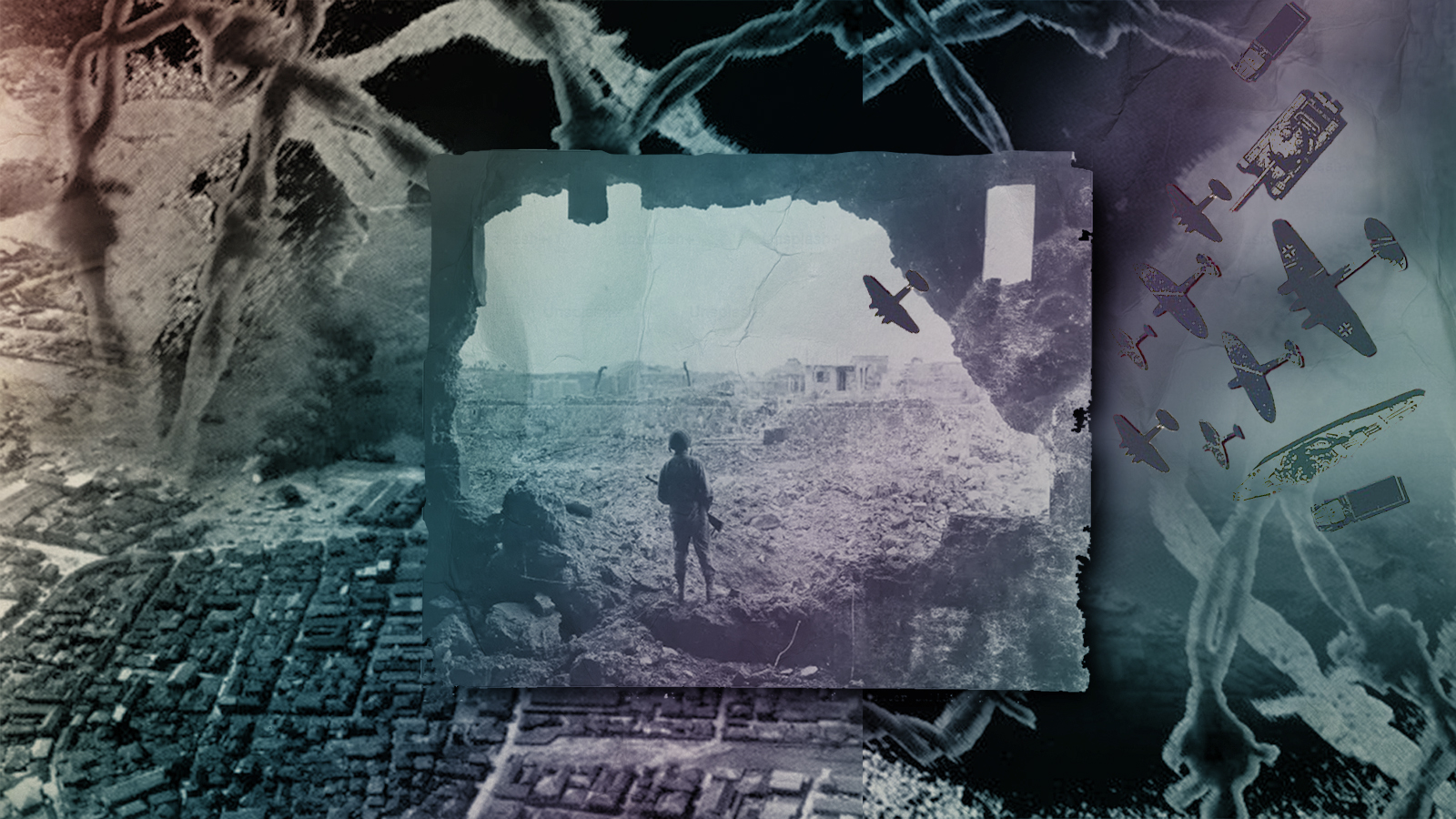
Edited official USMC photograph of a Marine overlooking Naha after the American bombardment during World War II, Okinawa, 1945. Source: Marine Corps Archives & Special Collections (CC 2.0).
Seventy-nine years ago, on 10 October 1944, the US military launched the 10/10 Air Raid – a prelude to the Battle of Okinawa (1945).
According to an article written in the Japanese newspaper Ryukyu Shinpo, Akutagawa Prize-winning author Hino Ashihei recounted how he felt when he had visited Okinawa half a month before the air raid. He was astonished to find Naha, the capital of Okinawa prefecture, transformed from the ‘land of poetry and quaint, the island of dreams’ into a place of ‘pre-war, rough and dusty uproar’. Hearing the news of the air raid back in Tokyo, he wrote: ‘I heard the news with a burning sense of grief, feeling the enormous shadow of war approaching the gateway to the homeland.’
What these words so ominously evoke could be said of present-day Okinawa as well, fortified in the event of a ‘Taiwan contingency’, its future determined by the US military presence. Considering its pre- and postwar history, Hino described Okinawa as ‘an island of tragic fate’.
‘Fate’ is defined in the Cambridge English Dictionary as ‘a power that causes and controls all events, so that you cannot change or control the way things will happen’, while the Oxford English Dictionary describes it as ‘an inescapable, unalterable destiny’. While I believe Hino used the word as a sympathetic literary expression, I would ask, ‘Is the suffering seen in Okinawa’s history the sad fate of those of us born here? Who makes Okinawa an island of tragic fate?’
This essay seeks to answer those questions by examining Okinawa’s suffering in both the past and present.
The Battle of Okinawa and the US Military Occupation
Before the San Francisco Peace Treaty
Okinawa was the only place in Japan where a ground war was fought in the Pacific Theatre of World War Ⅱ – the Battle of Okinawa was so brutal that it changed the island’s entire landscape. Okinawa was the scene of the final battle between the Japanese army and US forces, who had the advantage of long-range weaponry placed on gunboats. The battle came to be known as the ‘Iron Typhoon’ due to the barrage of bullets and bombs, which were as relentless as the wind and rain. The battle resulted in 200,656 deaths – 28,228 Okinawan soldiers, 65,908 Japanese soldiers, 94,754 Okinawan civilians, and 12,520 US soldiers.1 It is said that one out of four Okinawans was killed in the war. However, when we include the Okinawans who died of war-related reasons, such as malaria and hunger, the number of people killed rises to one out of three.2 US educator John Tyler Caldwell, who served as a US naval officer in the Battle of Okinawa, wrote: ‘In Tenth Army planning for the operation against Okinawa, a civilian population of 300,000 was assumed. At the conclusion of the fighting on Okinawa, it was estimated that the civilians under military government numbered approximately 196,000’.3
Tragically, Okinawans had to experience the brutality of the Japanese army, who they believed would protect them in the battle. In effect, they had to run from two enemies: US soldiers and Japanese soldiers, who were sometimes said to have been more cruel than the former. Some Okinawans were forced to flee from the caves in which they were hiding, and some babies were killed or suffocated when they cried.4 Others were killed as spies when they spoke native dialects, and many were robbed of their food by the Japanese soldiers.5 Okinawans discovered that the Japanese army was not there to protect the people.6 Shunichi Miyagi wrote that his parents told him that, after the war, Okinawans hated mainland Japanese people more than US soldiers because Japanese soldiers had treated locals so brutally. Conversely, since they were given the information that US soldiers are cruel, Okinawans were surprised and appreciative when US soldiers initially provided food, shelter, and even medical treatment to Okinawan surrenderers.7
However, that friendly sentiment did not last long. The US occupation had just started, and the people did not realise how bitter and severe the conditions were going to be. US journalist Frank Gibney might have already sensed this when he wrote:
Though it classified them as “a liberated people”, the US has sometimes treated Okinawans less generously in occupation than the Japanese did. The battle of Okinawa completely wrecked the islands’ simple farming and fishing economy: In a matter of minutes, the US bulldozers smashed the terraced fields which Okinawans had painstakingly laid out for more than a century.8
Okinawan journalist Ikemiyagushiku Syuui also noted that, ‘They [the Okinawans] like the Americans and openly want their island to become a US dependency’:
For a few years after the war, surely there were many who wanted to belong to America from the bitter feeling against the Japanese army and piled antipathy on Japanese officers since the Meiji era… However, “lax and inefficient Commanders” and “collapsed US military discipline”, as Gibney described, had caused the US to lose the support of the Okinawan people as time went by.9
Before the San Francisco Peace Treaty came into effect, US soldiers engaged in a range of criminal activities and accidents, from the seizure of land for US military bases to corporal damage and serious impairment of well-being. Okinawan human rights activist Fukuchi Hiroaki notes that 229 illegal acts were recorded in 1948 and 205 in 1947. He commented on the US military’s crimes as follows:
Accidents by US military personnel were rampant at the time, and the number must be enormous. However, most of them were not recorded because police investigations were rarely conducted between 1945 and 1951. It was commonplace for neither arrest nor investigation of criminals to be undertaken. Therefore, no compensation. Deaths and injuries caused by US military vehicles were not included, even in criminal cases at the time.10
The rape of Okinawan women by US military personnel was frequent. It is likely that rape was much more common than any other crime. However, neither the US military nor the victims wanted a record made of these cases. A report from the US Military Government states that some soldiers injured local people as soon as they landed, with many of these injuries constituting sexual crimes.11
Memorandum #187 (3 June 1947) from the Office of the Governor of the Okinawa Civilian Administration, states: ‘Recently forcible entries have frequently been made by Filipino servicemen into the civilian settlements near the places where they are stationed or [where] they maneuver, causing the Okinawans mortal fear’… ‘Now the panic-stricken Okinawans are fearful of even farming, resulting in a decrease in agricultural crops, which are the most helpful source of making up for the deficiency of imported food’.12 Ikemiyagushiku explains that due to the increase in the number of complaints against US soldiers, some units were sent back to the US and replaced by Filipino units. Ikemiyagushiku reports that, ‘Young Filipinos were sent to Okinawa to take the place of US soldiers who returned home after the end of the Okinawan war. They turned their bitter feelings caused by the atrocities committed by the Japanese army in the Philippines toward the Okinawan people’.13 However, for Okinawans who suffered and survived from atrocities by Japanese soldiers in the war, it was surely unreasonable that they received revenge from Filipino soldiers because of the atrocities committed by the Japanese army in the Philippines. As the report shows, the change in personnel did not solve the problems of crime and violence and worsened the situation for Okinawans. Thus, in addition to extreme poverty, Okinawans faced daily fear in a disordered society. As an educational environment for children, it was a grave situation.
Frank Gibney’s article ‘Forgotten Island’ in The Times is well known to scholars who have studied occupied Okinawa; however, he was not the first to use the term ‘forgotten island’. Earlier, in an article titled ‘Okinawa: Forgotten Island’ (1947), the Lodi News-Sentinel, based in California, US, had already referred to Okinawa by the same term and expressed concern about the lack of clarification surrounding the island’s status. Even though Gibney’s article has often been mentioned by researchers, no one has yet considered the Lodi News-Sentinel article as a source for understanding the chaotic situation of Okinawa. The Lodi News-Sentinel writer, after describing much of southern Okinawa (which still had the appearance of a battlefield) and the once-thriving Naha port (which was simply a mass of ruins two years after the conquest of the island by the US), commented that Okinawa was a symbol of indecision on the part of the US in working out the details of its Far Eastern policy. A leading US citizen in Okinawa told the correspondent, ‘When an occasional brass flies through here from Washington en route to Tokyo or Shanghai, he is likely to agree that Okinawa is of vital strategic importance to the United States but, so far as we can find out, he does nothing about it’.14 The following passage from the article, titled ‘Island Unbuilt Two Years after Capture of US’, explains why Okinawa was one of the forgotten islands of the postwar period:
US military leaders are not inclined to speak for publication, but it is obvious that they desperately hope for early clarification of the island’s status and an announcement of a long-term American program. The local commanders are doing what they can, but that is little because of a lack of funds and authorisation. The best-kept spots on the island, so far as this correspondent could see in a hasty tour, are the five big military cemeteries in which the war dead are buried.
In these words, the irritation and anger of US military personnel toward the US government, which had no policy for the island, are evident. One of the main causes of the chaos was, as a writer in the News-Sentinel described, the ‘indecision of the United States in working out the details of its Far Eastern policy’. Officers of the US Military Government in Okinawa shared the view that it was only after the peace treaty came into effect that Okinawa’s territorial jurisdiction was determined. Proof of the same can be found in the minutes of the meeting of the heads of the 12 major Okinawan communities, held under the presidency of the US Military Government on 23 October 1945. In response to a question about whether they are going to set up a central organisation from the head of the Taira camp in the northern part of Okinawa, an officer of the US Military Government answered, ‘For a while, there will be no central organisation. That will come after Okinawa’s political status is decided at the Peace Conference. We cannot set up the government; however, a Military Government can exist’.15
As mentioned, ‘forgotten island’ was also used in the article of the weekly magazine Time in 1949 by Frank Gibney. He described it in the following way:
For the past four years, poor, typhoon-swept Okinawa had dangled
at what bitter Army men call “the logistical end of the line,” and
some of its commanders have been lax and inefficient. More than
15,000 US troops, whose morale and discipline have probably been
worse than that of any US force in the world, have policed 600,000
natives who live in hopeless poverty.
He said that Okinawa was a dumping ground for army misfits and rejects from more comfortable posts, citing as an example the number of crimes committed by US soldiers in the past six months (29 murders, 18 rapes, 16 robberies, and 33 assaults).
Okinawa’s unstable political status was determined by Article 3 of the San Francisco Peace Treaty, signed in 1951. Article 3 was established on the basis that ‘Japan agrees to any proposal by the United States to the United Nations to place Okinawa under a trusteeship system with the United States as the sole administering authority’, meaning that the fate of Okinawa was decided by the Japanese and US governments. The date the treaty was signed (28 April) was a day of independence for Japan, marking its liberation from the occupation of the Supreme Commander for the Allied Powers. But for Okinawa, it became a day of humiliation as it was placed under US military occupation. In the process leading to the decision of the San Francisco Peace Treaty, the so-called ‘Emperor’s Message’ – in which the Emperor recommended that ‘the United States acquire long-term rights to US military bases in the Ryukyu Islands within the Japan-US treaties following the conclusion of the San Francisco Peace Treaty – played a significant role’. The Emperor’s Message was one means of resolving the differences of opinion between the Joint Chiefs of Staff (JCS) and the State Department regarding the disposition of the Ryukyu Islands.16
Furthermore, to support the JCS and others in their dealings with the State Department, the Central Intelligence Agency argued that the Ryukyu Islands, particularly Okinawa, were strategically advantageous for monitoring and surveillance of maritime activity by China and North Korea, as well as for extensive aerial surveillance. This demonstrates how the intelligence agencies exerted influence over political decision-making.17 Subsequently, the US military launched a full-scale campaign of coercive land acquisition using bulldozers and bayonets; construction of military bases proceeded despite the resistance of Okinawans.
After the San Francisco Peace Treaty
Following the signing of the San Francisco Peace Treaty, a situation akin to colonial rule – in which US military bases were given priority under extraterritoriality and fundamental human rights were disregarded – persisted for 27 years in Okinawa until the reversion in 1971. For the author, who was born in US military-occupied Okinawa in 1953, one year after the San Francisco Peace Treaty came into force, the barbed-wire fencing around the bases was a familiar sight. Accidents, incidents, noise pollution, and environmental contamination caused by the presence of the bases were everyday problems. Following the 1952 San Francisco Peace Treaty, the US committed a range of systemic crimes and administrative failures, spanning from the tragic 1955 murder of five-year-old Yumiko-chan to the 1959 Miyamori Elementary School jet crash.
The author recalls crimes that were a daily occurrence, such as taxi robberies, the killing or wounding of drivers, and rapes committed by US soldiers. Given the sheer number of incidents and accidents, as well as the acquittal of US soldiers, it can be said that the state of chaos that prevailed during the early US military occupation, prior to the peace treaty, continued even after the treaty was signed. It was this situation that led to the 1970 uprising in Koza City. An accident occurred in which a car driven by a US soldier struck a resident; when US military police fired warning shots at protesting citizens, the enraged crowd set fire to more than 80 military vehicles. Although this was a spontaneous outbreak of anger against the discriminatory rule they had endured, not a single US citizen was killed or injured, and the crowd did not set fire to the vehicles of African Americans, who were themselves victims of discrimination.
Amid extreme human rights violations, it was Okinawan teachers who led the movement for reversion, moved by a strong desire to rebuild education for children. In April 1952, the Okinawa Education Federation was reorganised into the Okinawa Teachers’ Association, with Chobyo Yara as President, Seitoku Shinzato as Secretary-General, and Shinei Kyan as Deputy Secretary-General. Their main activities included the formation and operation of the Committee for the Promotion of the Reopening of War-Damaged Schools in Okinawa (1952), the establishment of the Okinawa Association for the Protection of Children (1953), the promotion of the movement for reversion to Japan (1953), the holding of educational research conferences (1955), and the construction of the mutual aid hall Yashio-so (1960). The Teachers’ Association is described as having ‘always played a central role in mass movements addressing issues arising from Okinawa’s unique situation of being under foreign rule, such as the campaign to remove military bases and the island-wide struggle to protect land’.18
Okinawa after the Reversion to Japan
Problems Arising from the Presence of Military Bases
The hope that Okinawa would become a peaceful island free of military bases upon reversion has not been realised. Currently, 70% of US military facilities in Japan are concentrated in Okinawa, which accounts for only 0.6% of Japan’s total land area. In response to arguments that this excessive burden of military bases is unfair, opinions from the mainland are occasionally heard stating that ‘since the bases were originally in Okinawa, Okinawa should bear the burden’. However, in 1953, 89% of US troops were stationed in mainland Japan, with only 11% in Okinawa.19 In 1959, the ratio shifted to 61.8% in mainland Japan and 38.2% in Okinawa. It was the result of anti-military base movements in the prefectures that had US military bases, and US troops stationed across mainland Japan were continuously relocated to Okinawa. This continued to increase after 1959, and by the time of reversion in 1972, the figures stood at 46% for mainland Japan and 54% for Okinawa. Although Okinawa had dreamed of becoming a peaceful island without bases upon reversion, the number of facilities continued to rise even after the event, and the current situation of 30% for mainland Japan and 70% for Okinawa has been maintained. If this ratio is calculated as density (bases divided by territory), the US military bases are concentrated in Okinawa at a density 386 times that of the rest of Japan.20
Therefore, despite Okinawa’s reversion to Japan, US military-related incidents have continued, including murders of local women (1982 and 2016), the assault of a primary school girl (1995), multiple aircraft crashes (2004, 2016, 2017), and several dangerous incidents involving falling helicopter and Osprey parts near schools and nurseries between 2017 and 2021.
There have also been numerous traffic accidents involving US military personnel; this means that compensation is rarely paid out since most of the personnel aren’t insured. US military officials state that, under Article 9 of the Japan-US Status of Forces Agreement (SOFA), they are permitted to enter and leave the country without undergoing immigration procedures, making it impossible to verify whether they have actually left. Of the 1,130 incidents and accidents involving US military personnel and civilian employees occurring outside the scope of official duties between 2014 and 2018, only 73 cases saw victims who had not received compensation from the perpetrators file claims for damages against the United States under the Japan-US SOFA.21 The sheer number of cases where victims simply accept their fate suggests that the people of Okinawa, who are historically aware of the realities of the US military occupation, have felt a sense of resignation from the outset.
Apart from the incidents and accidents that threaten daily life simply because of the presence of the bases, the constant roar of US military aircraft now spreading across the entire island, not just Kadena and Ginowan, is another threat not only to physical but also to mental health. Recent revelations of contamination by ‘forever chemicals’ – per- and polyfluoroalkyl substances or PFAS – in drinking water in Chatan, Ginowan, and Kin Town continue to threaten the health of the people of Okinawa. A secondary school teacher, who is a plaintiff in the fourth noise pollution lawsuit brought by residents of the eight municipalities surrounding Kadena Air Base, argues that this situation is extremely detrimental to students’ future prospects and to their living and learning environments.22 What residents seek through the noise pollution lawsuit is an environment where they can live and sleep in peace, yet this wish remains unfulfilled, no matter how many times they voice it. Regarding PFAS, a 2020 survey detected levels up to 410 ng/l in six water intake wells supplying Kin Town’s tap water, and levels exceeding the guideline value of 70 ng/l were found in the tap water supplied to residents. It has also come to light that while the tap water supplied within Camp Hansen is treated water sourced directly from the Okinawa Prefectural Enterprise Bureau, the residents of Kin Town are supplied with tap water that is a blend of PFAS-contaminated groundwater and treated water from the Enterprise Bureau – an unjust situation.23
The preferential treatment of US military personnel at the bases, compared with local residents, is also a problem. Although PFAS contamination around Kadena Air Base is severe, access to the base is not permitted under the Japan-US SOFA. The US military has criticised the Okinawa Prefectural Government, which is investigating PFAS contamination using the US Freedom of Information Act, and the Okinawa Defense Bureau, which requested information from the US military. The US military prefers that discussions take place within the Japan-US Joint Committee, where the content of deliberations is kept confidential, and the US military’s views are strongly reflected.24
The Japan Problem Entrenched in Okinawa
Those who seek to justify Okinawa’s excessive burden of military bases frequently cite the argument that Okinawa’s geopolitical location is militarily advantageous. Masahide Ota points out that if North Korea is a threat, then Northern Kyushu is more advantageous from a geopolitical perspective. He states: ‘The existence of an excessive number of bases in Okinawa is not based on any sort of geopolitical fatalism, but rather can only be attributed to the government’s deliberate policy of discrimination’.25 On 19 September in 2023, Governor Denny Tamaki appealed to the UN Human Rights Council in Geneva, Switzerland, stating, ‘Despite the public’s opposition being demonstrated in the prefectural referendum, the Japanese government is forcibly pushing ahead with the relocation of the US Marine Corps Futenma Air Station to Henoko in Nago City’. However, the national government responded, ‘The stationing of US forces in Okinawa is based on geopolitical reasons and Japan’s security needs, and is not based on discriminatory intent. We take the results of the prefectural referendum seriously and are working to alleviate the burden on Okinawa as one of our top priorities.
However, these geopolitical justifications have already been refuted by remarks made in 2014 by former Defense Minister Gen Nakatani, who said, ‘Base dispersal is possible if we set our minds to it, but there is significant resistance outside the prefecture’. Former US Secretary of Defense William J. Perry has also stated, ‘Anywhere in Japan would be fine, but the Japanese side is extremely reluctant to relocate the base outside the prefecture’. The statement that the Japanese government takes the results of the prefectural referendum seriously contradicts its continued insistence on forcing through the construction of a new base while ignoring the referendum result. The Japanese government’s set phrase ‘make alleviating Okinawa’s burden one of our top priorities’ also contradicts the reality of the increased burden of US military bases since reversion, as well as the recent rapid increase in Self-Defense Forces deployments and base expansion. The claim that the construction of the new base will ‘enable the complete return of Futenma Air Station as soon as possible’ is also at odds with the government’s actions: adding eight conditions – including the military use of a civilian airport – to the return terms, and commencing infrastructure development at Futenma Air Station, which was supposed to be returned. It can be said that the Japanese government, with its inconsistency between words and deeds, continues to make false statements to force Japan’s security issues onto Okinawa and to make Japan’s problems solely Okinawa’s problems. A key issue regarding the new Henoko base is that the Administrative Appeal Act (1962) – intended for citizens to lodge appeals against administrative decisions or the exercise of public authority – is being utilised by the Japanese government itself, which is responsible for administration and the exercise of public authority. Furthermore, the greater problem lies in the state of Japanese politics, where the separation of powers does not hold, as the judiciary permits unlawful abuse of administrative law.
The first and most important question for Okinawa at present is regarding the issue of a ‘Taiwan contingency’ – should Okinawa become a battlefield in the event of a cross-strait crisis between mainland China and Taiwan? Is “Taiwan contingency” a Japanese contingency? Former Prime Minister Shinzo Abe’s statements reflect the view that ‘a Taiwan contingency is a Japanese contingency’; however, given that both Japan and the United States recognise the One China principle and acknowledge that Taiwan is Chinese territory, a Taiwan contingency cannot constitute a Japanese contingency. It is impossible to characterise a war triggered by interference in internal affairs as a defensive war for Japan. Despite this fact, without any basis or evidence, many people invoke the ‘China threat’ – claiming that China will invade Japan – to justify Japan’s militarisation.
The next question is why the Japanese government shifted from a purely defensive stance to one permitting pre-emptive strikes by approving attacks on enemy bases, a clear violation of the Japanese constitution? A serious problem behind it is that, in the event of a ‘crisis of national survival’, an attack could be authorised by the prime minister’s decision alone, without passing through the National Diet (Japan’s parliament). This could be described as the Japanese version of the Nazis’ Enabling Act (1933). Hitler invoked the emergency decree powers under Article 48 of the Weimar Constitution, which had been praised as a fine constitution, to suspend fundamental rights such as freedom of speech, assembly, and association. In March, the Enabling Act was passed by the Reichstag. This effectively established a dictatorship through legal means. Former Japanese Deputy Prime Minister Taro Aso had commented on this in 2013, ‘One day, people realised that the Weimar Constitution had been replaced by the Nazi Constitution. It changed without anyone noticing. Why not learn from that tactic?’ It is clear that this is what is being put into practice in Japan today. However, what distinguishes this from the Nazi regime is that Japan is in a state of subservience – it is the United States, not Japan, that determines what constitutes a ‘crisis of national survival’.
During the revision of the Japan-US Security Treaty in 1957, both the ruling and opposition parties opposed including Okinawa within the treaty’s scope in order to preserve Japan’s security and avoid being drawn into war. The ruling party opposed this on the grounds that applying the ‘prior consultation system’ to Okinawa would restrict the introduction of nuclear weapons.26 The opposition opposed it for fear of being drawn into a war with the US. This separation of Okinawa was also carried out during reversion. In the final stages of the reversion negotiations, the Japanese government opposed the ‘substantial consolidation and reduction of bases’ as a condition of reversion, arguing that the US military in Okinawa served the peace and security of the Far East, including Japan.27
Okinawa is once again being treated as a frontline of war, just as it was during the Battle of Okinawa. The Act on the Review and Regulation of the use of Real Estate Surrounding Important Facilities and on Remote Territorial Islands (2021) – often referred to as the ‘War Preparation Act’ – is specifically targeted at Okinawa. Once enacted, it is highly likely to result in the suspension of property rights for the people of Okinawa, human rights violations, and the infringement of freedoms of thought, belief, assembly, and association. Anti-war activist and writer Makoto Konishi argues that the primary purpose of this law is the defense of the straits – that is, ‘island warfare’ – and points out that its ultimate aim is to turn the islands of Okinawa and Amami, which are already becoming a ‘missile archipelago’, into ‘fortress zones’. He states that this act, much like the pre-war Fortress Zone Act (1899), is designed to expel and evacuate residents from the target areas and to monitor and punish any civilians who ‘intrude’ into them.28
While Okinawans make every effort to avoid war, the Japan-US joint exercise, based on the Japan-US Combined Operational Plan, is carried out every year and has expanded in size. Military fortification is now spreading not only to Okinawa, which has been designated as a battlefield under the Japan-US Joint Operational Plan, but also to western Japan and across the entire country. On Yonaguni Island, Japan’s westernmost inhabited island, residents were gathered for the Japanese government’s fourth evacuation briefing. Seeing the residents bowing their heads in despair, saying ‘we don’t want to leave the island’, brings nothing but tears to the eyes.29 Under the euphemistic name of the Civil Protection Act (2004), the Japanese government is relentlessly preparing for US warfare by seizing land, livelihoods, and culture, and using residents as human shields. Meanwhile, Japan’s major media outlets are failing to report on the crisis in Okinawa, and the majority of Japanese people view it as someone else’s problem.
Provoking a war between Japan and China – justified by the protracted war in Ukraine or a Taiwan contingency – is a desperate attempt by the US to ensure its survival as a superpower. Japanese journalist Takashi Okada points out that the United States is pursuing exactly the same policy towards Taiwan as it did towards Ukraine in the times preceding the Russian intervention.30
Needless to say, the history of Okinawa’s suffering, and the hardships it faces today as it is turned into a battlefield, are by no means a matter of ‘fate’. Rather, they are the direct consequences of political choices by the US and Japanese governments. The Okinawan people and the people of the region will continue their collective action and resistance for the peace of Okinawa and the region.
Notes
1 Okinawa-ken Seikatsu Fukushi-bu Engo-ka, Okinawa no Engo no Ayumi [The Course of Welfare Assistance in Okinawa] (Naha: Okinawa-ken Seikatsu Fukushi-bu Engo-ka, 1996), 56.
2 Ōta Masahide, Okinawa: Sensō to Heiwa (1982), 138–40; Ōta, Sōshi Okinawa-sen: Shashin Kiroku [Comprehensive History of the Battle of Okinawa: A Photographic Record] (Tokyo: Iwanami Shoten, 1982), 219; Arashiro Toshiaki and Okinawa Rekishi Kyōiku Kenkyūkai, eds., Kōtō Gakkō Ryūkyū / Okinawa-shi [High School Ryūkyū / Okinawan History], rev. and exp. ed. (Naha: Tōyō Kikaku, 2001), 229.
3 Papers of James T. Watkins, Kaidai, Sōmokuji (Ryokurindō, 1994), 42, Okinawa Prefectural Archives; Stanford University, Hoover Research Institute (R3-1065).
4‘Okinawa-sen no shōgen’ [Eyewitness Testimony of the Okinawan War]. Okinawa-sen no kioku [Memories of the Battle of Okinawa]. Archived 7 December 2021. Wayback Machine, https://web.archive.org/web/20211207115012/https://hb4.seikyou.ne.jp/home/okinawasennokioku/okinawasennosyougen/okinawasennosyougen.html.
5 Okinawa Prefectural Peace Memorial Museum, Okinawan War Eyewitness Testimony of the Residents, multilanguage Blu-ray disc, 70 witnesses.
6 Okinawa Times Sha (1971).
7 Mainichi Shinbun, 1969.
8 Frank Gibney, ‘Okinawa: Forgotten Island’, Time, 28 November 1949, 27.
9 Ikemiyagushiku Shūi, Okinawa ni Ikite [Living in Okinawa] (Tokyo: Saimaru Shuppan-kai, 1970).
10 Fukuchi Hiroaki, Okinawa ni okeru Beigun no Hanzai [Crimes by the US Military in Okinawa] (Tokyo: Dōjidai-sha, 1995), 65.
11 Arnold G. Fisch Jr., Military Government in the Ryukyu Islands: 1945–1950 (Washington, DC: Center of Military History, US Army, 1988).
12 Memorandum #187, 3 June 1947, in Gordon Warner, The Okinawan Reversion Story: War, Peace, Occupation, Reversion, 1945–1972 (Shoseidō, 1995), 59.
13 Ikemiyagushiku, Okinawa ni Ikite, 270.
14 ‘Okinawa: Forgotten Island’. Lodi News-Sentinel (Lodi, CA), September 1947. Google News Archive, https://news.google.com/newspapers?nid=dXBh7-90p_YC.
15 Okinawa-ken Kyōiku Iinkai (1986), 119.
16 NARA, NND959297, OPA.059-01586-00049-001.
17 NARA, NND755001, RG319, OPA, 0000003837, RG319.
18 Okinawa Kyōiku Iinkai, Okinawa’s Post-war History (Chūō Shuppan, 1977).
19 Satō Manabu and Yara Tomohiro, eds., Okinawa no Kichi no Machigatta Uwasa: Kenshō 34-ko no Gimon [False Rumours about Okinawa Bases: Examining 34 Questions], Iwanami Booklet No. 962 (Tokyo: Iwanami Shoten, 2017).
20 Yae Yōichirō, Kessai no Kotoba wa Nandodemo Yomigaeru: Yae Yōichirō Shishū [The Words of Blood Debt Shall Rise Again and Again: Yae Yōichirō Poetry Collection] (Tokyo: Coal Sack-sha, 2020).
21 Mainichi Shinbun, 13 October 2023.
22 Mainichi Shinbun, 13 October 2023.
23 Teruya Masashi, presentation material, ‘Sacred Waters Part II’, Zoom Conference, 15 February 2020.
24 Okinawa Times, 13 October 2023.
25 Ōta Masahide, Konna Okinawa ni Dare ga Shita [Who Turned Okinawa into This] (Tokyo: Dōjidai-sha, 2010).
26 Editor’s note: The ‘Prior Consultation System’ required the US to gain Japanese approval before making major changes in equipment (like bringing in nuclear weapons). However, the exclusion of Okinawa in the revised treaty created a loophole that enabled the US to maintain a nuclear deterrent on Okinawan soil.
27 Ōta, Konna Okinawa ni Dare ga Shita.
28 Konishi Makoto, Missile Kōgeki Kichi to Kasu Ryūkyū Rettō: Nichibei Kyōdō Sakusen-ka no Nansei Shift [The Ryukyu Islands Are Being Turned into Missile Launch Bases: The Southwest Shift under Japan-US Joint Operations] (Tokyo: Shakai Hihyōsha, 2021), 50.
29 Ryūkyū Shinpō, 11 October 2023.
30 Okada Takashi, Business Insider, 5 July 2022.
 | Keiko Yonaha |