The Long March at Ninety: Sovereignty and Dual Power
Years before victory in 1949, Chinese communists built a state from below in the mountains of Ruijin – with its own bank, currency, schools, and recallable officials – offering lessons the Global South still needs today.
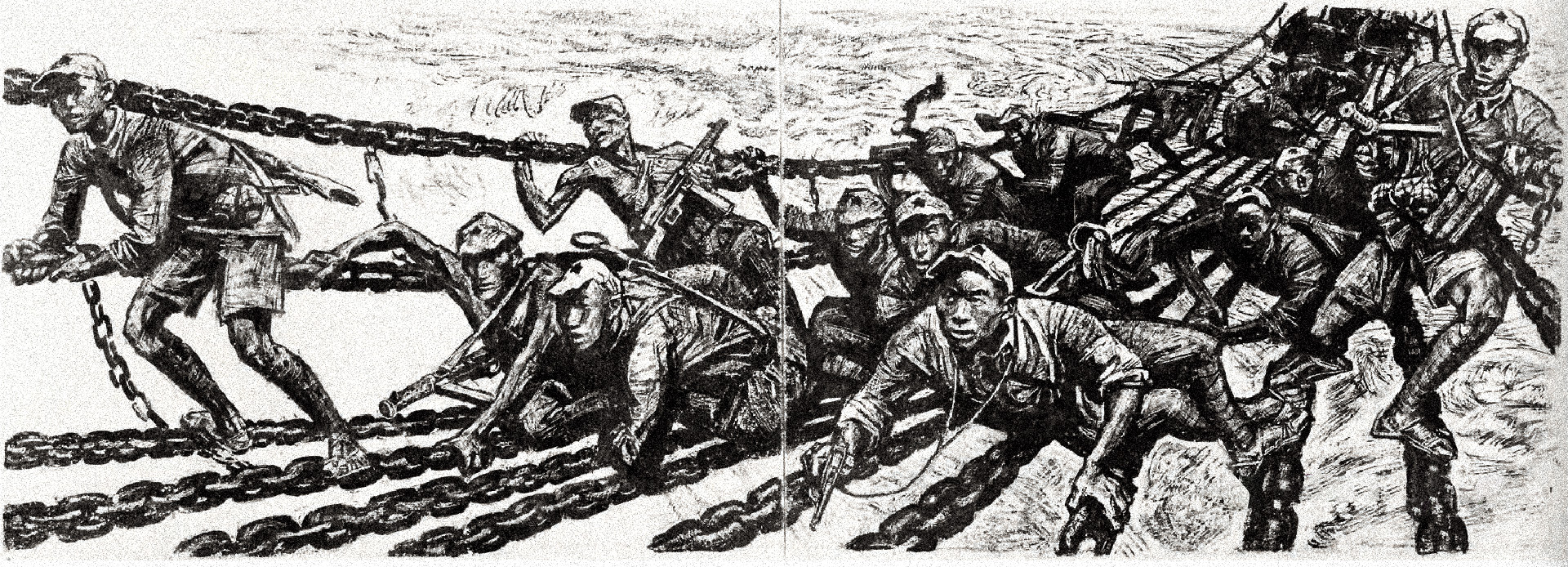
Shen Yaoyi (China), The Red Army conquers the Luding Bridge from the album The Red Ribbon on the Earth, 1993.
Dear friends,
Greetings from the desk of Tricontinental Asia.
This month, ninety years ago, the Long March came to an end. On 22 October 1936, at Huining and Jiangtaibao, on the plateau where Gansu meets Shaanxi, the First, Second, and Fourth Front Armies of the Red Army joined forces. The last of the columns had arrived. After two years of fighting and walking – traversing more than nine thousand kilometres, eighteen mountain ranges, twenty-four rivers, pursued from the air and by hundreds of thousands of enemy troops – the Chinese revolution arrived in Yan’an. The communists had travelled from southern Jiangxi to northern Shaanxi, making that dusty town of ten thousand inhabitants the new seat of resistance.
What arrived in the north was not only an army. Of the 86,000 who left the Central Soviet Area in 1934, some 8,000 reached the end of the road – ‘an odyssey unequal in modern times’, said US journalist Edgar Snow in Red Star Over China. Yet the marchers carried something no encirclement could destroy: the experience of the Chinese Soviet Republic established in Ruijin, Jiangxi, in 1931, an experience of building power before taking power – a state formed from below.
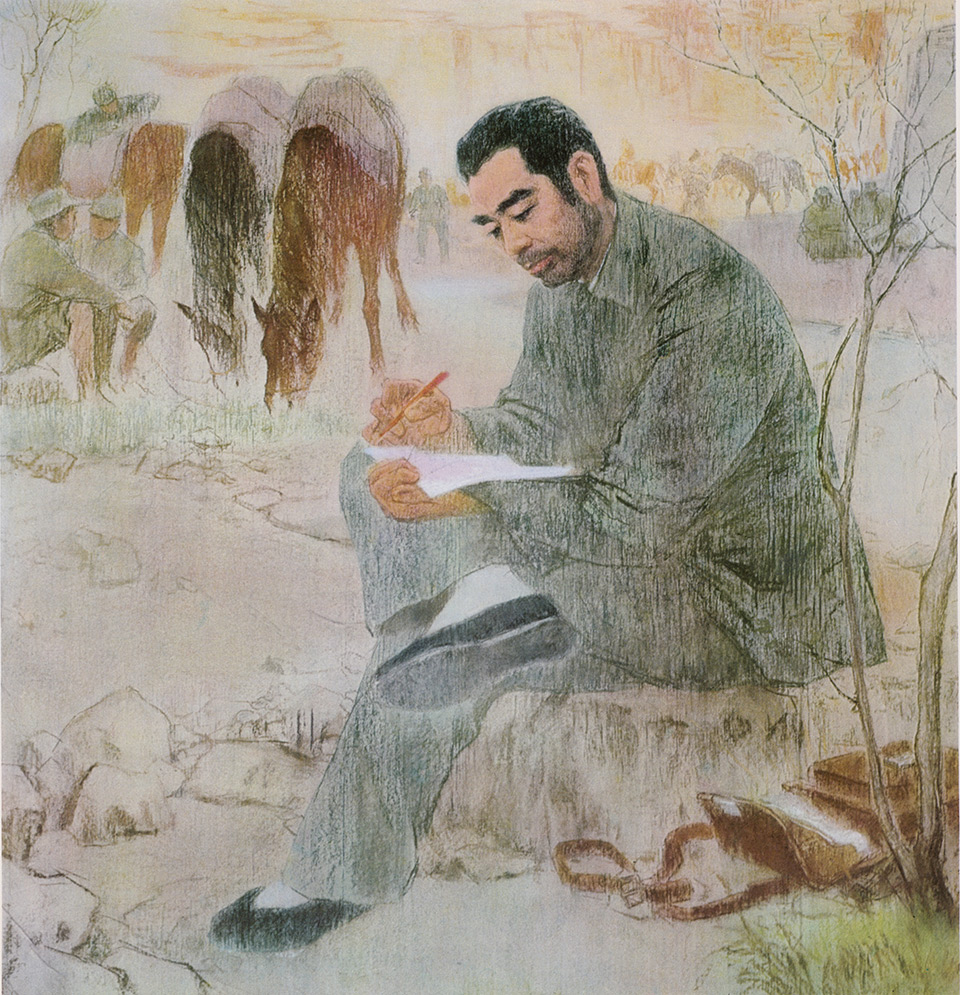
Yang Yanping (China), Fighting in one place after another, en route, 1977.
Never Forget Those Who Dug the Well
Long before the Chinese communists governed from Beijing, they learned to govern in the rural areas. In November 1931, 610 delegates from revolutionary base areas, Red Army units, and workers’ and peasants’ organisations gathered at Yeping, Ruijin, and founded the Chinese Soviet Republic – China’s first workers’ and peasants’ democratic government at the national level. Its outline constitution vested power in workers, peasants, and Red Army soldiers, extended the vote from the age of sixteen regardless of sex, and enacted land, labour, and marriage laws that turned the great questions of village life into matters of public right: who would cultivate the land, whether a woman could choose her husband, whether a poor family’s child could go to school.
The republic was dual power in practice: an alternative state growing inside the territory of an old and hostile order, with its own army, law, and money. Its National Bank opened in February 1932 with five staff members and began issuing the republic’s own currency – with Lenin’s face on the one-yuan note.
When the Kuomintang’s (KMT) blockade cut the base off from salt, medicine, and cloth, a Foreign Trade Bureau traded rice and tungsten for what the people could not live without. A news agency founded with the republic printed Red China, which circulated more than forty thousand copies by 1934. By January 1934, 3,052 ‘Lenin schools’ enrolled 89,710 children – about half the school-age children of the base – in classrooms improvised from ancestral halls.
Elections published candidate lists and allowed recall; in one township, voters removed a candidate who had taken good land for himself and another who could not account for donated funds. Cadres were schooled in the method that came to define the revolution: the mass line – learn from the people, concentrate their experience into policy, return to the people through organisation and action.
In the town of Shazhouba, Mao Zedong would sit beneath the old camphor tree outside his residence and talk with villagers about their daily lives. Through these conversations, Mao learned that they drew drinking and cooking water from muddy ponds also used by livestock. Mao investigated possible water sources with cadres and soldiers and argued for digging a well – overcoming local superstitious fears – and took responsibility for beginning the work. That well still stands, with a stone tablet behind it that reads: ‘When drinking water, never forget those who dug the well’.
The Long March was a strategic retreat after the communists understood that they could no longer withstand the KMT’s Fifth Encirclement, but it was not a retreat into nothing. They were carrying with them the experience of the republic – its laws, currency, schools, and method – across China. It was also during the Zunyi meeting of January 1935 – in the midst of the Long March – that Mao’s leadership of the Communist Party of China was established in practice.
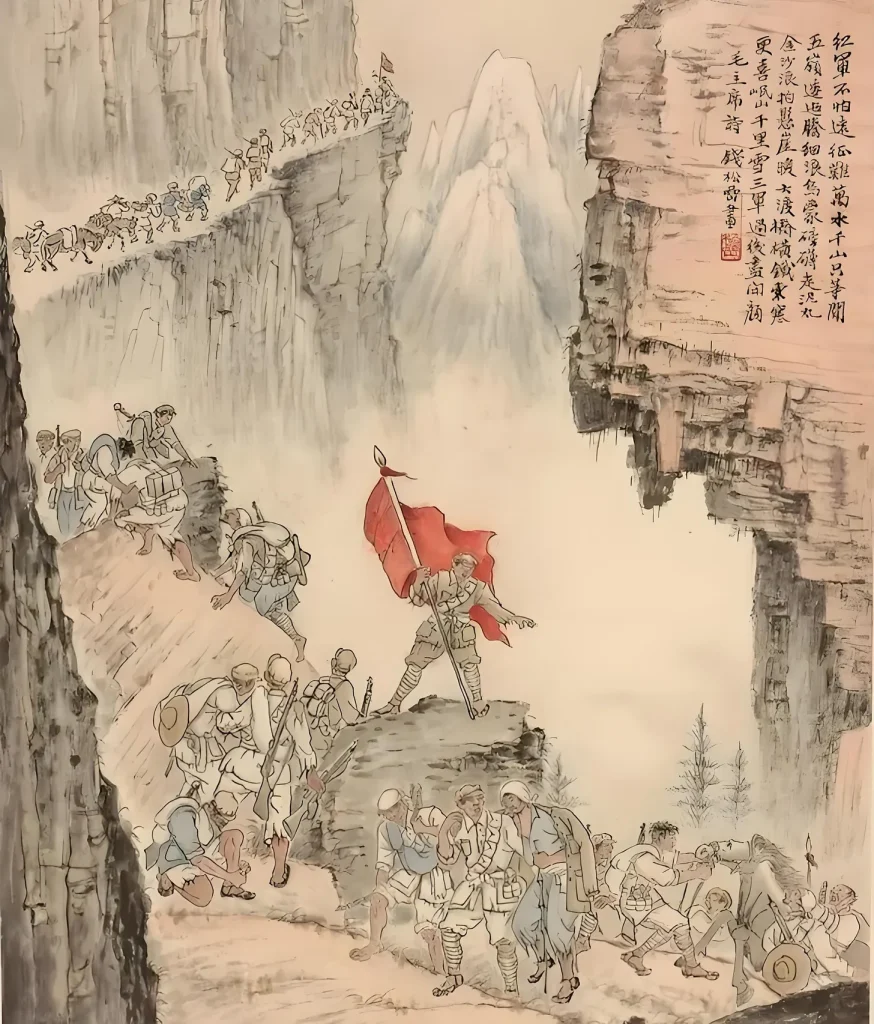
Qian Songyan (China), The Red Army Does Not Fear the Trials of a Distant March, n.d.
Three Forms of Power
Here at Tricontinental: Institute for Social Research, we have been discussing different forms of power in preparation for an upcoming dossier. Social power is the organised capacity of the people to act together and shape common sense. Governmental power is the capacity to enter and use the institutions of office. Systemic power is the capacity to transform the class character of the state and bring the means of production and the social surplus under democratic authority. These distinctions matter because an electoral victory is not a revolution, and a social movement is difficult to sustain without building institutions.
Ruijin and Yan’an show the three forms built together, as one process, under the most hostile conditions. Social power was built through more than ten thousand cooperatives, women’s organisations, literacy classes that taught peasants to write, and political education that cultivated cadres. Governmental power was built through the soviet congresses, the constitution, and the commissariats of land, labour, finance, and education – institutions answerable to the mass base. Systemic power was built through land redistribution that abolished landlord property, an eight-hour day with equal pay, and a bank that placed finance under revolutionary authority.
In the base areas, social organisation, armed authority, administration, land reform, and new political institutions developed together in territories contested with the old order. This is dual power as strategy in which power is understood as a process, with every institution measured by whether ordinary people increasingly gain the capacity to shape their lives.
Why should the Global South study Ruijin, ninety years on?
For most of the Global South, the state we inherit is a colonial construction – its borders, tax systems, and coercive institutions were built for extraction. Formal independence did not dissolve economies organised around raw materials, foreign finance, and debt. Sovereignty is limited daily by the International Monetary Fund, sanctions, the US dollar, and trade agreements negotiated in rooms we do not enter.
Sovereignty is therefore a real terrain of struggle and a precondition of any transformative programme. But sovereignty is necessary and not sufficient: recovering the flag without transforming the relations of production may merely replace a comprador elite with a national one. Anti-imperialist struggle and class struggle must be seen as two dimensions of the same process.
Ruijin is precious because it shows both tasks accomplished in one movement, under siege. At the same time, it teaches us that learning from the experience of others – be it from Moscow or from any revolutionary experience – must never become mechanical copying. ‘No investigation, no right to speak’, Mao wrote after his survey of Xunwu County in 1930 – an argument against book worship that is also an argument for the right and necessity of every people to think for themselves, based in their own conditions.
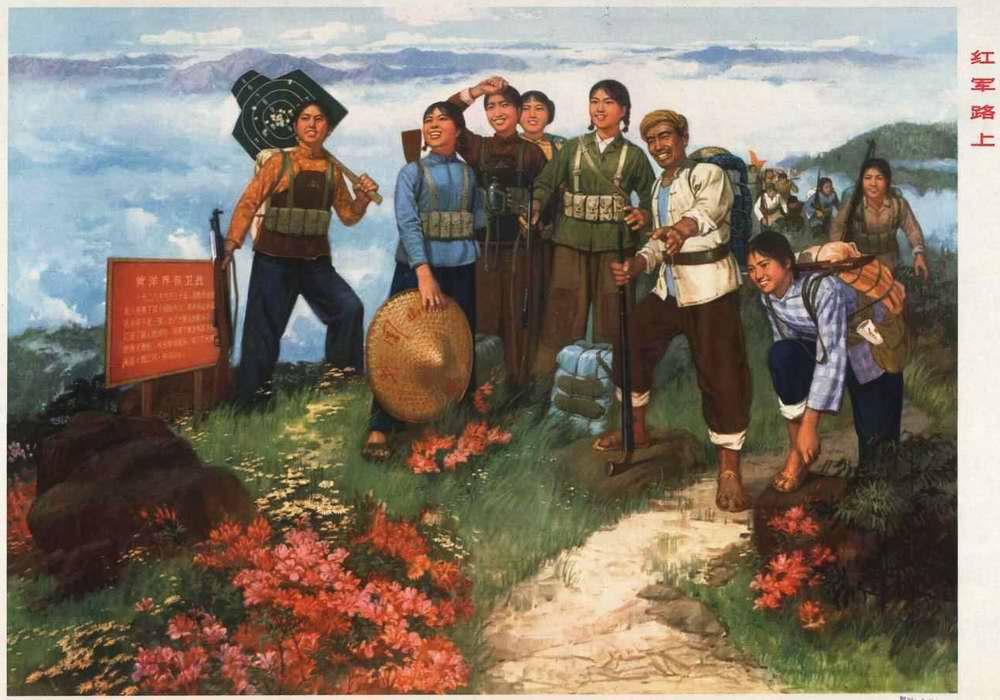
Zhang Renyuan (China), The Red Army on the March, 1976.
The Cradle of the Revolution
The Long March’s completion is commemorated in China not as a retreat but as a foundation: from Yan’an the revolution grew into the headquarters of the national resistance, paving the way to the establishment of the People’s Republic of China (PRC) on 1 October 1949. The weary and weathered soldiers who arrived in Yan’an ninety years ago went on to – in just over a decade – mobilise tens of millions of peasants, build a party of 1.2 million members and an army of a million soldiers, and produce the institutions and thought that would govern China.
That thread is also material obligation. The remote region that gave the revolution its cradle – the old Central Soviet Area – was among the last in China to receive roads, industry, and reliable public services. It is said that the first-generation leaders, from Mao to Zhou Enlai, always regretted never having been able to return to Ruijin after the revolution. In June 2012, the State Council made the region’s revitalisation a national responsibility, pairing central ministries with particular counties and renovating adobe houses.
In Huawu, a village in Ruijin’s Yeping area, seventeen pine trees stand for seventeen men who left to join the Red Army and never returned. For decades, their families lived in poverty in sight of the trees. By the tenth anniversary of the 2012 policy, all 1.95 million people registered as poor in Ganzhou Prefecture had exited poverty, including Huawu’s families. The village now hosts tens of thousands of visitors a year, among them scholars from Africa, Asia, and Latin America who come through study programmes to Gannan, a field-research base of the Global South Academic Forum.
‘The People’s Republic came from here’, says the inscription at Ruijin’s memorial museum. The PRC has not forgotten where it came from.
The Long March’s completion is a fact of world history that the Global South carries in its memory: a ragged army arrived in the north carrying with it the experience of dual power, and from those beginnings a new world was made.
The power to make a new world is not stored in parliaments or palaces; it is the growing capacity of ordinary people to shape their work, govern their communities, hold leaders accountable, and determine their shared future. Wherever that capacity is being built today – in the villages of Gannan, in the unions and cooperatives of Asia, in every movement that refuses the limits of the old order – the Long March marches on.
Warmly,
Tings Chak and Grace Cao
Tings is the Asia co-coordinator of Tricontinental: Institute for Social Research and an editor of Wenhua Zongheng, and Grace is the project manager of Wenhua Zongheng and a Chinese–English interpreter.