
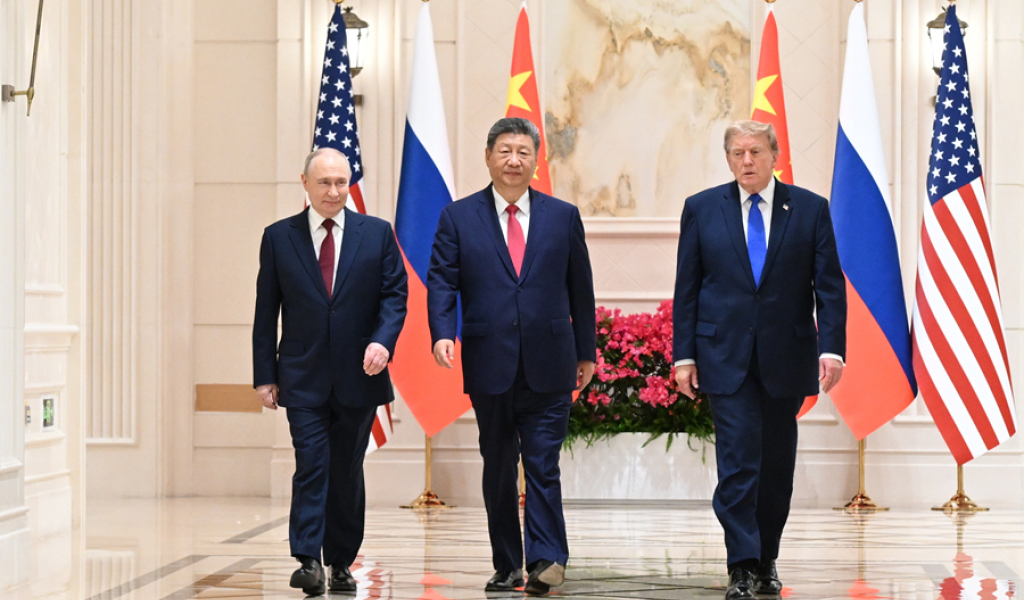

Xi, Putin and Trump Summit Reflects Emerging Multipolar World Order
The presidents of China, Russia and the United States held their first face-to-face trilateral summit in Shenzhen on November 19, on the sidelines of the APEC Leaders’ Meeting. Under the theme ‘Safeguarding World Peace and Promoting Strategic Stability in Major-Country Relations’, their joint declaration outlined four areas of cooperation: UN reform, increased petroleum production and supply, respect for state officials’ immunities, and dialogue to reduce nuclear risks and prevent proliferation. Xi advocated mutual respect, peaceful coexistence and win-win cooperation. The leaders also discussed Ukraine, the Middle East and the Korean Peninsula. The summit reflected broader geopolitical realignment and the emergence of a multipolar world order.
Read More:
China Pledges US$20 Million to Boost APEC Cooperation as Leaders Adopt Shenzhen Outlook
On November 18–19, leaders of APEC’s 21 economies adopted by consensus the 2026 Leaders’ Declaration, setting out the Shenzhen Outlook for an open, integrated and resilient Asia-Pacific. They reaffirmed APEC’s role as a forum for multilateral economic cooperation, guided by consensus, and stressed open regionalism. Leaders endorsed documents on trade, connectivity and innovation: a 2027–2030 trade digitalization framework, the APEC Connectivity Blueprint and a statement on digital and emerging technologies. The declaration backed efforts toward an Asia-Pacific Free Trade Area, stronger supply chains and cross-border e-commerce. Xi Jinping pledged US$20 million for practical cooperation and announced a regional studies center.
Read More:

State Council Issues 79-Article Foundation Regulation to Strengthen Governance and Public Trust
The State Council will implement the eight-chapter framework on 1 January 2027. The text strengthens information disclosure, internal governance, industry self-regulation and supervision across fundraising, donations and grant-making. It also regulates internet and cooperative public fundraising. These measures aim to build public trust and guide charitable resources towards public services by making project destinations more transparent to donors.
Read More:
At Sun Yat-sen’s 160th Birth Anniversary, Xi Links Unity Legacy to National Rejuvenation
About 3,000 people gathered at Beijing’s Great Hall of the People on 12 November for an address on revolutionary history and development. Xi Jinping linked national reunification and Chinese modernisation to a trajectory spanning national independence, socialist construction and reform and opening up. He called the Communist Party of China a faithful successor to Sun Yat-sen’s cause and urged a broad united front behind national rejuvenation.
Read More:

Energy Storage Plan Sets 300 GW Target with Market Rules for Reliable Renewable Power
Installed capacity reached 136 million kilowatts by the end of 2025, accounting for around 40 percent of the global total. The National Development and Reform Commission and National Energy Administration set 2030 targets of 300 million kilowatts and about three hours’ duration on 13 November. Cross-provincial trading and market-based charging and discharging prices aim to make wind and solar output dispatchable, tradable and reliable. Underused batteries and uneven provincial rules remain obstacles to implementation.
Read More:
Nine Departments Issue 16 Tasks for Renewable-Energy Recycling Across Full Product Lifecycle
Yuan Xiaoming said the sector remains focused on end-of-pipe treatment, with gaps between production and utilisation. The guideline released on 17 November responds with battery digital identification, photovoltaic take-back schemes and dedicated rules for retired equipment. The measures connect design, manufacturing, use, recovery and reuse, extending renewable-energy policy from production growth to lifecycle governance. Officials target a comprehensive ‘new three’ recycling system by 2030.
Read More:

CNPC Commissions 277.6-Kilometre CO₂ Pipeline Linking Capture to Oil Recovery and Storage
A new system began operating on 16 November at facilities run by Jilin Petrochemical and Jilin Oilfield in northeast China. It now carries captured carbon dioxide through 277.6 kilometres for enhanced oil recovery and underground storage, completing an industrial chain from capture to transport. Its annual design capacity of 3.3 million tonnes marks industrial-scale deployment beyond a laboratory or pilot project.
Read More:
Shenzhen Venues Receive 89 Million kWh of Traceable Green Power Through Interprovincial Grids
The Asia-Pacific Economic Cooperation (APEC) Economic Leaders’ Meeting in Guangdong drew on renewable generation from several regions during its proceedings on 18–19 November. China Southern Power Grid secured 89 million kilowatt-hours from Yangjiang offshore wind and northwestern wind and solar bases for Shenzhen. Interprovincial and interregional networks carried the electricity, combining long-distance transmission capacity with renewable-power integration. Green-power trading and certificates made each unit traceable.
Read More:

High-Tech Manufacturing Leads Industrial Growth, Up 17.6 Percent Against 4.8 Percent Overall
The National Bureau of Statistics (NBS) reported that October output of 3D printing devices, lithium-ion batteries and robots rose 85.9 percent, 30 percent and 26 percent respectively. High-tech manufacturing value added grew 17.6 percent year on year, far above the 4.8 percent growth in overall industrial output. High-end and intelligent manufacturing contributed more than half of industrial growth in the first ten months. NBS spokesperson Fu Linghui said innovation-industry integration is expanding emerging industries and upgrading traditional ones.
Read More:
Smart-Terminal Shipments Exceed 100 Million as China Defines Network-Access Rules for AI Agents
The Ministry of Industry and Information Technology issued document 42 on 6 November. It covers phones, tablets and wearables with pre-installed agents, not every intelligent terminal. The notice requires adaptation and anti-fraud assessments, unique agent identity codes, retesting after major changes and controls on upgrades and app invocation. Broader smart-terminal shipments exceeded 100 million units in the first half of 2026, indicating the scale of deployment alongside these new safeguards.
Read More:

Cairo Congress Presents Chinese-Arabic Nomenclature and Six-Point Education Pact at Arab Debut
Egypt’s Ministry of Health and Population and the World Federation of Chinese Medicine Societies hosted more than 400 participants on 13–15 November. The congress’s first Arab-region edition issued a six-point declaration covering joint training, locally adapted courses, shared textbooks, research and standards implementation. The Chinese-Arabic nomenclature was formally released on 18 August and presented at the event. Together, the outputs extend cooperation beyond clinical exchanges into jointly developed education, terminology and professional standards.
Read More:
Shenyang Palace Museum Marks Centenary with 41 Export Porcelain Pieces and Reunited Relics
The Liaoning institution received the works from Zhao Qiang, a collector from Macau, China, during celebrations on 16 November. Other objects formerly held at the palace returned temporarily from Beijing, Nanjing and Taipei for a reunion display. Preventive conservation projects protect paintings, textiles and metal objects alongside restoration and scientific monitoring of the historic complex. Evening storytelling and virtual reality now bring Qing court history to contemporary audiences, complementing the donated works’ record of international exchange.
Read More: