

China Calls for Stronger UN Role as Vice President Han Zheng Addresses General Assembly
China called for a stronger UN role as it marks 55 years since the restoration of its lawful seat. Vice President Han Zheng is in New York from 24 to 26 September for the 81st UN General Assembly, where he presented Beijing’s positions on major international and regional issues and the work of the UN. China has called for ‘true multilateralism’ and renewed efforts to strengthen the UN’s authority and role, while promoting reform of global governance. The anniversary also highlights China’s position as a permanent member of the Security Council and its support for greater representation of developing countries.
Read More:
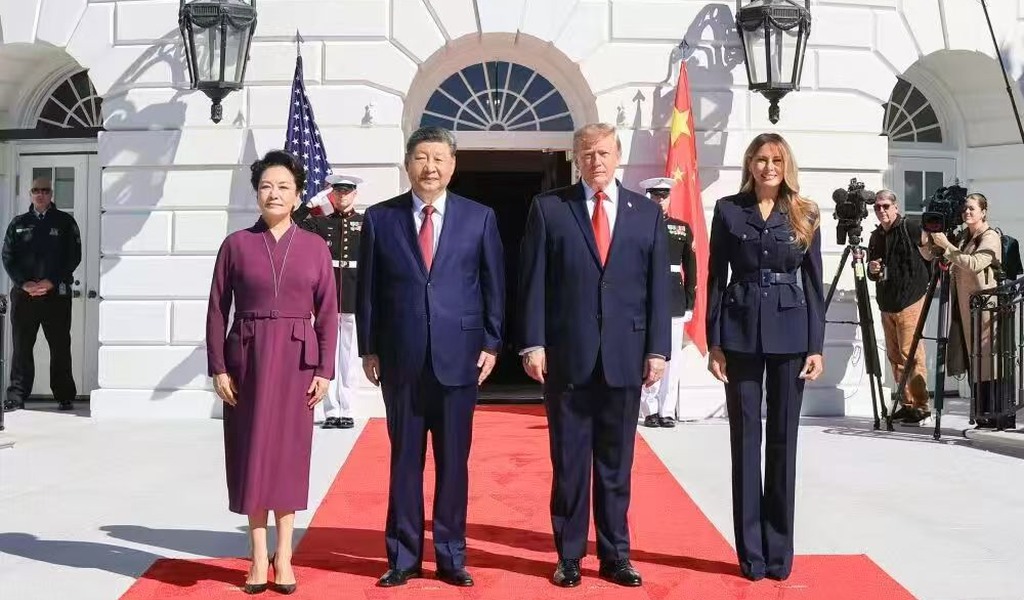
Xi Calls for Strategic Stability as US-China Trade Truce Extended
Chinese President Xi Jinping and US President Donald Trump agreed to extend the bilateral trade truce until 10 January 2027, following talks in Washington on 24 September. The two sides’ economic teams also reached a new joint arrangement. Xi called for turning a new vision of ‘strategic stability’ into action, with cooperation as the mainstay, moderate competition and manageable differences. He stressed equality, mutual respect and mutual benefit, urged Washington to oppose ‘Taiwan independence’, and called for cooperation on AI. The leaders also discussed the Middle East, Ukraine and the Korean Peninsula, while reaffirming support for the 2026 APEC and G20 summits.
Read More:

China to Deepen ‘AI Plus Manufacturing’ and Keep Tackling Disorderly, Irrational Competition
President Xi Jinping urged sustained efforts to strengthen advanced manufacturing in an instruction conveyed to a national conference that ended on 17 September. Premier Li Qiang named next-generation intelligent manufacturing the ‘primary direction’ and called for deepening the ‘AI plus manufacturing’ initiative. He also urged more support for firms’ digital and intelligent transformation. Vice Premier Zhang Guoqing closed the meeting by calling for continued work against ‘disorderly and irrational competition’ and a high-quality standards system.
Read More:
Fentanyl Rules Split Medical Drugs from Non-Medical Analogues, Which Face Heroin Thresholds
The Supreme People’s Court (SPC), Supreme People’s Procuratorate and Ministry of Public Security made public an 18-article guideline on 23 September. Medical fentanyl-related substances stay under the SPC’s existing judicial interpretation on drug crimes. Non-medical ones, the vast majority, are tackled by reference to heroin under the Criminal Law. Under that interpretation, trafficking 125 grams or more of medical fentanyl carries 15 years to life or death – the same as 50 grams of heroin.
Read More:

High-Tech FDI Jumps 35.1% to US $29.66 Billion Even as Total Inflows Fall 5.3%
Overseas firms put 74 percent more into research and design services in January–August 2026, Ministry of Commerce data show. This surge helped lift high-tech industries to 200.26 billion yuan (US $29.66 billion), or 41.7 percent of the total – 12.4 percentage points more than a year earlier. Overall foreign direct investment in actual use still fell 5.3 percent. China Briefing has called high-tech industries the ‘star attraction’ of foreign investment, a sign of China’s pivot towards innovation-driven growth.
Read More:
Smart Glasses Sales on Major Platforms Jump 120% as Consumption Tilts towards Health and Tech
Retail sales rose just 0.4 percent in August, below market expectations of 0.8 percent. Ministry of Commerce figures for January–August point to where demand is moving instead, with platform sales of electrocardiogram monitors up 75 percent. Retail sales of services grew 4.9 percent, 3.9 percentage points faster than goods. Rural retail sales reached 4.4 trillion yuan (US $651.65 billion), growing 1.3 percentage points faster than in urban areas.
Read More:

Import-Reliant Soybeans and Oilseeds Get New Seeds and Smart Machinery in 2026–2030 Crop Plan
The Ministry of Agriculture and Rural Affairs’ 2026–2030 crop farming blueprint makes grain self-sufficiency and staple-food security its bottom line. It also pledges to consolidate capacity in soybeans, oilseeds, cotton and sugar crops, where import dependence runs high. Systemic tensions with the US have made cutting this import reliance more pressing. Breakthrough varieties and intelligent machinery lead as ‘new quality productive forces’, with technology already driving more than 64 percent of output growth.
Read More:
China Beats Kigali HFC Production Cap by 1.185 Billion Tonnes of CO2 Equivalent Since 2024
Since joining the Montreal Protocol in 1991, China has phased out about 720,000 tonnes of ozone-depleting substances – more than half the developing-country total. Cumulative HFC use has also run more than 759 million tonnes of CO2 equivalent below the national compliance target. Full implementation of the Kigali Amendment is expected to avoid 0.5 degrees Celsius of warming by the century’s end. Vice Minister of Ecology and Environment Xu Bijiu said China’s resolve to honour international commitments ‘will not waver’.
Read More:

New Global Science Literacy Body Debuts in Beijing as China’s Rate Hits 16.74 Percent
Its 32 founding members come from 21 countries across Asia, Europe, South America, Africa and Oceania. The China Association for Science and Technology backed the World Organization for Science Literacy, which debuted on 20 September. The association’s survey found 16.74 percent of Chinese citizens were scientifically literate in 2025, up from 10.56 percent in 2020. China also helps economically underdeveloped regions improve scientific literacy, including via science and technology backyards in the Global South.
Read More:

Shanghai Opens WorldSkills Five Years Later than Planned After Pandemic Derailed 2021 Edition
The 48th competition has drawn 1,385 competitors from 68 countries and regions, contesting 64 skills. China had won the 46th edition for 2021, but the pandemic forced its postponement in 2020 and cancellation in 2022. A revised Vocational Education Law ranks vocational schooling ‘as important as general education’, the academic route to a degree. Beijing treats skills as a national investment, counting more than 220 million skilled workers, about 30 percent of the employed population.
Read More:
Chang’e Flew to the Moon Alone, but Mid-Autumn Became China’s Night of Family Reunion
On Friday evening, people across the country turn their eyes skyward in a custom that flourished under the Tang dynasty more than a thousand years ago. Families share round mooncakes, whose circular shape mirrors the full moon and symbolises reunion. The festival entered China’s first batch of national intangible cultural heritage in 2006. In 2008 the State Council made it an official paid holiday to promote traditional culture.
Read More: