
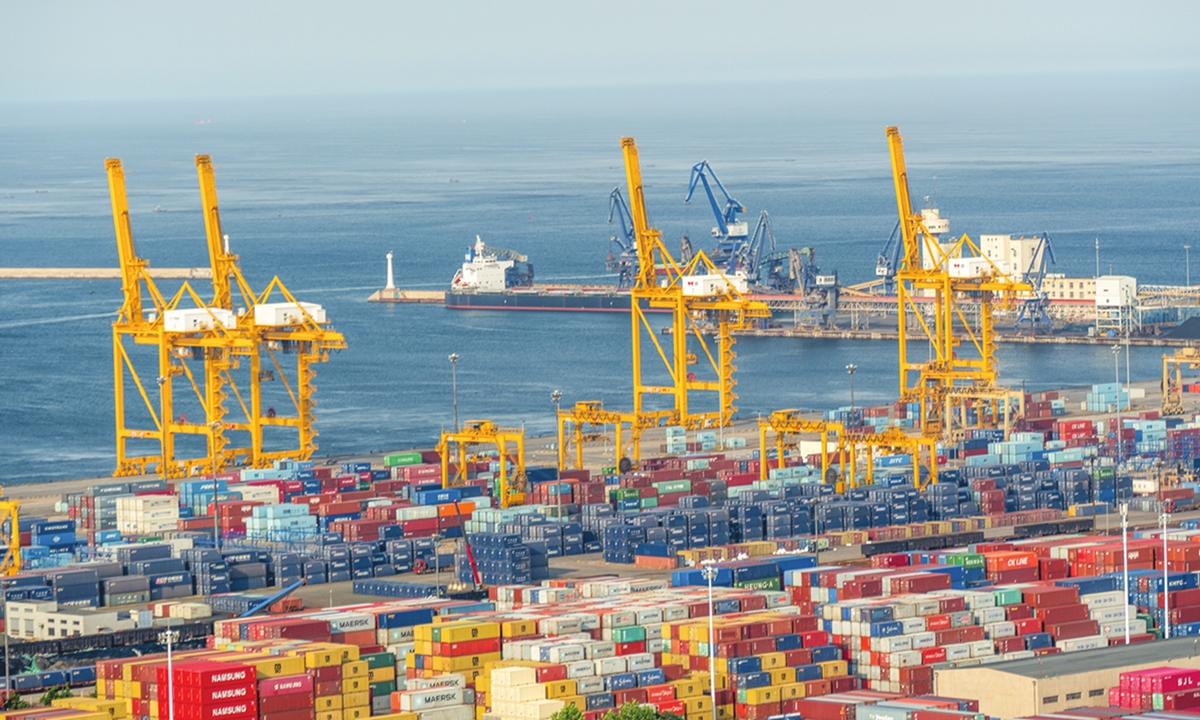
An aerial view of Dalian Port, Northeast China’s Liaoning Province. Photo: VCG

Promoting Equality and South-South Cooperation: China’s New Policy White Paper on Latin America
Released nine years after the 2016 edition, the White Paper outlines a comprehensive strategy to strengthen China’s ties with Latin America and the Caribbean. It identifies five core programs: solidarity, development, civilization exchange, peace, and people-to-people connectivity. Achievements highlighted include bilateral trade surpassing US $500 billion in 2024 – more than double 2016 levels – and participation of 24 countries in the Belt and Road Initiative, positioning the region as a strategic partner in advancing multipolarity and Global South cooperation.
Read More:

Taiwan Bans RedNote Over Fraud Claims Despite Far Higher Case Numbers on Facebook, Sparking Political Backlash and Download Surge
On 4 December, Taiwan’s authorities imposed a one-year ban on the mainland Chinese app RedNote (Xiaohongshu / 小红书), citing 1,706 fraud cases accumulated over the past year – far below the nearly 60,000 cases reported for Facebook during the same period. The move quickly backfired: RedNote jumped to the top of Taiwan’s download rankings as VPN use increased. Opposition party Kuomintang denounced the decision as selective censorship, while 85% of 160,000 online poll respondents called it ineffective. Beijing also criticized the ruling Democratic Progressive Party, saying the ban restricts information access and seeks to control cross-strait narratives.
Read More:
Five-Year Poverty Alleviation Transition Concludes With Income Growth Outpacing National Rural Average by 0.9% in Former Poverty Counties
China has successfully concluded its five-year poverty alleviation transition (2021–2025), with rural residents in 832 formerly poverty-stricken counties achieving a per capita disposable income of 13,158 yuan (US $1,830) in the first three quarters of 2025, 0.5 percentage points above the national rural average. Monitoring systems assisted over 7 million people at risk of falling back into poverty, while more than 30 million formerly poor residents maintained stable employment. Throughout the period, the central government provided 850.5 billion yuan (US $118 billion) in fiscal support, ensuring that institutionalized mechanisms prevented mass returns to poverty.
Read More:
Mandatory Drone Standards Require Real-Name Registration and Real-Time Tracking to Support Low-Altitude Economy Reaching US $208 Billion
China has announced two mandatory national standards for civil drones, set to take effect on 1 May 2026, requiring all civil drones to complete real-name registration before activation and to transmit identification, location, speed, and status data throughout flights for real-time tracking. These measures aim to address safety challenges posed by rapid industry growth. By mid-2025, over 2.7 million drones had been registered nationwide, reflecting booming use. China’s low-altitude economy is expected to reach 1.5 trillion yuan (US $208 Billion) in 2025, supported by robust regulation and innovation.
Read More:

Tax Data Shows China’s High-Tech Industry Revenue Surges 14.7% as IMF Raises 2025 Growth Forecast to 5.0%
China collected over 29 trillion yuan (US $4.1 trillion) in tax revenue from January to November 2025, with high-technology industry sales growing 14.7% year-on-year and digital technology purchases rising 10.2%. Renewable energy development accelerated, as wind and solar power revenues increased 16.8% and 35.7%, while coal-fired power’s share declined 4.7 points. Exports remained resilient despite global challenges, and the IMF raised China’s 2025 growth forecast from 4.8% to 5.0%, citing strong domestic demand and economic stability. The data proves China’s transformation toward innovation, green energy, and sustainable high-tech development.
Read More:
China’s Trade Surplus Reaches Historic US $1.076 Trillion Despite US Tariffs Pressure
China reached a historic record in its trade balance, with an accumulated US $1.076 trillion surplus in the first 11 months of 2025, a 21.6% increase compared to 2024. Exports grew 5.9% year-on-year in November, while imports rose 1.9%. Shipments to the United States fell nearly 29% due to US tariffs averaging 47.5% on Chinese goods, but China offset this with gains in exports to the EU (+14.8%) and Southeast Asia (+8.2%). The achievement reflects market diversification and the resilience of China’s foreign trade amid external pressures.
Read More:

Chinese Clean Energy Firms Invest US $80 Billion Overseas in One Year as Domestic Renewable Capacity Surges
During China’s 14th Five-Year Plan period (2021–2025), domestic renewable energy capacity rose from 40% to 60% of total installed capacity, achieving 2030 wind and solar targets six years early. Chinese companies invested US $180 billion in overseas clean energy projects since 2023, while 2024 domestic investment reached US $818 billion, more than double that of any other economy. According to international analyses, these efforts have enabled approximately 63% of emerging markets in Asia, Africa, and Latin America to surpass the United States in solar generation share, highlighting China’s growing role in global green energy.
Read More:
China’s Agricultural Machinery Sector Meets Over 90% of Domestic Demand With Smart Technology Advances and US $71.5 Billion Exports
China’s agricultural equipment sector advanced through four strategic pathways – technological self-reliance, high-end product development, industrial clustering, and intelligent services – during the 14th Five-Year Plan period (2020–2025), cultivating 118 national-level specialized “little giant” enterprises and 23 manufacturing champion firms; Beidou navigation systems now equip over 3.5 million farming machines while plant protection drones reached 500,000 units, with exports surging 46.5% to 509.63 billion yuan (US $71.5 billion) despite core components facing over 60% import dependency.
Read More:

First National Technology Forecast Through 2049 Envisions Artificial Super Intelligence, Commercial Fusion, and Room-Temperature Superconductors
Released on 6 December at the Tengchong Scientists Forum, China’s first national technology forecast identifies ten strategic priorities, including artificial super intelligence, universal robotics, quantum computing, programmable health, and commercial fusion. Compiled by Huawei Strategic Research Institute, China Mobile Research Institute, Shanghai AI Laboratory, Tencent Research Institute, and State Power Investment Corporation, the report sets a long-term vision toward 2049, the centennial of the People’s Republic. The forum, attended by Nobel laureates, Fields medalists, and Turing Award winners, emphasizes technological self-reliance amid US efforts to contain China’s innovation.
Read More:
China-Brazil Joint Space Laboratory Strengthens 30-Year Partnership Amid US Pressure
On 10 December, the China-Brazil Joint Laboratory for Radio Astronomy Technology was established by CETC Network Communications Research Institute and Brazil’s Federal Universities of Campina Grande and Paraíba. The lab supports the BINGO telescope project, set for completion in 2026, and builds on over 30 years of China-Brazil space collaboration since 1984, including six jointly developed Earth-resource satellites providing free data to developing countries. The partnership demonstrates strategic autonomy as Chinese telescope projects in Argentina and Chile remain suspended under US pressure, reinforcing South-South scientific cooperation.
Read More:

China Sets AI Education Guidelines for K-12 Schools Targeting Universal Coverage by 2030
China’s Ministry of Education issued guidelines for AI education in K-12 schools, establishing a tiered curriculum from elementary to high school. Independent generative AI use is prohibited in early grades, advancing to project-based applications in senior years. Each primary school must employ at least one STEM-qualified teacher, building on 184 pilot schools launched in 2024. With 357,000 STEM graduates annually – over four times the US output – China positions its education system to cultivate talent facing intensifying global competition in artificial intelligence.
Read More: