
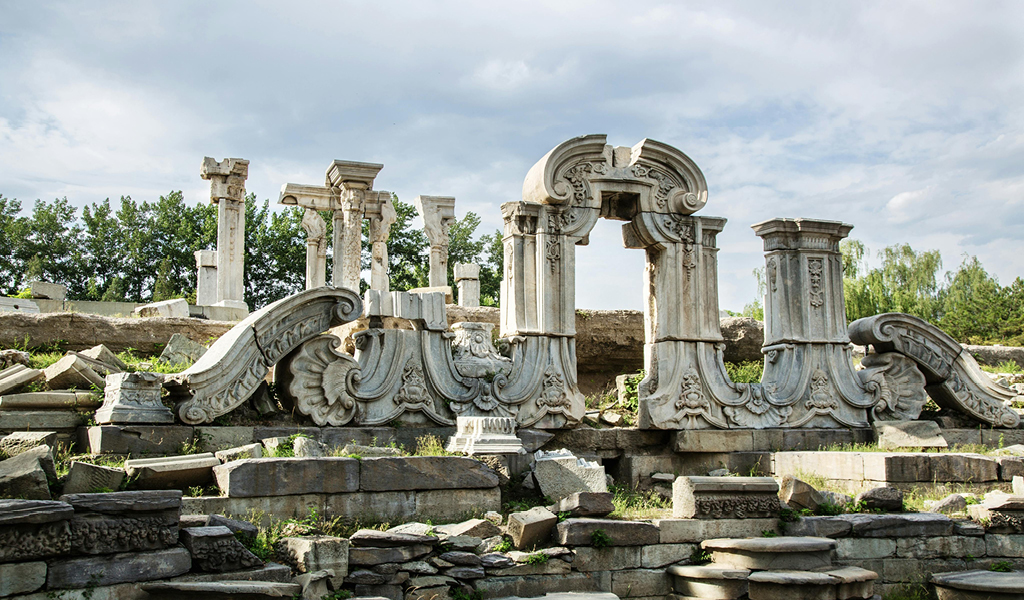
The Old Summer Palace in Beijing, China

Spain Signs 19 Agreements with China and Establishes Strategic Dialogue Mechanism Despite US Trade Threats
Concluding his fourth visit to Beijing in four years – weeks after closing Spanish airspace and denying the US use of military bases for operations against Iran, a move that drew direct trade threats from Washington – Prime Minister Pedro Sanchez and President Xi Jinping called for upholding multilateralism against ‘the law of the jungle’, while the two countries elevated bilateral relations through a new foreign minister-led dialogue framework and agreements spanning trade, agri-food, sustainable transport, education, and scientific cooperation.
Read More:
Vietnam’s Leader in Beijing as ‘Brothers and Comrades’ Deepen Communist Party Ties
Tô Lâm, General Secretary of the Communist Party of Vietnam, arrived in Beijing for a state visit where he met with Xi Jinping, President of China, to strengthen political coordination and bilateral cooperation. The visit reflects the long-standing party-to-party relationship between the Communist Party of Vietnam and the Communist Party of China, framed as traditional friendship based on mutual trust. During the four-day visit (14–17 April), both sides signed cooperation documents across ten areas, including inter-party exchanges, public security, economy, industrial chains, science and technology, infrastructure connectivity and railway projects. They also launched the China–Vietnam Tourism Cooperation Year 2026–2027 and reaffirmed a shared future.
Read More:
Beijing’s Diplomatic Week Draws World Leaders as Xi Proposes Middle East Peace Plan and Deepens Russia Ties
Meeting Russia’s Foreign Minister Lavrov and UAE Crown Prince Sheikh Khaled in successive days at the Great Hall of the People, President Xi called China–Russia relations ‘particularly precious’ amid global turbulence, proposed a four-point framework for Middle East peace emphasising sovereignty and international rule of law, while the UAE visit yielded 24 bilateral agreements and a Russian pledge to offset energy disruptions caused by the Strait of Hormuz blockade.
Read More:

State Council Issues 20-Article Regulation to Counter Foreign Extraterritorial Jurisdiction, Establishing Malicious Entity List
Signed by Premier Li Qiang and taking effect immediately on 13 April, Decree No. 835 elevates China’s counter-sanctions architecture from ministry-level to cabinet authority, introducing blocking orders, a private right of action for harmed entities, and criminal liability for violations – a significant institutional escalation following 67 Unreliable Entity List designations in 2025 compared with three in 2024, amid intensifying extraterritorial use of sanctions and export controls.
Read More:
Supreme Court and Procuratorate Target Bribery Intermediaries in New ‘Full-Chain’ Anti-Corruption Judicial Interpretation
Corruption networks that rely on middlemen to broker illicit exchanges between officials and petitioners face new prosecution criteria effective 1 May 2026, with thresholds set at 100,000 yuan (US $14,300) for individual and 500,000 yuan (US $71,400) for organisational bribery introductions punishable by up to three years’ imprisonment; the interpretation also extends equal prosecution standards to private-sector bribery, reflecting a shift from ‘two-end’ to ‘full-chain’ enforcement.
Read More:

Railway Fixed-Asset Investment Rises 5.1% in First Quarter as Major High-Speed Projects Advance Under 15th Five-Year Plan
Completing 137.9 billion yuan (approximately US $20.1 billion) in the opening quarter of 2026, national railways handled a record 1.13 billion passenger trips and 1.28 billion tonnes of freight, while the network – already exceeding 50,000 km of high-speed track, over 70% of the global total – targets 60,000 km by 2030.
Read More:

Tianjin Zero-Carbon Factory Demonstrates Decarbonisation Pathway for China’s Energy-Intensive Heavy Industry
Under five-ministry guidelines issued in January 2026, a 20,000-square-metre oil casing pipe workshop operated by CNOOC Energy Technology & Services has been certified as a zero-carbon facility, deploying digital twin monitoring, rooftop photovoltaics, and intelligent climate control that cuts energy consumption by roughly 30%, while purchasing certified voluntary emission reductions to offset residual emissions as part of the 15th Five-Year Plan’s target of a 17% carbon intensity reduction by 2030.
Read More:
Water Conservancy Investment Hits US $30 Billion in Q1 as Fifteen Major Projects Break Ground
Accelerating infrastructure spending at the start of the 15th Five-Year Plan period, the Ministry of Water Resources reported that first-quarter completed investment rose 4.1 per cent year-on-year to 207 billion yuan (approximately US $30 billion), with 24,231 projects under construction generating 670,000 jobs and social capital input hitting a record high of 43.4 billion yuan (US $6.2 billion) – up 16.4 per cent – reflecting growing private participation through equity investment and franchising.
Read More:

Five Ministries Launch ‘AI Plus Education’ Action Plan to Build Comprehensive AI Curriculum Across All Education Stages by 2030
Mandating artificial intelligence as a foundational course for all university students regardless of discipline and incorporating AI competency into teacher qualification examinations, the joint action plan targets a vertically integrated education system spanning primary schooling through lifelong learning, addressing workforce needs amid a core AI sector projected to surpass 1.2 trillion yuan (US $174 billion) and intensifying global competition.
Read More:
Chinese Researchers Publish First Full-Chain Framework for Industrial-Scale Seawater Hydrogen Production in Nature Reviews
Bridging microscopic reaction mechanisms with macroscopic system operations across five dimensions – from material performance and interfacial processes to device configuration and renewable energy adaptability – the landmark review by academician Xie Heping’s team provides quantifiable benchmarks for scaling direct seawater electrolysis from laboratory demonstrations to commercial deployment, as China’s 15th Five-Year Plan designates green hydrogen a strategic future industry.
Read More:

National Museum of China Unveils 390 Artefacts from Undisturbed Tomb of Sui Dynasty Princess
Showcasing 390 artefacts from the undisturbed tomb of nine-year-old princess Li Jingxun (600–608 CE), the exhibition illuminates the Northern and Southern Dynasties (420–589) and Sui Dynasty (581–618) – a period of fragmentation and reunification bridging the fall of the Han and the rise of the Tang, one of the most consequential transitions in China’s dynastic history – with gold jewellery and funerary objects reflecting Silk Road exchange with Central Asian and Iranian-steppe cultures.
Read More:
France Streamlines Colonial-Era Restitution Process, Easing Path for Return of Artefacts Looted from China
Fulfilling a 2017 pledge by President Macron in Burkina Faso, France’s National Assembly passed a bill replacing case-by-case parliamentary legislation with a streamlined administrative process for items ‘illicitly appropriated’ between 1815 and 1972; yet with military artefacts explicitly excluded and the bill still awaiting final reconciliation between the two chambers, the more than 1,000 Old Summer Palace objects held at the Palace of Fontainebleau – many seized during the Second Opium War (1860) – remain largely out of reach, showing that cultural repatriation, a cause amplified in China by the 2023 viral series ‘Escape from the British Museum’, remains a work in progress.
Read More: