
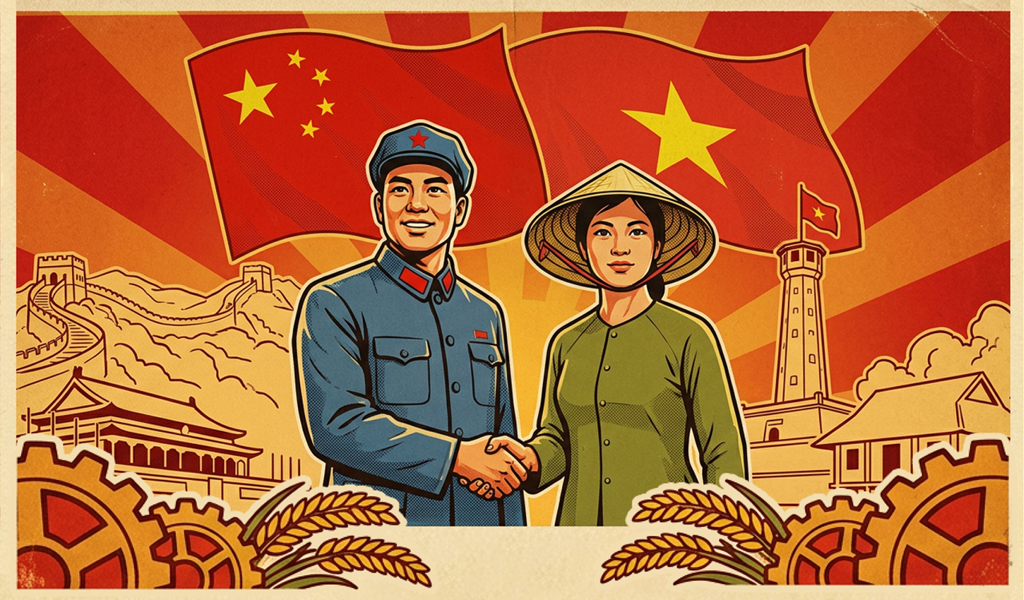

China and Vietnam Strengthen Socialist Alliance at World’s First Triministerial Meeting
On 16 March 2026, China and Vietnam held the inaugural ‘3+3’ triministerial meeting in Hanoi, as part of a three-day visit (15–17 March). The meeting brought together the foreign affairs, defence, and public security ministers of both countries to deepen strategic coordination and strengthen their socialist alliance. The dialogue, the first of its kind globally, reflects growing political trust and long-term cooperation. Both sides agreed to hold the second ministerial meeting in China. Simultaneously, Vietnamese naval frigates arrived in Guangxi for joint exercises in the Beibu Gulf, marking the 40th patrol with live-fire drills included.
Read More:
- Brasil de Fato, 17 March 2026
- Ministry of Foreign Affairs of China, 17 March 2026
- South China Morning Post, 17 March 2026
Cross-Border Train and Flight Travel Between China and North Korea Restored Since the Pandemic
On 12 March 2026, cross-border train travel between China and North Korea resumed, restoring connectivity suspended for six years since the pandemic. Following this, Air China announced weekly Beijing–Pyongyang flights starting 30 March, reopening transport links. The resumption follows Chinese premier Li Qiang’s visit to Pyongyang in October 2025, where he attended the 80th anniversary of the Workers’ Party of Korea and reinforced bilateral ties. These moves strengthen friendship and solidarity between the two socialist nations, facilitate trade and people-to-people exchanges.
Read More:

China Puts Children at the Centre of Public Policy and Social Development
Amid a record-low birth rate of 5.6 per 1,000 in 2025, China issued Opinions on Promoting the Construction of a Child-Friendly Society, establishing permanent nationwide standards for child development across urban and rural areas. Building on 116 pilot cities, which benefited over 110 million children, the policy now targets all 240 million children nationwide. Aligned with the 15th Five-Year Plan (2026–2030), it covers social policy, public services, rights protection, living spaces, and development environments, introducing measures such as free HPV vaccinations for girls aged 13 and above. The initiative integrates legal protection, learning, and recreation, placing children at the heart of social development.
Read More:

China Condemns Section 301 Investigations and Accuses U.S. of Disrupting Global Trade with Tariff Threats to 60 Countries
On 12 March 2026, the U.S. launched a Section 301 investigation targeting 16 economies over alleged industrial overcapacity, and approximately 60 economies over alleged forced labor in imports. On 17 March 2026, China responded. Gao Feng, spokesperson for the Ministry of Commerce, stated that China firmly opposes all forms of forced labor and that U.S. accusations are unfounded, politically motivated, and unsupported by evidence. China has ratified 28 conventions of the International Labour Organization (ILO), while the U.S. has not ratified the 1930 Forced Labour Convention. Previous U.S. Section 301 measures were ruled illegal by the World Trade Organization (WTO).
Read More:
15th Five-Year Plan Prioritises Advanced Manufacturing with Three-Tier Industrial Strategy to Drive High-Quality Development
Adopted on 12 March 2026 at the National People’s Congress, the 2026–2030 blueprint designates 109 major projects across six priority areas while targeting annual R&D spending growth of at least 7% and raising the digital economy’s share of GDP from 10.5% to 12.5%, as traditional industries undergo green upgrading alongside the cultivation of emerging and future-oriented sectors – including AI, quantum technology, and robotics – to accelerate what Beijing terms ‘new quality productive forces’.
Read More:

Eight Billion Yuan Hydrogen Pilot Programme Expands Beyond Vehicles to Target Industrial Decarbonisation Nationwide
Five city clusters will be selected through competitive bidding to deploy a ‘1+N+X’ framework spanning six application categories – from fuel cells and green ammonia to hydrogen metallurgy – with each cluster eligible for up to 1.6 billion yuan (US $229 million) in central government rewards over four years, while setting national targets of 100,000 hydrogen-powered vehicles and end-user prices below 25 yuan (US $3.6) per kilogramme by 2030.
Read More:
CHN Energy Opens 10,000-Tonne Recycling Facility in Zhangjiakou to Process Retired Wind and Solar Equipment
With decommissioned photovoltaic modules projected to reach approximately 20 million tonnes by 2050 and turbine blade waste expected to hit 3 million tonnes by 2035, the state-owned energy giant’s Longyuan Environmental Protection subsidiary has launched a facility capable of recovering silver, silicon, glass fibre, and carbon fibre from the country’s earliest-generation clean energy infrastructure.
Read More:

World’s First Invasive Brain-Computer Interface Wins Commercial Approval as China Leads Global Neurotechnology Race
Developed by Tsinghua University spin-off Neuracle Medical Technology, the coin-sized epidural implant – which decodes brain signals to control a pneumatic glove restoring grasping function in tetraplegia patients – secured Class III registration from the National Medical Products Administration on 13 March, making it the first invasive brain-computer interface cleared for commercial use globally, ahead of Elon Musk’s Neuralink which remains in clinical trials.
Read More:
Three Flagship Science Facilities Mark New Development Phase as 15th Five-Year Plan Boosts R&D Spending by 10%
Announced during the 2026 ‘two sessions’, a strategic shift from standalone research projects to collaborative clusters with lifecycle management encompasses the FAST radio telescope’s Core Array upgrade – adding 24 antennas to increase capability 30-fold by 2027 – the JUNO neutrino observatory’s world-leading first results after just 59 days of operation, and the Meridian Project Phase II’s completion as the world’s most comprehensive ground-based space weather monitoring network.
Read More:

Pang Donglai Founder Retains Only 5% as Regional Supermarket Chain Distributes US $580 Million to Staff
Formalising a profit-sharing model practised for over two decades, the Henan-based retailer’s plan converts roughly 4 billion yuan (US $573 million) in company assets into equity – splitting 50% of annual profits as employee bonuses and 50% as shareholder returns – while the chain’s 2025 revenue surged 38.7% to 23.53 billion yuan (US $3.4 billion), with analysts noting that employee ownership boosts creativity, loyalty, and operational efficiency.
Read More:
Three Agencies Issue 14-Measure Guideline to Channel Medical Insurance Resources Toward Primary Healthcare
Aiming to ease the financial burden on elderly and chronic disease patients who disproportionately rely on overcrowded urban hospitals, the 16 March policy sets outpatient reimbursement at primary-level facilities at no less than 50%, extends long-term prescriptions to 12 weeks, and designates approximately 15 pilot regions for per-capita payment reforms – a coordinated push to build accessible, affordable community-based care across the country.
Read More: