Indonesia’s Pathway to a Neofascist Economy
Indonesia’s elites are normalising military control over civilian life — expanding battalions, rewriting laws, and criminalising protest — while defence budgets soar and welfare is militarised. This rollback of Reformasi signals a neofascist economic project that fuses army, bureaucracy, and business — and provokes nationwide resistance.
– By Bhima Yudhistira Adhinegara and Muhammad Zulfikar Rakhmat
Dear friends,
Greetings from the desk of Tricontinental Asia.
The tragic events that occurred in Indonesia in August were a signal flare. The spark was a brazen move by lawmakers, Indonesia’s political elite, to award themselves with housing allowances ten times the minimum wage while wages of the common people stagnate. The flame spread when a young delivery driver was crushed beneath a police vehicle. In the ferment that followed, ten people were killed, 952 are still imprisoned. The streets of Jakarta and other cities were filled with smoke from burning tyres, chants from furious crowds, and the suffocating gas of police crackdowns. The fuel that lit this fire is clear: Indonesians are rising against the military’s suffocating return to power, politically and economically.
President Prabowo Subianto, a businessman and former general linked to human rights abuses under the military dictator Suharto, is marching the country back towards a system that Indonesians fought to dismantle in 1998. He has unleashed a hundred new battalions of soldiers – not for defence but for civilian activity such as farming, feeding children, and even producing pharmaceuticals. Food estates and free-meal programmes are dressed up as welfare. In reality, they are camouflage for a military takeover of the civilian economy. What looks like public service is in fact the consolidation of power.
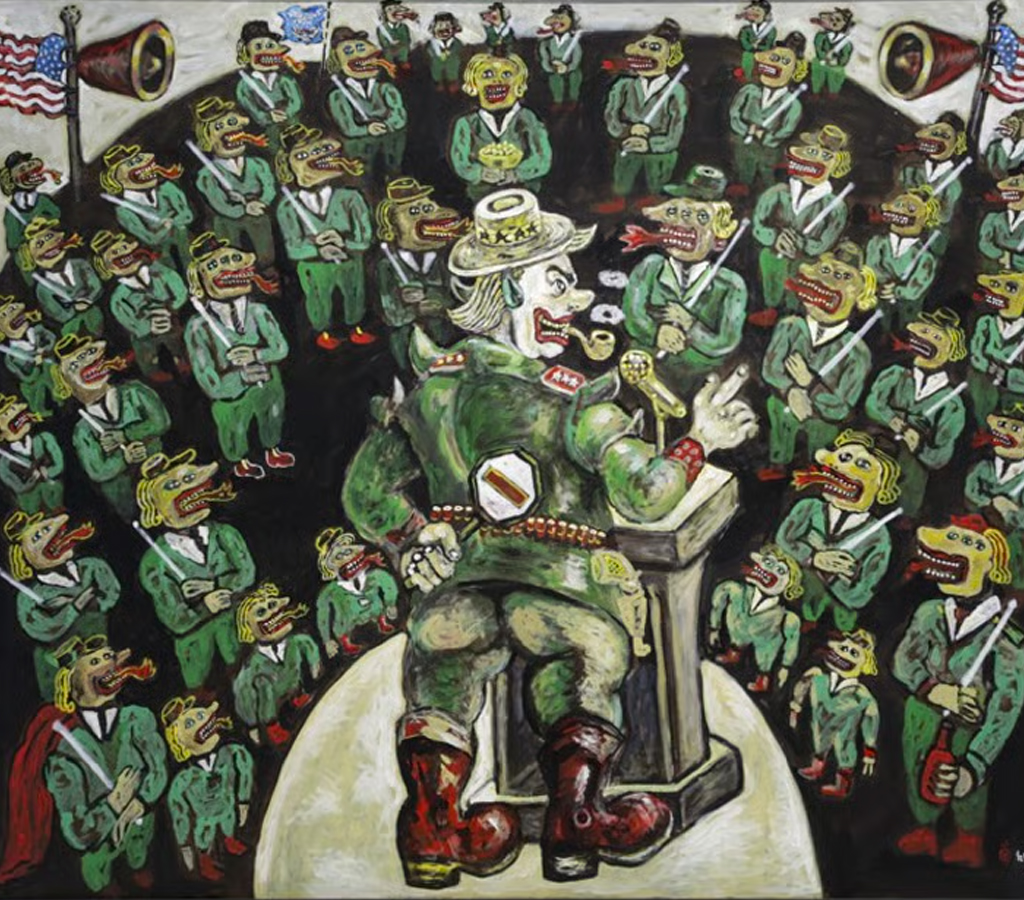
Heri Dono (Indonesia), Conference for security defence, 2016.
Parliament has already greased the wheels. In March, lawmakers rammed through revisions to the Armed Forces Law to expand the number of government agencies where active-duty officers can serve. Disaster relief, counterterrorism, border management, and even the attorney general’s office are now fair game for military men. This is not reform. It is regression, a deliberate dismantling of the democratic guardrails erected after the overthrow of Suharto. Students saw it clearly when they occupied Jakarta’s Fairmont Hotel to demand the military be sent back to the barracks. They know what is at stake: their generation’s future is being stolen in backroom deals.
When ordinary Indonesians poured into the streets, the government revealed its true face. Protesters were not met with dialogue but with bullets, checkpoints, and accusations of ‘treason’. Thousands were rounded up. Social media was throttled. Workers and students demanding dignity were branded extremists. This is the language of authoritarianism, not democracy. It is the state branding citizens who dare to speak out as enemies of the nation.
The memory of the Malari incident, demonstrations that occurred on 15 January 1974, still circulates among students. That wave of protest cracked the façade of the Suharto regime but did not end it; two and a half decades passed before Reformasi sent the military to the barracks and reasserted civilian rule. The lesson of Malari is brutal and clear: when a society fails to check militarised governance early, fear solidifies into habit and the costs of reversal multiply. Today’s detentions, internet throttling, and the casual branding of dissent as treason recycle a familiar script. To call this ‘law and order’ is to forget what law is for and whose order it protects.
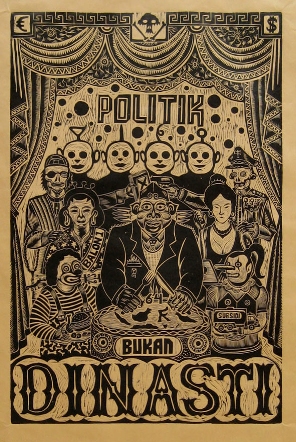
Taring Padi (Indonesia), Politics is not a dynasty, n.d.
Back to the August tragedy, the money tells the story. Indonesia’s defence budget is skyrocketing – the budget has grown by 166.5% between 2021 and 2026. For 2025, $15 billion has been allocated for the military and a further $22 billion is projected for 2026. This is a 40% surge at a time when schools are underfunded and hospitals overstretched. Officials insist it is about ‘modernisation’. But modernisation does not require soldiers planting rice. It requires civilian planning capacity, competent public procurement, and democratic oversight. The point, then, is not efficiency but enclosure: to embed the military into the sinews of the economy so thoroughly that rolling it back will appear impossible or too costly. The defence budget is not about defending the country, it is about embedding the military into every aspect of economic life.
This is how neofascist economies are built. Not with a single coup or a sudden collapse of democracy but with the steady normalisation of military control over the economy, the bureaucracy, and dissent. Indonesia still has a parliament, newspapers, and elections but those institutions are being hollowed out. Each new battalion, each new appointment of a general to a civilian post, and each mass arrest of protesters chips away at the foundations of civilian rule.
To understand the present, we must link three terrains.
- The legal terrain. Revisions that widen military roles in civilian agencies are not technicalities; they are the architecture of rollback. Reformasi’s core achievement was to disentangle the armed forces from the routine of governance. Any law that blurs those lines inches the country back toward dwifungsi (meaning ‘dual function’, a concept used by Suharto to justify militarisation). The insistence that these deployments are time-bound should not reassure us; authoritarianism grows through exceptions that become the rule.
- The economic terrain. Indonesia’s current development narrative champions downstreaming in strategic sectors, large infrastructure, and ‘food estate’ programmes. When security forces become implementers and guarantors of these projects, two corrosive processes follow. First, military-business fusion: procurement, land access, and logistics increasingly orbit around security institutions, creating new rents and unaccountable cashflows. Second, disciplinary welfare: nutrition and social protection become instruments for political patronage rather than entitlements grounded in citizenship. A social policy delivered by soldiers is not neutral; it is an education in obedience.
- The social terrain. The repression of protest is not episodic but systemic – it signals to workers, youth, and rural communities that the price of critique is criminalisation. When the state’s first reflex to dissent is arrest, charges of treason, and digital throttling, it narrows society’s horizons, teaching people to manage their anger in private and accept the untenable as permanent. This, too, is economic policy by other means: fear depresses bargaining power as effectively as any anti-union statute.
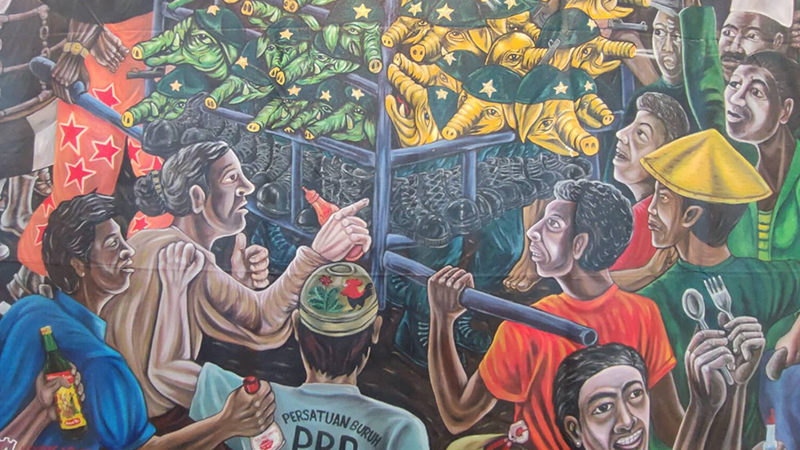
Taring Padi (Indonesia), Carrying Pigs, n.d.
The world cannot shrug this off as just another case of instability in the Global South. Indonesia is the world’s third-largest democracy and a G20 economy. Its debt rating could be downgraded, worsening fiscal pressures. If it succumbs to military authoritarianism, it will not only betray its people’s hard-won freedoms but also set a dangerous precedent for the region. A democracy as vast and vital as Indonesia cannot be quietly strangled while the world looks away.
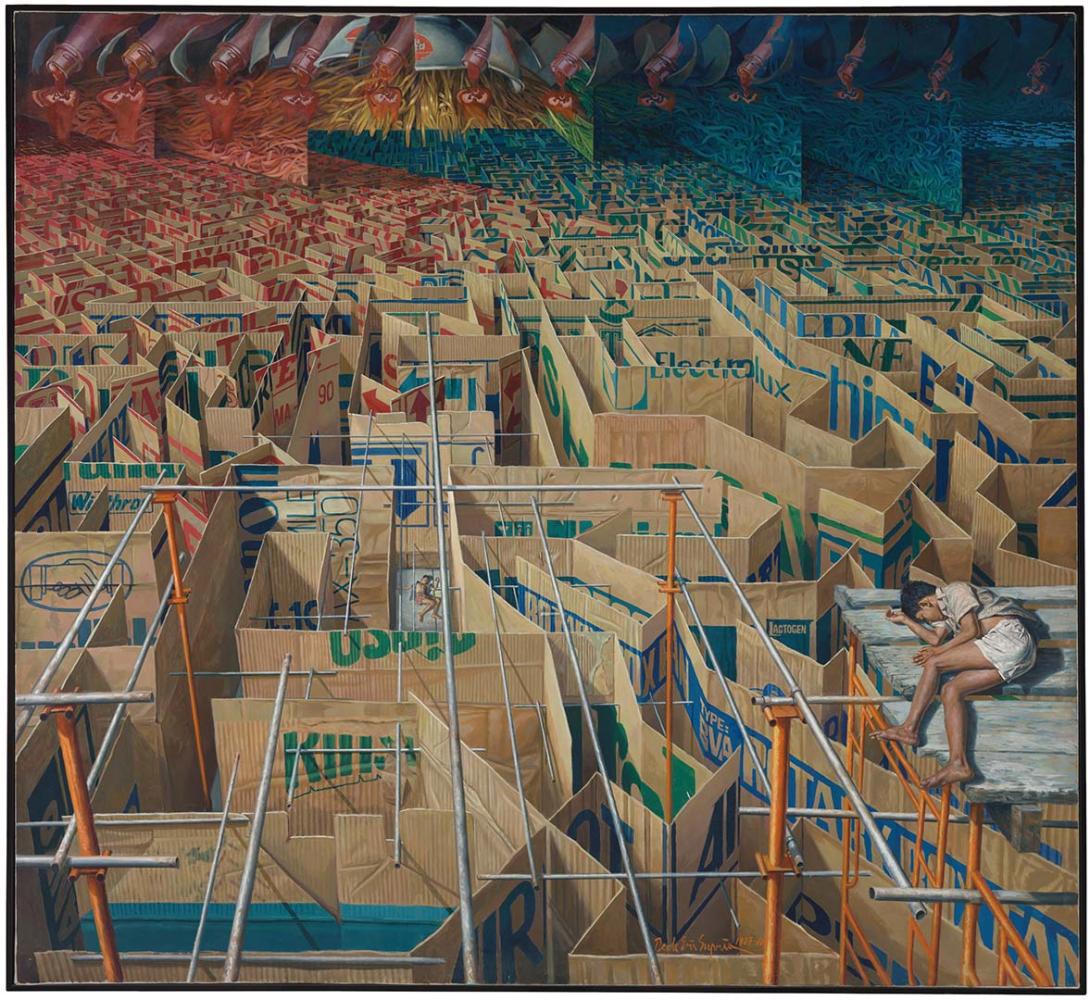
Dede Eri Supria (Indonesia), Labyrinth, 1987.
The choice now lies with Indonesians. Will they surrender to a regime that cloaks militarisation in the language of food security and welfare or will they fight to reclaim the unfinished promises of 1998? The protests sweeping the country are not only about perks for politicians. They are about whether Indonesia’s future will be shaped by the people or the generals.
Activists on the ground are correct when they say that this is a struggle for the soul of Indonesia. The time for polite warnings has passed. If Indonesians and their allies abroad do not act decisively, the barracks will once again rule the archipelago – not by coup, but by fiscal allocations, bureaucratic decrees, and the steady suffocation of dissent. Undoing the damage may be far harder than resisting it today.
Warmly,
Bhima Yudhistira Adhinegara and Muhammad Zulfikar Rakhmat
Bhima Yudhistira Adhinegara is the Executive Director of the Centre of Economic and Law Studies (CELIOS).
Muhammad Zulfikar Rakhmat is the Director of the China-Indonesia and MENA-Indonesia desks at CELIOS.