Contemporary Challenges for the Malaysian Left
To understand the current situation in Malaysia we need a brief overview of the history and political and economic development of the country.

To understand the current situation in Malaysia we need a brief overview of the history and political and economic development of the country. The Portuguese first came to Southeast Asia in the early 16th century. They, and the Dutch who came about 130 years later, had mercantile interests – they wanted to control the trade routes so that they could acquire the commodities that were in demand in the European market. Hence, they wanted control of the shipping routes and main ports, but were not interested in controlling the hinterland.
The industrial revolution in Europe created a hunger for raw materials such as tin, coffee, sugar, and rubber. The colonial powers needed control over the land in South East Asia to be able to mine, and to open plantations. They also needed cheap labour for the production of these commodities. The local population was not too inclined to slave in difficult conditions for low wagesi. Also, the British thought it best to not disrupt the indigenous Malay population, but instead relied on labour from India and China to develop the colonial economy. This led to a massive influx of Indians and Chinese to the Malayan peninsula starting in the mid-19th century.
Malaya, being colonised by the most ‘virile’ industrial power of that time, experienced the fastest development of mines, plantations, roads, railways, and ports, compared to Indonesia, Indochina, and the Philippines. This resulted in massive demographic changes – at Independence in 1957, the immigrant population of Chinese and Indians was actually slightly more than half the total population of Malaya. The class character of Malayan society had changed dramatically in the colonial period. Prior to 1800, the vast majority of the population were peasants and fishermen engaged in a subsistence economy. The colonial economy generated a large working class in the plantations, tin mines and the railways, and this in turn sparked off a network of supporting economic activities – market gardening, import of food and other basic necessities, retail trade, local production of some consumer products, transport, etc.ii
In the meantime, the native Malay population was shielded from the colonial economy, and their lifestyle and economic activities did not change much. The British were outwardly ‘respectful’ of the Sultans of the various States and provided handsomely for them, as this helped sustain the myth that the British were benevolent ‘advisors’ to the native rulers. Land was plentiful in Malaya, so the British had no cause to deprive the Malay peasants of their land. But they enacted a law that forbade the Malay farmers from converting their rice fields to plantations of rubber or other commodities for export.iii Rice was the staple grain for the Malays as well as the immigrant Chinese and Indians. The British needed a sufficient supply of inexpensive rice for immigrant labour.
The only strata within the indigenous community which resented British rule were the Malay chieftains and lesser royalties whose sources of income – levies on the produce of the peasants, contributions for the use of rivers, etc. – were compromised when the British took over the administration of land in Malaya. There were, therefore, a series of revolts by these chieftains in the late 19th century, but they were not able to get the support of the peasants (whose way of life had not been much affected by the colonial economy) or the Sultans who were well looked after by the British.iv
The Malayan Communist Party and the Independence Struggle
The Malayan Communist Party (MCP) was founded in 1930 in Singapore. The MCP retreated into the jungle in early 1942 and resisted the Japanese occupation of Malaya as the Malayan People Anti-Japanese Army (MPAJA). The MPAJA was largely ethnic Chinese as the Japanese had a pronounced anti-Chinese bias. The MCP was recognised by the British post-World War II, with its leader Chin Peng receiving the Order of the British Empire in London. The MCP opened offices in several towns in post-World War II Malaya and continued organising the population.
Independence was in the air in Asia, spurred by vibrant independence movements in China, India and in Indonesia by the end of World War II. Though many of the Malay and Indian nationalists had been on the opposite side during the Japanese occupation, the MCP managed to set up a broad-based coalition called the All Malayan Council of Joint Action (AMCJA).v It comprised the trade union movement, the MPAJA, the Malayan Democratic Union (a party set up by urban English educated Malayans), the Malayan Indian Congress, some Chinese business interests, and others. The AMCJA formed a pact with PUTERA, a coalition of Malay nationalists comprising the Parti Kebangsaan Melayu Malaya, Angkatan Pemuda Insaf (API), and the Angkatan Wanita Sedar (AWAS).
The AMCJA-PUTERA coalition had a series of discussions that resulted in the ‘Peoples Constitution’ detailing how the nation would be governed post-Independence. However, the British rebuffed the efforts of this coalition to initiate negotiations for independence. The AMCJA-PUTERA coalition called for a Hartal that was carried out on 20 October 1947. All activity in Malaya was stopped for a day – a nationwide strike where even businesses did not open.
The British struck back. API was banned in July 1947 and several of its leaders including the charismatic Ahmad Boestamam was detained and imprisoned. The British then passed legislation to control the militant trade union movement. Unions had to limit themselves to specific sectors of the economy. The then-existing General Labour Unions had to reorganise themselves into smaller sector-based unions and register with the Registrar of Trade Union (RTU). The RTU however refused to recognise many of the re-organised unions. When they attempted to continue to organise the workers, these unions were deemed illegal criminal organisations and their leaders detained. Strikes were met with brutal repression with instances of workers being killed by the authorities.
On 17 June 1948, a unit of the MCP assassinated three British planters in Sg Siput Perak. The British declared the Emergency, arrested thousands of activists and outlawed the MCP, which took to the jungles. In the initial period, MCP units were able to prevail, over-running small rural police stations and even briefly taking over the administration of a rural town, Gua Musang. The British High Commissioner of Malaya, Sir Henry Gurney of Malaya was assassinated on 6 October 1951.
The British countered with the Brigg’s Plan in 1950 to deny food supplies to the communist forces. All the Chinese farmers scattered in the peri-urban regions were forced to move into 540 security camps, with barbed wire fencing all around, and a single-entry point guarded by the military or police. The farmers were allowed to tend to their crops during the day but were under curfew from dusk to dawn. Plantation workers were not permitted to buy rice. The management of estates gave each family a daily ration of cooked rice depending on the size of the family. The indigenous community, the Orang Asli, too was similarly confined in security camps.
The communist insurgency, deprived of food, was not able to sustain larger units. A decision was taken in 1952 to retreat to the Malayan-Thai border.vi The British also had a propaganda blitz where they painted the MCP as Chinese dominated and injurious to the long-term welfare of the Malay population.
Meanwhile the British set up Legislative Councils with representatives from the elites of Malayan society – the Malay aristocracy and non-Malay business leaders. They recognised United Malay National Organisation (UMNO) that was set up by Malay aristocrats and elites in colonial civil service. A national election was called in 1955 in which the Alliance Party, a coalition led by UMNO, won 51 out of the 52 seats contested. It had campaigned on the pledges of Amnesty for the MCP and Independence within two years. The leader of UMNO, Tunku Abdul Rahman was designated as the Chief Minister of Malaya.
The MCP responded to the 1955 election pledges by indicating that it was interested in Amnesty. The MCP could see by then that winning the armed struggle would be near impossible. They wanted access to the people and the electoral space. A talk was held between Alliance leaders and the MCP in Baling, Kedah in December 1955. The MCP were prepared to lay down arms and even dissolve the MCP. They wanted the right to return to Malaya and participate in the political process.6 The Tunku insisted on surrender, detention, and rehabilitation. An agreement could not be reached. The MCP leaders felt that Tunku had to take a strong stand to impress the British so as to win independence. They hoped that negotiations would resume after independence, but the MCP had to wait 30 long years for that. In August 1957, the British granted independence to Malaya helmed by the Alliance government.
The Economic Development of Post-Independence Malaysia
Malaya was primarily a producer of primary commodities during independence (1957). Rubber was its biggest export, and tin was the second largest. The plantation companies have since diversified to oil palm – now 5.6 million ha out of the 8.4 million hectares of agricultural land in Malaysia is dedicated to oil palm cultivation, while rubber is grown on 1 million ha of mainly smallholder farms. In the 1980s, the government managed to acquire a majority of shares in the plantation companies listed on the London Stock Exchange and currently more than 60% of plantation land is held by government-linked companies.
In the 1970s, the Chief Minister of Penang then, Dr. Lim Chong Eu, pioneered special economic zones catering for multinational electronic companies looking for lower costs of production. Many multinational corporations opened factories in Penang and a network of supporting factories have evolved over the years. Electronic components are now the largest export commodity of Malaysia, dwarfing oil palm. Employment in the manufacturing sector now accounts for about 18% of total employment, but wages are at about the minimum wage level, and around 30% of all workers in manufacturing are foreign workers. Much of our manufacturing is linked to global chains.
Post-independence, large petroleum deposits were discovered in Malaysia. The government enacted the Petroleum Development Act in 1974 which vested ownership of all petroleum discovered in Malaysia in Petronas, a company fully owned by the Ministry of Finance. Any foreign oil company which discovers petroleum in Malaysia has to negotiate an income sharing agreement with Petronas. Petronas has been contributing between 20 to 40% of the federal revenue for the past 30 years.
On the social front, the following significant steps have been taken:
- Rice farmers (around 200,000) and traditional fishermen (80,000), predominantly ethnic Malay, receive subsidies of various sorts. But they still constitute one of the poorest sectors of Malaysian society.
- 110,000 rural families have been allocated ten acres of land each under the Federal Land Development Authority land schemes. Slightly less than a half a million ha of land has been utilised for this scheme. Oil palm is the main crop.
- The Employment Provident Fund (EPF), that was set up in the late colonial period has now grown to cover about twelve million members (out of a labour force of sixteen million) and has total assets of RM 1.2 trillion (Malaysia’s GDP in 2025 is RM 1.875 trillion).
- The Social Security Organisation (SOCSO) was set up in 1971 pursuant to a 1969 Act of Parliament and currently covers about nine million workers. It compensates workers for workplace injuries, and provides a life-long pension if a worker becomes disabled for any reason. SOCSO recently initiated schemes to cover gig riders and housewives.
- The government has set up a network of hospitals and clinics such that 95% of the population is within three km of a health care facility. Childhood immunisation is at 99% of the eligible population. Life expectancy increased from 66.5 years at independence to 75 years currently. Mortality under five is now 7.8 per 1000 live births.
- Schooling is free up to the secondary level – thirteen years in total.
Malaysia’s GDP has increased 24-fold, in real terms, between 1970 and 2020. The population’s access to modern conveniences – refrigerators, cars, washing machines, gas cookers, televisions, handphones, etc. – has increased tremendously. However:
- Wages are about 1/8th of the wages in Europe for work of a similar nature.
- Household debt is about 200% of total household income. The ratio is higher for the lower decile of the population.
- Many working people work more than 48 hours per week to try and make ends meet.
- 21% of children under-five in Malaysia are stunted.vii
- House prices are exorbitant, and housing loans are a major component of household debt.
- Old age poverty is a sad reality in Malaysia. 75% of the retirees aged 65 and above do not have any savings to draw upon.
- While highly subsidised health care is available for all, the public health care system is underfunded, receiving only 2.4% of the GDP. Waiting lists are long, and so, many families take out private insurance so that they can go to private hospitals if there are delays in the public health care system.
- 50% of the rice consumed in Malaysia is currently imported. As wheat cannot be grown in Malaysia, we are totally dependent on wheat imports. Malaysia is a highly food insecure country!
In addition, since the 1990s, Malaysia has entered a number of Free Trade Agreements which threaten the economic sovereignty of the country and seriously impair the ability of the Malaysian government to manage the national economy. For example:
- The ASEAN Free Trade Agreement has tied us to a zero-tariff policy for over 98% of goods vis-à-vis ASEAN countries. This constrains us from raising our minimum wage by a larger quantum as then, cheaper manufactured goods from ASEAN would devastate our manufacturing sector. And our food producers are subject to dumping of excess produce from the neighbouring ASEAN countries.
- The Comprehensive and Progressive Agreement for Trans-Pacific Partnership and other agreements grant foreign investors numerous rights including the right to enter any economic sector that is open to local businesses, freedom from any requirements to enhance local technical capacity or use local inputs, and freedom from any form of capital controls.
- The Investor State Dispute Settlement (ISDS) provisions exist in several of these FTAs.viii
Malaysians are living better in material terms, but are under severe economic stress as incomes are generally low, and the cost of living is high. There is a high level of insecurity and uncertainty and therefore stress. This needn’t be so. Our analysis (Table 1) shows that too large a portion of national income accrues to the owners of capital!
Table 1: The share of national income accrued to various social groups in Malaysia.
Social Strata | Share of National Income |
16 Million Working People | 29% |
Government | 16% |
Owners of Capital & Top Managers (0.3 million individuals) | 55% |
The Parliamentary Left
The radical Malay nationalists who were detained in 1947 were released in 1955 before the national elections. Some among them, including Boestaman, set up the Parti Rakyat (Peoples Party) while others entered the Parti Buruh (Labour Party). These two parties contested the general elections of 1959 as the Socialist Front and won eight seats in the 104-member parliament. They also did well in the Municipal elections winning a majority of seats in the Penang City Council and the position of Mayor.
The Alliance government abolished Local Council Elections and used the Internal Security Act (ISA) to detain more than a thousand Socialist Front leaders and activists in the 1960s, seriously impeding the expansion of the Front.ix Issues involving language and the nature of Malaysia also divided the Chinese and the Malay members of the Socialist Front. The Chinese members, largely in the Parti Buruh, wanted equality for all nationalities in Malaysia, with three official languages. The Malays, largely in the Parti Rakyat, wanted Malaysia to be recognised as part of the Nusantara Melayu (the Malay homeland); while the languages and religions of the immigrant communities would be respected, Malay language and culture should be the bedrock upon which the Malaysian nation should be based. These issues led to the break-up of the Socialist Front in 1966.
The Parti Buruh, weakened by the detention of many of their leaders and disillusioned with the electoral process, decided not to contest the 1969 elections. A significant number of them went underground and linked up with the MCP. The Parti Buruh was then de-registered. The Parti Rakyat won two state assembly seats in Pahang in 1969, but the two elected members spent their terms under detention under the ISA. These were the last election victories of the Parti Rakyat.
Ethnic Imbalances in Malaysia
For reasons that have been elucidated in the section on the colonial period, the Malay community was economically disadvantaged during independence. As they had remained outside the modern economy, the academic achievement of Malays and their representation in the professions was far below their population ratio.
This was recognised by the Malaysian leaders at that time, and a special provision (Article 153) was included in the Federal Constitution empowering the Constitutional Monarch to grant special quotas for Malays in educational institutions and permits for businesses. Many special residential schools and junior colleges were set up to enable the Malay population to catch up academically. Many scholarships and business permits have been awarded. Intake into government jobs such as clerical staff, teachers, and nurses have witnessed a very high proportion of Malays resulting in our 1.6 million civil service now being more than 85% bumiputera.x
This affirmative action premised on ethnicity – termed the New Economic Policy (NEP) – has seen the creation of a large Malay middle class and has stabilised Malaysian society considerably. But, as the Table 2 shows, there is still a significant imbalance – the Malay community hasn’t reached their population ratio in some key professions.
Table 2: Bumiputera participation in selected professions
Profession | 1973 | 2014 | 2023 |
Engineer | 13.5% | 32% | |
Medical doctor | 7.6% | 46% | |
Veterinary doctor | 30.8% | 42% | |
Dentist | 8.4% | 52.8% | |
Accountant | 17.9% | 32.3% | |
Lawyer | 20.3% | 38.9% |
The Malay community constitutes about 60% of the population of Malaysia. The indigenous populations of Sabah and Sarawak make up another about 10% of the population. They are collectively termed bumiputera (sons of the soil) in some government documents. The Chinese community makes up 23% of the Malaysian population while the Indians constitute 7%, and the Orang Asli are around 200 thousand strong. The figures in the Table 2 attest to the fact that even 60 years post-independence, the bumiputera are lagging behind in several occupations.
The bumiputera communities are still over-represented in agriculture which is a low-income sector. Even in the formal sector, the available data indicates that they are earning much less than non-Malay workers as their median EPF savings were significantly lower than the non-Malay population (as Table 3 shows). Also, they did not have other financial assets to rely on during the Covid-19 lockdown and had to withdraw a large portion of their already meagre retirement funds.
Table 3: Median EPF savings (in Malaysian Ringgit) before and after the Covid-19 lockdowns, by ethnic group.
Race | Savings (April 2020) | Savings (December 2022) | Decline |
Bumiputera | 15,541 | 4,937 | -10,604 |
Malay | 16,938 | 5,529 | -11,409 |
Othe Bumiputera | 10,591 | 3,302 | -7,289 |
Chinese | 45,756 | 45,162 | -594 |
Indian | 25,724 | 14,929 | -10,795 |
Class Differentiation of the Malay Community and the Reformasi Movement
Malay society has undergone a massive change in the past 65 years. Now, the majority of them are wage-earners in urban areas. The feudal ties that bonded them to their rural villages have been weakened. They are part of the urban working class and are struggling financially because of low wages and high cost of living.
UMNO, the party that led the nation to independence and that oversaw the implementation of the ethnic based affirmative action favouring the Malays has also transformed from a grassroots-based party of school teachers, journalists, and religious leaders into a party of businessmen, contractors, and corporate bosses. Much of the financial allocations meant for the Malay poor is now captured by this stratum of Malay business people.
The financial crisis of 1997-1998 led to a severe crisis within the UMNO elite. There were too many crony capitalists who needed funds, and there was disagreement on who to save, whether to accept IMF loans, etc. The then Prime Minister, Dr. Mahathir Mohamad, sacked his deputy Anwar Ibrahim citing sexual impropriety. This sparked the Reformasi movement. Ibrahim campaigned on the issue of governance, corruption, and the fattened Malay elite who had hijacked funds meant for uplifting the Malay poor. He utilised his Islamic credentials to strengthen his criticism. A significant part of the Malay urban population joined the movement.
Ibrahim was imprisoned in 1999.xi Mohamad stepped down as Prime Minister in 2003. In 2009, Najib Bin Razak became the Prime Minister. Then, the 1MDB scandal erupted in 2016. This reignited the Reformasi movement. The corruption associated with the UMNO elite had become common knowledge by then. The mighty UMNO party began losing ground and the Pakatan Harapan, Ibrahim’s coalition, formed the government in 2018.xii
The Current Status of the Malaysian Left
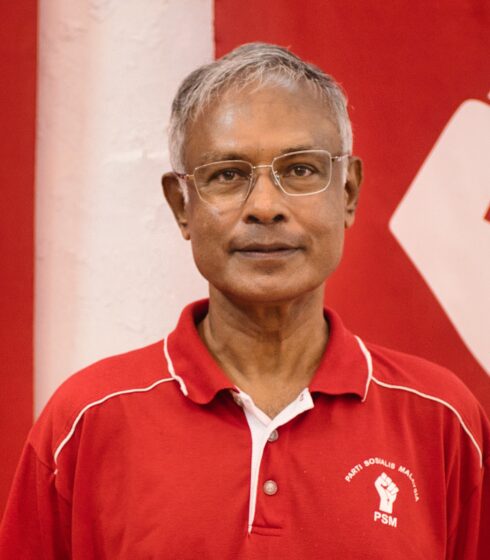
The Parti Sosialis Malaysia (Socialist Party of Malaysia or PSM) is currently the most visible and active left party in Malaysia. However, because of our origins as student activist groups working among plantation workers (largely Indian), currently about 60% of PSM members are Indian. The PSM began working with non-Indian ethnic groups in the late 1990s and our Chinese and Malay membership is increasing gradually. We need many more cadres of all ethnic groups.
Apart from the PSM, there are several other left parties in Malaysia:
- The veterans of the MCP and the Parti Buruh. These veterans outnumber the PSM. The former members of the MCP who were allowed back into Malaysia after the Haatyai Peace Accord of 1989 have formed the Kawan Karib (Close Friends) and the 21st Century associations. They have regular dinners and social gatherings. But they are not politically active apart from publishing several memoirs and biographies that detail their role in the struggle for independence. Some among them support our fund-raising dinners.
- The Parti Rakyat. It is a shadow of its former self. It still puts up a few candidates at each general election, but does little in the intervening periods except for the occasional press statements. The PSM is trying to persuade them to join us in forming a progressive third force coalition.
- The Socialist Alternative. The Socialist Alternative is a small group that is affiliated with the Committee for a Workers’ International. They come out with periodic analyses of the current situation. Their analyses are good, but lacking in concrete ideas of how to move forward given the current reality. They still practice ‘entryism’ which makes it difficult to include them in joint activities. In any case, they believe that the PSM is leading the working class astray with our reformist policies and participation in elections.
- Left-leaning individuals in media, NGOs, academia, and civil society. There are quite a large number of such individuals. They are supportive of our campaigns and other activities. The PSM is keen to get them onboard as there is a lot of work to do.
Challenges Facing the Left in Malaysia
The left in Malaya/Malaysia has been beaten down twice in the past 80 years. The British managed to neutralise the armed insurrection of 1948. By 1952, the MCP was effectively excluded from Malayan society. The Alliance government used the ISA to detain hundreds of Socialist Front leaders and union activists in the 1960s, and crippled the parliamentary left. History, they say, is written by the victor. The left has been vilified by official propaganda for the past 80 years, both in the print media as well as in the text books.
As a result, the public perception of the left is rather negative. Many Malaysians feel that the left is innately authoritarian, anti-democratic, and violent. The armed insurgency of the MCP, the authoritarianism of the Soviet Union from 1930 onwards, the genocidal regime of the Khmer Rouge, and Western propaganda have all contributed to this fairly entrenched view.
Religion has a great influence over the Malaysian population. About 80% of Malays surveyed a few years ago said that Islam was the most important component of their identity, only then ethnicity, and nationality. Some Malays fear that joining the PSM would make them too ‘secular’ and impair their ‘Aqidah’. Conservative religiosity isn’t confined to Muslims. In the recent by-elections for the state seat of Ayer Kuning (on 26 April 2025), our candidate Bawani was attacked by opponents for being an atheist.xiii
The PSM has responded to these two perceptions and fears by arguing that:
- We believe in democratizing society – at the workplace through unionisation, at community level through the formation of community level councils, and by re-instituting local government elections.
- We contest elections, we organise campaigns as permitted by the laws of the country.xiv
- We have been involved in so many community struggles for the past 30 years. There hasn’t been an instance where we initiated any violence.
As for the perception that the left is against religion and faith, we state that we are not anti-religion. There is no requirement to renounce religion in order to become a PSM member. The PSM believes that religion is a personal matter and there should be no compulsion on anyone to follow or leave any particular religion. There are people of all faiths in the PSM. There are also atheists and agnostics. It is their right to not believe. We also point out that socialism, which is based on solidarity with all, including the poor and the marginalized, is much more in line with the principles of religions than capitalism.
There are quite a number of people who believe the left does not have the capacity to manage a modern economy. Unfortunately, there is some truth in the general perception that parties left of the social-democrats are idealistic and out of touch with current reality. Too many in the left have not given sufficient thought about our programme for the first five years after taking power should be. We need to move from critiquing capitalism and imperialism to explain, in layman terms, how we will transform the current reality into something that is better for all the citizens. We need a realistic transitional programme that the ordinary person can understand, and identify with. It cannot be just an article of faith!
In the Malaysian context we need to have positions on the following issues (among others):
- Our stance on foreign capital already invested in Malaysia? At present our economy is export oriented and we need market access. The value of Malaysia’s exports is equal to 75% of GDP. Disengaging too abruptly from the global system would result in high unemployment rates and economic misery.
- Are we thinking of working towards a planned economy like there was in the USSR, or of a well-regulated market economy that allocates resources through a system of prices set by supply/demand mechanics (as has developed in China)?
- What is the role of small and medium sized firms in the economy we are envisaging? Many of them are owned by Malaysian Chinese. Would we want to develop a strategic partnership with them to enhance Malaysia’s industrial and technological self-reliance?
- How would we reduce the tendency of the leaders of our movement being over-influenced or even bought over by business interests?
- Would we want to put up tariffs to protect domestic manufacturing industries which are obliged to implement the higher wages we would legislate? If so, how would we disentangle ourselves from international trade and investment agreements that Malaysia has signed on to? These agreements tie us to a low or zero-tariff regime.
- Or would we keep wages relatively low, so that our industries remain competitive, but increase the social wage (subsidised health care, public transport, free tertiary education, residences for rent, etc.)? Or would we implement a negative income tax that would level up the income of all working Malaysians to a basic minimum?
- How would we handle the fiscal deficit and the RM 1.2 trillion debt that the government has accumulated?xv Debt repayment is now RM 56 billion or 17% of total government revenue. Would we increase corporate taxes unilaterally or would we try to do this in conjunction with ASEAN and other countries?
- Could we use the modality of debt financing? If so, to what extent?
These are some of the issues that we need a clear understanding of if the left intends to take over the management of a modern economy that is closely integrated into the global capitalist economy. The PSM is working on several of these issues in our Policy Research Bureau, but there are many issues that we still do not know enough about.
There is thus a basis for the comment, ‘you people are good activists who speak up for the marginalized. Stay as an NGO and continue the good work’. In other words, they do not trust us to manage the economy and fear that we would crash it by causing capital flight, unemployment, and social unrest. We need to address these fears by clarifying our own understanding of these issues, and achieving a consensus about the pace of progress towards socialism.
Apart from all the negative perceptions of the left in the Malaysian public, the left faces a very ethnically polarised society. After the demolition of the left at the end of the 1960s, all the main political parties – both in government and opposition – were ethnic or religious based. Fifty years of ethnicised politicking has created a highly polarised society. The Malay population (60% of total population) are still the poorer compared to the Chinese (23% of the total). The Malays are anxious that the affirmative action they have enjoyed would be withdrawn. They fear becoming ‘second class citizens’ in their own country.
The Chinese business class’s grouse is that they are creating wealth for the nation, but are being unfairly treated. Communities of Chinese farmers who have been tilling state land since before independence keep getting evicted with scant compensation whenever nearby urban centres need houses or industrial sites. The Chinese fear that their vernacular schools will be closed, and that Islamic dress codes and other restrictions will be enforced on them.
The indigenous peoples of Sabah and Sarawak – the Kadazan, Murut, Sulu, Bajau, Iban, Bidayu, Kenyah, Kayan, Penan, and several others (10% of the total Malaysian population) – feel that they are being neglected by the government, and that their land rights are being trampled upon. The Indians (7% of total population), are resentful that they are left out of most affirmative action programmes and denied government jobs, though there are many Indians who are in need. They also are afraid that some of the 500+ Tamil primary schools in the country will be closed down. Hindu Temple demolitions are another sore point.
The PSM is trying to impress on the people that:
- The grievances and fears of all the communities are valid and have to be dealt with in a spirit of solidarity. The Malaysian Constitution presents well-balanced formulae for handling most of the outstanding issues. However, certain issues are exaggerated and played up by politicians vying for power.
- The working people of all ethnicities need to be united to demand a fairer share of the economy.
- The main political parties which play up and exaggerate ethnic conflicts are actually traitors to the working people, for they divert attention from the crucial issue – 55% of the wealth created by our collective effort is going to 3% of the population leaving 97% of the population with only 29% of the wealth.
Apart from the above challenges, repression by the authorities is a persistent danger. This was consistently used to cripple left movements in the past.xvi The likelihood of this being used against us is high if we succeed in rallying more people to our side and appear as a threat to the status quo.
Undoubtedly, the Left in Malaysia faces several tough challenges. However, the PSM believes that we have the ideas that can take this nation forward. And we are working hard to build a movement that will bring a progressive coalition of political parties and people movements to power.
Notes
i The annual mortality rates for immigrant labour in some estates were as high as 10% for certain years due to malnutrition, malaria, other infections, and snake bites.
ii Kevin Henison and Jim Glassman, ‘Class in Southeast Asia’, in Class, Economy and Politics in South East Asia (University of Philippines and Journal of Contemporary Asia, 2024).
iii Rice Land Enactment (1917).
iv Dato Maharaja Lela assassinated James W. W. Birch, the British Resident of Perak in November 1875, launching the Perak War against the British. He was executed by the British in 1877. There are several other noblemen e.g. Mat Kilau and Dato Bahaman, who also rebelled and resisted British colonial rule.
v The Japanese encouraged Indian nationalists to set up the Indian National Army under Subash Chandra Bose. This army fought alongside the Japanese in the Burmese – Indian border.
vi Chin Peng, Alias Ching Peng: My Side of History (Media Masters Pte, 2003).
vii UNICEF.
viii ISDS provisions provide for foreign investors to by-pass national courts and refer disputes with the host government to a private Tribunal in Hong Kong, Europe or in the US.
ix The ISA empowered the Minister of Home Affairs to detain persons suspected of being a threat to the security of the Nation for a period of two years, without the requirement to charge the persons in Court. The period of detention could be extended for another two years if the Minister deemed it necessary. Individuals have been held for up to 20 years under this Act. This Act was repealed in 2013.
x Bumiputera means ‘son of the soil’. It refers to ethnic Malays who make up about 60% of the population of Malaysia and indigenous Sabahan and Sarawakians who make up another 10% of the population of the country.
xi On sodomy charges. These were reversed in 2004 and Ibrahim was released.
xii Results of the General Elections in Malaysia. The Barisan Nasional is the coalition led by UMNO. Should be noted that some coalition members left after 2018 and others left in 2022. The total number of seats in the Malaysian Lower House is 222.
Year
Seats won by the Barisan Nasional
2004
198
2008
140
2013
132
2018
79
2022
30
xiii We only obtained 6.3% of the votes cast, as we had anticipated. But we achieved our targets – exposure in the mainstream media as well as several dozen videos about our analyses and work in social media.
xiv The PSM organises campaigns highlighting major issues affecting the people. Our last campaign was for universal old age pension to address old age poverty. An 18-month long campaign. We are just beginning a campaign to defend and improve the public health care system which is chronically underfunded and under assault.
xv Malaysian GDP was RM 1875 billion at the end of 2024.
xvi Six senior members of the PSM were arrested under the Emergency Ordinance in 2011 and investigated for ‘attempting to rekindle the armed struggle’. The Emergency Ordinance allows detention without trial for an indeterminate period, just like the ISA. The PSM conducted a vigorous campaign and managed to release us after a month.
 | Jeyakumar Devaraj |