Fifty Years After Soweto: A Struggle Without Documentation Is Not a Struggle
South Africa’s anti-apartheid photographers did not merely record brutality. They preserved evidence, built collective memory, and transformed the camera into a weapon of political education and international solidarity.
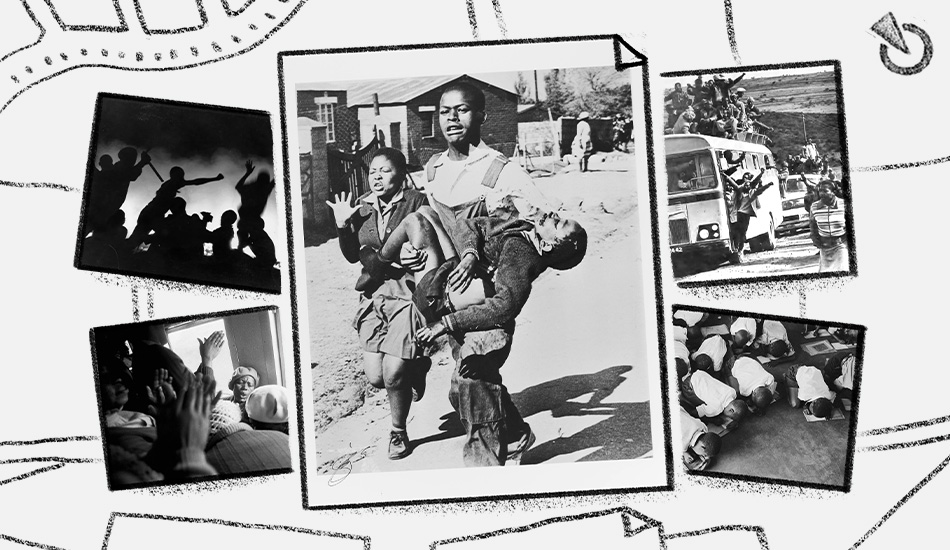
This art bulletin is dedicated to Abdullah Ibrahim (1934–2026), the legendary South African jazz musician and anti-apartheid activist who passed away this month. During his lifetime, he weaponised cultural expression – and in particular the piano – into a profound act of political resistance, including through his song ‘Soweto’.
Stand at the corner of Moema and Vilakazi streets in Orlando West, Soweto, South Africa. Twelve-year-old Hector Pieterson was shot here at half past nine on the morning of 16 June 1976 – half a century ago this month. Now look down. Near this spot, photographer Masana Samuel ‘Sam’ Nzima took six frames with a Pentax SL and a 50mm lens. The third became an image that travelled the world: eighteen-year-old Mbuyisa Makhubo running with Hector’s body, his sister Antoinette Sithole running alongside them. On the ground beneath them, a deep shadow falls across the asphalt. That shadow is evidence – recording the angle of the morning sun, the specific stretch of the Soweto road, the exact moment the apartheid state shot a schoolchild.
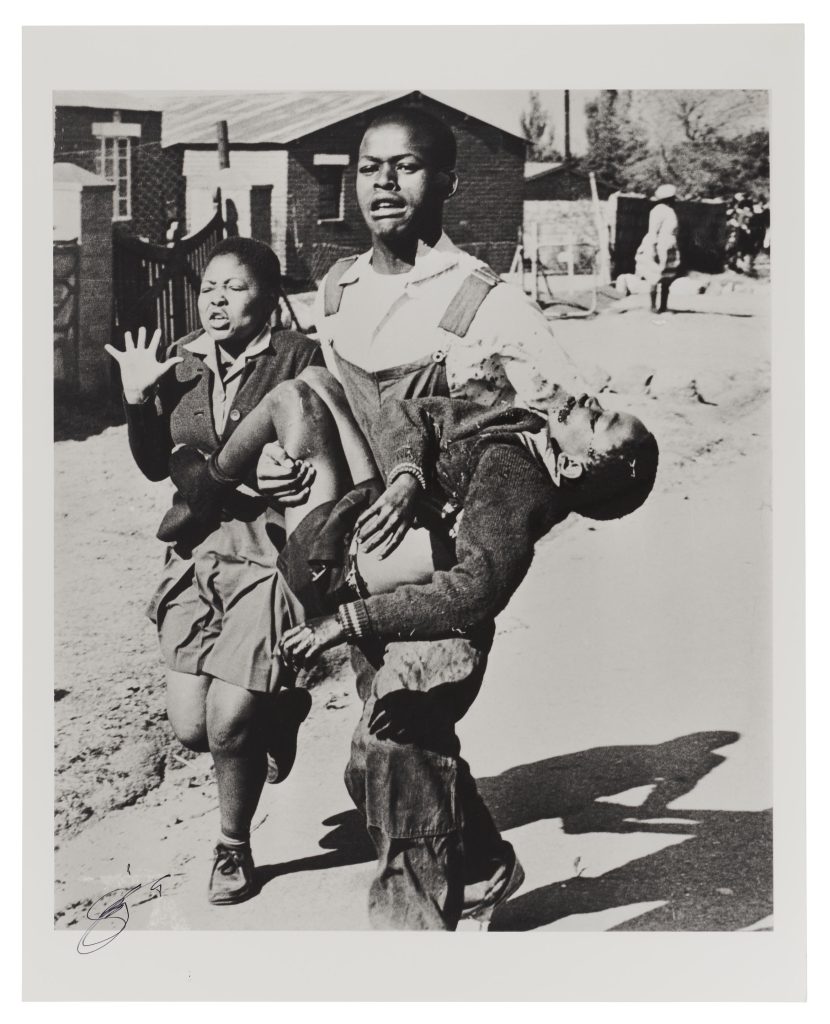
Hector Pieterson being carried by Mbuyisa Makhubo, 16 June 1976. Credit: Sam Nzima.
This image became an international symbol, endlessly reproduced as posters and silkscreened onto millions of T-shirts throughout the 1980s by the international anti-apartheid solidarity movement, from the Organization of Solidarity with the Peoples of Asia, Africa, and Latin America (OSPAAAL) in Havana and the Anti-Apartheid Movement (AAM) in London to the Medu Art Ensemble in Gaborone, Botswana. Together, these groups made visible the brutalities of the apartheid regime and helped mobilise a global movement towards its defeat. This bulletin, however, is not about a single photograph but about a generation of photographers who documented apartheid, revealing its shadows, and the liberation struggle waged against it.
Photographing the Soweto Uprising
On 16 June 1976, between 3,000 and 10,000 schoolchildren marched in eleven columns toward Orlando Stadium. Their immediate grievance was the imposition of Afrikaans as the language of instruction in African schools, decreed without consultation. Their broader grievance was Bantu Education – or, as prime minister Hendrik Verwoerd had engineered it over two decades, a ‘separate and inferior’ system designed to teach Black children that there was no place for them beyond their labour. The Soweto Students’ Representative Council – led by nineteen-year-old Teboho ‘Tsietsi’ Mashinini, nineteen-year-old Murphy Morobe, and sixteen-year-old Seth Mazibuko – had resolved to start the march at Naledi High School on 13 June.
The first shots were fired at about 09:30. Fifteen-year-old Lesley ‘Hastings’ Ndlovu was the first child killed; Hector Pieterson was the second. By the end of the day, at least twenty-three were dead in Soweto, most of them students and young people; by the end of the year, more than 700 had been killed across the country.
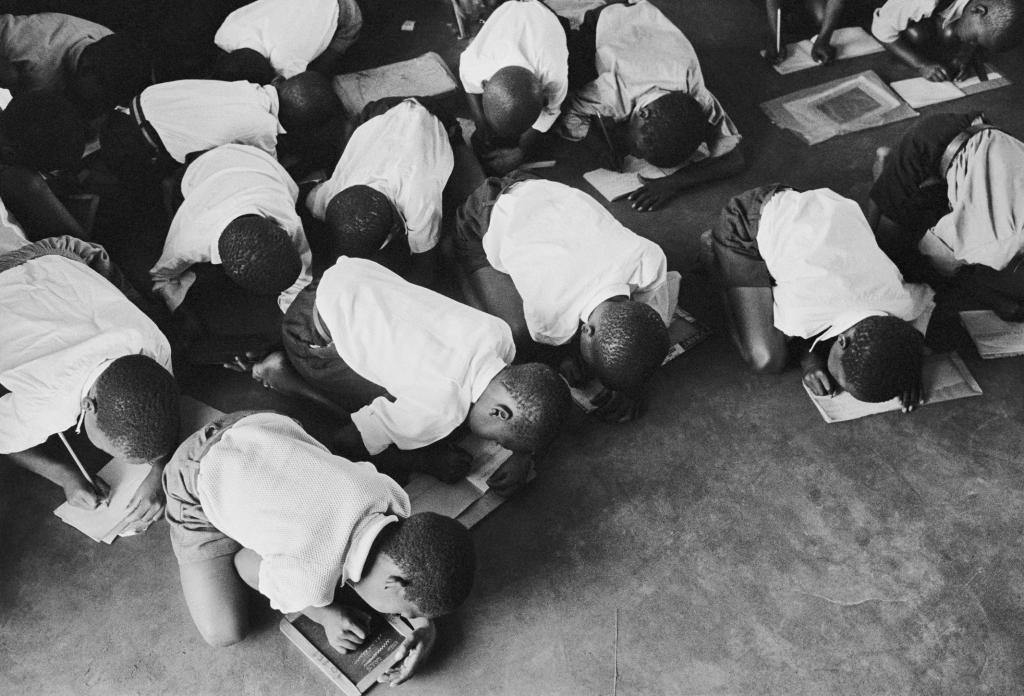
Students kneeling on the floor to write, 1960s. Credit: Ernest Cole.
Alongside the students were the photographers. Sam Nzima worked for The World, the country’s most prominent Black newspaper at the time; Peter Magubane photographed for the Rand Daily Mail; and Alf Kumalo worked for the Sunday Times. They photographed. They were beaten. Some were arrested. They smuggled the negatives out through any channels available to them.
Kumalo, who lived in Soweto and chronicled the township for half a century, was persecuted by the same apartheid forces he was photographing. He recalled, ‘I was arrested, beaten up. They cracked my skull’.
It was not just photographers who bore witness to the atrocities that day in Soweto. Inside Chris Hani Baragwanath Hospital, Dr. Malcolm Klein noticed that some of the casualties arrived with ‘strange wounds: small entrance holes in their upper bodies, with larger exit wounds lower down’. Doctors later realised that police had been firing from helicopters overhead. When the police demanded a list of every patient admitted with a bullet wound so that survivors could be prosecuted for ‘rioting’, the doctors and admission clerks refused. Instead, they recorded the reason for admission as ‘abscess’. ‘In this way’, Klein said, ‘we protected an unknown number of patients from being victimised twice by police brutality’.
The Camera Was My Gun
The cameras kept working after that morning and, over the decades, photography became more than a record of events: it became a practice of political education, collective memory, and resistance. ‘A struggle without documentation is not a struggle’, Peter Magubane recalled telling young protesters who refused to get their pictures taken that morning in Soweto. Magubane himself had spent 586 days in solitary confinement in 1969 for his photographic work, often hiding his camera in a hollowed-out Bible.
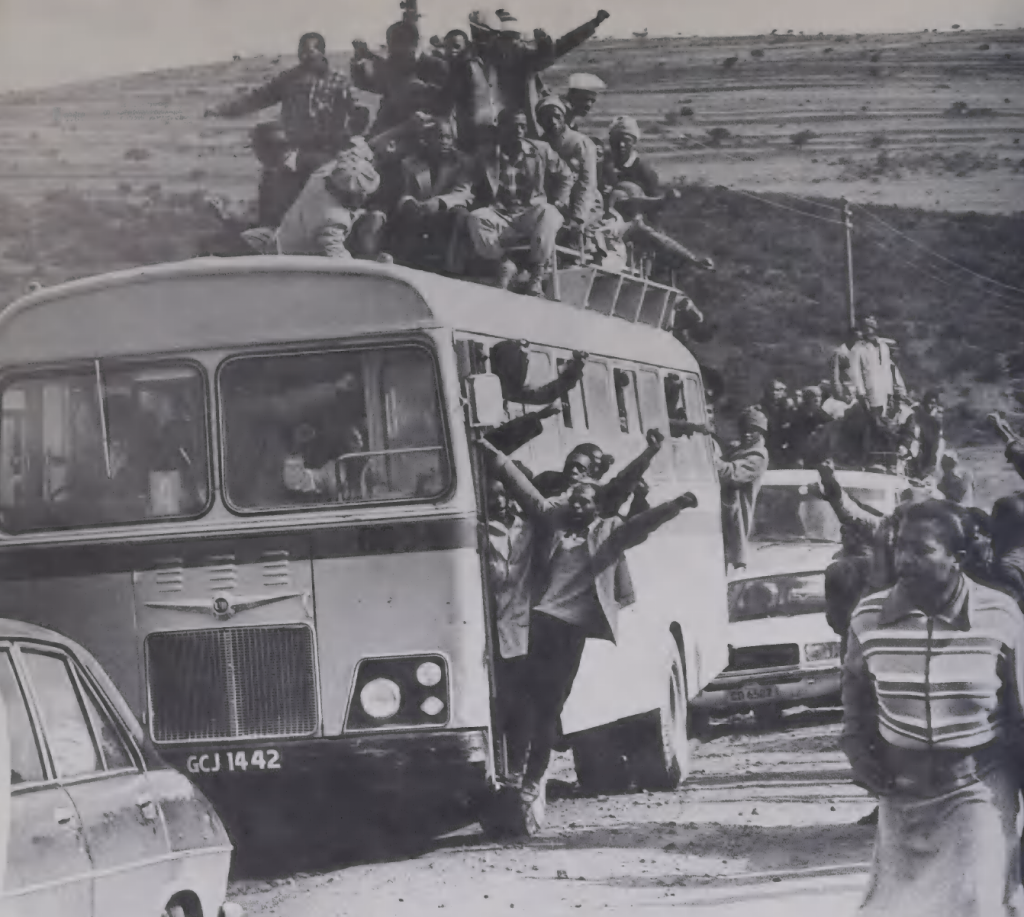
Funeral procession in Zwelitsha, King William’s Town (now Qonce), Eastern Cape, 1978. Credit: Peter Magubane.
Look at one of Magubane’s photographs, published in Soweto: The Fruit of Fear (1986): a bus packed with mourners, fists raised through the windows, more on the roof, a line of cars behind, open hills beyond. The year is 1978. The place is the Eastern Cape, the region of Steve Biko, a co-founder of the Black Consciousness Movement that inspired the Soweto Uprising. Biko had been killed in police custody the previous September. Here, Magubane documents a new political form under apartheid, in which funeral processions became substitutes for the meetings and marches that had been banned. In this context, cameras also took on a new meaning. As Magubane said, ‘I was able to carry my gun; the camera was my gun. I was able to kill apartheid with my gun’.
Look at another image, this time by Ernest Cole. A line of Black men, naked and facing a wall, hold up their arms as they undergo the medical examination of mineworkers under the apartheid migrant labour system. The same apparatus that classified those bodies had classified Cole’s: to obtain the passport that allowed him to leave South Africa with his negatives, he reclassified himself from Black to ‘Coloured’ and changed his surname from Kole to the more English-sounding Cole. The negatives he carried out – including the image of the mineworkers – were published in the United States in 1967 as the book House of Bondage. The book was banned at home. After the South African embassy refused to renew his passport, Cole spent years living on the streets. In 1990, one of South Africa’s greatest photographers died stateless in New York. His ashes were later returned to South Africa and buried in Mamelodi.
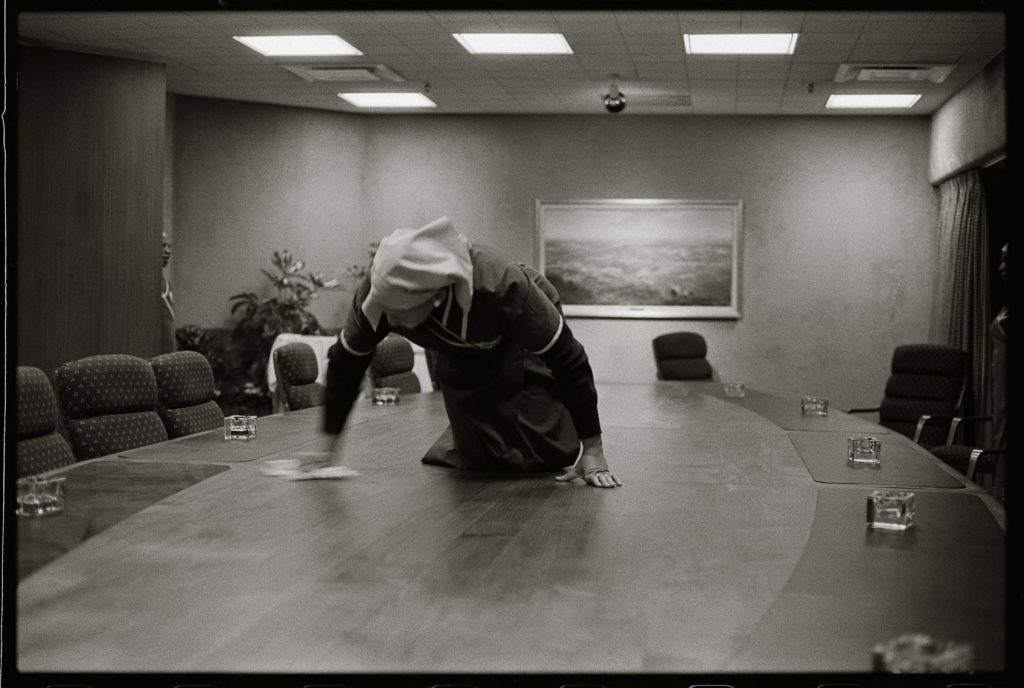
Night Cleaner Polishing the Boardroom Table, Johannesburg, 1984. Credit: Lesley Lawson.
Look at Lesley Lawson’s Working Women (1985). Lawson spent the early 1980s photographing Black women at work across South Africa, from domestic workers in white suburban kitchens and factory workers on production lines to agricultural labourers on white-owned farms. The book paired her photographs with the women’s own words on hours, pay, and the journey to work, giving a visual record to women whose labour underwrote the apartheid economy but was largely invisible in the media iconography of the decade. Lawson worked with the South African Committee for Higher Education (SACHED), which was the workers’ education trust, and Working Women functioned not only as a teaching tool for workers’ study groups, but also as a documentary record.
Look at Santu Mofokeng’s 1986 photographic series, Train Church. One image captures a carriage of the Soweto-Johannesburg commuter line at dawn: workers stand with hands raised, mid-song, while one man bangs against the train’s interior wall as if it were a drum. The commuter line – the daily mechanism of the apartheid economy that carried Black workers in and out of the white city before dawn and after dark – was transformed into a church, where mostly middle-aged women in work clothes sang, preached, and found solace. It was ‘a daily ritual’, as Mofokeng called it. Despite the dehumanising logic of the apartheid economy, Black workers were actively building the cultural and spiritual life that the system was designed to deny them. Mofokeng’s own commitment, he said, was to photograph ‘ordinary Black South Africans going about the day-to-day business of living’ – survival and collective life as resistance.
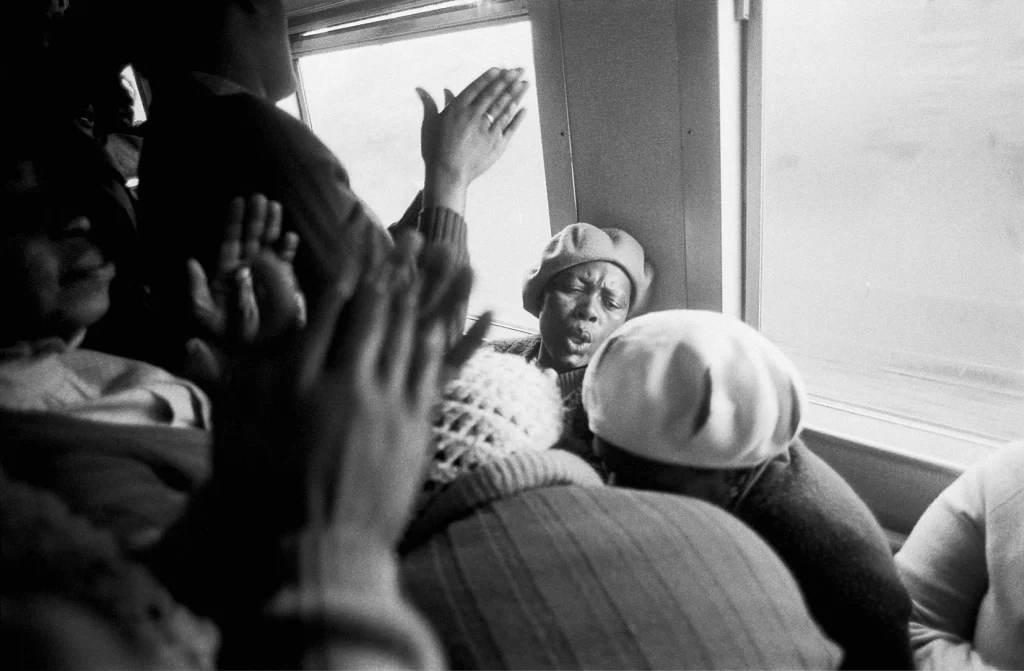
Hands in Worship, Johannesburg–Soweto Line from the series Train Church, 1986. Credit: Santu Mofokeng.
None of these photographers worked alone; all were embedded in this collective life, and many were involved in political organising. Omar Badsha, born into Durban’s Indian community in 1945, was a trade unionist before he became a photographer, serving as the first general secretary of the Chemical Workers’ Industrial Union. He bought his first camera in 1975 to document factory conditions and to teach workers’ classes. In 1981, Badsha helped initiate Afrapix, a collective of about forty women and men photographers that operated from the South African Council of Churches’ Khotso House in Johannesburg – raided and later bombed in 1986 – and maintained darkrooms in Durban and Cape Town.
A thread connecting all this photographic and political work was Black Consciousness, a movement and a set of ideas first articulated by Steve Biko. In the South African Students’ Organisation Policy Manifesto of 1973, Biko wrote that the Black Consciousness Movement ‘seeks to infuse the Black community with a new-found pride in themselves, their efforts, their value systems, their culture, their religion and their outlook to life’. The ‘Black man’ as defined by Biko was a political category, naming everyone the apartheid state had sorted into its non-white tiers – the African workers of the mines and the townships, the Coloured workers of the Cape factories and docks, the descendants of the Indian and Chinese indentured labourers Britain had shipped to cut sugar or work in the gold mines – and held them as one majority defined by their relation to white capital. For this reason, Biko stressed, ‘the importance of Black solidarity to the various segments of the Black community must not be understated’. The photography of the anti-apartheid movement was also about visibilising an entire colonial visual and racial order and building the solidarity to dismantle it.
Just a Little Atrocity Deep in the City
Fifty years later, more than three decades since the legal end of apartheid, the racial-capitalist system remains. The photograph of Hector Pieterson and the annual 16 June commemoration in Soweto continue to inspire new generations of youth in South Africa, across the continent, and throughout the diaspora in their own struggles for the unfinished work of liberation.
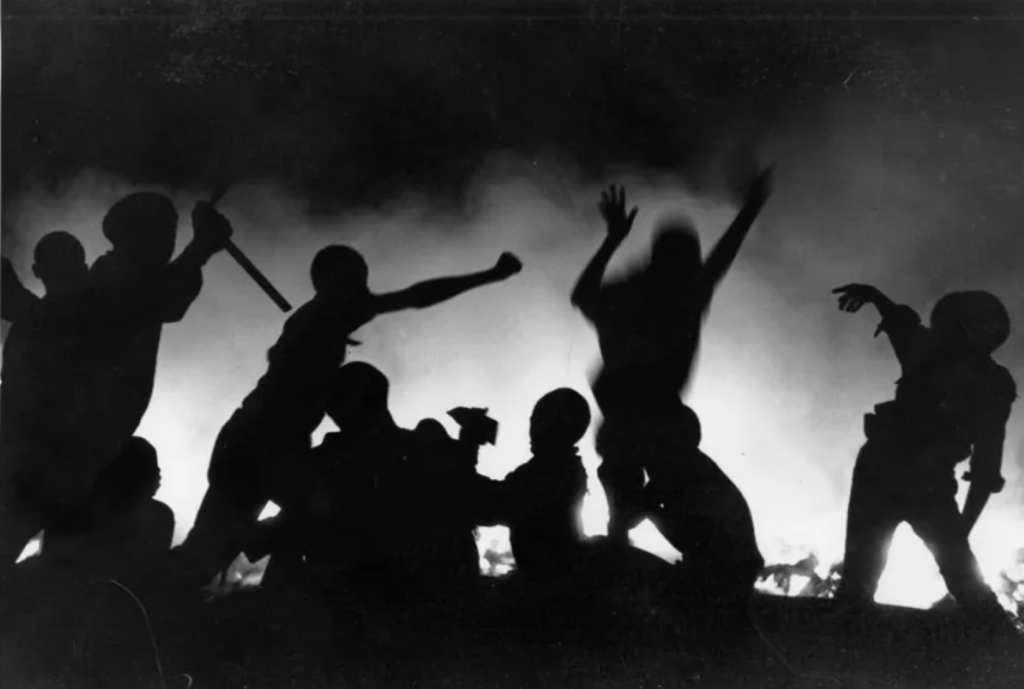
Youth in Diepsloot, Johannesburg, silhouetted against the night sky, 1970s. Credit: Alf Kumalo.
The struggle is not only South African. Since the US-backed Israeli genocide began in October 2023, more than two hundred Palestinian journalists – photographers among them – have been killed. Among those who have forced the world to keep seeing Gaza are Bisan Owda, whose daily social media videos from Gaza have reached tens of millions, and Wael Dahdouh, the Al Jazeera bureau chief who kept reporting after burying his son, cameraman Hamza Dahdouh, in January 2024. Alongside them are countless Palestinian photographers, journalists, and ordinary people documenting the destruction of their own world as it unfolds. Tricontinental’s dossier, Despite Everything: Cultural Resistance for a Free Palestine, traces the longer arc of Palestinian cultural workers documenting resistance since the Nakba, insisting that a struggle without documentation is no struggle.
As Miriam Makeba sang in ‘Soweto Blues’, the state tried to reduce the massacre to ‘just a little atrocity, deep in the city’. Fifty years later, the photographs, songs, testimonies, and archives of struggle continue to refuse that erasure:
The children got a letter from the master
It said: no more Xhosa, Sotho, no more Zulu
Refusing to comply, they sent an answer
That’s when the policemen came to the rescue
Children were flying, bullets, dying
The mothers screaming and crying
The fathers were working in the cities
The evening news brought out all the publicity:
Just a little atrocity, deep in the city
In solidarity,
Tings Chak
Art Director, Tricontinental: Institute for Social Research