Storm the Heights of Culture: Public Art in the German Democratic Republic
Today, there is growing recognition of the German Democratic Republic’s (DDR) building-integrated art and the type of society rooted in education, dignity, and imagination of the working class the DDR sought to build.
Listen to ‘Aufbaulied’ (1948), sometimes called ‘Aufbaulied der FDJ’ (The Free German Youth’s Song of Rebuilding), written by Bertolt Brecht with music by Paul Dessau.
In 1977, if you drove out to the northern shore of Lake Aasee in Münster, then part of West Germany, on a warm afternoon you would find three concrete pool balls the size of small cars resting on the grass by the shore: Claes Oldenburg’s Giant Pool Balls. The sculptures were originally installed that year for the first Skulptur Projekte Münster (Sculpture Projects Münster), one of West Germany’s landmark experiments in bringing contemporary art into public space, whose language of abstraction, Pop art, and enlarged consumer objects was largely removed from depictions of everyday working-class life.
In that same year, across the border, the German Democratic Republic (Deutsche Demokratische Republik, DDR) was marking the twenty-fifth year of its own public art programme. One of its most ambitious examples still stands in Berlin. Cross Alexanderplatz in Berlin today and look up. On the Haus des Lehrers (House of the Teacher) – the twelve-storey building designed by Hermann Henselmann’s collective and completed in 1964 – Walter Womacka’s Unser Leben (Our Life) wraps around the tower as a monumental ceramic-tile frieze, or horizontal mural band, its roughly 800,000 hand-cut tiles forming a 125-metre-long, seven-metre-high panorama of socialist life in the DDR. Begin with the northern face: a woman lectures at a chalkboard; a brigade meets around a table; a worker leans over an atomic model beside a young couple with a child; a peasant swings a scythe. A parabolic mirror. A rocket. A dove. Behind and between them: hands, banners, a red flag.

Walter Womacka, Unser Leben (Our Life), 1962–1964.
Womacka finished the frieze while the DDR was still staffing its schools and factories with antifascists who had survived the Nazi concentration camps of Buchenwald and Ravensbrück. Thirty-six years after the dissolution of the state that commissioned it, the frieze is still on Alexanderplatz – its colours as bright as if Womacka had just stepped down from the scaffolding. This Art Bulletin is about the East German programme that put works of art like this one into everyday public view, the socialist traditions it belonged to, and what has been destroyed and preserved in the time since.
Baubezogene Kunst (Building-Integrated Art)
The DDR was founded in October 1949 out of the rubble of Nazi defeat, in the Soviet occupation zone, and set about a rapid programme of land reform, mass nationalisation, and antifascist reckoning. Meanwhile, the Federal Republic of Germany, across the western border, was quietly restoring Wehrmacht officers to the Bundeswehr, West Germany’s newly created armed forces, and Nazi jurists to the judiciary. On 22 August 1952, the DDR Council of Ministers of East Germany passed the Verordnung über die künstlerische Ausgestaltung von Verwaltungsbauten (Ordinance on the Artistic Design of Administrative Buildings), an ordinance obliging state construction projects to spend one to two per cent of the approved budget on ‘works of volksverbundener, realistischer Kunst’ (realist art connected to the people) inside and outside of buildings. Schools, kindergartens, town halls, hospitals, cinemas, department stores, apartment blocks, transformer stations, the lobbies of factory canteens: all of them were to include art within or on them, and the state had to pay for it.
In German, this was called baubezogene Kunst (building-integrated art). The West Germans, working from the same Weimar-era antecedent, ran a parallel Kunst am Bau (art in architecture) programme. The political difference lay not in the mechanism but in what the two states asked their artists to put on the walls, and for whom. A related contrast appeared in 1955, when the first documenta exhibition opened in the West German town of Kassel, just a short drive from the East German border. Founded by Arnold Bode, documenta became one of the world’s major recurring exhibitions of contemporary art and was understood from its beginning as West Germany’s aesthetic counterweight to state-regulated Socialist Realism – the official artistic doctrine of the socialist bloc, which called for realist, accessible representations of workers, peasants, and socialist construction. The exhibition foregrounded the abstract painters – Wassily Kandinsky, Paul Klee, Max Beckmann, and later Jackson Pollock and Willem de Kooning – whom the CIA’s Congress for Cultural Freedom and the Museum of Modern Art’s (MoMA) international programme were also promoting through the same postwar decade. In opposition to this logic, the DDR built public art for a working class that was itself building socialism.
Over four decades, the DDR commissioned an estimated ten thousand such works. Larger works were awarded by open competition and often produced by artist collectives, which is one reason individual authorship matters less in this tradition than in bourgeois art history.
The programme can be understood as part of the comprehensive transformation of society, reducing the gap between art and production, between artists and workers. This ethos was best summarised by SED First Secretary Walter Ulbricht in 1958, at the Fifth Party Congress of the SED, when he stated, ‘[The working class] must storm the heights of culture and make it its own’. The following year, this idea was taken up at the first Bitterfeld Conference, held on 24 April 1959 in the Kulturpalast (Palace of Culture) of the Bitterfeld Chemical Combine, where a worker-writer named Werner Bräunig gave the movement its motto: ‘Greif zur Feder, Kumpel!’ (Pick up the pen, comrade!). The conference called on writers to enter factories, painters to join brigades, and workers to go into studios. In this vision, the state’s walls became the newspaper of the people, and Womacka’s Unser Leben on Alexanderplatz was one of its front pages.
Walls in Dresden and Eisenhüttenstadt
Take a train just two hours south from Berlin to Dresden. On the west façade of the Kulturpalast, designed by Wolfgang Hänsch and completed in 1969, is a mural thirty metres long and ten and a half metres high, made of 466 concrete panels coated with coloured glass splinters: Der Weg der roten Fahne (The Way of the Red Flag), created between 1968 and 1969 by a collective of teachers and students from the Dresden Hochschule für Bildende Künste (Dresden Academy of Fine Arts) around Gerhard Bondzin. The mural reads left to right as a history of the German workers’ movement – the 1848 revolutions and the publication of the Communist Manifesto; the founding of the Social Democratic Party of Germany (SPD); the November Revolution and the murdered revolutionaries Rosa Luxemburg and Karl Liebknecht; the German volunteers of the Spanish Civil War; the resistance to Nazism; and the founding of the DDR in October 1949.
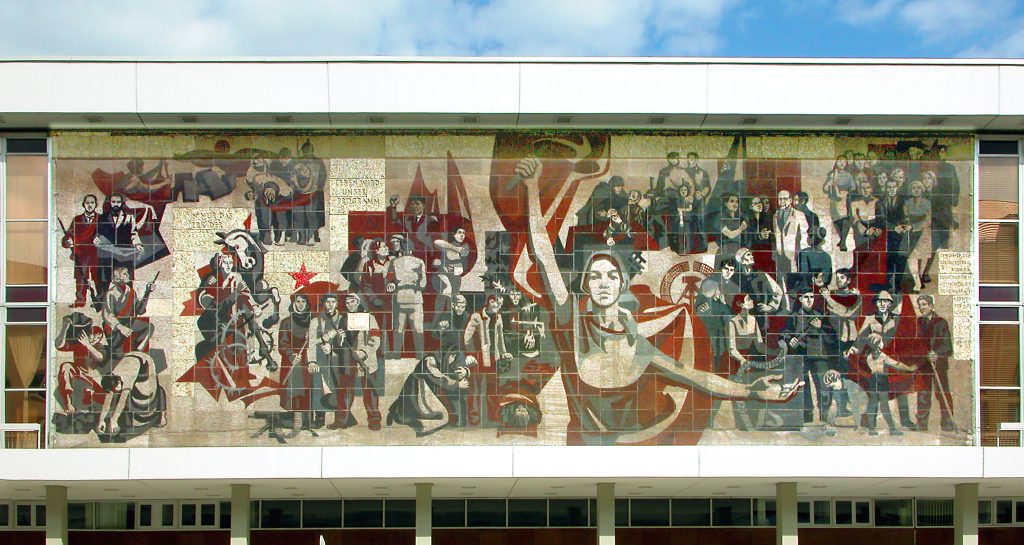
Gerhard Bondzin and collective, Der Weg der roten Fahne (The Way of the Red Flag), 1969.
The composition can be seen clearly from the Schloßstraße boulevard: a woman at the centre with a raised arm stands before a factory gate, alongside armed workers at a barricade and soldiers with red flags where the swastika once appeared. The concrete panels render these figures in the primary colours of a strike leaflet enlarged to architectural scale. The Bondzin collective completed the mural in the summer of 1969 for the DDR’s twentieth anniversary. It has since been designated a cultural monument, though the Kulturpalast around it has been remade twice, first in the early 1990s and then again in the 2012–2017 renovation, which transformed the concert hall into a home for the Dresden Philharmonic Orchestra.
Travel northeast and you will reach Eisenhüttenstadt, where the DDR built Stalinstadt – its first planned socialist city – from 1950 onward on previously undeveloped land around the Eisenhüttenkombinat Ost steelworks, drawing a whole generation of post-war refugees into a new industrial centre. A short walk from the town hall, on the north façade of what was then the Magnet department store on Lindenallee (then Leninallee), is a second Womacka mural completed in 1965: Frieden durch technisches Wissen, technischen Fortschritt (Peace through Technical Knowledge, Technical Progress). A worker’s hand releases a white dove against an industrial backdrop of state flags; on the sleeve are images of tools, workers, and technological labour. It is an image of peace – the peace of a country that had lost between five and seven million people in the Second World War, whose western neighbour had already been rearmed within NATO by 1955, and whose own children were being taught in kindergarten to recognise the dove as part of a shared visual language of peace.
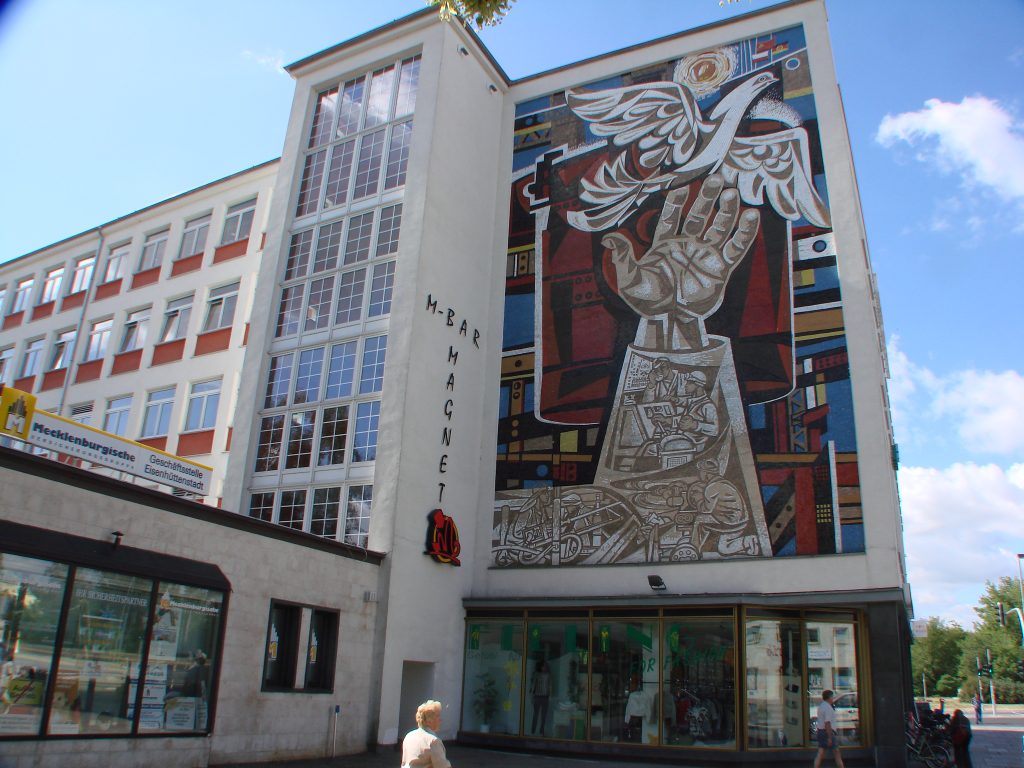
Walter Womacka, Frieden durch technisches Wissen, technischen Fortschritt (Peace through Technical Knowledge, Technical Progress), 1965.
World Peace and Internationalism
The dove recurs across DDR public art. Ortraud Lerch’s Friedenstaube (Peace Dove) in Berlin brings the symbol to the façade of an everyday apartment building with a glass mosaic. The lineage was legible: Picasso’s dove, lithographed for the 1949 Paris Peace Congress, was translated into ceramic, glass, and enamel across the DDR’s public buildings by artists working in a state whose antifascist self-understanding made peace a matter of policy.
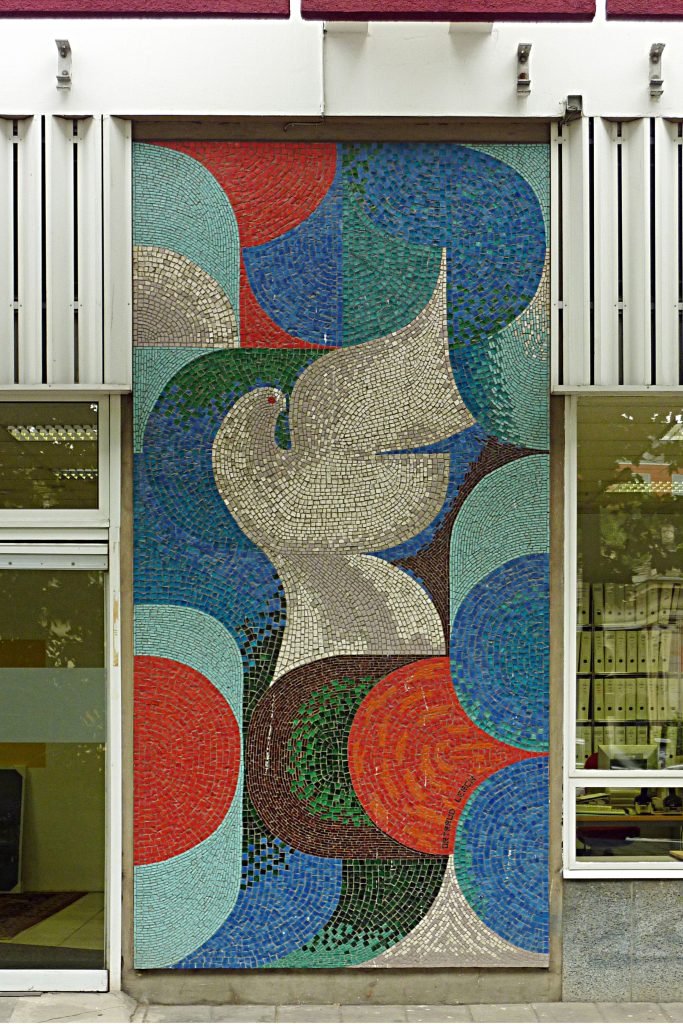
Ortraud Lerch, Friedenstaube (Peace Dove), 1977.
The dove was not the whole of the DDR’s visual language of peace. Over time, that symbol was joined by images of people from different countries, linking peace to anti-colonial liberation, socialist internationalism, and Völkerfreundschaft – friendship among peoples.
Willi Neubert’s enamel painting Internationale Solidarität (International Solidarity) was originally located at the Stadthalle, or civic hall, in Suhl, Thuringia, but was removed in the early 1990s. It was reinstalled in Thale in 2010, the industrial town where Neubert had long lived and worked. The work shows peace and liberation not as a finished condition but as something won through struggle: beneath the wings of a dove, the world appears as a field of international solidarity.
International class struggle, the dynamic process of liberation, and Völkerfreundschaft took many forms across DDR public culture. The DDR’s own resources were limited, yet it supported liberation movements and young nation states across the globe through material projects that included building schools, hospitals, and factories; training thousands of students free of charge; and printing and shipping movement magazines as well as providing offices for some liberation movements in East Germany. A significant part of this solidarity work was raised and sustained by ordinary people through mass campaigns at workplaces, schools, and neighbourhoods.
‘Solidarität üben!’ (Practise Solidarity!) was a rallying cry of the Solidaritätskomitee der DDR (Solidarity Committee of the DDR), the central body that tied this work together. It informed people about anti-colonial and liberation struggles and called for donations through nationwide campaigns, using posters and informational materials created by visual artists to explain, encourage, and publicise this solidarity work. Practising solidarity meant two things at once: knowing what was happening in the world and acting on it.
For example, between 1965 and 1989, the Solidarity Committee channelled approximately 1.3 billion DDR marks in humanitarian aid raised from the population to Vietnam, including ambulances, printing presses, and support for the Krankenhaus der Deutsch-Vietnamesischen Freundschaft (Vietnam-GDR Friendship Hospital, today Việt Đức Hospital) in Hanoi, still one of Vietnam’s leading surgical centres. Across such campaigns, solidarity was made visible through posters, stamps, exhibitions, and other printed materials. In this way, internationalism was not confined to speeches or state agreements. It appeared on city walls, in printed images, and in everyday acts of giving, making solidarity visible as part of a hopeful future.
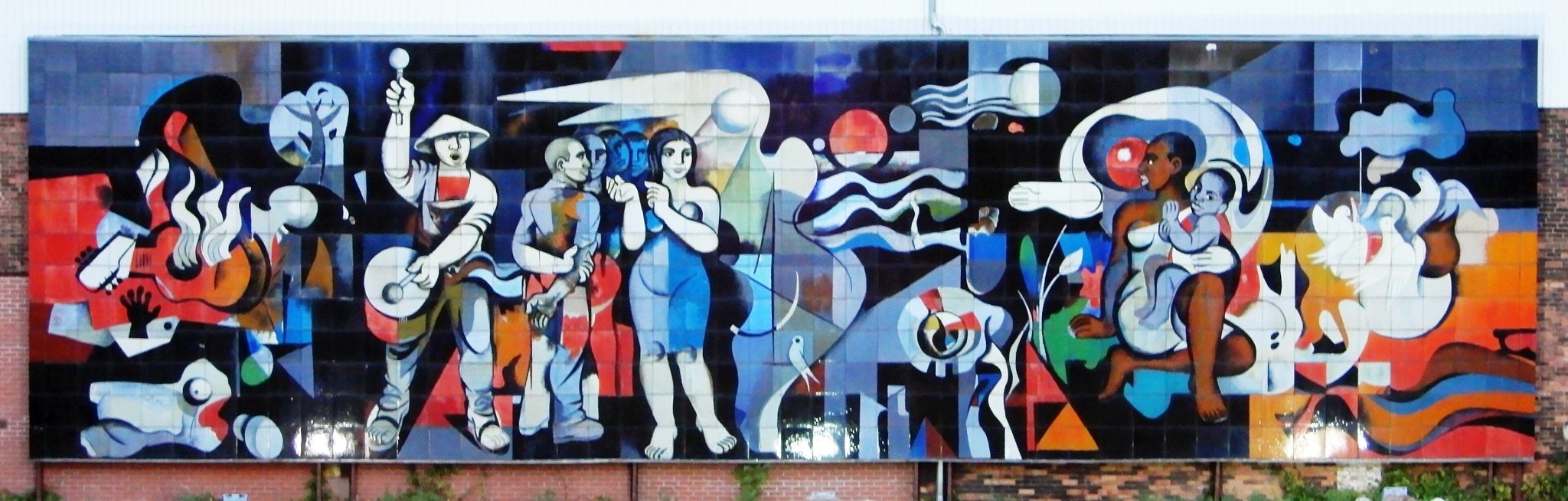
Willi Neubert, Internationale Solidarität (International Solidarity), 1977–1978.
What Was Destroyed and What Survived
After 1990, the reunified Federal Republic of Germany (Bundesrepublik Deutschland, BRD) set about undoing much of the DDR’s public cultural infrastructure. That year, the West German painter Georg Baselitz declared publicly that ‘there are no artists in the DDR’; the ensuing Bilderstreit – literally, ‘image dispute’, the post-reunification battle over how to judge East German art – ran through the newspapers for a decade. A large share of the baubezogene Kunst (though no one has a precise count) was painted over, dismantled during renovations, or removed with the buildings themselves, often under the claim of clearing away ‘DDR propaganda’.
The Palast der Republik (Palace of the Republic) – the DDR’s parliament and cultural centre on the site of the former Berliner Stadtschloss – became the most visible symbol of this process. Closed in 1990 allegedly because of asbestos contamination (though most of it had already been extracted), it was voted for demolition by the Bundestag (the federal parliament of Germany) in 2003 and demolished between 2006 and 2008. With it disappeared the building that had housed the Palast-Galerie (Palace Gallery), a permanent exhibition curated by Fritz Cremer – whose sculpture of Bertolt Brecht stands in front of the Berliner Ensemble – under the title Dürfen Kommunisten träumen? (Are Communists Allowed to Dream?). The gallery included works by many important DDR artists; after 1990, these works were transferred to federal custody and warehoused. The site is now occupied by the Humboldt Forum, a museum and cultural complex housed behind the reconstructed façade of the Hohenzollern palace – a return to the centre of Berlin that has been widely contested as both an erasure of DDR memory and a restoration of Prussian imperial imagery. It opened in phases from 2020 and cost roughly 680 million euros.
Where art and architecture survived the first two decades after the end of the DDR, there now appears to be greater recognition of their historical and cultural value, as well as a growing desire to preserve them. Perhaps thirty years of austerity have increased people’s desire to be reminded of their humanity and dignity – and of socialism. The Kunstarchiv Beeskow in Brandenburg, an archive and collection, holds over twenty-three thousand works of DDR-commissioned art removed from public buildings after 1990. A series of major reassessment exhibitions – Kunst in der DDR (Art in the DDR) at the Neue Nationalgalerie in Berlin in 2003, Abschied von Ikarus: Bildwelten in der DDR – neu gesehen (Farewell to Icarus: Visual Worlds in the DDR – Seen Anew) at the Neues Museum Weimar in 2012, and Behind the Mask: Artists in the GDR at the Museum Barberini in Potsdam in 2017 – has moved the debate a certain distance from where Baselitz left it.
These reassessments are not only about recovering artworks from storage or restoring murals to public view. They also reopen the question of what the DDR attempted to build: a society in which art was not treated as a luxury object for private ownership but as part of the everyday education, dignity, and imagination of the working class.
The DDR is also being read again within the socialist tradition through the research of the Berlin-based Zetkin Forum for Social Research and the Internationale Forschungsstelle DDR (International Research Centre on the DDR). Together with Tricontinental: Institute for Social Research, the centre publishes the Studies on the DDR series, which re-examines the history, principles, and lived experiences of this socialist state for progressive movements today.
Warmly,
Zetkin Forum for Social Research