Haiti: The Mirror Where the Empire Rehearses
We talk about Haiti, about the military intervention led by Nayib Bukele, a key piece of the Shield of the Americas promoted by Washington, and about what this history means for Venezuela and Nuestra América.
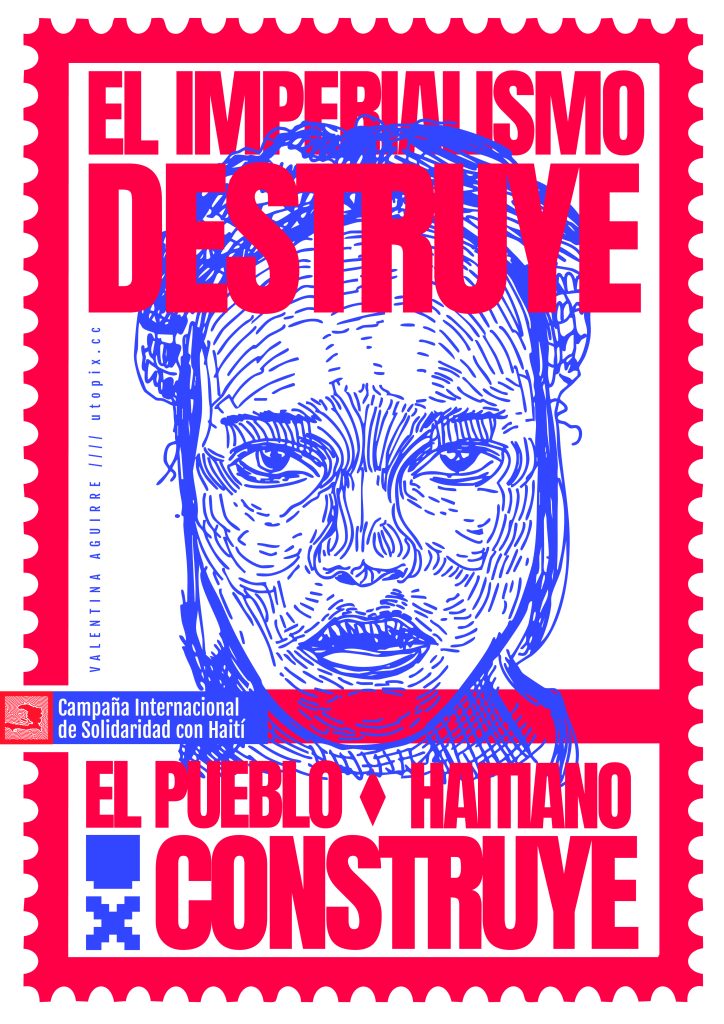
Valentina Aguirre (Venezuela), Haiti Resist! [Haití Resiste!], 2022.
In the early morning of February 29, 2004, a U.S. plane took off from Port-au-Prince carrying President Jean-Bertrand Aristide and his wife, Mildred Trouillot. They did not know where they were being taken. Nearly a day later, they landed in Bangui, the capital of the Central African Republic. From there, Aristide stated it bluntly: he had been the victim of a modern coup d’état, carried out through a kidnapping. The Bush administration maintained that he had resigned of his own free will.
Twenty-two years later, in the early morning of January 3, 2026, U.S. forces bombed targets in Caracas, Miranda, Aragua, and La Guaira, and took President Nicolás Maduro and his wife, Cilia Flores, to New York. The White House presented their capture as a trophy, despite war had not been declared between the two countries.
Two daybreaks, two countries, the same gesture: forcibly removing a presidential couple from their own territory. It is no calendar coincidence. It is a method perfected over time, and Haiti has been its laboratory, ignored for far too long. Today, we turn to Haiti, to the military intervention led by Nayib Bukele in recent weeks, a key piece of the Shield of the Americas promoted by Washington, and to what this history means for Venezuela and for Nuestra América.
A History of Invasions
To understand Haiti, one must return to its revolution. In November 1803, at Vertières, enslaved Africans and their descendants defeated Napoleon’s army. On January 1, 1804, they proclaimed independence, consolidated the abolition of slavery, and founded the world’s first Black republic. For a capitalism sustained by slavery, Haiti was a terrible example. The major powers never forgave it.
In 1825, with French warships off its coast, King Charles X issued an ordinance forcing Haiti to pay 150 million francs to compensate former slaveholders for the loss of their “property.” The sum was reduced to 90 million in 1838, but Haiti was forced to borrow from French banks to pay it. That misnamed “independence debt”—in reality, a ransom—devoured a large share of state revenues for decades, while the loans tied to it dragged on into the twentieth century.
Subsequent governments bent to this imposed order, turning their backs on the majorities, who responded with recurring revolts. The United States did not recognise Haitian independence until 1862, although it had traded with the island long before.
Between 1915 and 1934, at the height of imperial expansion, the United States occupied Haiti. As early as December 1914, Marines had taken the gold from the national bank to New York. The occupation seized control of customs and finances and reorganised the country to serve U.S. corporations. Under the corvée system, thousands of peasants were forced to work without pay in conditions akin to slavery.
The occupation was met with fierce resistance. The cacos, a peasant guerrilla force led by national hero Charlemagne Péralte, resisted with machetes and old rifles dating back to the war of independence until 1920, even after Marines assassinated Péralte in 1919. Thousands of Haitians died in a repression that deployed machine guns and aircraft against peasants.
Out of that history emerged a fabricated image of Haiti as a violent, backward country incapable of governing itself. That image is not a description; it is a tool. It justifies every new intervention and is rooted in a racism that cannot be hidden: Black people who liberated themselves, without asking permission or forgiveness, continue to be denied the right to decide their own destiny.
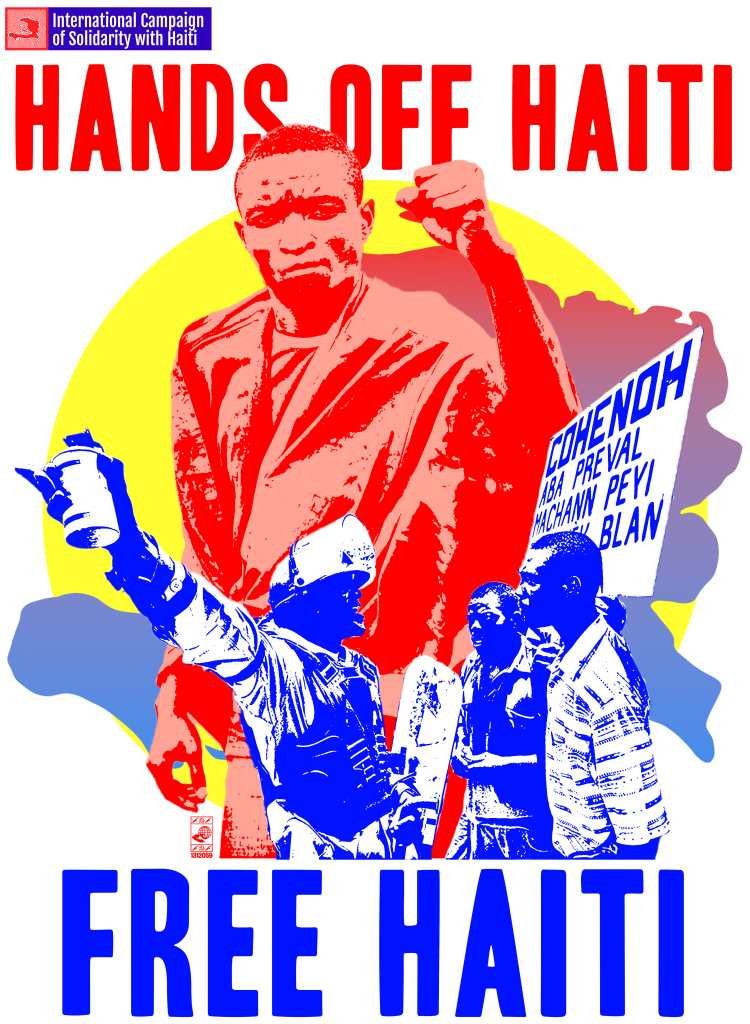
1312059 (Rumania), Haiti, 2025.
From Duvalier to the 2004 Kidnapping
The occupation ended in 1934, but Washington retained control of Haitian finances until 1947. This was followed by nearly three decades of the Duvalier dictatorship (1957–1986), propped up by the United States.
After its fall, hopes for popular participation emerged. Its most visible expression was Jean-Bertrand Aristide, a Salesian priest who organised the poor through liberation theology. On December 16, 1990, he won the first free elections in the country’s history, with nearly 67% of the vote, backed by popular sectors organised under the FNCD and later in Fanmi Lavalas. On September 30, 1991, just seven months after taking office, a military coup overthrew him. Several of those involved, including leaders of the paramilitary group FRAPH, were on the CIA payroll. Thousands of activists and civilians were murdered over the next three years.
From exile, Aristide led a government backed by mass mobilisations demanding his restoration to office and a return to constitutional order. Washington turned that demand into another military intervention: in September 1994, some 20,000 U.S. troops landed to reinstate him. Aristide returned, however, bound to a neoliberal program agreed upon with international financial institutions, the so-called Paris Agreement. Many in the neighbourhoods welcomed the troops with relief, while other currents within Lavalas rejected them. This gave rise to a deep fracture within the popular camp—precisely what the empire sought.
With little room to carry out his program, Aristide handed over power in 1996 to René Préval, who had served as his prime minister in 1991. Préval governed until February 2001, implementing neoliberal policies. In 1999, he allowed Parliament’s term to expire and ruled by decree, fuelling the narrative of an authoritarian Lavalas.
Aristide returned to power on February 7, 2001, with his popular base intact, but facing a divided movement, worn-down institutions, and elites who had accompanied him in 1990 now turned into enemies. As if following a well-rehearsed script, a wave of mobilisations gathered momentum, denouncing him as a dictator. His supporters handed the opposition the greatest gift: on December 5, 2003, they stormed the Faculty of Human Sciences at the State University, beat students, and broke the rector’s legs. The rector was Pierre-Marie Paquiot.
The right capitalised on the outrage through the Group of 184, a coalition of businesspeople, media owners, centre and right-wing parties, trade unions, student organisations, and former Lavalas allies. Meanwhile, an insurgency led by soldiers under the command of police commissioner Guy Philippe advanced from the north. Years later, Philippe would be elected senator and convicted in the United States of laundering money from drug-trafficking. There were abuses on both sides.
Aristide had made a bold move in 2003, and went further on the bicentennial of independence, January 1, 2004: he demanded that France repay the ransom, which his government calculated at more than $21 billion. Two months later, with the rebels nearing the capital and under pressure from Paris and Washington, he was removed from the country aboard a U.S. plane. He accused both governments of orchestrating his kidnapping.
That same day, the Security Council approved Resolution 1529, authorising a Multinational Interim Force led by the United States, alongside France, Canada, and Chile. In June, MINUSTAH arrived, with Brazil and Uruguay, among the countries contributing. The coup had been draped in a multilateral cloak.
Two Decades of Tutelage
MINUSTAH remained in Haiti from 2004 to 2017, with a heavy Latin American presence under Brazilian military command. It left behind allegations of sexual abuse and a cholera epidemic, introduced in 2010 by UN peacekeepers, that killed nearly 10,000 people. That same year, following the devastating earthquake, President Obama reinforced the U.S. presence under the pretext of reconstruction through the controversial Interim Haiti Recovery Commission (IHRC), co-chaired by former President Clinton.
In 2016, Secretary-General Ban Ki-moon apologised. Apologies, but no reparations: the promised fund was never financed, and the victims remain without compensation.
Other formulas followed. In 2023, Resolution 2699 authorised the Multinational Security Support Mission, led by Kenya. In September 2025, Resolution 2793 transformed it into the Gang Suppression Force (GSF), with an authorised strength of up to 5,550 personnel. A year later, its own spokesperson admitted it would not reach that target.
In parallel, the government created a task force backed by Vectus Global, the company owned by Erik Prince, the founder of Blackwater. According to Human Rights Watch, its explosive drone strikes killed at least 1,243 people between March 2025 and January 2026, including 17 children with no connection to gangs.
All of this is endorsed by the unelected government of Prime Minister Alix Didier Fils-Aimé, who has headed the executive branch since the Transitional Presidential Council dissolved in February 2026. The population does not know how the country’s resources are being managed, while public outrage increasingly gives way to indifference. Haiti has not held elections since 2016, and on October 28, elections were postponed once again, this time until July 18, 2027.
The wounds of 2004 have never closed. Now, with the militarisation of neighbourhoods by various armed groups operating as instruments of sociopolitical control, they have deepened into an enormous open wound. Occupation is not the cure.
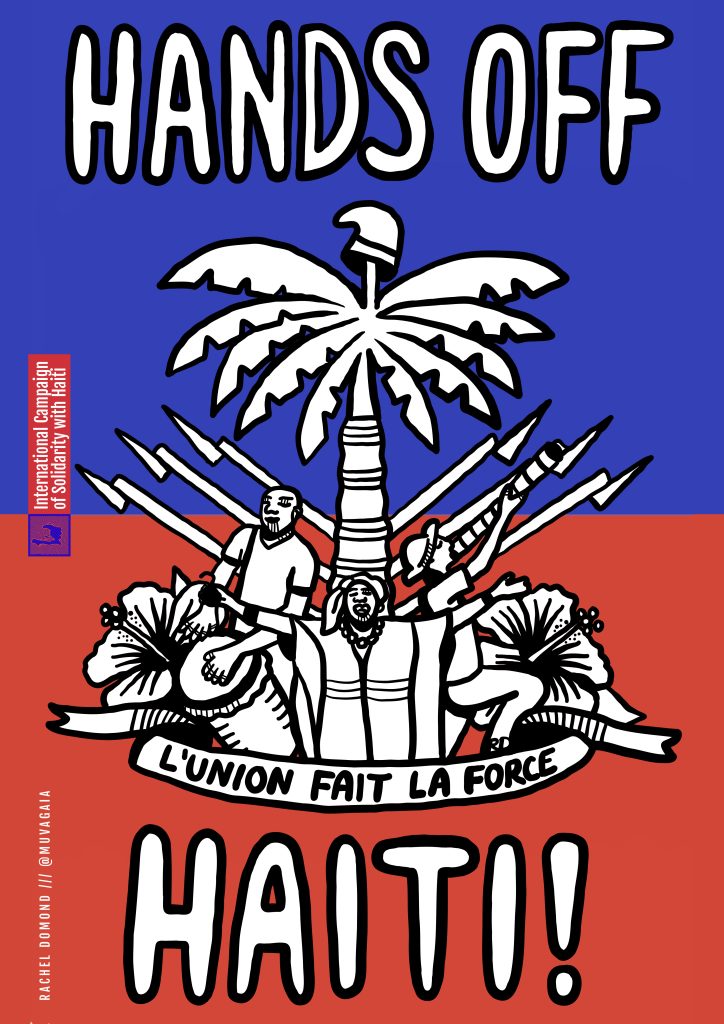
Rachel Domond (USA), Unity Makes Strength [L’Union Fait La Force], 2022.
Bukele in Haiti
On October 18, four Salvadoran air technicians serving with the GSF went missing following an ambush in Croix-des-Bouquets, on the outskirts of Port-au-Prince. Nayib Bukele responded by deploying more than 2,000 soldiers, along with helicopters and armoured vehicles, and Donald Trump publicly backed the deployment. On November 2, the UN spokesperson clarified that the vast majority of these troops do not operate under the GSF: only about 200 are integrated into it. The rest answer to their own chain of command.
A Colombian Hercules aircraft also took part in transporting the troops, while the Dominican Republic expressed its support for the deployment. Both governments, like El Salvador, are members of the Shield of the Americas, the alliance launched by Trump in March 2026 to align like-minded governments under the banner of the war against “narcoterrorism.”
UNA-Haiti, a diaspora organisation, denounced bombings and helicopter attacks on Croix-des-Bouquets, Canaan, and the Cul-de-Sac plain in an open letter to the UN Secretary-General. It spoke of families hiding under their beds and of children killed “not by gangs, but by foreign bombs.” Bukele denies it. No independent investigation has been conducted.
A Haitian comrade writes to us in anguish. A large part of the population, bombarded by propaganda, sees the Salvadorans as a way out of insecurity, while critical voices are barely heard. He warns that Haiti could become a new Gaza, with its people’s freedom of movement strangled by violence. The public displays of support for the troops recall the reception given to U.S. soldiers in 1994. Fils-Aimé thanked Bukele and is due to travel to San Salvador in mid-November to discuss the future of the contingent.
Venezuela Before the Mirror
The similarities are obvious. In both cases, the United States forcibly removed a president and his wife. In both, the punished country had challenged an established order: Haiti by demanding repayment of the colonial debt, Venezuela by asserting control over its own resources. In both, the operation was framed in the language of law enforcement: chaos and gangs back then; narcoterrorism today.
Yet the differences are just as revealing. In 2004, there was a semblance of a legal justification: talk of a voluntary resignation, followed immediately by the arrival of the UN to provide cover. On January 3, there was no such pretence: there was open bombing, a presidential announcement, and an indictment in a New York court, where Maduro and Flores await a trial scheduled for June 2027. The head of state is no longer in exile; he is a defendant.
The other difference lies in the aftermath. Today, Haiti is a dismantled state, governed without elections and administered by foreign forces and private contractors. Venezuela, by contrast, retains its institutions, its own armed forces, and a fabric of popular organisation. That difference is precisely what is at stake.
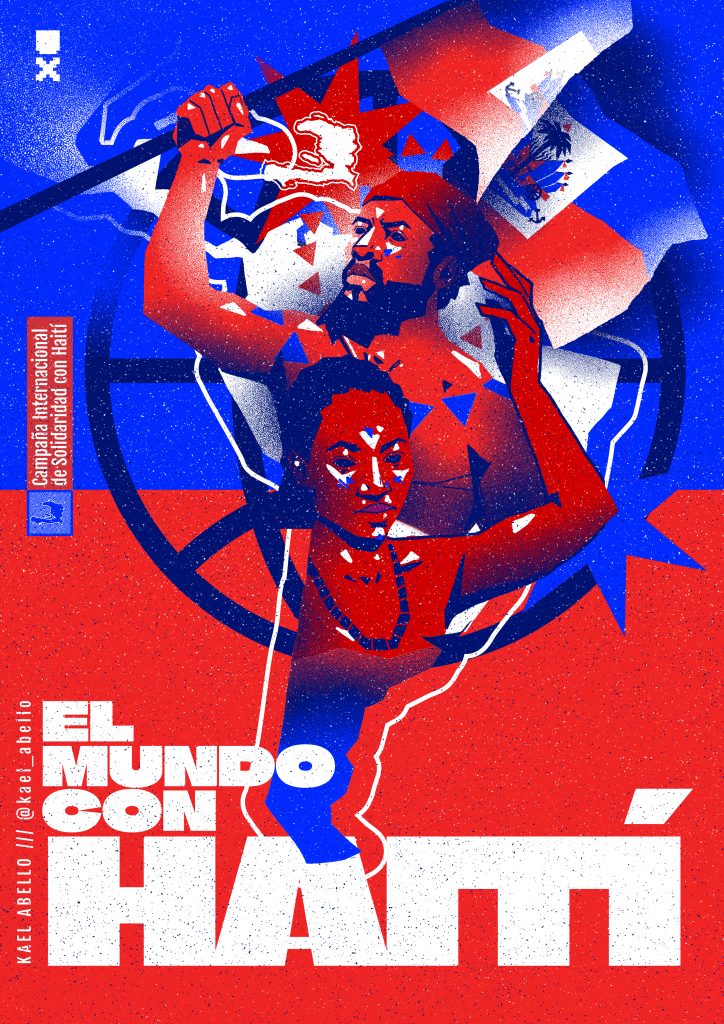
Kael Abello (Venezuela), The World with Haiti [El Mundo con Haití], 2025.
The New Model of Intervention
Taken together, the two cases reveal the outline of a new U.S. model, made up of three parts.
First, the surgical strike: swift, overt, requiring no one’s permission, designed to dismantle any state that does not bend to US interests.
Second, outsourcing when the objective is to administer a territory. Let allies supply the troops and bear the human cost—Kenya yesterday, El Salvador today—while mercenaries provide the technology.
Third, the criminalisation of a political conflict. By recasting a political conflict as a criminal matter, sovereignty disappears from the conversation. A country is no longer being invaded: criminals are being pursued. The clearest example is the attempt, without any basis in international law, to portray a sitting president as a criminal who must answer before the courts of another country.
Bukele understands this, which is why he offers himself as a regional battering ram. In this militarised Caribbean, with the siege tightening around Cuba, no one should mistake Haiti as an isolated case. It is a script designed to silence, at any cost, the peoples who have shown the way in resisting colonial oppression.
In Closing
More than twenty years of multilateral missions, occupations, coups, and UN mandates have not brought peace to Haiti. The population has received bullets, cholera, drones, postponed elections, and governments without a people. Peace does not descend from the sky in the form of bombs.
The question for us, in Venezuela and across Nuestra América, is what we can learn from this history. Haiti is nobody’s backyard. It is the country that taught us, in 1804, that freedom is won. And it remains the mirror in which the empire rehearses the methods it later applies across the rest of the world, beginning with Nuestra América.
Warmly,
Carmen Navas Reyes and Jean Jores Pierre
Jean Jores Pierre is a Haitian economist and data analyst specialising in social and solidarity economics. He has extensive experience working with social movement organisations in Haiti. He is currently pursuing a master’s degree in data Analytics at Purdue University Global.
Carmen Navas Reyes is a researcher at the Tricontinental Institute, Nuestra América Office, and the Department of Feminisms of the Global South.