ASEAN and the Need for an Alternative Regionalism
Nearly six decades after its founding, Southeast Asia’s intergovernmental bloc still serves governments and tycoons while almost half of all Southeast Asians live in poverty or on low incomes, largely shut out of social protection.

Ho Rui An (Singapore), Lonely Vectors, 2021–2022.
Dear friends,
2026 marks the 59th anniversary of the founding of ASEAN, and its 49th summit of leaders was held from 16–18 November in Manila, Philippines. The organisation’s founding principles – drawn up in 1976 – emphasise mutual respect for sovereignty, non-interference in internal affairs, peaceful settlement of disputes, and renunciation of force. These principles are noteworthy from the standpoint of nation-states and ruling classes but are ultimately self-serving: they contain no reference to how ASEAN relates to the peoples of its member-states or to their well-being. The framework is exclusively state-centred and reflects a top-down approach to regional integration.
It took 40 years, with the adoption of the ASEAN Charter in 2007, for the organisation to establish its three guiding pillars: the political-security community, the economic community, and the socio-cultural community. The political-security pillar concerns states and their interactions and the economic pillar facilitates business through open markets. Only the socio-cultural pillar deals with the peoples of ASEAN – ostensibly aiming to promote an inclusive, people-centred, and socially responsible community.
However, all three pillars suffer from infirmities: a lack of binding mechanisms due to non-interference and consensus principles; diverse political systems and levels of governance; economic disparities and uneven distribution of benefits; a poor record in economic integration; superficial and ambiguous commitment to human rights; pressures from big powers and a lack of unified stand; limited financial and human resources; bureaucratic inefficiency; and diverse cultures and languages.
The question is: how have Southeast Asia’s almost 700 million peoples fared under the ASEAN framework for development?
Persistence of Poverty and Inequality
Poverty rates remain high across most of the region. Using World Bank thresholds, nine of eleven Southeast Asian countries register high poverty rates. Cambodia, Myanmar, Timor Leste, and Laos range from 25% to 60% poverty; Malaysia, Thailand, Indonesia, and the Philippines fall in the 12–30% range; Vietnam straddles 10–12%; only Singapore and Brunei have low rates. High poverty amid persistent inequality exposes the non-inclusive, elite-centred character of the region’s growth.
Data for 2025 from the World Bank, Asian Development Bank (ADB), World Inequality Database, and national statistics offices, reveal that 306 million Southeast Asians – 44.7% of the region’s 686 million people – were classified as poor or low-income. Of these, 20.6% were earning less than $100 a month, and 24.1% had low incomes of $100–$250 a month. The upper income and rich together comprised only 8.5% of the population. The rich, who earn $5000 or more a month, comprise a mere 2.6% of the total.
Inequality becomes more pronounced across the nine countries with the highest disparities – the Philippines, Indonesia, Vietnam, Thailand, Malaysia, Cambodia, Laos, Myanmar, and Timor Leste. In these countries, the poor and low-income groups comprise 56% of the population while the rich and upper-income earners constitute only 3.55%.
On the Gini Coefficient Index, where 40 is considered a danger threshold, Singapore registers 45.9, Malaysia 40.7, and the Philippines 40.7, with Laos close behind at 38.8. The irony is that Singapore, the region’s richest country, also has its highest inequality.
The sources of wealth among the region’s elite include dynastic family conglomerates in real estate, banking, retail, and manufacturing – such as Indonesia’s Salim Group, Thailand’s CP Group, the Philippines’ SM Group, and Malaysia’s Kuok Group – as well as extractive industries, property development, export-oriented manufacturing, and newer technology and start-up sectors. Cronyism and monopolisation have long been determinant factors in wealth formation through government contracts, licenses, and regulated industries.

YEE I-Lann (Malaysia), Tikar/Meja, 2019–2020.
Weak Social Protection
Social protection policies are designed to reduce poverty, inequality, vulnerability, and social exclusion by ensuring income security, access to essential services, and support against life’s hazards. Using the World Bank’s ASPIRE database, four levels of social protection in Southeast Asia can be identified, namely, comprehensive, moderate, limited, and weak.
Singapore and Malaysia have comprehensive systems. Singapore relies heavily on personal savings, achieving high coverage and financial sustainability but marginalising vulnerable groups with inadequate incomes. Malaysia mixes contributory and non-contributory programs, though informal workers, migrants, and rural populations remain excluded.
Thailand and Vietnam have moderate systems and have noteworthy programs in terms of subsidised coverage and poverty reduction support. Both nonetheless exclude informal workers and rural populations. Indonesia and the Philippines have limited systems, again leaving out informal workers as well as rural people with the elderly and disabled inadequately protected.
Cambodia, Myanmar, and Laos have weak systems. Cambodia’s programs cover only formal workers and the poorest households. Myanmar’s implementation has been disrupted by political instability and conflict. Laos’ schemes provide inadequate coverage for most of the population.
Overall, Southeast Asian social protection systems exclude informal workers, who comprise on the average around 70% of the workforce and over 80% in Cambodia and Myanmar.
The region also falls short of global benchmarks for health and education spending. UNESCO recommends 4–6% of GDP for education, but Southeast Asia averages only 3.37%, with only Malaysia, Brunei, and Timor Leste meeting the benchmark. The WHO recommends 5–7% of GDP for health, yet the regional average is only 2.79%, and no Southeast Asian country meets the benchmark. The region’s dismal health protection record is attributed to the predominance of tertiary healthcare – urban-based, private, specialised, and costly – over primary healthcare, which is preventive, community-based, and universally accessible. Only Thailand, Malaysia, and Vietnam have strong primary healthcare systems.
A large informal economy, fiscal constraints, widespread inequality, skewed policy priorities, and political instability pose significant barriers. Despite the 2018 ASEAN Declaration on Strengthening Social Protection, the regional organisation has done little as a bloc to support social protection.
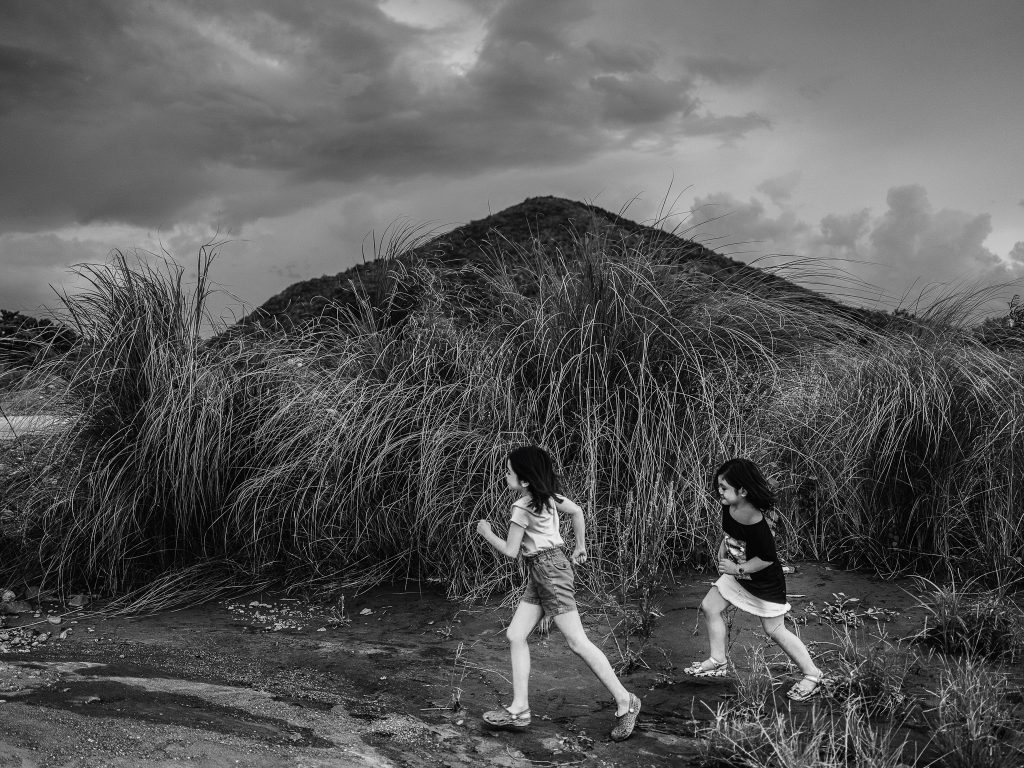
Xyza Bacani (Philippines), Untitled, n.d.
Economic Vulnerabilities
The ADB predicts that regional economic growth cannot be sustained as global demand weakens amid high inflation, rising interest rates, capital outflows, currency depreciation, reduced government spending, dollar appreciation, the US-China trade war, US trade tariffs, and collateral damage from the Russian invasion of Ukraine, and the US-Israeli war on Iran.
The region’s vulnerabilities are heightened by the predominance of informal workers who are mostly women, crucial to national economies but ineligible for mandated benefits. Informal workers are part of the broader ‘precariat’ class lacking tenure security, earning low wages, and facing dire working conditions. Oxford Economics forecasts that formal work will also decline as global trade downturns reduce demand.
Southeast Asia faces a funding gap of almost $500 billion in collective debt payments due over four years, attributed to rising interest rates and a stronger dollar. The region’s debt-to-GDP ratio grew from 49% in 2019 to 66.4% in 2025, with Singapore, Malaysia, Laos, Thailand, the Philippines, and Myanmar all exceeding the 60% threshold beyond which a debt crisis could arise.
The Regional Comprehensive Economic Partnership (RCEP), the world’s biggest trade bloc, came into effect in January 2022, comprising ASEAN economies plus China, Japan, South Korea, New Zealand, and Australia. An UNCTAD study points to tariff revenue losses, damaged economic and financial capacity, and worsened trade balances for ASEAN while benefiting developed country members. RCEP is also seen as injurious to developing countries’ industrial development, weakening regulatory mechanisms, and lacking commitments on human rights, labour protection, and environmental standards.
The proliferation of data centres in Southeast Asia following a boom in artificial intelligence (AI) usage also poses grave challenges for the region’s peoples. Situated mainly in rural areas, data centres need large tracts of land, and huge amounts of water and power that could deprive agrarian populations of these livelihood sources, displace indigenous communities from their ancestral lands, and overturn rural ecologies. The US-dictated Pax Silica initiative in the Philippines provides such an infrastructure for data centres and other AI-related activities. Southeast Asia currently has over 2,000 data centres in Indonesia, Malaysia, Singapore, Thailand, Vietnam, and the Philippines; hundreds more are under construction with over a thousand in the planning stage.
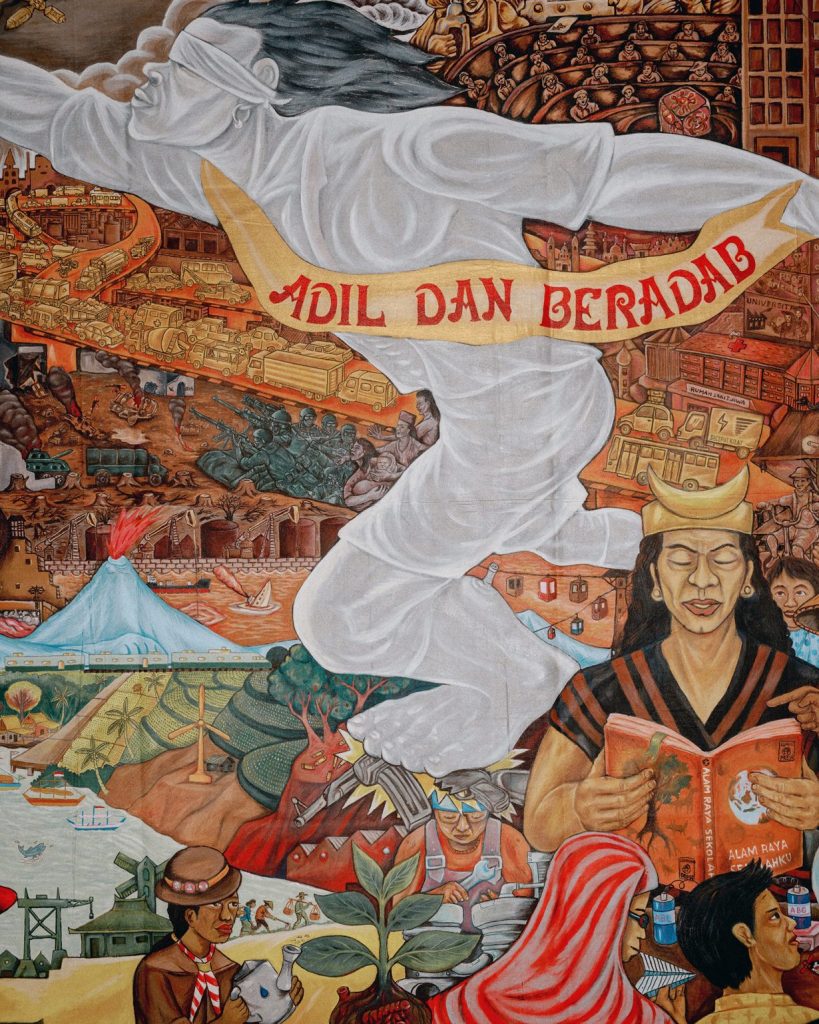
Taring Padi (Indonesia), Adil dan Beradab (detail), 2023.
Towards a Regionalism From Below
Southeast Asia’s state-centred regionalism, elite-driven growth model, fragmented social protection, and vulnerable economic position together produce systemic failure for the majority of the region’s people. ASEAN’s principles and pillars serve states and governing classes rather than peoples; growth has enriched a small elite while millions live in poverty or low income; social protection excludes the informal majority and underfunds health and education; and debt, dependence, and unequal trade agreements compound vulnerability.
The implicit alternative is a people-centred and grassroots-based inclusive regionalism grounded in progressive social movements, the rights of informal workers, genuine social protection, democratic accountability, and solidarity across borders. In other words, a regionalism from below rather than the ASEAN model of regionalism from above.
Warmly,
Eduardo C. Tadem
Eduardo is professor emeritus of Asian Studies at University of the Philippines and convenor of the Program on Alternative Development at UP Center on Integrative and Development Studies.
Disclaimer: The views expressed by the author do not necessarily reflect the views of Tricontinental: Institute for Social Research.