Restoring the Relevance of Socialism in Contemporary Chile
To think seriously about socialism today is to recognise that Chile’s organic crisis can only be resolved through an alternative that is anti-oligarchic, popular, and socialist.
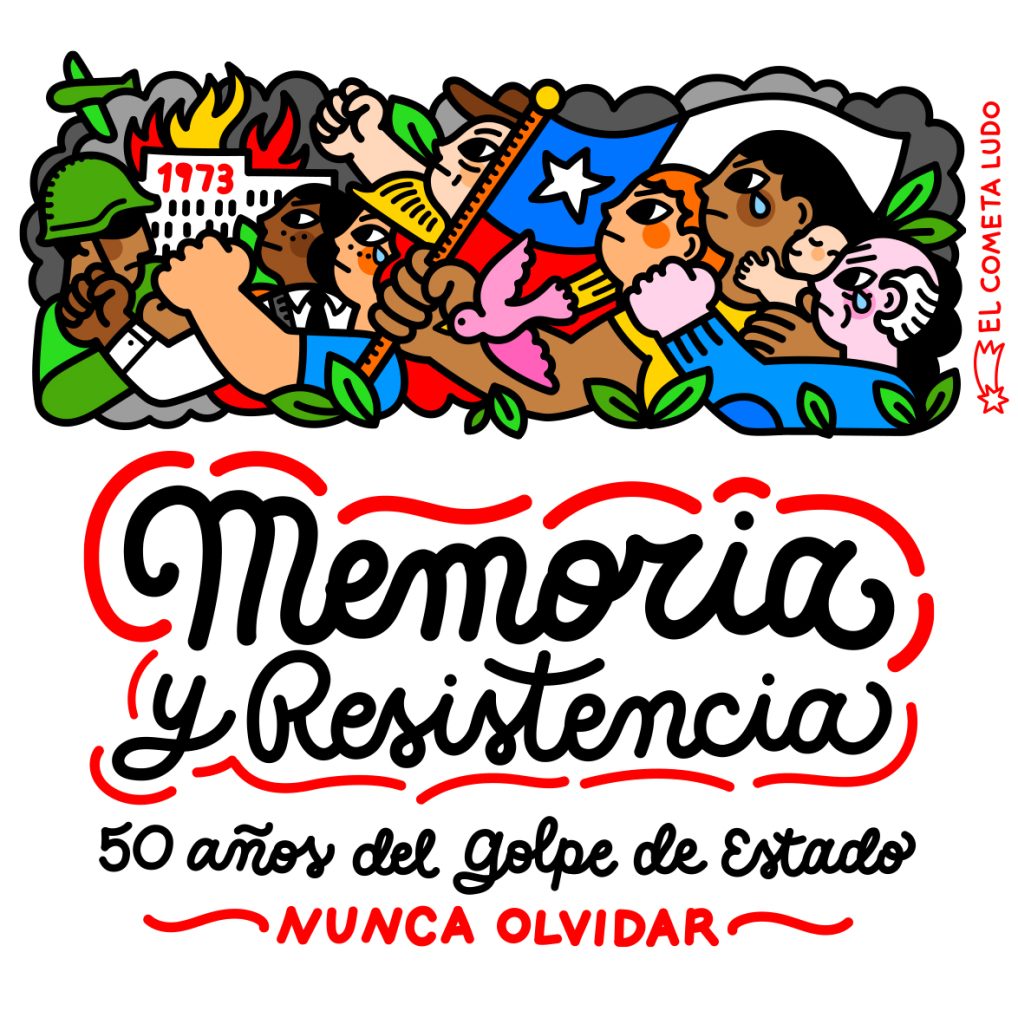
Artwork by El Cometa Ludo (Chile). Courtesy of the artist.
I. The Proscription of the Socialist Hypothesis
For more than three decades, from the negotiated transition to democracy to a democratic order constrained by the guardianship of the 1980 Constitution, Chile underwent a methodical ideological operation: the proscription of the socialist hypothesis from public debate. This exclusion was partly legal, but above all cultural and semantic. Chilean neoliberalism did more than privatise social rights; it severed our political imagination.
One of those obstacles was legal: a rigged Constitution, drafted behind closed doors by the Ortúzar Commission, with Congress remained shut down and thousands of Chileans detained and disappeared by the civil-military dictatorship.
This Constitution, designed to be unamendable, entrenched a single economic model through principles such as the ‘subsidiary’ role of the State: neoliberalism, the system that made Chile one of the most unequal countries in the world. Compounding this economic straitjacket were the ‘locks’ on democracy: a two-thirds supermajority was required to reform its core chapters, including those related to social rights. For three decades, attempts to guarantee rights such as housing or abortion were repeatedly met with the argument that such reforms were unconstitutional, while no governing coalition ever secured the two-thirds majority threshold. The dictatorship understood what it was doing and what it had done.
During this period of retreat, the dominant hegemony imposed a suffocating dogma: the only possible politics was the efficient management of the existing order. ‘Socialism’ gave way to the friendlier but toothless label of ‘progressivism.’ Tomás Moulian described this impasse:
The transformism of the Chilean political system operated by dismantling the imaginaries of rupture and replacing the will of popular sovereignty with a mythology of consumption and technocratic governability. Democracy was reduced to the ritual of voting while decisions about life and work remained shielded by the fetish of the market. (Chile actual: anatomía de un mito, 1997).
To think about socialism today, we must break free from this ideological blackmail. We must recognise that the compassionate management of the existing model has reached its historical limit, and that Chile’s organic crisis can only be resolved through an alternative that is anti-oligarchic, popular, and socialist.

Artwork by El Cometa Ludo (Chile). Courtesy of the artist.
II. Breaking with a Progressivism That Has No Horizon
Why is progressivism insufficient to meet the demands of the working class? Because it rests on the illusion that the State is a neutral instrument, one that can be adjusted through regulatory tweaks without challenging the underlying system of accumulation or the relationship between capital and labour. By separating immediate gains from the building of popular power, progressivism ultimately demobilises the very forces responsible for those gains. Unless reforms challenge the ownership of the means of production and the foundations of finance capital, they will be co-opted or reversed when the ruling classes counterattack.
This is what Chile is living today under José Antonio Kast’s government. The oligarchy is not merely defending its interests; it is disciplining the popular classes through cuts to social spending, aggressive collection of student debt under the State-Guaranteed Credit (CAE), and the shifting of market costs onto families. In doing so, it undermines rights won through years of struggle. This is the Pinochetist restoration, stripped of the ‘intellectual foundation’ it once claimed to have. What remains is farce and the shameless abuse of State power.
In her polemic with Bernstein, Rosa Luxemburg issued a warning about the limits of progressivism:
People who pronounce themselves in favour of the method of legislative reform in place and in contradistinction to the conquest of political power and social revolution, do not really choose a more tranquil, calmer and slower road to the same goal, but a different goal. Instead of taking a stand for the establishment of a new society they take a stand for surface modifications of the old society. (Reform or Revolution, 1899).
This does not mean dismissing reforms. In Marxist theory, reform and revolution are two moments within a single dialectical whole. Struggles over working hours, wages, and public health are the ‘revolutionary gymnastics’ through which the working class becomes aware of its own strength. Progressivism’s mistake is to treat reform as an end in itself, cut off from popular self-organisation and confined to whatever big business is willing to tolerate.
Artwork by El Cometa Ludo (Chile). Courtesy of the artist.
III. Marxism as a Creative Force
Thinking about socialism also means avoiding two deviations: the pragmatic accommodation of existing institutions, and the dogmatic tendency to mechanically apply twentieth-century formulas to the hyper-digitalised and fragmented reality of the twenty-first century. We embrace the lesson of José Carlos Mariátegui: ‘We certainly do not want socialism in America to be a tracing and a copy. It must be a heroic creation.’ (‘Aniversario y balance,’ Amauta, 1928).
Mariátegui’s call for heroic creation resonates with Badiou’s understanding of communism, not as a teleology of history, but as an emancipatory hypothesis and a creative impulse capable of intervening in the fissures of reality. It points to the possibility t of rupture in which those who ‘do not exist’ within a system assert themselves as political subjects. Gramsci teaches us that the struggle for power is a hegemonic struggle, consisting of forming a historical bloc of subaltern classes capable of dismantling bourgeois common sense. Ultimately, socialism is the radical democratisation of existence: the leap from the prehistory of necessity to the conscious realm of freedom, the freedom of the people and of organised majorities.
From this follow four theses:
- Socialism does not emerge automatically when capitalism’s contradictions become unsustainable. It is an alternative way of organising production, distribution, and the market. In fact, crises can just as easily give rise to more intensified forms of capitalism.
- Because socialism presents an alternative, socialist spaces can exist within capitalism. The challenge, therefore, is to organise these ‘microsocialisms’ that bring them into conflict with capital.
- Socialism is above all a political task: the conscious organisation of the subjective and objective conditions, without mandatory preliminary stages.
- There is no final victory. Either system can be defeated. Socialism must be chosen and built every day, as a task that is never complete.

Artwork by El Cometa Ludo (Chile). Courtesy of the artist.
IV. The Global Chessboard: Multipolarity and Experiences in Nuestra America
We are witnessing the decline of U.S. unipolar hegemony and the rise of a multipolar order in which China plays a decisive role. Its model of ‘socialism with Chinese characteristics,’ based on sovereign planning, scientific leadership, and ‘common prosperity,’ demonstrates that modernisation need not follow the U.S. model, whose wars have left entire regions collapsed in the Middle East and elsewhere. Socialism, by contrast, offers large-scale development without resorting to warmongering imperialism. It opens the way and anticipates a new global geopolitical vision: humanity aboard a common vessel, a Noah’s Ark we all inhabit together.
Regardless of our borders, global data reveal not only capitalism’s inability to redistribute wealth, but also its teleology of accumulation. The G20’s first report on global inequality (2025) found that, between 2000 and 2024, the richest 1% of the world’s population captured 41% of all new wealth, while the poorest 50% received just 1%. This trend shows no sign of reversing and appears to be deepening. Socialism, by contrast, has expanded literacy worldwide and, in China alone, has lifted 800 million people out of extreme poverty.
In Nuestra América, Cuba remains, despite the blockade, a model of sovereignty, solidarity without borders, and internationalism. Mexico’s Fourth Transformation, which identifies itself as centre-left, has driven profound changes with exceptional popular support. Colombia’s Government of Change demonstrated both the power of mobilisation to challenge entrenched oligarchies and the institutional and media obstruction that capital mobilises against any attempt at redistribution.
The lesson is clear. A sovereign project in Chile requires coordination across Latin America and a shared horizon for building a more just, multipolar world grounded in common prosperity. Above all, it requires a strong popular base capable of confronting transnational capital. Today, it demands a committed and active popular movement capable of countering the narratives amplified by artificial intelligence on social media. Perhaps this is where we begin to answer the question: Which socialism?
Artwork by El Cometa Ludo (Chile). Courtesy of the artist.
V. Prefigurative Practice: Socialism Can Only Be Reached Through Socialism
Socialism is not a future event; it is a prefigurative practice in the present, a way of living today the society we seek to build. Like democracy, socialism is both a means and an end, and the only path to it runs through its practice. In Chile’s revolutionary tradition, this understanding has a name and a face: Luis Emilio Recabarren. He did not wait to win the presidency before beginning to build socialism. He built it in the nitrate miners’ mutual-aid associations (mancomunales), in the workers’ printing presses, in proletarian theatres, and in popular cultural centres. For Luis Emilio, the self-organisation of the people was both the weapon in and of the struggle and the seed of a new society.
An urgent task is to draw a clear distinction in our work with the masses between targeted welfare programs and the charity of the neoliberal model—which treats the people as passive clients or beneficiaries—and the socialist praxis that recognises communities as active agents of transformation. We must reclaim core social values, starting with solidarity. Solidarity is socialist because it is rooted in cooperation and empathy among equals. It prefigures the society we are building and allows us to live in it here and inhabit it. This principle must guide our work in local government and in social movements alike.
Community pharmacies (Farmacias Populares), fair-rent housing programs (Arriendo a Precio Justo), and free community college-prep courses are not merely side projects. They challenge the logic of the commodity. Proof that health, housing, and education can be organised around social justice rather than profit.
Concrete victories, such as reducing the work week to 40 hours, raising the minimum wage, or making university education free, strengthen labour’s position against capital. But these gains will endure only if they are rooted in an organised critical mass of people who are conscious of their historical role and recognise their responsibility to defend and advance the socialist revolution.

Artwork by El Cometa Ludo (Chile). Courtesy of the artist.
VI. Our Historical Task: Putting the Socialist Hypothesis Back on the Table
Finally, and this is no minor point, in recent years the left-wing and progressive forces have increasingly taken refuge under the banner of ‘anti-neoliberalism.’ Yet we must state clearly, and with dialectical rigour, that anti-neoliberalism is no longer enough.
From a dialectical perspective, to define oneself as ‘anti-neoliberal’ is to remain at the level of negation: a reactive, defensive position. It seeks to preserve the few remaining protections of the welfare state or to loosen the market’s grip. Anti-neoliberalism tells us what we reject, but it lacks the creative force, the historical project, and the utopian vision that the present moment demands.
This insufficiency is dangerous because the vacuum left by the absence of an alternative project is being filled, both globally and locally, by the advance of the far right and fascism. We are witnessing the rise of a new fascism: ignorant, loud, and anti-intellectual. It exploits popular discontent, captures the anger of the dispossessed, and redirects it toward the hatred of migrants, hostility toward women and LGBTQ+ people, and an obsession with repressive authoritarianism.
In confronting a fascism that mobilises raw emotion and offers simplistic solutions, we cannot rely on the lukewarm, watered-down, technocratic discourse of progressivism or ‘anti-neoliberalism.’ The fascist advance will not be stopped by compassionately managing the existing model. It will be defeated only by confronting the structural causes rooted in capital itself. That is why we categorically affirm: being anti-neoliberal is not enough. We must be decisively socialist.
To be decisively socialist means recovering our ability to propose a fundamentally different society, based on social ownership of strategic resources, democratic economic planning, and popular sovereignty. It means treating political education and grassroots organising not as academic exercises, but as our primary means of confronting far-right demagoguery. We are not condemned to manage the existing order, nor to fear neo-fascist barbarism. Let us rebuild the socialist hypothesis with theoretical rigour, political combativeness, and love for our people. For the renewal of critical thought. For the heroic creation of socialism in Nuestra América.
Kind regards,
Millaray
This text is adapted from a presentation by Millaray Huaquimilla Neyra, executive secretary of the Alejandro Lipschutz Institute of Sciences (ICAL), at the event ‘Which Socialism?’, held last August and co-organised by ICAL, Tricontinental: Institute for Social Research, and the Centre for Public Policy Studies on Territory and Community.