Hands Off Asia
As economic power drifts eastward and the world order churns, Nepal’s former prime minister Prachanda asks who stands to gain from the emerging order – and why progressive unity matters more than ever.
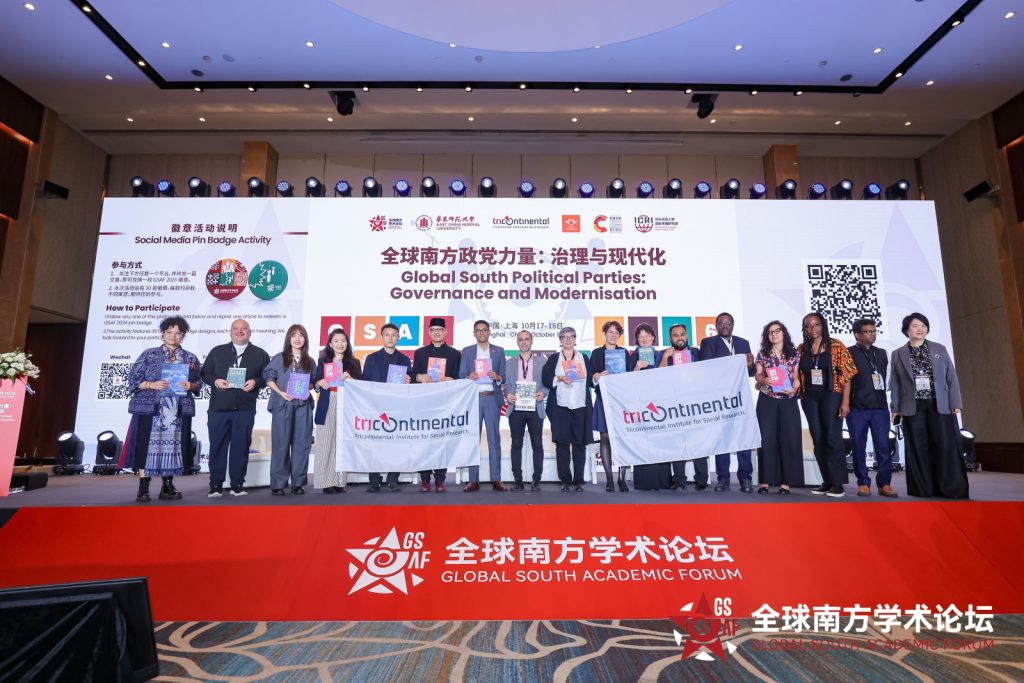
Launch of the Hands Off Asia book at the 2026 Global South Academic Forum in Shanghai.
Dear friends,
Greetings from the desk of Tricontinental Asia.
On 16 October, at the Global South Academic Forum in Shanghai, we launched the book ‘Hands Off Asia: A People’s Call for Sovereignty and Solidarity’, which collects the speeches delivered at the Hands Off Asia conference in Colombo, Sri Lanka.
Included in the volume is the keynote speech delivered by Pushpa Kamal Dahal (Prachanda), the former prime minister of Nepal and a senior leader of the Nepali Communist Party. Prachanda, who led the Nepali communist movement to overthrow the monarchy, knows well the immense challenges of fighting imperialism and governing under the constraints of a neocolonial international structure. His speech is reproduced below.
Something special has happened in Nepal: there are half a dozen former prime ministers, but unfortunately, currently I am the only one who is represented in parliament – and I believe I am also the only former prime minister with the opportunity to present here. That is both an opportunity and a challenge.
Distinguished leaders and delegates, comrades: I feel deeply honoured to be part of this important conference of progressive intellectuals in the beautiful city of Colombo, a city that has long stood at a crossroads of civilisation, culture, commerce and political ideas.
I extend my sincere appreciation to the organisers for bringing together political leaders, intellectuals, social activists, and representatives of people’s movements from across Asia to deliberate on the issues that will profoundly influence the future of Asia and the future of world humanity. I thank the Tricontinental: Institute for Social Research for supporting this very important and unique programme.
We meet at a time when the world is undergoing great turmoil, trauma, and transformation – a moment of extraordinary international geopolitical dynamism, in which a major shift is taking place. The Atlantic-centric power is shifting to Asia, our own region. A new international order appears to be emerging; the epicentre of power is slowly but surely moving towards Asia, pointing to the rise of China and other Asian countries. It is said that the twenty-first century is going to be the Asian century. The global order is also changing from unipolarity to multipolarity. This is a matter of delight for the countries and peoples of the Global South. Unipolarity was hegemonic; multipolarity is more democratic, and the Global South will have its due voice and strength.
As the world order changes, the geopolitical, economic, technological, and ideological foundations of the global system are being reconfigured. The monopoly of influence enjoyed by a handful of countries for decades is gradually giving way to a more plural and contested international landscape. The central question before us, therefore, is not simply whether power is shifting from one region to another. The important question is: what kind of world order will emerge from this transition, and whose interests will it serve?
The principal ideological contradiction of the world at present is, as we know very well, the contradiction between imperialism and socialism. For many people, imperialism remains associated primarily with colonial occupation, military conquest, and direct political domination. While this form has not entirely disappeared, the models and mechanisms of domination have changed and become more sophisticated, taking multidimensional forms deeply embedded within the structures of globalisation. In the era of the fourth industrial revolution, imperialism often functions through economic dependency rather than territorial occupation. Techno-imperialism is a newer version of imperialism.
Imperialism always seeks to concentrate power and money in the hands of a few elites at the expense of the large sections of the population. Such a system only increases poverty, inequality, injustice, conflict, and war. We, the progressive people of Asia, must stand together to counter this imperialist onslaught in Asia and say loudly: Hands off Asia!
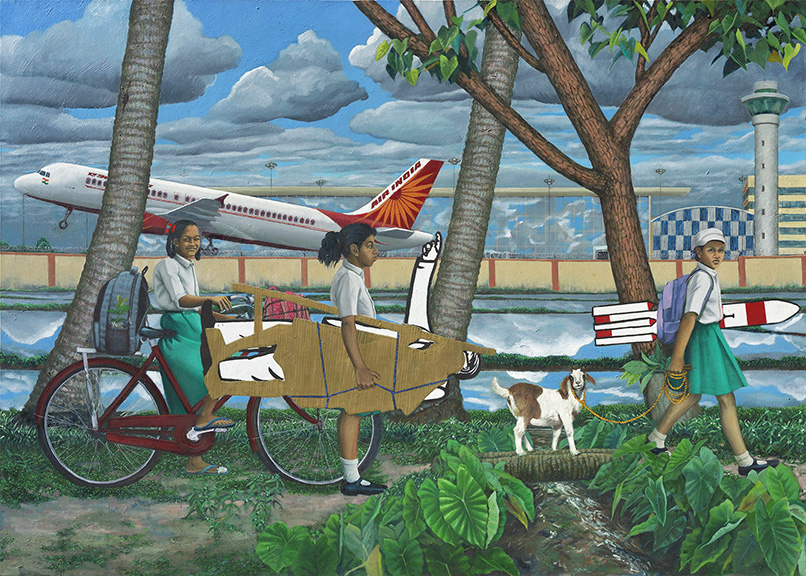
K. P. Reji, Mary Had a Little Lamb, 2020.
Developing countries find their policy choices constrained by external financial institutions, debt obligations, unequal trade arrangements, speculative capital movements, and the structural vulnerabilities of dependent economies. Economic sovereignty can be weakened without a single bullet crossing the border. Similarly, strategic competition among the major powers increasingly manifests through military alliances, security partnerships, military bases, arms transfers, and geopolitical rivalry.
Control over data, digital infrastructure, communication networks, artificial intelligence, and the information ecosystem is becoming yet another important source of geopolitical power. Digital platforms shape public opinion, influence electoral processes and determine access to information. The concentration of technological power in the hands of a limited number of actors raises fundamental questions about digital sovereignty and democratic accountability. These are the areas imperialism seeks to control in order to impose its hegemony.
We are witnessing the rise of information warfare. Disinformation campaigns, algorithmic manipulation, cyber operations, psychological influence, and narrative control have become powerful tools in contemporary international politics. Political destabilisation frequently occurs through indirect means: external actors often seek influence through economic levers, ideological penetration, media manipulation, and political engineering rather than overt intervention. This reveals that contemporary imperialism operates as an integrated system encompassing economic, military, technological, political. and ideological domination.
Sovereignty cannot be reduced merely to the authority of the state. Sovereignty must be understood as the people’s collective capacity and expression to determine their own political, economic, social, and cultural destiny. National independence means little where a country’s resources are controlled by external interests, where citizens remain excluded from decision-making, and where development benefits only a handful of privileged elites.
Similarly, democracy cannot be confined to periodic elections. Democracy must encompass meaningful participation in political, economic, and social life – a life in which workers, peasants, women, indigenous communities, youth, marginalised groups, and ordinary citizens have an equal share and active participation.
Nepal’s modern political transformation emerged through the integration of armed insurgency, democratic movement, and revolutionary aspiration. The People’s War was not simply an armed conflict; it represented a political response to deep structural inequality, social exclusion, feudal exploitation, centralised state power, and limited democratic participation. The people’s movement subsequently created a historic convergence of democratic and progressive forces. The abolition of the feudal monarchy and the establishment of a federal democratic republic represent a profound transformation in Nepal’s political history. Nepal shows how armed conflicts can be resolved through peaceful means and a democratic process.
We were the first party to advocate the election of a Constituent Assembly and promulgate a new constitution through it. The constitution promulgated by the democratically-elected Constituent Assembly institutionalised the principles of federalism, inclusion, proportional representation, secularism, social justice, and republicanism.

Hit Man Gurung (Nepal), God Has Left My Place II, 2018.
But political transformation does not automatically produce economic transformation. Political change must be accompanied by institutional reform, economic democratisation, and social transformation. Progressive movements must learn from Nepal’s experience in transforming society from a feudal setup into a democratic, socialist-oriented new system.
Throughout history, progressive forces have often achieved remarkable victories when united, and suffered serious setbacks when divided. If we progressive people act in unity, we can definitely achieve the desired result – Nepal is a clear example of this. Unity requires understanding of fundamental principles: democracy, sovereignty, social justice, equality, peace, environmental sustainability, and human dignity. Progressive organisations must place the interests of the people above narrow partisan interests. The future of transformative politics thus depends not upon sectarian competition but upon strategic cooperation.
The rise of the Generation Z movements – popularly called the Gen Z movements – in Sri Lanka, Bangladesh, Nepal and elsewhere raises many serious questions about social and economic transformation. Traditional political actors often misunderstand these movements. Many young people are not rejecting politics itself; they are rejecting exclusionary politics, unresponsive institutions, corruption, unemployment, and the concentration of power. Their demands are legitimate and deeply connected to contemporary reality. But in this regard we must also take into account the negative role played by the imperialist powers.
Comrades, delegates: the ultimate test of any political party and project is whether it improves the lives of ordinary people. An economic system that generates wealth without enhancing livelihoods inevitably produces instability. Extreme wealth concentration undermines democracy, social cohesion, and economic sustainability. Asia is among the regions most vulnerable to climate change, despite contributing relatively little to it. Sustainable industrialisation, renewable energy transition, ecological protection, and climate adaptation strategies must therefore become central pillars of our development position. Development should serve human needs rather than the exclusive pursuit of profit.
The future of Asia depends upon our ability to choose cooperation over confrontation. The growing strategic competition among the major powers presents good opportunities and challenges. The Asian countries must resist pressures that seek to divide the region into competing geopolitical camps. The principles of peaceful coexistence, sovereign equality, non-alignment, and mutual respect remain profoundly relevant; the Bandung spirit is still vital and important for us. Asia’s prosperity will be strengthened not through confrontation but through cooperation. At the international level, solidarity remains the need of the hour. We reaffirm our support for the Palestinian people’s right to statehood. We oppose occupation, indiscriminate violence, and violations of international humanitarian law by any country under any pretext. South–South cooperation should become a cornerstone of the emerging multipolar world, and all progressive people must join hands to counter any form of imperialism and intervention under any pretext. If we unite and act together, we will definitely succeed in achieving our goal.
Progressive movements must engage actively in intellectual and ideological work to build confidence, critical awareness, and informed citizenship. I therefore propose that we adopt a common development agenda of the Asian peoples. Such an agenda should unite the progressive forces around peace, sovereignty, economic democracy, food sovereignty, climate justice, digital sovereignty, gender equality, youth empowerment and regional solidarity. Political parties, trade unions, peasant organisations, women’s movements, youth organisations, indigenous communities, academics, and progressive intellectuals should work together through such platforms of meaningful cooperation.
Finally, as progressive people, we must adhere to the spirit of internationalism. The emerging multipolar world must not reproduce old hierarchies in any form, including so-called new forms; it should be based on equality, mutual respect, shared learning, and collective responsibility. Let us move forward together with courage, wisdom, solidarity and determination. We will definitely succeed in creating a just and peaceful world.
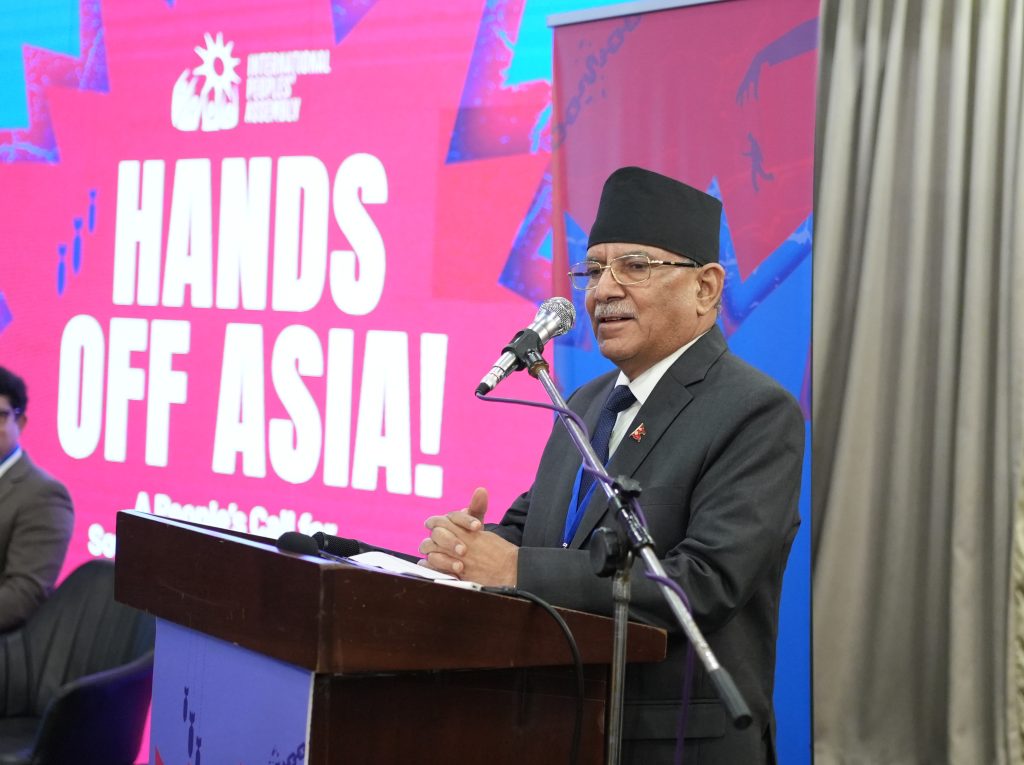
Pushpa Kamal Dahal (Prachanda) speaking at the Hands Off Asia conference in Colombo, Sri Lanka.
Prachanda’s speech reminds us that changes in the world order, by themselves, are not a necessary guarantor of progress. Much depends on the capacity of political parties and social movements to articulate and implement an agenda for social change. Hands Off Asia, therefore, requires us to be more ‘hands on’ with organisation, policymaking, and governance if we want to build a brighter future for the peoples of Asia.
To read the other speeches at the conference, download the Hands Off Asia book here. Additionally, you can watch the panel discussions from the conference here.
Warmly,
Tings Chak and Atul Chandra
Tings and Atul are co-coordinators of Tricontinental Asia.