

China’s Top AI Models Close Performance Gap with US to 3 Percent, Lowest on Record
China’s leading artificial intelligence (AI) models have narrowed the performance gap with US rivals to around 3 percent, the lowest on record, down from 9 percent in May and 15 percent earlier in 2026, according to Bloomberg Intelligence; Stanford’s 2026 AI Index said the gap had ‘effectively closed’. DeepSeek is no longer China’s only serious challenger: Alibaba’s Qwen, Z.ai’s GLM and Moonshot’s Kimi rank near the global frontier on third-party benchmarks, with some scoring above DeepSeek on composite tests.
Read More:
PLA Navy Hospital Ship Auspicious Ark Arrives in Guinea for First Medical Visit
China’s naval hospital ship Auspicious Ark docked at the Port of Conakry on 3 October for a seven-day goodwill visit, the first by a Chinese naval hospital ship to Guinea, as part of Mission Harmony-2026. At the previous stop in Mauritania, the vessel handled more than 1,600 consultations in a single day and a woman with a high-risk pregnancy gave birth aboard. Chen Renbing of the Guinea Overseas Chinese Association said the visit marked ‘a new level in the friendship between Guinea and China’.
Read More:

Revised Audit Regulations Add Interference Protection and Extend Scope to State-Owned Resources
Premier Li Qiang signed a State Council decree on 24 September revising the regulations on the implementation of the audit law, taking effect on 1 December. The 64-article revision adds a formal registration system requiring auditors to document any unwarranted attempts to inquire into or interfere with audit matters. It also extends special audit investigation powers to state-owned resources management and requires audit institutions to share information and transfer clues across ten national supervision channels, including discipline inspection and NPC oversight.
Read More:

Huawei and Qualcomm’s 5G Patent Deal Reverses Royalty Flow for the First Time
Huawei and US chipmaker Qualcomm on 5 October announced their first cross-licence covering 5G, computing, AI and networking. China Daily reported the accord as the first revenue-positive agreement between the two companies, with net payment flowing to the Chinese firm. Huawei earned its first licensing income in 2011, from Motorola. The arrangement reverses a royalty channel that long moved surplus to US patent holders, and will push Huawei’s cumulative licensing value beyond US $6.9 billion.
Read More:
Central SOEs Post 7.5 Percent Profit Margin as First Five-Year Plan Earmarks US $297 Billion for Infrastructure
The first five-year plan for China’s centrally administered state enterprises (2026–2030) targets a further 5-percentage-point rise in value-added from strategic emerging industries. The plan earmarks about 2 trillion yuan (US $297 billion) this year for the ‘six networks’ infrastructure programme; R&D spending rose 2.7 percent in January–August and the operating profit margin reached 7.5 percent, up 0.2 percentage points. The results challenge the assumption, long entrenched in other regions, like Latin America, that public enterprise is inherently inefficient.
Read More:

China Completes First Offshore Platform to Boost Gas Recovery by Reinjecting Captured CO2
China’s state energy company CNOOC has completed the main structure of the country’s first offshore platform to reinject carbon dioxide to boost natural gas recovery, at the Dongfang 1-1 gasfield off Hainan Province. The platform will capture CO2 produced alongside natural gas, pressurize it and inject it underground to recover otherwise hard-to-reach reserves while permanently storing more than 1 million tonnes of CO2 annually. UNECE identifies carbon capture, use and storage (CCUS) as critical to the 90 billion tonnes that its member countries need to sequester by 2050 to meet Paris Agreement targets.
Read More:
Xinjiang Connects China’s First 100-MW CO2 Energy Storage Plant, Deployable on Flat Land
Xinjiang Uygur Autonomous Region has connected to the grid China’s first 100-megawatt compressed carbon dioxide energy storage plant. The system uses off-peak power to compress CO2 into liquid and releases it as gas to drive turbines at peak demand, storing 290 million kilowatt-hours a year and discharging 180 million. Unlike pumped-hydro and compressed-air storage, the closed-loop design requires no particular geography: no mountains, no caverns.
Read More:

DeepSeek and Huawei Release Six Ascend Components Challenging Nvidia’s CUDA Software Monopoly
DeepSeek and Huawei on 30 September announced that code written for one chipmaker’s processors can run unchanged on another’s. The two companies open-sourced six Ascend components that mirror one-to-one their existing Nvidia-platform tools, including the TileLang language, and jointly released a supernode solution based on 128 Ascend 950 chips. The move targets the CUDA software ecosystem underpinning US chipmaker Nvidia’s dominance in AI computing.
Read More:
CAS Launches First Batch of 10 Frontier Projects on Dark Matter and Synthetic Cells
The Chinese Academy of Sciences (CAS) unveiled on 29 September the first batch of ten frontier research projects targeting the synthesis of new elements, the nature of dark matter and dark energy, measurement of chemical bonds and creation of synthetic cells. The projects draw on 77 major national scientific facilities, 43 operated by CAS, combined with AI-assisted research. The academy is opening participation to scientists worldwide, targeting global leadership in each field by 2030.
Read More:

‘Traces of Justice’ Tops US $170 Million National Day Box Office With a 92-Year-Old Scientist’s Story
The National Day holiday box office topped 1.16 billion yuan (about US $170 million), led by ‘Traces of Justice’ with 423 million yuan (about US $62 million). The crime drama is built on the career of Cui Daozhi, 92, a forensic scientist who received the Communist Party of China’s July 1 Medal. Daily takings exceeded 100 million yuan (US $14.84 million) for seven consecutive days.
Read More:
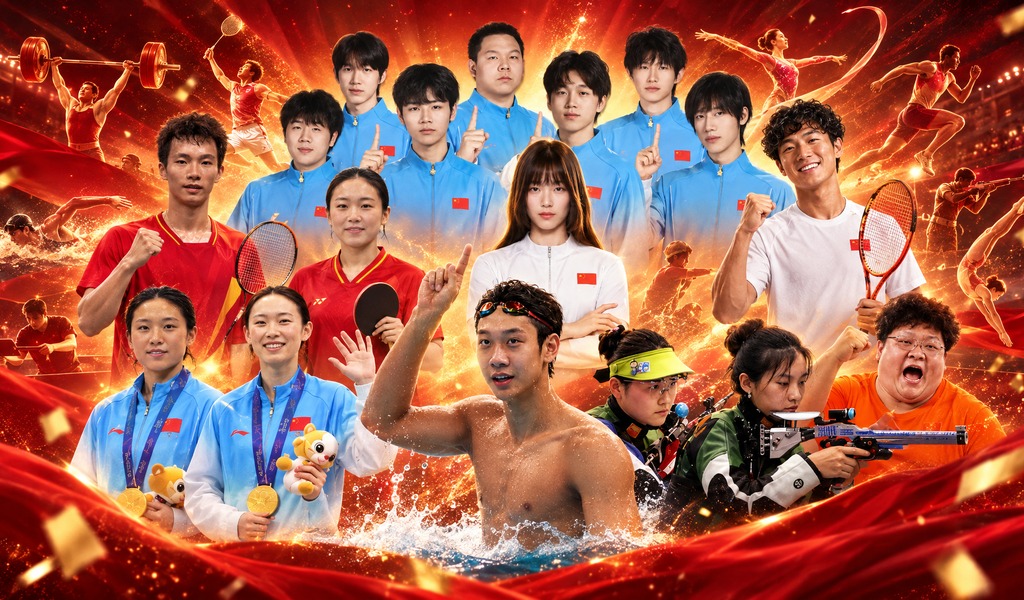
China Takes Record 169 Golds Overseas as 13-Year-Old Yu Zidi Becomes Youngest Asian Games MVP
The Asian Games closed in Nagoya on 4 October. China topped the medal table for a 12th consecutive edition with 169 golds; of the 815-strong delegation, 548 made their Games debut. Junior-high swimmer Yu Zidi, 13, won three golds and set three records, including 2:06.10 in the 200m individual medley; she and Thailand’s Puripol Boonson were named co-MVPs, and at 13, Yu Zidi is the youngest MVP in Asian Games history.
Read More: