Literacy and Organisation: The Literacy Process in Zambia and the Internationalist Solidarity of MST
Five years ago, the Landless Workers’ Movement (MST), in partnership with the Socialist Party of Zambia, launched one of the boldest literacy projects: bringing Brazilian popular education to rural and urban communities in southern Africa.
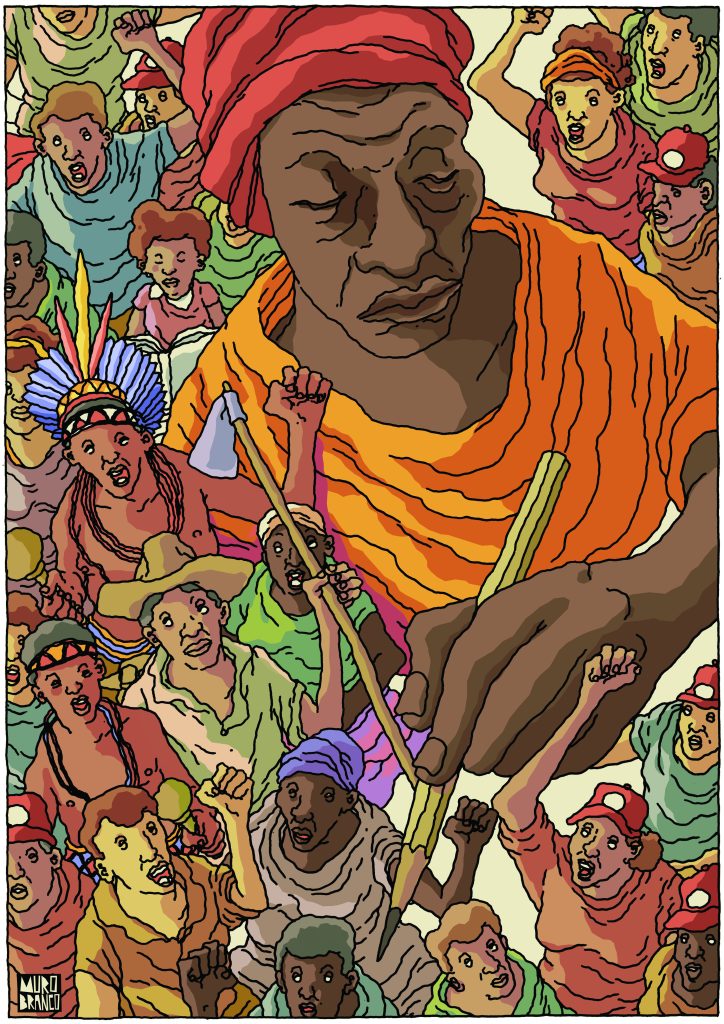
Art by Túlio Carapiá and Clara Cerqueira (Brazil) for ‘To Hope, 100 Years of Paulo Freire’, a poster exhibition, 2021. Available at Tricontinental’s website.
Comrades,
Greetings from the Nuestra America office of Tricontinental: Institute for Social Research.
September is a month filled with anniversaries. Naturally, for the peoples of the continent, it also marks another anniversary of the events of September 11, 1973, which shook the heart of the Third World: the CIA-orchestrated coup d’état against President Salvador Allende and the Popular Unity project in Chile. To learn more, we recommend Dossier 68, which we published on the 50th anniversary of the coup.
However, September is also a month of celebration, as two dates coincide that call on us once more to reflect on our political practice and our most urgent tasks. International Literacy Day falls on September 8, followed on September 19 by the birth anniversary of Brazilian educator and popular pedagogue Paulo Freire. He not only developed a literacy method rooted in the material reality of his students—using generative words as a first approach to written language—but also developed a methodology of popular education that, to this day, enables hundreds of thousands of people to gain critical awareness of their reality and tirelessly pursue its radical transformation.
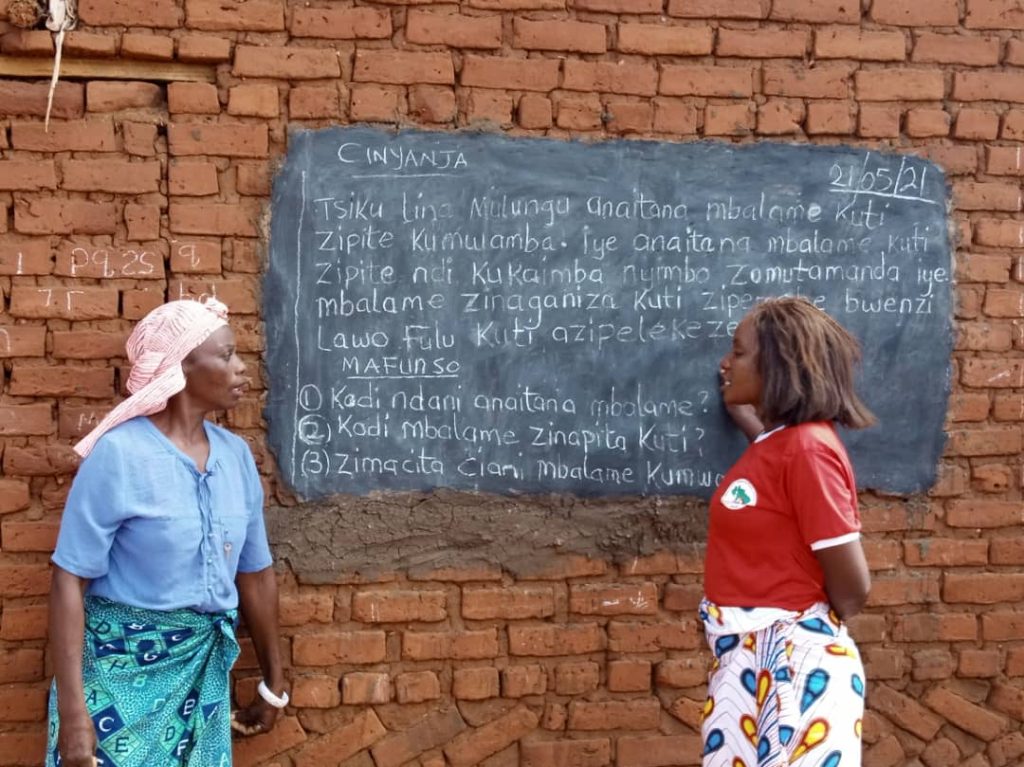
Photo: MST’s Samora Machel Internationalist Brigade (Zambia).
With this anniversary in mind, we asked the Samora Machel Internationalist Brigade of the Landless Workers’ Movement (MST) to share the experience of the Fred M’Membe Literacy and Agroecology Campaign, developed in Zambia, Africa, for our September bulletin. Below are their words:
Five years ago, a political decision crossed the ocean: not to wait. Driven by this challenge, the Samora Machel Internationalist Brigade of the Landless Workers’ Movement (MST), in partnership with the Socialist Party of Zambia, launched one of the movement’s boldest literacy projects, bringing Brazilian popular education to rural and urban communities in southern Africa. The result is the Fred M’Membe Literacy and Agroecology Campaign, which has already taught more than 5,000 people to read and write across four provinces with the help of about 350 volunteer educators.
The Scenario: A Colonial Legacy
To understand the process, one must understand its context. Zambia possesses immense cultural and linguistic wealth, with over 70 local languages, yet English remains the sole official language. This linguistic hierarchy is a legacy of British colonial rule, when English was imposed as an instrument of administration and control and eventually became a symbol of social prestige and access to power. Today, over half of the population (55.3%) cannot read or write in English, with women—particularly those living in rural areas—making up the majority of this group.
The inequality is stark. According to the 2018 Demographic and Health Survey, one-third of women and 18% of men in Zambia are illiterate. In the Eastern and Western provinces, half of women aged 15 to 49 cannot read. Moreover, access to formal education is not fully guaranteed by the state: after the initial years of state-funded schooling, families are required to pay fees, pushing a large portion of the population out of the school system.
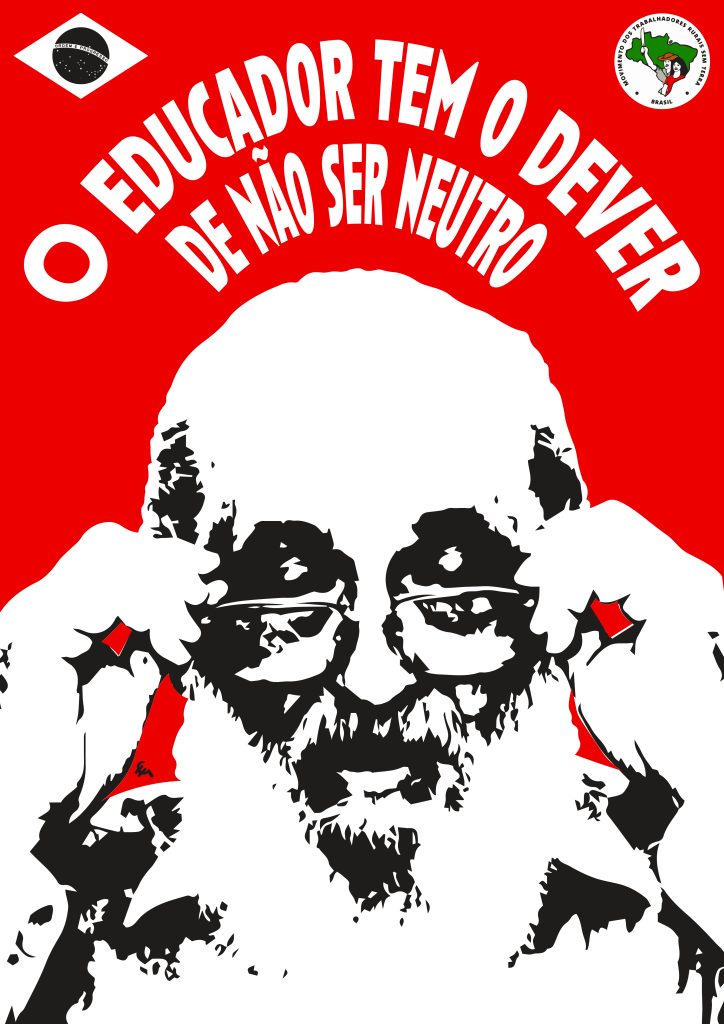
Art by shenby (United States) for ‘To Hope, 100 Years of Paulo Freire’, a poster exhibition, 2021. Available at Tricontinental’s website.
A Methodology Built Collectively
At the outset of the dialogue between the MST and the Socialist Party of Zambia, the Cuban method ‘Yo sí puedo’, developed by educator Leonela Relys Díaz in 2001, served as the primary reference. This method has since been used to teach more than ten million people in 30 countries. However, it soon became clear that simply transplanting a method from Cuba or Brazil would not respond to Zambia’s specific realities. The campaign therefore became a laboratory for collective construction, drawing on the Cuban experience, Paulo Freire’s pedagogy, and the knowledge generated within the communities themselves.
From this convergence emerged their own method: To Talk, To Read, To Write the Words and the World. Its name reflects the educational philosophy of the process: first to speak, because every person already carries a history, a culture, and an understanding of reality; then, to master words as tools for autonomy; and at the same time, to read and write the world, to understand the social relations that shape it in order to transform it. As Elizabet Cerqueira, the brigade’s coordinator in Zambia, reaffirms, the project draws from Paulo Freire the principle that no one educates anyone alone, and from the MST the understanding that education and popular organisation must go hand in hand.
The literacy process in Zambia defies any notion of the traditional classroom. There are no rows of desks, projectors, or libraries. Instead, classes take place in improvised spaces: community schoolrooms with exposed-brick walls, corners of churches, social centres, and open-air spaces where a tree’s shade serves as a roof. Amid tall grass or seated on straw mats, students and educators gather in circles—often with babies sleeping in chitenges tied to their mothers’ backs—using a simple wooden blackboard as the centrepiece of their learning.
It is in this precarious setting that the method To Talk, To Read, To Write the Words and the World comes to life. Words do not come from distant textbooks, but from generative themes rooted in the communities’ own reality: the seed being planted, the rain that fails to fall, the price of corn, the illness that arrives with the floods, or the name each person dreams of learning to sign.
Grounded in Freirean principles, the process begins with words from the learners’ daily lives to build reading and writing skills. This entire effort is sustained by volunteer work: around 350 educators, mostly young students and local peasants, give their time and energy without compensation, driven by the conviction that teaching is also a form of learning and that real transformation begins with collective commitment. Far from being a weakness, this material improvisation highlights the project’s political strength: people build their own school with what they have, where they are, and in whatever ways they can, turning literacy into a first act of collective organisation.
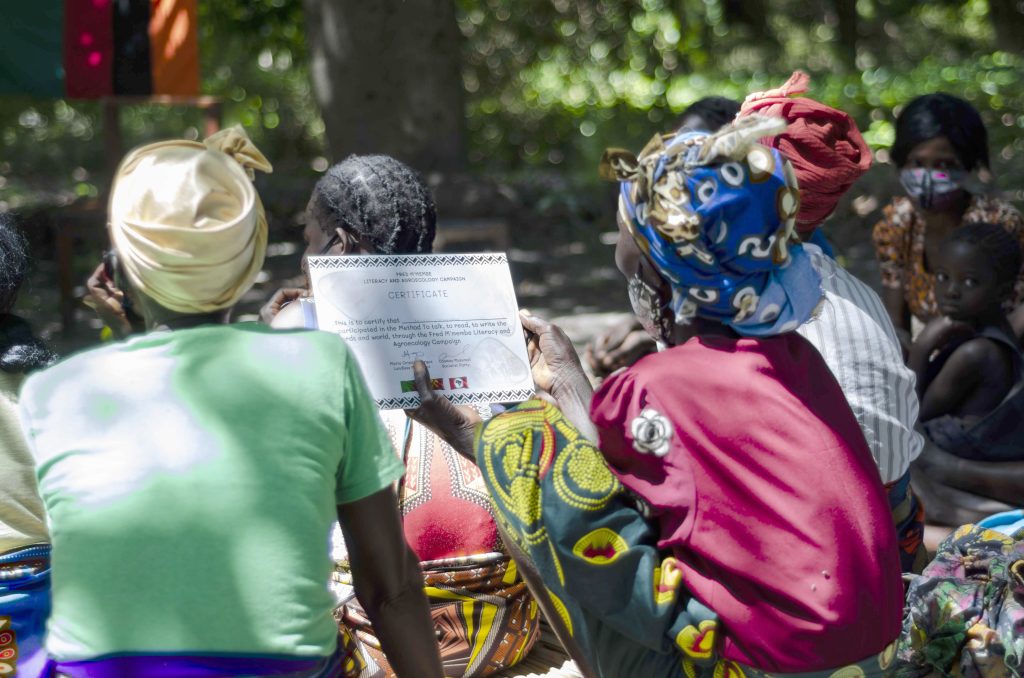
Photo: MST’s Samora Machel Internationalist Brigade (Zambia).
Literacy and Agroecology: A Single Process
The most unique aspect of the campaign is the integration of literacy with agroecology. This is no accident: 1.5 million small-scale farmers produce 90% of Zambia’s food, and peasant families are highly vulnerable to the impact of climate change. In rural areas, most students are also farmers—men and women whose hands bear the marks of field labour. Learning to read and write therefore also means learning to understand the world around them and gaining tools to improve their production and living conditions.
In Lusaka, at the graduation ceremony for the campaign’s second phase, Socialist Party President Fred M’Membe captured the political significance of the moment: “For the first time I am in a room in this country where everyone knows how to read and write. This is today a liberated zone.” More than 350 people, mostly women, completed that stage of the campaign.
Education As a Right, Not a Privilege
A foundational principle of the campaign is that participation is completely free. In a country where many families live on less than two dollars a day, removing the costs of fees, materials, and transportation ensures that no one is excluded. In several communities, bicycles were even provided to help educators travel to classes. Instruction takes place where people are: in community schools, churches, social centres, and beneath the shade of trees.
The initiative has experienced steady expansion. First mobilised in 2019 and officially launched in 2021, the campaign initially reached rural communities in the Eastern and Western provinces enrolling 2,130 students. In its second phase, it expanded to urban areas in Lusaka, Copperbelt, and Central, surpassing 4,000 participants who learned to read and write. By 2022, the stated goal was to alphabetise 10,000 peasants. In March 2024, another 400 students graduated, and classes continue today across the Central and Eastern provincial corridors.
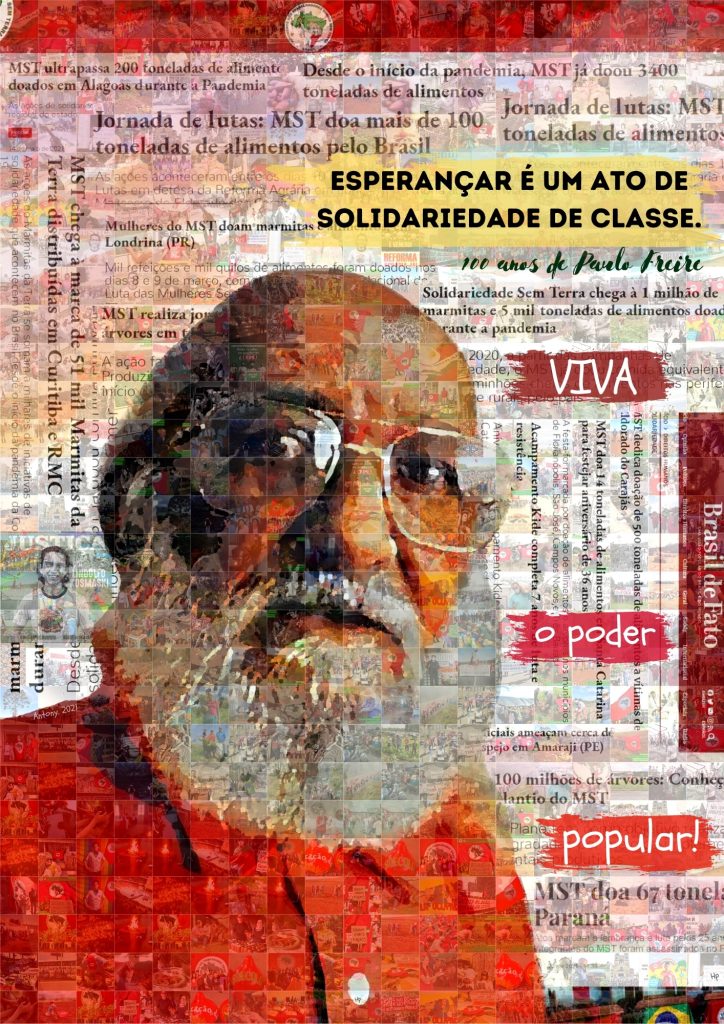
Art by Antony Corrêa (Brazil/MST) for ‘To Hope, 100 Years of Paulo Freire’, a poster exhibition, 2021. Available at Tricontinental’s website.
An Act of Resistance and Internationalism
The political dimension of the process is explicit. As Cosmas Musumali, general secretary of the Socialist Party, notes, ‘the ability to read, write, and express oneself is fundamental for emancipation, especially for women, who are marginalised from political processes and the economic sector.’ Literacy is also tied to popular health. In January 2024, amid a national cholera outbreak, the MST and the Socialist Party organised a grassroots health clinic to serve local communities.
As Amílcar Cabral wrote to Paulo Freire, education must spring from the heart of the people and restore to peasants the dignity stripped away by colonisation. The Zambian campaign honours and carries forward the struggles of Cabral, Freire, and the African peoples who have always known that words, like seeds, only bloom in fertile soil. Five years on, the lesson is clear: when people organise, paths can be built even where they were told it was impossible. Speak. Read. Write the words and the world. The campaign continues.
Elizabet Cerqueira da Conceição
 | Elizabet Cerqueira da Conceição |