BRICS in Delhi: Building a Trading System Free of Western Control
When Washington can freeze a nation’s money at will, the answer emerging from the recent summit in India was not a rival currency but a quiet rewiring of how countries pay one another.
Dear friends,
The recent two-day BRICS summit in Delhi was important because it indicated that even the government of Indian Prime Minister Narendra Modi – which had earlier attempted to enter into a strategic relationship with the US and Israel – now realises that its future lies in maintaining strategic autonomy.
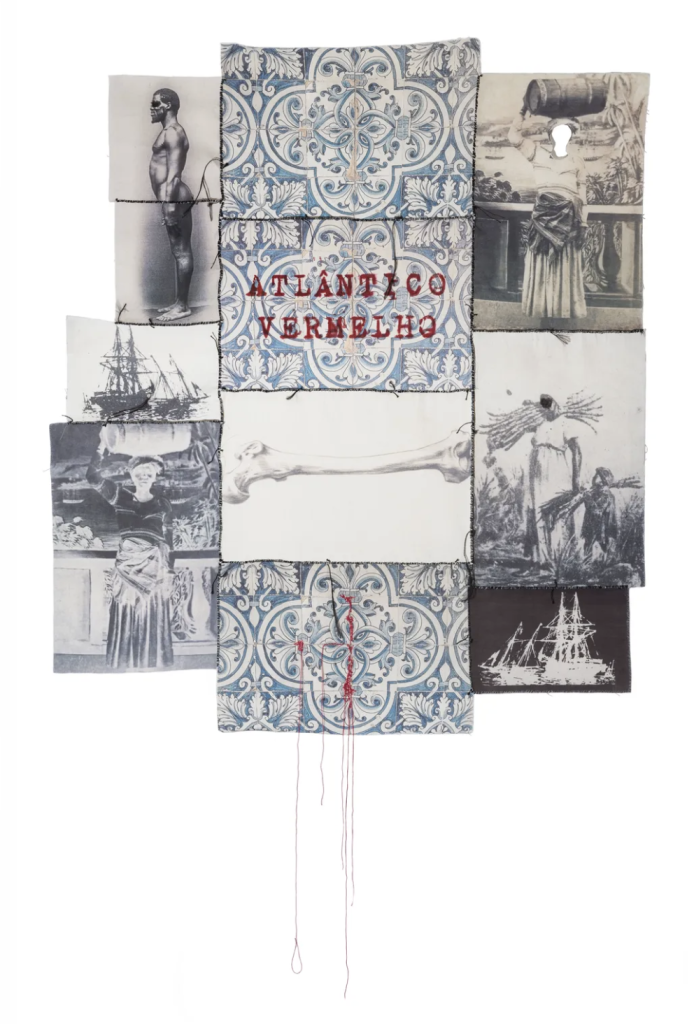
Rosana Paulino (Brazil), Atlântico vermelho (Red Atlantic), 2017.
The objective reality is that the US, EU, NATO, and the G7 (clubs of settler-colonial and ex-colonial powers) are no longer the decisive forces in the world. Instead, the world is moving towards a much more flexible multipolar world order. The writ of the West, whether through their financial sanctions or military interventions, no longer runs. The BRICS Delhi Declaration strategically focused on creating alternative channels of trade and financial flows. These are to be independent of US banks and the SWIFT system through which most global transactions are negotiated. It is through US control of the SWIFT system and the Western banks that the West can impose what it calls ‘global’ sanctions on Russia and Iran, with which they are at war – either directly, as in Iran, or through their proxy, the Volodymyr Zelenskyy-led Ukrainian government against Russia.
The war on Iran provided the strategic backdrop of the summit, even though it was not directly mentioned in the proceedings. The US military interventions, either through Israel in West Asia or directly as in Venezuela, show that the US is not willing to leave its position as the world’s sole hegemon – or as Francis Fukuyama called it, the ‘American Imperium’. This is also in the context of the Modi government surrendering many of India’s earlier geostrategic positions, most importantly on Palestine. Its cosying up to Israel has been in sharp contrast with the larger consensus among African, Asian, and Latin American countries that see the settler-colonial state of Israel as the key problem in West Asia.

Hannibal Alkhas (Iran), Victory Over Fascism, 1996.
Commons Problems
Given the differences within BRICS, and particularly with India as the host country, it is not surprising that the summit focused on what is a common problem for all countries that are not part of the US-led neo- and settler-colonial alliance. That problem is how to conduct trade with each other without negotiating the US Trade Rules – a set of tortuous documents that allow the US to ‘ban’ virtually any trade it wants to stop. Under the administration of President Donald Trump, US trade rules can be used to impose higher tariffs (up to 100%) on all India’s exports to the US because India imports oil from US-sanctioned Russia. At the same time, the US hypocritically continues to import enriched uranium from Russia that it requires for its nuclear power plants.
Given that the US is still the world’s largest economy in nominal terms (though not in purchasing power parity terms), and that it can freeze any country out from most bank and financial transactions through the SWIFT system, the Delhi summit decided to focus on trade as its most important issue. This is central to most countries’ desire for independent foreign and economic policies, and to maintaining their autonomy.
The strategic route the BRICS has taken is not to try to create an alternate currency that every country can use. Such an alternate system would require either a new currency or a currency of a member state to be backed by the central banks of the BRICS countries. Instead, it has chosen a system that allows each country to transact in their domestic currencies for goods they buy from others. Several problems must be addressed if this is to be done. One is a simple mechanism for transferring money from one side to the other, provided both sides have agreed on a conversion rate. The other is how to link the central banks on both sides to enable such a transaction.
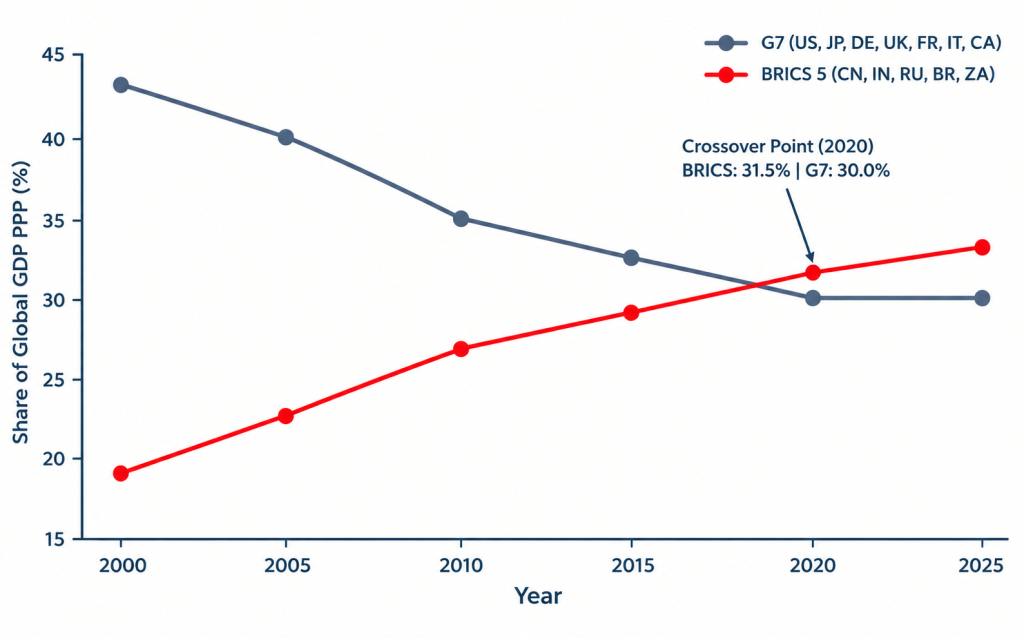
Global GDP Share (%) in PPP Terms: BRICS 5 vs. G7
A major advantage most of the BRICS countries have today, particularly those likely to handle the largest share of transactions, is that they already have payment gateways for internal transactions within each country. The challenges are as follows:
- Interconnecting each country’s payment systems, such as India’s UPI, Brazil’s Pix, China’s CIPS, and Russia’s SPFS. South Africa is left out for now unless it links itself to one of the four above.
- Pricing each commodity in the currency of the country selling its product and applying the exchange rate fixed for the day between the two countries’ currencies.
- Fixing each country’s currencies with respect to the others. Because only four countries’ payment systems are involved, the central banks of these countries have to fix the exchange rates between them every day.
While a single internal reserve currency made life much simpler in days when only banks communicated with each other, advanced digital payment gateways within BRICS make the problem far more tractable today. Computer systems and digital connectivity are a relatively easier problem than creating a BRICS reserve currency. This also prevents any country from emerging as a hegemonic power within BRICS, as the US does within the G7.
Towards Sovereignty
Why are countries trying to move away from SWIFT and the Western financial systems? This stems from the enormous financial power the US wields within such a system: the power not only to impose financial sanctions on any country for political reasons, but also to seize money held in Western banks that operate through the SWIFT system. In 1979, Iran’s money in US banks was seized by the US. In 2022, Russia’s money in European banks was seized by the EU countries.
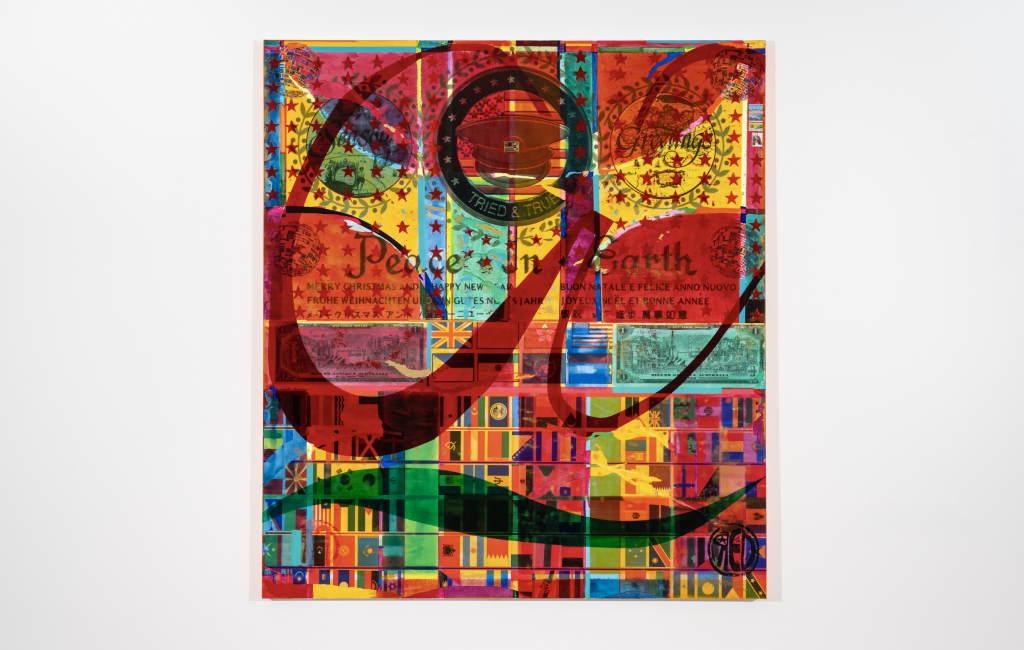
Pu Yingwei (China), A Study in Scarlet: Sovereign Police (Celebration), 2021.
The financial sanctions the US imposes on any country get teeth through the extraterritoriality claims of its laws. For example, in December 2018, chief financial officer and deputy chair of Huawei, Meng Wanzhou, was arrested in Canada based on a provisional extradition request from the United States. This is the extraterritoriality that the US enjoys by virtue of it being the world’s hegemon and the US court’s interpretation of its laws. According to the US, any transaction in dollars anywhere in the world falls under US law and US courts’ jurisdiction.
The move away from SWIFT, the US dollar, and US–EU currencies and banking systems is not merely a convenience for BRICS countries. It matters if they want to exercise their right to trade with whichever country they want, based on their domestic laws and not the extraterritorial reach of US and EU laws. In effect, it is simply asserting that the days of colonialism and neocolonialism are over.
Supporters of the BRICS process believe that the world needs to unite against attempts by the West to control the world through not only direct military means, but also through the existing financial and economic structures. Colonial and neocolonial wars are still being waged, from Venezuela to Iran. Each of these wars will have to be fought by the people of these countries, but the support of progressive forces worldwide is necessary.
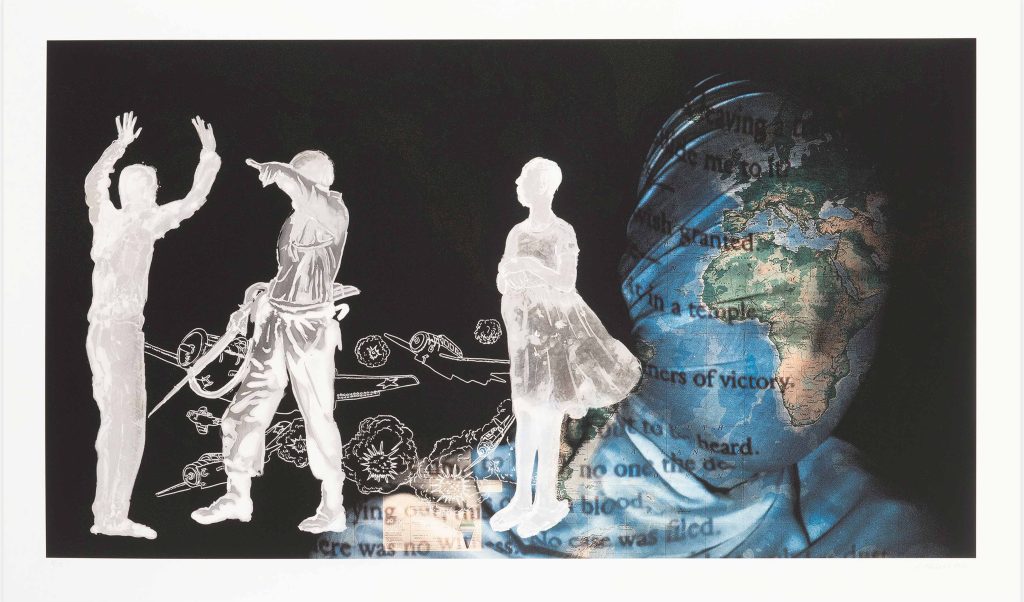
Nalini Malini (India), I – that is Africa I – that is Asia, 2015.
The attempt to control the world financially is even more dangerous because it affects all our economies. Countries in BRICS may have different approaches on geopolitical issues – as we are seeing on Palestine, the Russia–Ukraine War, and the US–Israeli war on Iran. But all the BRICS countries share a common interest: freeing their trade from the extraterritorial powers that the West, particularly the US, wields.
If the BRICS can address the critical issue of how we can build a trading system on a one-to-one basis without going through any third-party intermediary, it would be a major achievement. The time for such a system has not only come, but we also have the instruments for it: the payment gateways of four major economic powers in BRICS. This is by no means a major technological problem and only needs the will for such an implementation.
Warmly,
Prabir Purkayastha
Prabir is a scientist and political activist. He is a founding member of the Delhi Science Forum and editor of Newsclick.in.