

Xi reaffirms ties with North Korea as US, Japan and South Korea hold military drills
On 9 September, President Xi Jinping reaffirmed Beijing’s commitment to strategic ties with Pyongyang, calling the relationship an ‘unshakable’ policy and describing China and North Korea as friendly socialist neighbors that ‘stand side by side and share joys and difficulties.’ In 2026, ties advanced with Xi’s June visit to Pyongyang, the resumption of passenger rail services after six years, and progress on the Yalu River Bridge. Meanwhile, the US, Japan and South Korea are holding the Freedom Edge military exercise through 11 September, which Pyongyang condemned as a provocation, amid growing tensions on the Korean Peninsula.
Read More:
Xi to Attend BRICS Summit as India and China Prepare Successive Presidencies
Xu Feihong, Beijing’s ambassador in New Delhi, wrote in The Hindu on 7 September that the two countries will hold the rotating chair in succession. President Xi Jinping will attend the 12–13 September summit, his first visit to India in seven years. Sound coordination between the two chairs, Xu said, would safeguard the common interests of developing countries.
Read More:

Over One Billion Voters Set to Elect 2.6 Million Grassroots Deputies Across China
Turnout in the round that ended in 2022 reached 86.49 percent at county level and 85.63 percent at township level. That meant 921 million ballots for county congresses and 623 million for township congresses. County and township are the only tiers citizens fill by direct ballot, and their deputies are tasked with conveying public views and resolving practical problems. Xinhua describes the exercise as one of the world’s largest democratic practices.
Read More:

Import Growth Outpaces Exports for a Sixth Month as Zero-Tariff Access Reaches 63 Countries
The General Administration of Customs reported on 8 September that August goods trade reached US $683.8 billion, up 26.3 percent in dollar terms. For a sixth consecutive month, import growth outran exports, 28.2 percent against 25.0 percent. China has removed import duties for 63 countries and cut its average tariff to 7.3 percent. It has been the world’s second-largest import market for 17 consecutive years, an opening for Global South exporters.
Read More:
China’s Central Bank Says It Never Sought a Surplus, Urges Deficit Economies to Adjust Too
The G20 finance meeting in Asheville ended without a communiqué. All members present except China backed a US chair’s statement telling countries with excessive and persistent external surpluses to curb their overreliance on exports. Pan Gongsheng, the governor of the People’s Bank of China, answered that the country has never deliberately pursued a trade surplus. He urged deficit economies to cut fiscal deficits and raise savings, and surplus economies to promote consumption and investment growth.
Read More:
Solar Capacity Overtakes Coal for First Time as China Supplies over 80% of World’s Modules
The National Energy Administration announced the milestone on 1 September, drawing on official figures for the end of July 2026. Installed photovoltaic (PV) power stood at 1.286 billion kilowatts against coal’s 1.285 billion. Output is another matter: solar holds 31.5 percent of installed capacity but supplied only 13 percent of electricity consumption in January-July. China supplies over 80 percent of the world’s PV modules, putting that transition within reach of countries that cannot manufacture it.
Read More:

World’s First Humanoid Robot for Hybrid Crop Breeding Automates Pollination Long Done by Hand
The Chinese Academy of Sciences released GEAIR 2.0 on 4 September at the 33rd China Beijing Seed Industry Conference. Developers put stigma recognition at 92.8 percent, up from 85 percent, and demonstrated a tomato pollination in under 10 seconds. Xu Cao’s team gene-edited the flower itself, making it male-sterile with a stigma the robot can reach. Manual crossing accounts for over 25 percent of fresh-market tomato breeding costs in China.
Read More:
Six Agencies Issue Rural Investment Plan Covering Bonds, Credit, Insurance and Private Capital
The text was made public on 7 September and carries no aggregate spending figure. Its one quantified target is a 2030 deadline for the mechanism itself, aligning it with the 15th Five-Year Plan period. Government funding retains the leading role, with bonds, loans and insurance leveraged alongside non-government capital. Price and subsidy policy must now move in step with those funding channels.
Read More:

Ministry Plan Targets 9,800 EFLOPS of Intelligent Computing and Adaptation to Domestic Chips
The Ministry of Industry and Information Technology released a five-year plan for the information and communications industry on 7 September. Intelligent computing capacity is to rise from 1,590 EFLOPS (each a quintillion operations per second) in 2025 to 9,800 by 2030, roughly a sixfold increase. The plan’s computing task pairs that target with greater efforts to adapt infrastructure to domestically produced chips. Capacity had already reached 2,185 EFLOPS by end-June 2026, up 177 percent year on year.
Read More:
BeiDou’s 7,569 Ground Stations Open Their Data to Industry While Staying Publicly Owned
The Ministry of Natural Resources and the National Data Administration announced the arrangement on 4 September. Officials call it a shift from an underused public resource to a compliant, tradable asset, opened to key industries under state supervision. The network’s 420 national, 3,293 provincial and 3,856 coordinated stations refine China’s own satellite navigation for autonomous driving and urban governance. Ministry chief planner Zhang Bing called it a replicable model for managing public data in other sectors.
Read More:

Algorithm Governance Widens from Eight Platforms to 25 in Push for Gig Workers’ Social Security
About 200 million people work in flexible employment, 84 million in new forms – 21 percent of the workforce. Zhao Shitang, a vice-minister at the Communist Party of China’s Society Work Department, announced the expansion on 9 September. Unreasonable order assignment and opaque pricing have been addressed, and some localities now pause the delivery timer at red lights. A separate occupational injury insurance scheme covered nearly 30 million workers by June 2026.
Read More:
Chinese Malls and a Metro Operator Hand Prime Advertising Space to National Role Models
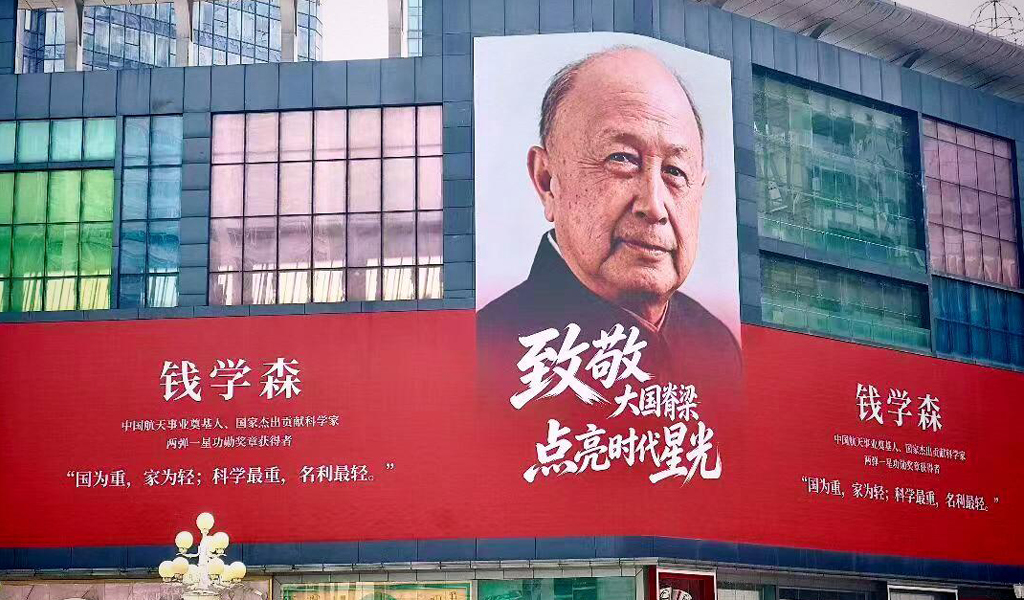
A 7.8-metre lightbox of rocket scientist Qian Xuesen replaced a paid commercial poster in Heze, Shandong, on 7 August. The mall agreed the swap with an advertising company, and no national order required it. Similar displays reached Anhui, Inner Mongolia, Jiangxi and Henan. Zhengzhou Metro then gave six honourees three major interchange stations, among them hybrid-rice researcher Yuan Longping and Nobel laureate Tu Youyou.
Read More: