Resistance to Japan’s Growing ‘War Posture’ Against China
Missile units on southern islands, troops moving on civilian ferries, command bunkers dug underground: a grassroots movement across Japan is trying to halt the drift back towards imperial confrontation. Remembering the 81st anniversary of the atomic bombings of Hiroshima and Nagasaki.
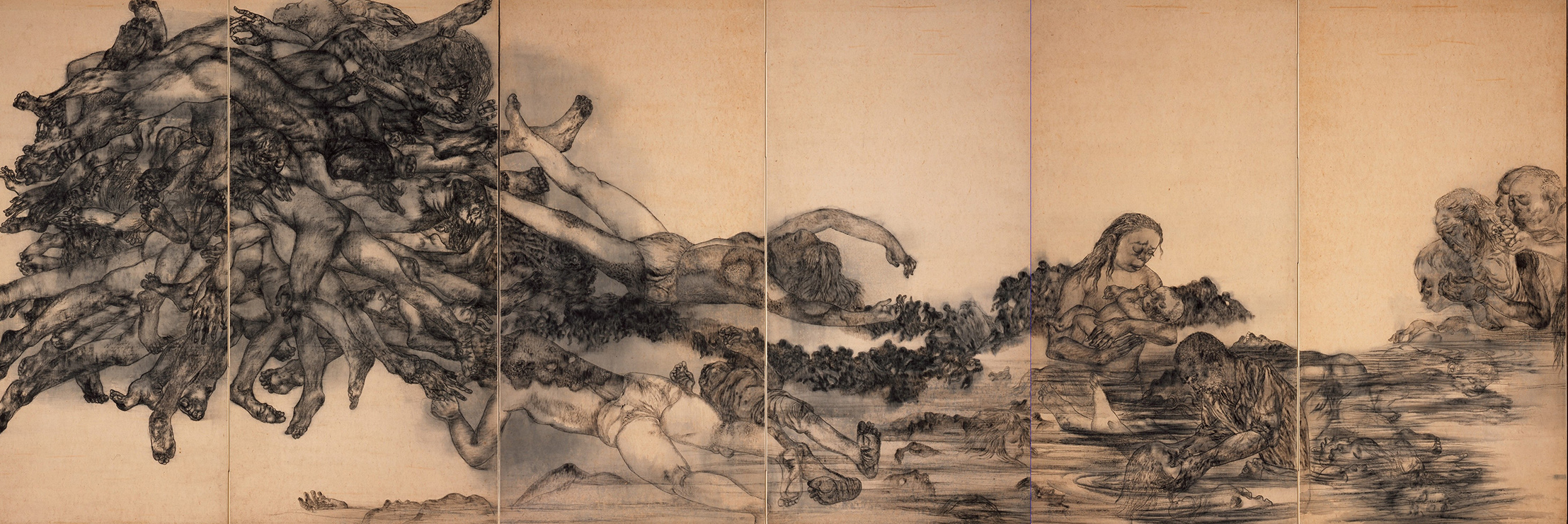
Iri and Toshi Maruki (Japan), V Boys and Girls, 1951.
Dear friends,
The government of Japan is rapidly building a war posture against China. It began in Okinawa and Amami in the mid-2010s, and has expanded to Kyushu, western Japan, and the whole country. Since 2026, Japan has begun deploying long-range missiles capable of reaching mainland China.
Exercises by Japan’s ‘Self-Defence Force’ (SDF) and joint Japan–US drills frequently use civilian airports and ports, as well as public roads and facilities. Civilian ships and ferry routes are now transporting troops and military equipment. The Japanese government and the Ministry of Defence are moving SDF command headquarters underground. This is officially framed as ‘deterrence’. But in reality, these activities anticipate a war with China, and, in such a scenario, going underground protects the command headquarters, while the people living above ground remain exposed.
This is not Japan’s doing alone. For several years, warships and carriers from Britain, France, Germany, and the Netherlands have been in the waters near China for joint exercises. These are the very imperialist powers that, from the 1840s to the 1940s, invaded and occupied China. In 2024, the joint Japan–US exercise Keen Sword 25 deployed 45,000 Japanese and US troops, 40 warships, and 370 aircraft. This exercise was joined by Australian and Canadian forces, with the UK, France, Germany, Italy, and NATO as observers. Over 30 civilian airports and ports were used alongside military bases. A joint Japan–US command post was set up in Okinawa and Amami for the joint exercise. In the islands where missile units are based – Amami, Okinawa, Miyako, Ishigaki – anti-ship missile drills simulated attacks on Chinese vessels. On 6 May 2026, Japanese Defence Minister Shinjirō Koizumi observed a live-fire missile drill, simulating an attack on Chinese vessels, by SDF units in northern Luzon, the Philippines.
In March 2025, then-Defence Minister Gen Nakatani proposed a ‘One Theatre’ concept to US Secretary of Defence Pete Hegseth – treating the Korean Peninsula, the East China Sea, and the South China Sea as one theatre of operations. Even the South China Sea, far from Japan, is now part of the SDF’s theatre. This can only be interpreted as a proposal for the military encirclement of China.
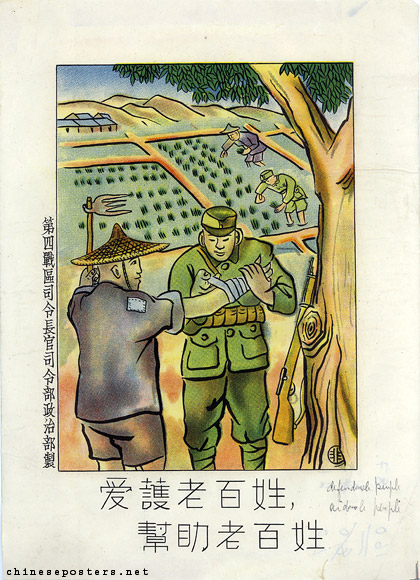
Mai Fei (China), Cherish the common people, help the common people, 1938.
The Trajectory of Imperial Japan
The war posture against China that is now being built follows the trajectory of Imperial Japan. Since its rise 150 years ago, modern Japan repeatedly invaded and occupied its neighbours, killed and dominated vast numbers of people, and became a great power in Asia. Postwar Japan – without deeply reflecting on and taking responsibility for its colonial history – is now re-militarising. The current Sanae Takaichi administration appears determined to move even further down this imperial trajectory.
In November 2025, Prime Minister Takaichi stated that Japan would use military force if China ever moved to unify with Taiwan by force. This would amount to waging war on China without the latter directly attacking Japan. China considers Taiwan to be a territory that was colonised by Japan after the First Sino-Japanese War (1894–95) – a war of aggression against China and Korea. For China, ‘unification’ means recovering that colonised territory. Takaichi’s remarks amount to Taiwan’s former colonial masters preventing that recovery and reunification. Her remarks also broke the Japan–China Joint Communiqué (1972) and the Treaty of Peace and Friendship (1978) – an over fifty-year arrangement that embodied Japan’s promise to build peace and friendship between the two countries. More frightening is Japanese domestic opinion – polls at the time showed that close to seventy percent of people felt that there was no need for Takaichi to retract her remarks.
In 1937, as Japan was invading China, the Japanese government and media pushed the slogan ‘Chastise the Violent Chinese’, branding China’s entirely legitimate resistance as violent and outrageous. This narrative was used to justify Japan’s own aggression and whip up public support for the war. Many citizens supported these slogans and a national unity in support of the war was manufactured. Inside that narrative bubble, there was no room to discuss the real root of the problem – Japan’s own aggression. This same history is unfolding in Japan today. Statements stirring hostility toward China flood the government and media, with almost no attempt to understand China’s own point of view.
We cannot simply watch. We must stop this before it advances further – or Japan will once again become an aggressor against the peoples of China and Asia. In such a process, lives and livelihoods across East Asia will be lost. Japan must reckon honestly with 150 years of its modern history, stop preparation for war, and become a country on the side of peace in East Asia.
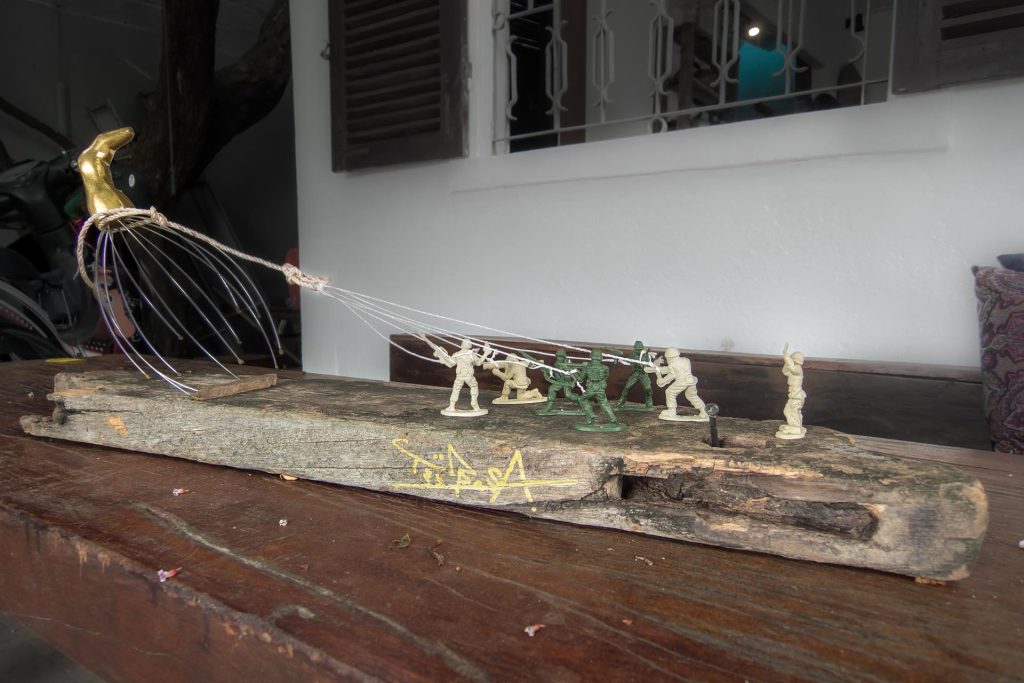
Tsubasa Kato (Japan), Untitled, n.d.
Resistance to Japan’s War Posture
This new war posture, built up since the 2010s, went almost unreported nationally. Resistance has remained isolated. As the militarisation spread from Kyushu into western Japan, we finally began, from late 2023, preparing to connect these isolated struggles into one fight. Through 2024, we held exchange and solidarity gatherings across Okinawa and western Japan: Ehime in April, Okinawa in August, Kure in September, Oita in November. In February 2025, we held a founding assembly in Kagoshima, launching the Stop the War! Okinawa–Western Japan Network. Our founding declaration closed with this pledge:
‘“Know. Connect. Stop it.” – To create peace, we take a new step into struggle. Sharing information, pooling wisdom, connecting, standing in solidarity – with the combined power of citizens, we will stop this war made by the state.’
In June 2025, we brought people from across Okinawa and western Japan to Tokyo for government negotiations, a Diet rally, and a citizens’ solidarity rally. Since then, we have held a range of actions. In October 2025, we rallied in Hōsono, Kyoto, where a huge missile depot is under construction. In November 2025, we went to Oita, where another depot is nearing completion, and to Kumamoto, the country’s first long-range missile deployment site. In December 2025, we gathered in Kure, Hiroshima, where a vast comprehensive military hub is planned. And in May 2026, we went to Maizuru, Kyoto, a major naval port slated to host Tomahawk missiles. At every one of these actions, local residents stood alongside people who had travelled from across the country. A third ‘Tokyo Action’ is planned for October 2026.
After the Takaichi administration’s landslide victory in the February 2026 elections to the House of Representatives, growing numbers of young people, especially women, joined protests against constitutional revision and militarisation. Protests in front of the Diet on 19 April 2026, plus solidarity demonstrations nationwide, drew over 50,000 people. These protests were the result of people organising their own actions. What began in Tokyo is now spreading nationwide. Back in 2015, student-led protests erupted when the government tried to enact laws that would allow Japan to directly join US-led wars. But the recent protests far exceed the scale and geographic spread of the 2015 protests. For Japan, where youth-led, anti-war activism has long been absent, this is a genuinely groundbreaking development.
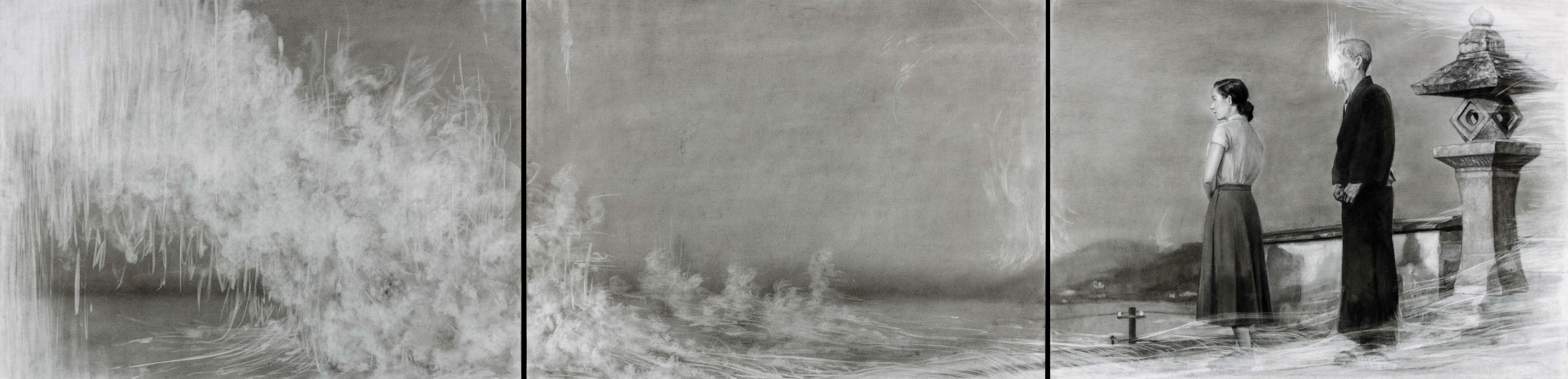
Meiro Koizumi (Japan), Fog #15, 2020.
Three Challenges for Resistance
There are three main challenges to building resistance to Japan’s war posture. The first is to merge the struggle in militarised regions with the new youth struggle. This requires a convergence of the regional struggles against militarisation, the anti-constitutional-revision movement running continuously since 2015, and the new youth-led anti-war and anti-Takaichi movement. The more deeply and broadly these movements merge, the more the struggle can grow into one great wave covering all of Japan. In October 2026, we plan to hold an action in Tokyo to unite these forces, raise our voice against Japan’s growing war posture against China, and strengthen the anti-war movement.
The second challenge is to overcome and dismantle the ‘China threat’ narrative spreading through Japanese society. The government and media frame militarisation as deterrence. Most citizens accept this framing and don’t oppose the huge cost it entails. Rearmament always comes bundled with tax hikes and cuts to social security. Meanwhile, many citizens face growing hardship in daily life and are calling for social security and tax relief. If more people understood that China has no reason to attack Japan, and that it is in fact the Japan–US war posture that is risking war in East Asia, support for militarisation should fall. There are no Chinese military drills near the US, but there are Japan–US–NATO drills right next to China. Therefore, dismantling anti-China narratives is an urgent task.
The third challenge is to build an anti-war movement in solidarity with the peoples of the Global South – those once colonised by the imperialist powers, Japan included. The Western countries and Japan, dominant for centuries, are now in historic decline. China, India, Indonesia, Brazil, and others are gaining economic strength and political voice. These countries promote peaceful resolution of disputes and have opposed wars of aggression against Vietnam, Iraq, Libya, and Palestine. It is the Global South, China included, pushing hardest to stop the Western-backed Israeli attacks on Palestinians since 2023. This stance runs unbroken from the Ten Principles of Bandung to the Non-Aligned Movement.
The reckless US actions against Venezuela, Cuba, and Iran are the death throes of a declining power. The countries building this war posture against China are the same Western core states led by the US – and it exists to weaken China, the centre of the Global South, to delay their own decline. Our struggle shares common cause with people fighting US aggression in Venezuela, Cuba, and Iran. Japan’s anti-war movement does not yet carry this awareness. But we must grasp our own struggle through exactly this lens, and carry it forward as a genuinely international struggle – our historic task, living here in East Asia at this turning point in human history.
The Hands Off Asia initiative carries the hope of becoming the seed of an ‘Asian People’s Anti-War Network’, linking the Japanese people’s resistance with the struggles of East Asian and Global South peoples. Eighty-one years after Hiroshima and Nagasaki, the work of stopping the next war has only just begun.
Warmly,
Hiroyuki Takai
Takai is the co-representative of the Stop the War! Okinawa–Western Japan Network and author of Who Invites War in East Asia? – China Containment and US-Japan War Plans in the Ryukyu Arc. This essay is adapted from his remarks at the webinar ‘Re-Narrativising Hiroshima and Nagasaki, Resisting Japan’s Remilitarisation’ on 11 August 2026, organised by the International Peoples’ Assembly Asia and Tricontinental: Institute for Social Research.
Disclaimer: The views expressed by the authors do not necessarily reflect the views of Tricontinental: Institute for Social Research.