FIDEL x 100: A Century in the Battle of Ideas and Emotions
From OSPAAAL to FIDEL x 100, Cuba’s revolutionary culture continues to form political consciousness, carry historical memory, and build solidarity across movements, generations, and borders.
Listen to ‘Y en eso llegó Fidel’ (And Just Then, Fidel Arrived, 1959) by Carlos Puebla, performed in the lively guaracha rhythm that helped carry the song from revolutionary Cuba to union halls, cantinas, political schools, and liberation movements across Latin America.
Havana, August 2026
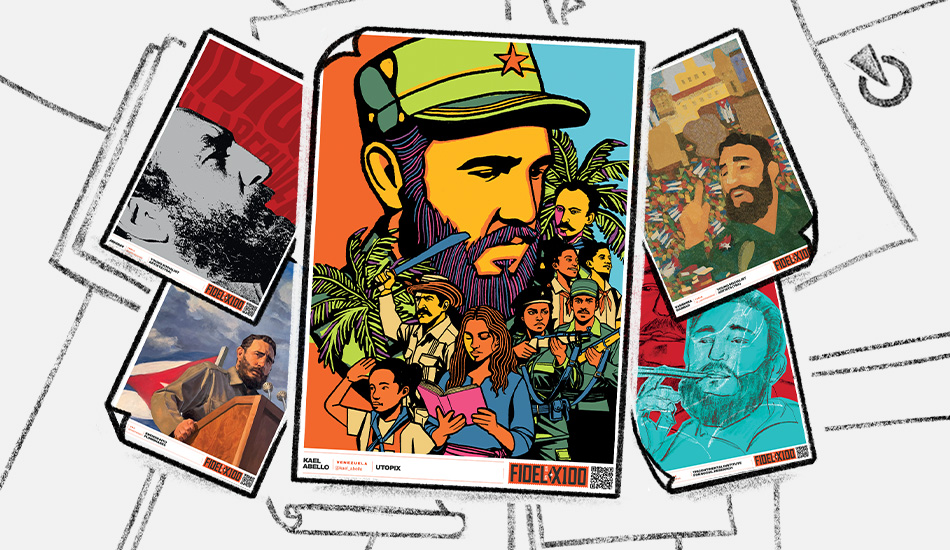
From 6 to 9 August, more than 180 delegates from 27 countries representing more than 130 organisations gathered at the University of Havana for the IV Continental Assembly of ALBA Movimientos, a space for articulating popular movements around the project of socialism, anti-imperialism, and continental integration. As part of the assembly’s cultural programme, FIDEL x 100 commemorated the centenary of Fidel Castro’s birth with more than 200 posters created by over 100 cultural workers from 32 countries.
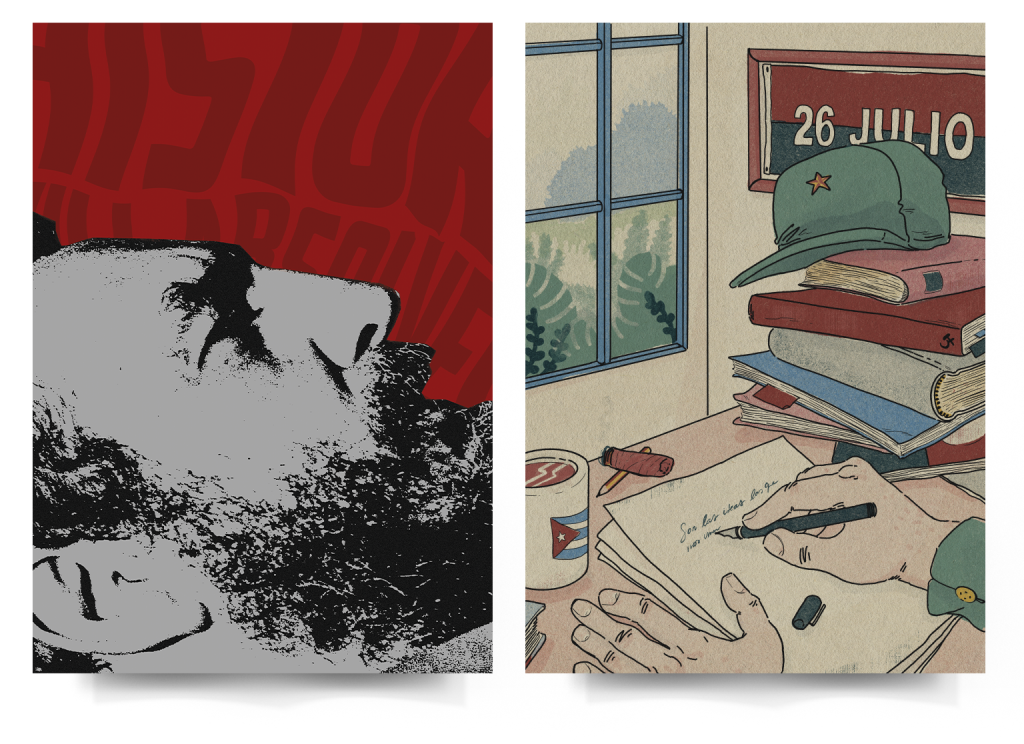
Left: Abhinav (India, Young Socialist Artists/Tricontinental); right: Daniela Ruggeri (Argentina, Tricontinental).
The exhibition emerged from an open call organised by the International Peoples’ Assembly, ALBA Movimientos, Utopix, Young Socialist Artists, Pan Africanism Today, and Tricontinental: Institute for Social Research. The diversity of the works – in style, technique, language, and political tradition – reflected the international reach of Fidel’s legacy. Yet the exhibition was not simply an act of commemoration. It was a recovery of Fidel’s ideas as tools of struggle – the ideas that helped make the Revolution possible and continue to sustain it today.
The full archive is available as a free downloadable collection to be printed, exhibited, studied, and used by organisations around the world. Like the posters that decades earlier travelled folded inside Tricontinental, the magazine founded by the Organisation of Solidarity with the Peoples of Asia, Africa, and Latin America (OSPAAAL), these works are intended to circulate: from assemblies to political schools, from union offices to classrooms, from movement headquarters to neighbourhood walls. We invite you to use them in this way.
FIDEL x 100 belongs to a much longer history. The Cuban Revolution did not treat culture as something secondary to politics, nor as mere decoration for revolutionary achievement. It understood cultural work as part of the material infrastructure of revolution itself: a means of forming political consciousness, cultivating technical and artistic capacities, sustaining collective memory, and extending international solidarity beyond the island’s shores.
Havana, Sixty Years After the Tricontinental Conference
That tradition acquired one of its clearest institutional expressions in January 1966, when Havana hosted the first Tricontinental Conference. More than 500 delegates from liberation movements, revolutionary governments, communist parties, and popular organisations across Africa, Asia, and Latin America gathered to forge a common anti-imperialist strategy against colonialism, capitalism, and war.
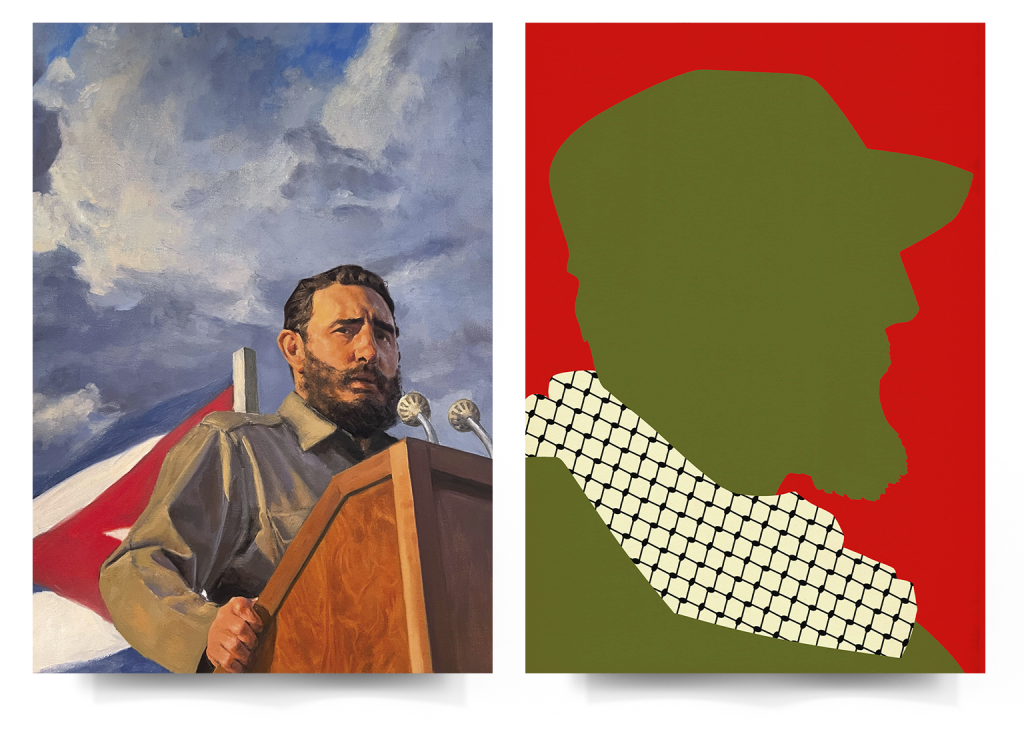
Left: Ian Matchett (US, Swords into Plowshares Peace Center and Gallery); right: Ignacio Andrés Pardo Vásquez (Chile, Utopix and Quinmantú).
Out of the conference emerged OSPAAAL, one of the most important institutions of revolutionary internationalism in the twentieth century. Through its publications, solidarity campaigns, educational work, and especially its extraordinary poster production, OSPAAAL helped build a shared political language for struggles taking place across three continents.
Over three decades, the organisation produced around nine million posters distributed to more than sixty countries, many folded inside the pages of Tricontinental. The magazine and posters travelled to places where revolutionary diplomats could not, making the struggles of Vietnam, Palestine, Angola, Mozambique, Puerto Rico, South Africa, Chile, and dozens of others visible to each other as part of a common front against imperialism.
Many of the graphic designers who created these posters had learned their craft in Havana’s advertising agencies before the Revolution. After 1959, they turned those same techniques against empire. Typography, photography, colour, montage, among other visual techniques – once employed to sell commodities – were repurposed to build international solidarity, make anti-imperialist struggles legible across languages, and forge a revolutionary visual language capable of crossing borders.
As the Cuban designer Félix Beltrán later reflected, ‘The poster could circulate in countries where a functionary was not allowed to speak about the ideas of the Revolution’.
The poster thus became more than a medium of communication. Under conditions of blockade and diplomatic isolation, it became an instrument of international organisation. Alongside the revolutionary cinema of the Cuban Institute of Cinematographic Art and Industry (Instituto Cubano del Arte e Industria Cinematográficos, ICAIC), the editorial work of Casa de las Américas, and the international educational institutions built by the Revolution over subsequent decades, OSPAAAL formed part of the cultural infrastructure through which Cuba internationalised its revolutionary project.
A Revolution Can Only Be the Child of Culture and Ideas
By the end of the twentieth century, the Cuban Revolution had survived what many believed would be its final test. The fall of the Soviet Union plunged the island into the Special Period, while Washington tightened the blockade expecting that socialism would finally collapse under economic isolation. Across much of the world, the triumph of neoliberalism was proclaimed as the ‘end of history’, as political scientist Francis Fukuyama famously declared, and Cuba was widely treated as a relic whose disappearance was only a matter of time.
It was during this conjuncture, speaking at the Aula Magna (Great Hall) of the Central University of Venezuela on 3 February 1999, that Fidel returned to a principle that had occupied the Revolution since its earliest years, ‘Una revolución solo puede ser hija de la cultura y las ideas’ (A revolution can only be the child of culture and ideas).
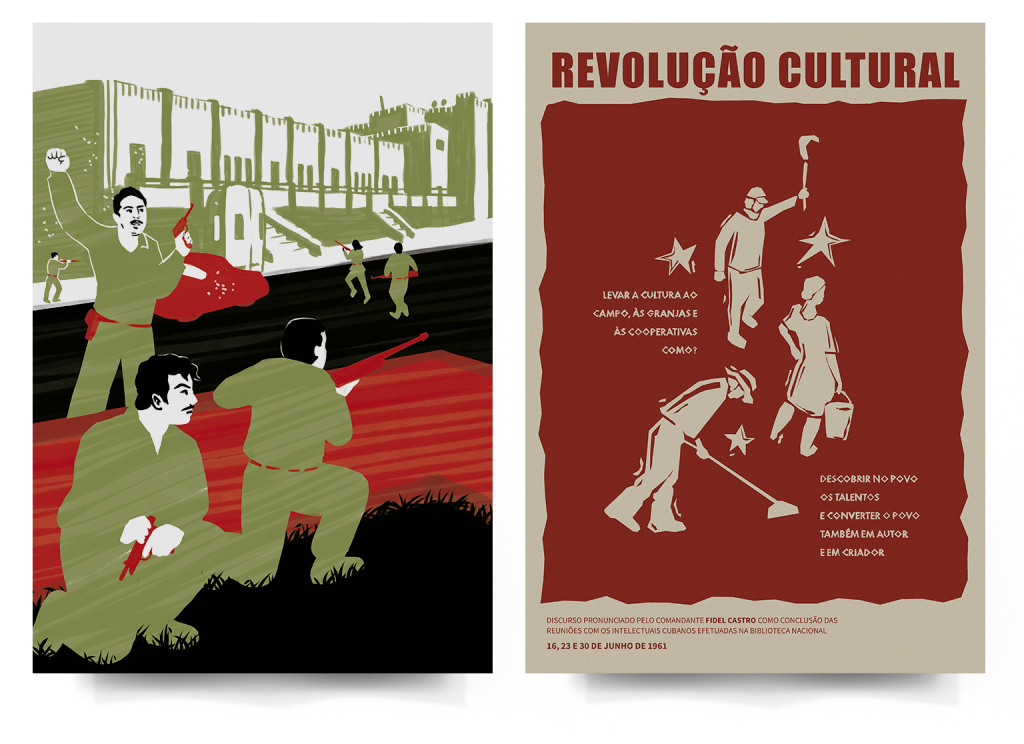
Left: Ingrid Neves (Brazil, Tricontinental); right: Isabela Molin (Brazil, MST).
This was not a defence of culture in the abstract, nor a call to privilege the battle of ideas over material transformation. It was a reaffirmation that revolutions do not simply inherit revolutionary human beings, including the cultural and intellectual workers needed to sustain them; they must help create them. Political consciousness, technical capacity, collective discipline, and internationalist commitment are not spontaneous products of economic change. They must be consciously organised, cultivated, and reproduced across generations.
The National Literacy Campaign of 1961 (Campaña Nacional de Alfabetización) was one of the Revolution’s earliest demonstrations of this principle. More than 100,000 young brigadistas of the Conrado Benítez Brigades travelled to the countryside as part of a nationwide literacy army. By the end of the campaign, more than 700,000 adults had been taught to read and write, reducing illiteracy in Cuba to 3.9%. Yet literacy was only one outcome. Those who taught were transformed alongside those who learned, encountering rural poverty firsthand and participating directly in the remaking of Cuban society. Education became not simply the transmission of knowledge but the formation of a new revolutionary subject.
The same principle shaped the Revolution’s publishing houses and journals, film institutions, art schools, scientific centres, medical training programmes, and educational exchanges with the peoples of Africa, Asia, and Latin America. Together they formed the cultural infrastructure through which the Revolution sought not only to defend itself but to reproduce itself and contribute to the wider anti-imperialist struggle.
The Cultural Congress of Havana, 1968
For eight days in January 1968, around 500 participants from more than seventy countries gathered at the Hotel Habana Libre for the Cultural Congress of Havana. The congress is often remembered as a meeting of writers and artists, but this barely captures its scope. Participants included novelists, poets, economists, physicians, scientists, architects, filmmakers, publishers, educators, sociologists, critics, cultural administrators, and militants from national liberation movements. Dependency theorists shared commissions with painters. Teachers worked alongside guerrillas. Representatives of newly independent states met organisers operating clandestinely under colonial rule. Delegations included participants from the Democratic Republic of Vietnam and the South Vietnamese liberation movement, as well as from the liberation struggles in Guinea-Bissau, Angola, and Cape Verde, alongside delegates from across Latin America, Africa, Asia, Europe, and North America. They met not as representatives of isolated national cultures but as participants in a common anti-imperialist project. The congress reflected the Cuban Revolution’s expansive understanding of culture – not as artistic production alone but as the entire field through which societies produce knowledge, values, institutions, technical capacities, and political consciousness.
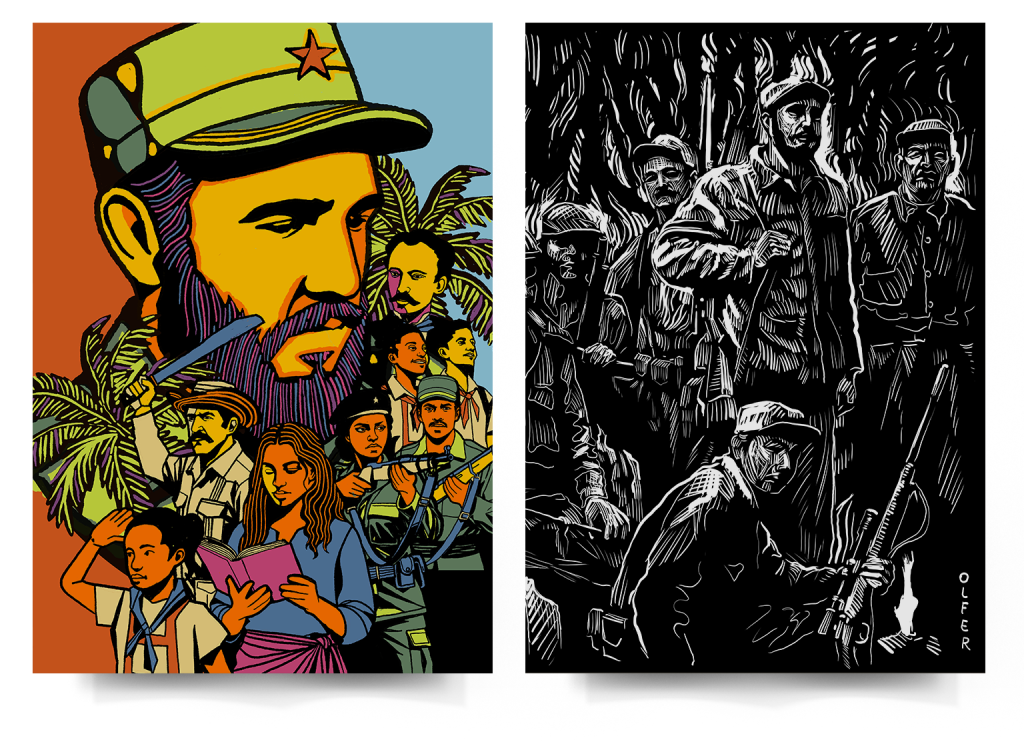
Left: Kael Abello (Venezuela, Utopix/Tricontinental); right: Olfer (Perú, Utopix).
The congress advanced three interrelated arguments.
The first concerned the role of intellectual labour. Revolutionary struggle required far more than sympathetic artistic representation. Writers, scientists, physicians, teachers, economists, filmmakers, publishers, and cultural workers all possessed specialised forms of knowledge that could either reproduce imperial domination or be organised in the service of liberation. Their task was not to observe the Revolution from outside but to place their work within the collective project of national liberation and socialist construction.
The second was organisational. In his ‘Message to the Tricontinental’, published in April 1967 while he was fighting in Bolivia, Che Guevara called for ‘two, three, many Vietnams’ to stretch imperialism across multiple fronts. By the time the congress met in January 1968, Che had been killed in Bolivia three months earlier. Closing the congress, Fidel extended that strategy onto another terrain, calling for ‘un Vietnam en el terreno de la cultura’ (a Vietnam in the field of culture). The struggle against imperialism could not be confined to the battlefield or the factory. It also required institutions capable of contesting the production of knowledge, the circulation of images, Western scientific and technical authority, publishing, education, and the international media.
The third argument challenged the geography of history itself. Cuban poet and later president of the Casa de las Américas, Roberto Fernández Retamar, rejected the familiar division between ‘developed’ and ‘underdeveloped’ countries, insisting instead that the modern world was divided between countries that had been underdeveloped and those that had underdeveloped them. The implication reached beyond economics. If colonialism had relegated Asia, Africa, and Latin America to the ‘periphery’ of history, then the liberation struggles unfolding across the Third World had begun to overturn that geography. The principal engine of historical transformation no longer lay in the imperial metropoles but in the peoples fighting colonialism, imperialism, and capitalist domination. As Fernández Retamar would later crystallise in his essay Calibán, it was the Third World that stood at the centre of the revolutionary conjuncture and of history.
This legacy is the subject of Tricontinental’s latest dossier, A Vietnam in the Field of Culture: The Cultural Congress of Havana, 1968 (August 2026). Read it here.
FIDEL x 100
Nearly a decade after Fidel Castro’s death, the Cuban Revolution confronts one of its most difficult moments since the Special Period. The United States has once again tightened the longest economic blockade in modern history. Cuba’s continued inclusion on the US State Sponsors of Terrorism list has further restricted the island’s access to international finance and trade, while Washington has moved to impose a total blockade on oil deliveries to the island, barring one Russian tanker that got through in March 2026. The effects of the sanctions are the intended consequences of an economic war designed to make everyday life increasingly difficult and undermine the social foundations of the Revolution.
Economic war has always been accompanied by ideological war. The blockade seeks not only to constrain Cuba materially but also to isolate its revolutionary experience from new generations and from the peoples of the world. Against this strategy, the defence of the Revolution cannot be reduced to economic resilience alone. It also requires the continued organisation of culture, political education, historical memory, and international solidarity. In this conjuncture, propagating Fidel’s ideas is not an exercise in remembrance but part of defending the revolutionary process itself.
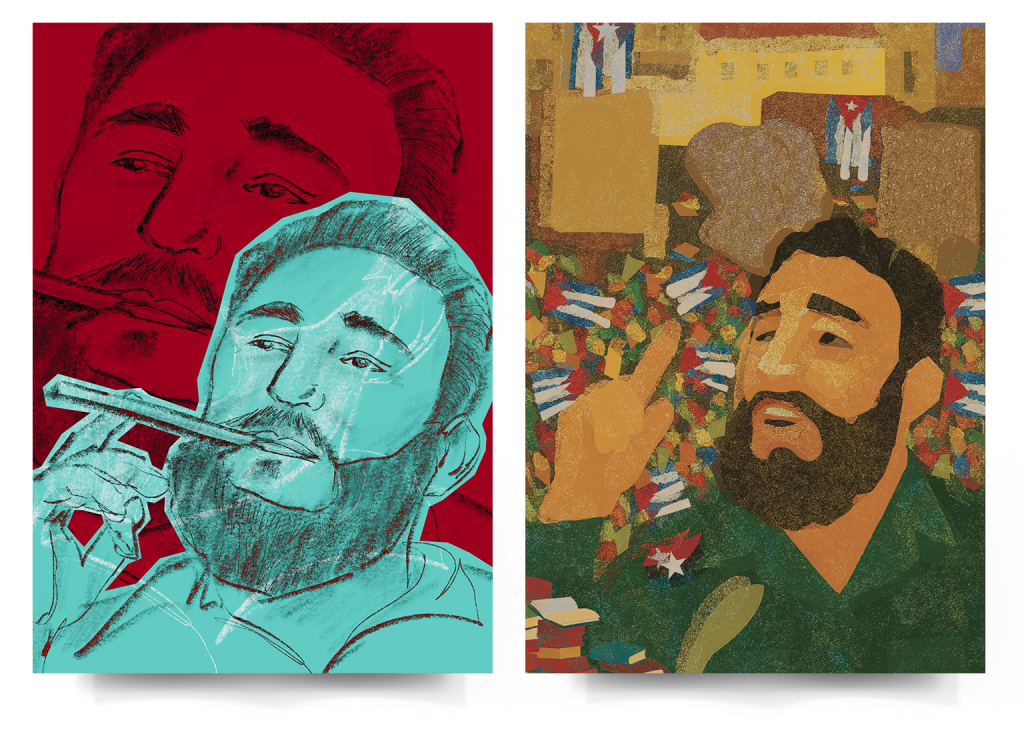
Left: Tings Chak (China, Tricontinental); right: Vanshika Babbar (India, Tricontinental/Young Socialist Artists).
It is here that FIDEL x 100 finds its place.
The exhibition is one contemporary expression of the international cultural front that took shape in Havana nearly six decades ago. It brought together contributions from more than 100 cultural workers, many of them activists in people’s organisations – from the Young Socialist Artists in India to the Landless Workers’ Movement (MST) in Brazil to the Party for Socialism and Liberation in the United States.
The posters approach Fidel from different angles. Some return to the young revolutionary of ‘History Will Absolve Me’, his self-defence after the Moncada assault in 1953. Others revisit the battle of ideas, literacy, agrarian reform, medical internationalism, and anti-imperialist internationalism. Their diversity reflects the many fronts on which Fidel’s legacy continues to speak to present struggles.
The exhibition has already travelled to the Mariátegui School in Argentina, MST encampments in Brazil, mobilisations in Mexico commemorating the 26 July Movement, Hands Off Asia gatherings in Sri Lanka, and political education courses in Pakistan.
Download the archive. Print the posters. Hang them in political schools, trade union offices, community centres, party headquarters, libraries, universities, movement spaces, and neighbourhood assemblies. Use them to teach, to debate, to commemorate, and, above all, to organise. Let us multiply the images and ideas of the Cuban Revolution, carry forward Fidel’s legacy, and continue the task of creating ‘a Vietnam in the field of culture’. A century after Fidel’s birth, the task remains before us.
In solidarity,
Kael Abello, member of the Utopix art collective and the Art and Culture Department of Tricontinental: Institute for Social Research.
Tings Chak, co-coordinator of the Art and Culture Department of Tricontinental: Institute for Social Research.