What Fidel Castro Gave Us: The Thirty-Third Newsletter (2026)
The revolutionary legacy of Fidel Castro, who would have turned 100 this week, reminds us that breaking free from neocolonial plunder demands the rigorous construction of productive capacity and an unyielding commitment to human dignity.
Dear friends,
Greetings from the desk of Tricontinental: Institute for Social Research.
I was only sixteen years old when I first set eyes on Fidel Castro at the 1983 Non-Aligned Movement (NAM) summit in India. When Fidel, who would have turned 100 this week, met Indian Prime Minister Indira Gandhi at the conference venue, he broke protocol and gave her a giant bear hug. Fidel loved India, something I would learn from him eighteen years later in Durban, South Africa. ‘I went to India many times’, he told me then, ‘but never for very long’. I was too scared to tell him that I had seen him from afar at the NAM conference and had, because of his gigantic personality, imagined that Cuba was an enormous country – and not an island nation of approximately 110,000 square kilometres with a population smaller than that of the Calcutta metropolitan area where I was born. Seeing him from afar, in his green military fatigues, I pictured him as a young Fidel marching into Havana from the Sierra Maestra, all the while wondering if he was carrying a pistol under his cloak to protect himself from the assassins who seemed never to touch him.
At the 2001 World Conference Against Racism in Durban, Fidel was the only world leader to receive a standing ovation in both the governmental and non-governmental forums. He spoke with a sincerity that cut through political alignment. This was the period of ‘human rights’ and ‘globalisation’, terms that meant so little as the engine of inequality ground along without mercy. What was the point of these forums about racism and environmental destruction, about debt and women’s rights, when everything seemed to be going from worse to worse? As household debt reached catastrophic levels for ordinary people in the Global South, leaders in their bespoke suits muttered clichés. Fidel, in his military fatigues, was their antithesis. His bluntness and smile made the truth palatable and inspired people to join him in fighting for a dignified future. We stood to applaud Fidel not only because of what he said, but also because he spoke our language.
Two years before Fidel came to the 1983 NAM summit, he addressed a conference of Committees for the Defence of the Revolution (CDR), neighbourhood groups that were established in 1960 and have played a vital role in safeguarding their communities and the nation. Fidel pointed to the record of the Cuban Revolution but also to the limitations imposed on it by the severe US blockade. Yet the blockade, Fidel said, ‘has not impeded us from achieving feats never before accomplished’. Among them, he listed:
The feat of providing employment for practically our entire population, putting an end to idleness; putting an end to vices, gambling, drugs, prostitution; ending illiteracy; ensuring at least a sixth-grade level of education and striving for the ninth-grade level; and having virtually the best standard of public health care of any underdeveloped country in the world.
‘Difficulties will not keep us from moving forward’, Fidel said.
That is the fundamental lesson for the Third World. Yes, colonialism ravaged our countries. Yes, the neocolonial structure continues to leech resources and wealth from our countries. Yes, the structure of war and debt imposes an enormous tax on any country that tries to exercise its sovereignty. Yes, all of this is true, and these are difficulties. But difficulties will not keep us from moving forward.
Fidel was not a utopian socialist. He rejected those who believed that you could leap from poverty directly to wealth. He had read Marx, particularly the widely circulated and studied pamphlet Critique of the Gotha Programme (1875), in which Marx wrote, ‘Right can never be higher than the economic structure of society and its cultural development conditioned thereby’. In other words, a society whose productive forces cannot generate sufficient surplus, and therefore sufficient leisure and cultural institutions, cannot by itself create the conditions for human emancipation. Liberal rights to property in a capitalist system, for instance, guarantee every person the freedom to own property, which had been restricted under pre-capitalist social formations. But they do not guarantee freedom from property – in other words, the freedom from the tyranny of being without property. Only ‘in a higher phase of communist society’, marked by abundance, can the social basis for freedom be established. ‘Only then’, Marx wrote, ‘can the narrow horizon of bourgeois right be crossed in its entirety and society inscribe on its banners: From each according to his ability, to each according to his needs!’
Fidel knew that such an argument differentiated his tradition from that of utopianism and liberalism. But he also understood a fundamental axiom: the uneven development of capitalism under colonial and neocolonial conditions would not allow the poorer nations to develop their productive forces but rather would only allow them to develop their underdevelopment. This meant that the national liberation fronts had to overthrow the colonial rulers and then conduct two historical tasks simultaneously and with great skill: build the productive forces (which should have been the task of the bourgeoisie) and socialise the means of production (which is the mission of the socialist project). In the poorer nations, both the task of the bourgeoisie and of the proletariat must be accomplished by the socialist forces under immense duress. Difficulties will not keep us from moving forward.
In 2001, I was sitting in a hotel room in Durban with Fidel and members of his delegation as he asked me questions about caste discrimination in India. Fidel’s curiosity was infectious, and self-aware. I was trying my best, in awe of him, to explain things. I was thirty-four years old and wondering how my six-month-old daughter was doing back at home.
Fidel began to tell me about the difficulties of building socialism and how the Cuban Revolution had not done enough to batter down the hierarchies of race and gender in the early decades. Yes, the Cuban Revolution had desegregated public spaces, but not enough was done to tackle the entrenched nature of racism. It was important to address the stubborn realities, to start with the hard facts and then try to find the method to change the situation. Denial of the facts is an impediment to progress. That was clear to Fidel.
Addressing the Durban conference, Fidel provided a master class on the stubborn realities. ‘Racism, racial discrimination, and xenophobia’, he said, ‘are not naturally instinctive reactions of human beings – they are born directly from wars, military conquests, slavery, and the individual or collective exploitation of the weakest by the most powerful all through the history of human societies’. If we face that fact, then it is not enough to have seminars on better behaviour or to share best practices to undo racism. We must change the system that endows social hierarchies with such power. We must overthrow and transform the system of capitalism itself.
When I was sitting with Fidel, I raised Marx’s distinction between the ‘realm of freedom’ and the ‘realm of necessity’. The former referred to those parts of the world that had been able – partly through colonialism – to endow themselves with advanced productive forces and therefore set the stage for the transition to socialism. The latter – the victims of colonial plunder – had yet to move beyond the basic needs of the people and were therefore far from socialism. And yet, against the expectations of classical Marxism, it was in the realm of necessity that revolutions took place, where socialism ‘is young and has its mistakes’, as Che wrote in 1965. ‘We make our mistakes’, Fidel told me, ‘but we must be honest about them. We cannot pretend that we do not make mistakes. But we must also remind ourselves that we have some certainties. We cannot always be apologising for our efforts when our efforts are only to make the world a more human place’.
A revolutionary such as Fidel does not give us only this or that idea. What he gives us, particularly in these intimate moments, is the example of a revolutionary – what Ho Chi Minh called the necessity of emulation. Watching Fidel explain his ideas with passion and certainty only made me feel more passionate and certain. It deepened my desire to emulate not him, as an individual person, but the way he participated in the struggle to save our humanity from brutality and to try honestly to build a socialist world.
If you listen to Fidel’s most important speeches, you will see that they are filled with details that might seem irrelevant to his audience. He would read, for instance, from records of crop production in each district of Cuba, telling those gathered in the Plaza de la Revolución about the minute details of bureaucratic administration. Why did he do this? Fidel, our revolutionary professor, was telling us that socialism is about the details: being attentive to the science of building the productive forces, being clear and honest about setbacks, and opening the door for mass participation to transform failures into successes. Difficulties will not keep us from moving forward.
Warmly,
Vijay
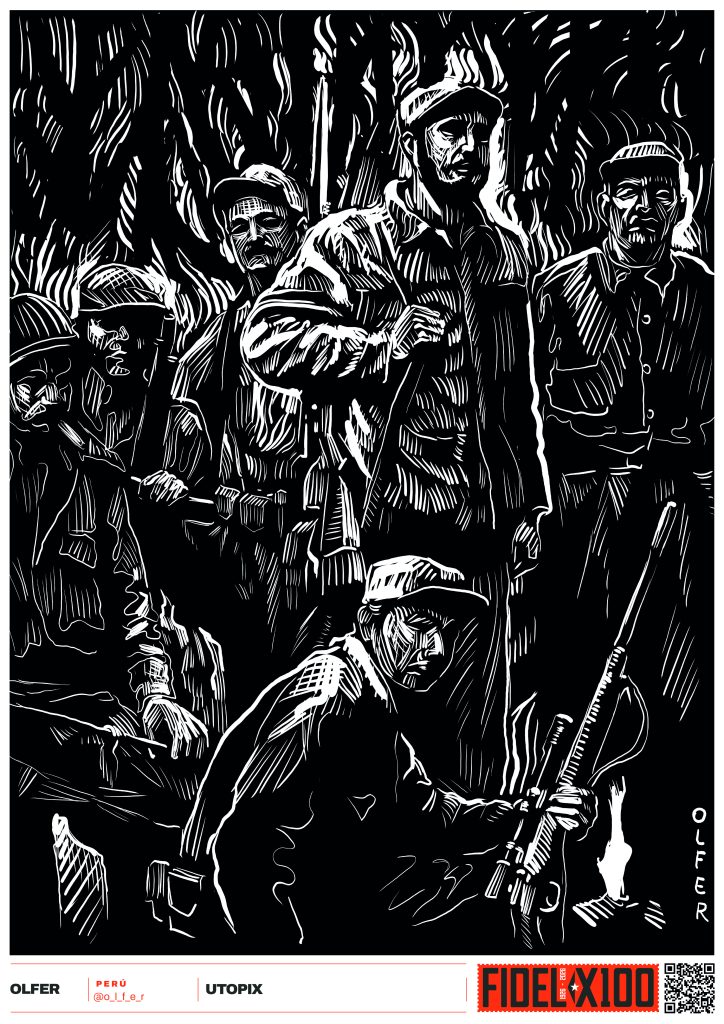
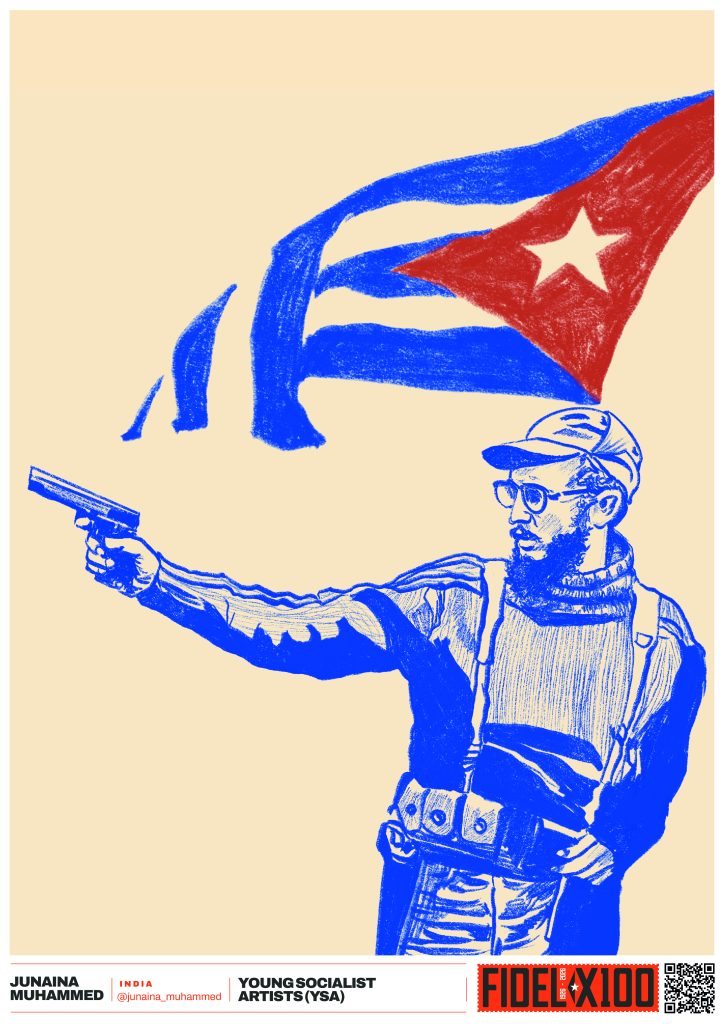
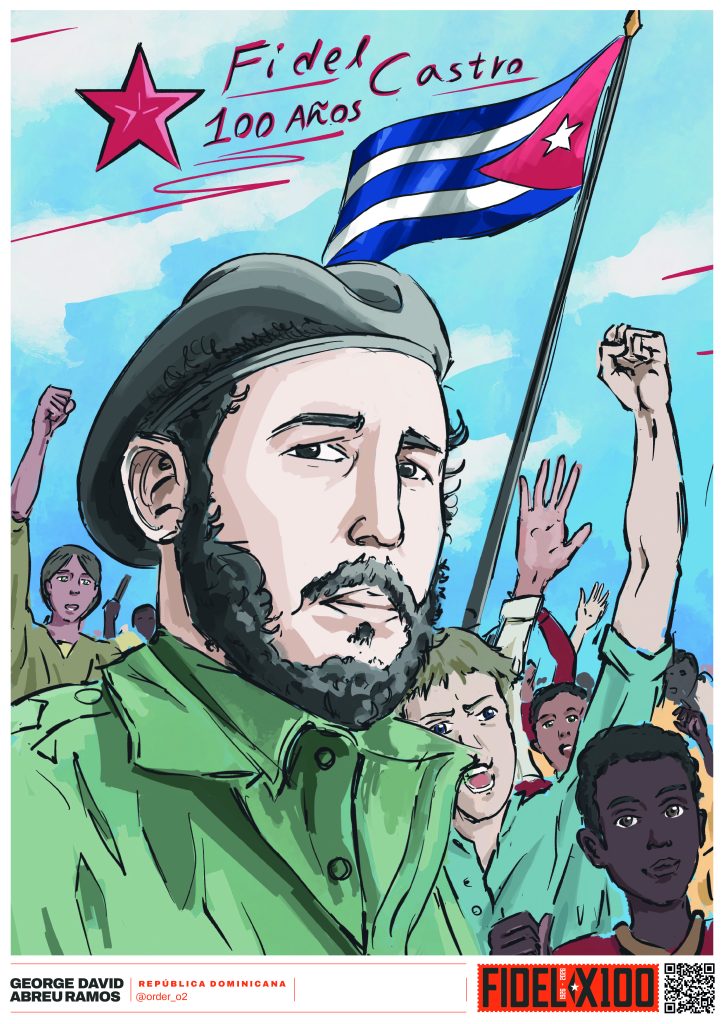
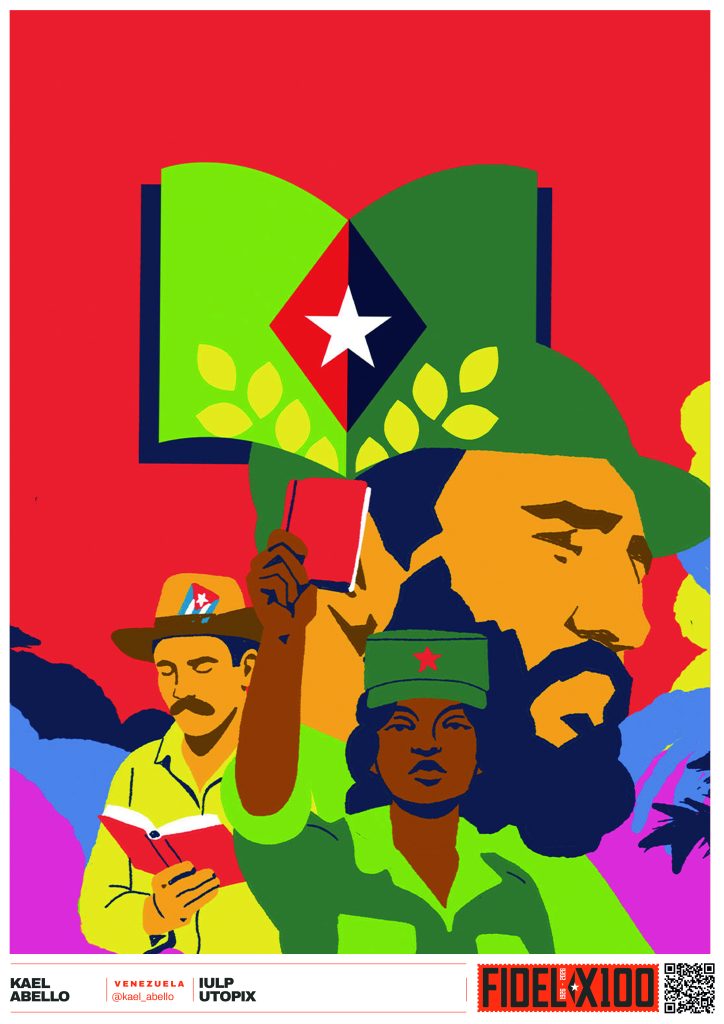
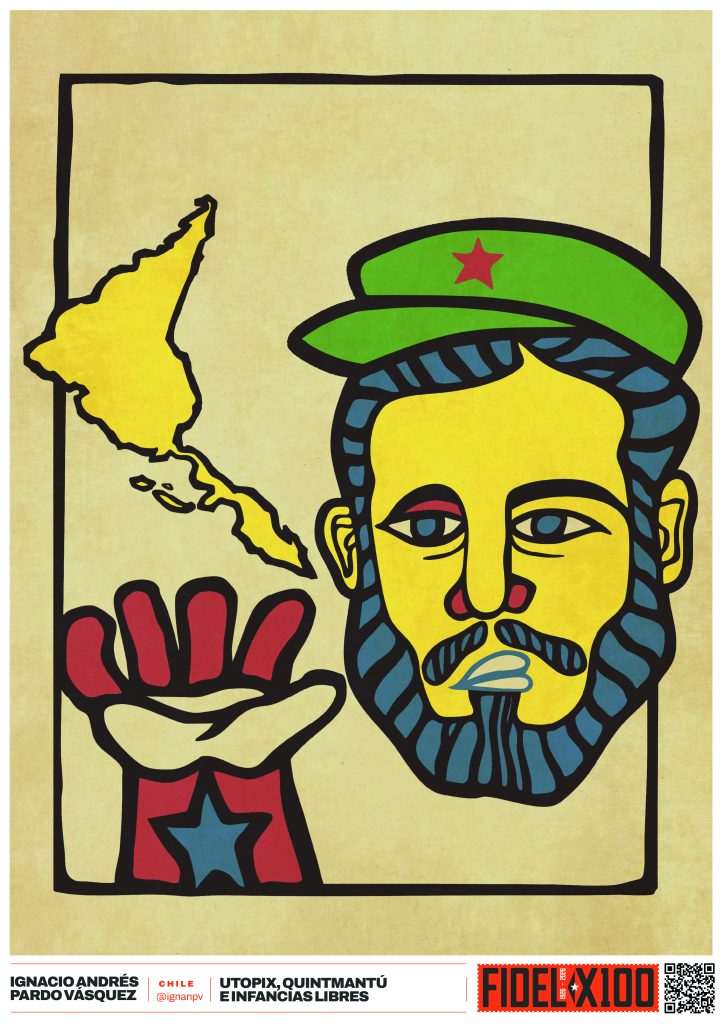
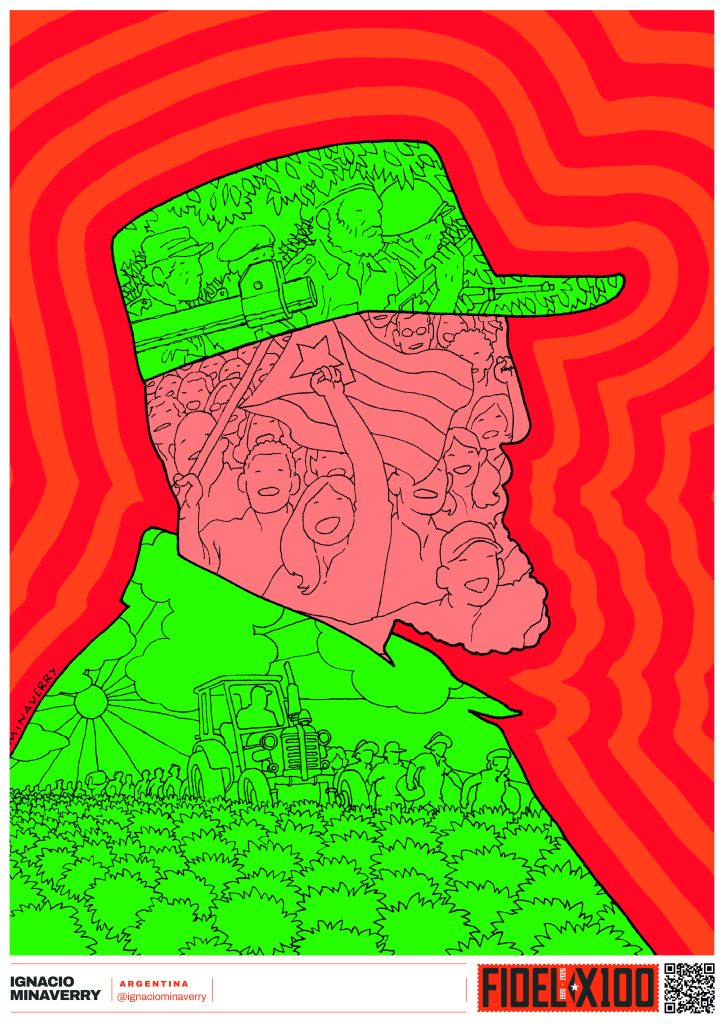
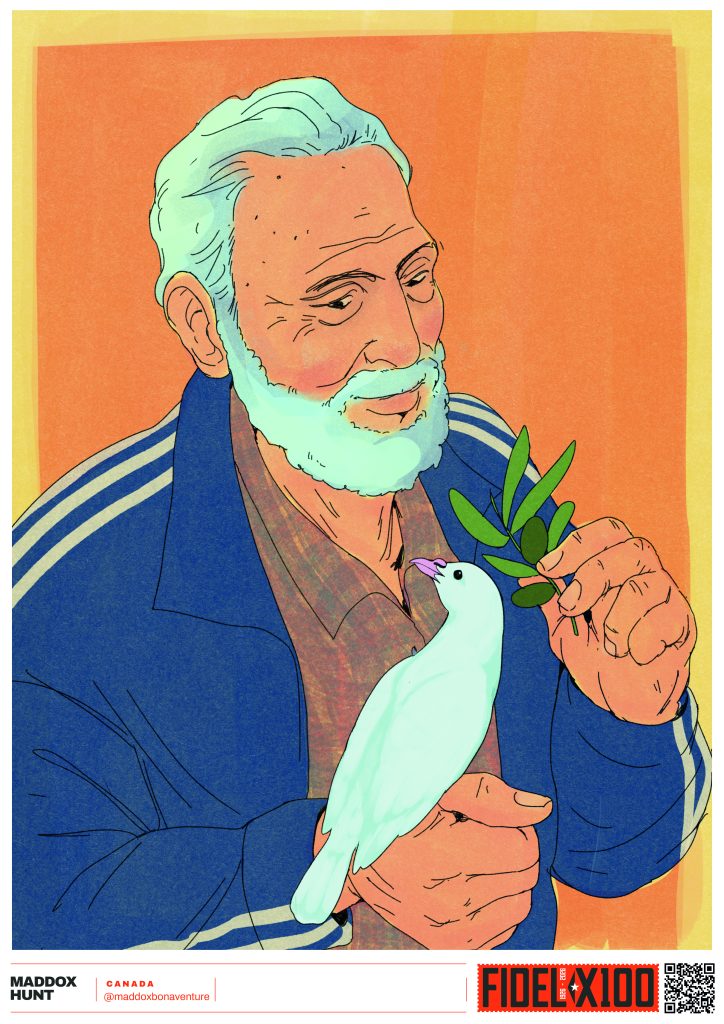
PS: The artworks in this newsletter are drawn from FIDEL X 100, a poster initiative to mark the centenary of Fidel Castro’s birth. The initiative was organised by Utopix, Tricontinental: Institute for Social Research, the International Peoples’ Assembly, ALBA Movimientos, Pan Africanism Today, Instituto Simón Bolívar, and Young Socialist Artists.