A Vietnam in the Field of Culture: The Cultural Congress of Havana, 1968
In 1968, delegates from seventy countries gathered in Havana to confront cultural imperialism and imagine culture as a decisive front of anti-imperialist struggle.
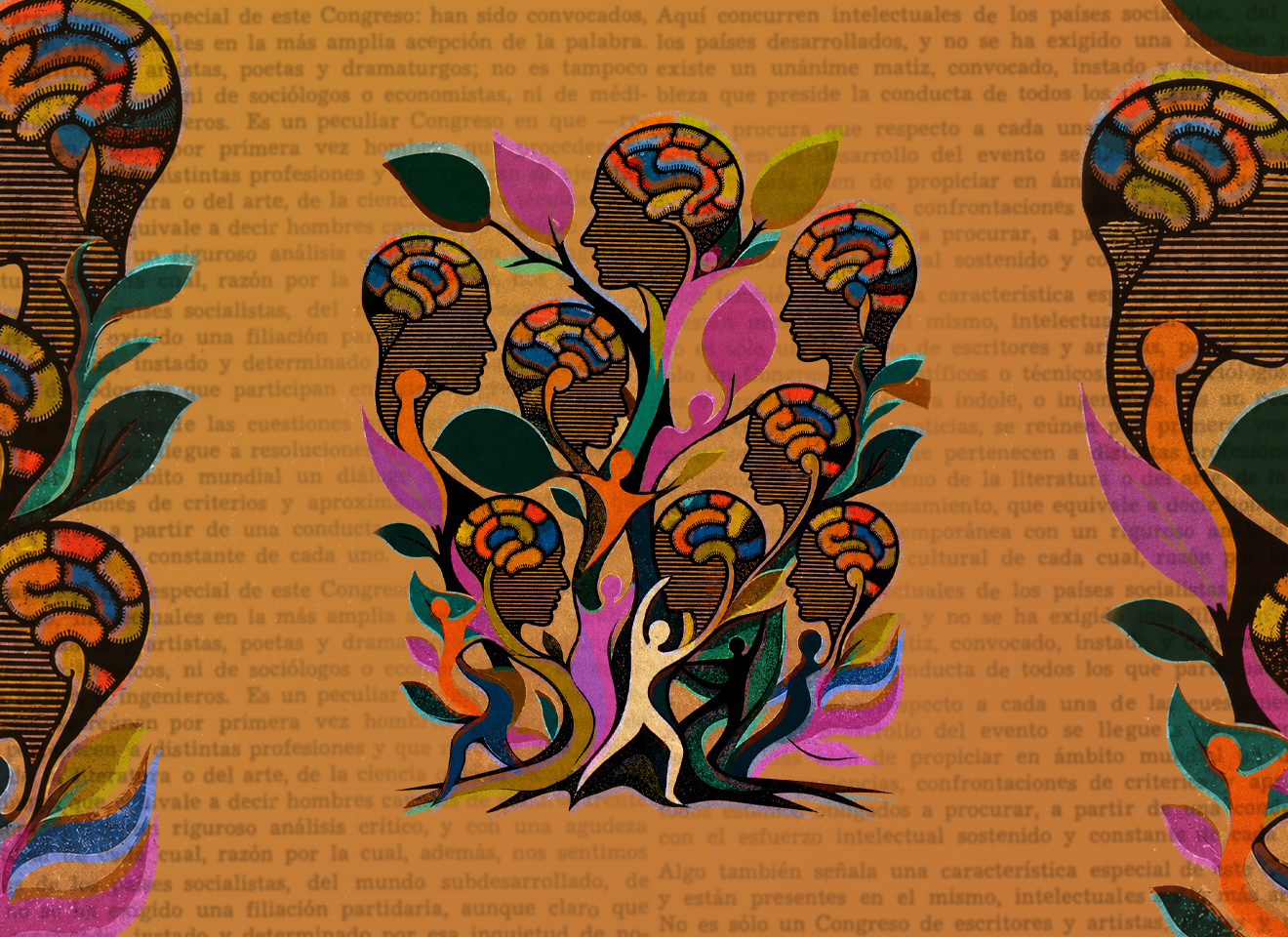
‘There can be nothing more anti-Marxist than dogma… nothing more anti-Marxist than the petrification of ideas’.
– Fidel Castro, closing speech, Cultural Congress of Havana, 12 January 19681
‘I make revolution, therefore I exist, therefore we exist’.
– René Depestre, commission I, Cultural Congress of Havana, 19682
On the morning of 4 January 1968, in the Hotel Habana Libre, Cuban president Osvaldo Dorticós opened the Cultural Congress of Havana. Over the following 9 days, 470 delegates from 70 countries would fill the commission rooms. Together, they sought to understand how imperialism operates through culture in all its dimensions and what it would mean to build an anti-imperialist front capable of confronting and dismantling it.3
The congress took place at a moment when revolution felt not only possible but imminent. Vietnam was fighting the most powerful military on Earth to a standstill. Armed liberation movements in the Portuguese colonies of Angola, Guinea-Bissau, and Mozambique were building new societies in the zones they had already liberated.4 Across Latin America, guerrilla movements were multiplying in the wake of the Cuban Revolution. The peoples of the Third World were in motion on every front. The grief over Ernesto ‘Che’ Guevara’s murder in Bolivia three months earlier had only sharpened the collective resolve of the delegates and the movements they represented. The question was no longer whether imperialism could be defeated but by whom and on what fronts.
The Cultural Congress of Havana was organised across five commissions that mapped the fronts on which the cultural battle was being waged: Culture and National Independence (commission I); the Integral Formation of Man (commission II); the Responsibility of the Intellectual (commission III); Culture and Mass Media (commission IV); and Artistic Creation and Scientific-Technical Work (commission V).5 As Dorticós observed in his opening statement, it was ‘the first time, as far as we know, [that people] from all continents, belonging to different professions’ had been brought together around a common cultural mandate.6 The decision to invite not only cultural workers such as artists and writers but also doctors, economists, sociologists, scientists, technicians, and intellectual workers of all backgrounds was a deliberate political choice, insisting that culture was not merely an auxiliary to political and military struggle but a front of anti-imperialist struggle in its own right.
The congress was not confined to commission rooms and speeches: it reverberated across the city through billboards, posters, and radio broadcasts. In the lead-up to the congress, the Instituto del Libro (Institute of the Book) published popular editions of works by several participating writers, and films by some of the delegates were screened in cinemas across Havana. On the evening of 9 January, the exhibition Del Tercer Mundo (From the Third World) opened at the Pabellón Cuba in Vedado. Conceived as a cinematic journey rather than a conventional exhibition, it used light, sound, montage, and movement to guide visitors through the unfinished history of Asia, Africa, and Latin America. Visitors moved through six zones that told the unfinished story of the Third World, from the myth of ‘virgin’ lands, through the violence and deprivation of imperial domination, and to the revolutionary struggles of the present. The exhibition drew on neon animations, comic strips, satirical film montage, and sound effects that included a horror tunnel of hunger and rotating light boxes that multiplied Cuban photographer Alberto Korda’s iconic image of Che alongside the question: ‘And we, the exploited of the world, what is our role?’ The exhibition, produced collectively by over a hundred people, was visited by more than 250,000 during its three-month run, with hours that allowed students and workers to attend on their way home, as if visiting a popular cinema.7
The mass participation and cultural breadth of the congress embodied its foundational argument: that culture contains the totality of how a society produces and reproduces human life. As the congress’s general declaration concluded: ‘if the defeat of imperialism is the unavoidable prerequisite for the achievement of an authentic culture, the cultural fact par excellence for an underdeveloped country is the revolution’.8
The discussions that took place over those nine days produced one of the richest collective analyses of cultural imperialism of the twentieth century and a vision of anti-imperialist culture whose scope and ambition continue to challenge movements today to think of culture not merely as art or propaganda but as a terrain of struggle across every dimension of social life. Yet the congress has been little-studied and virtually absent from many historical accounts of the period ever since. This dossier presents a synthesis of some of those discussions, organised into five sections: the diagnosis of how cultural imperialism operates, the praxis of culture within active liberation struggles, the theoretical formulations that emerged from the congress, the vision of the new human being, and the role of the intellectual worker in the revolution.
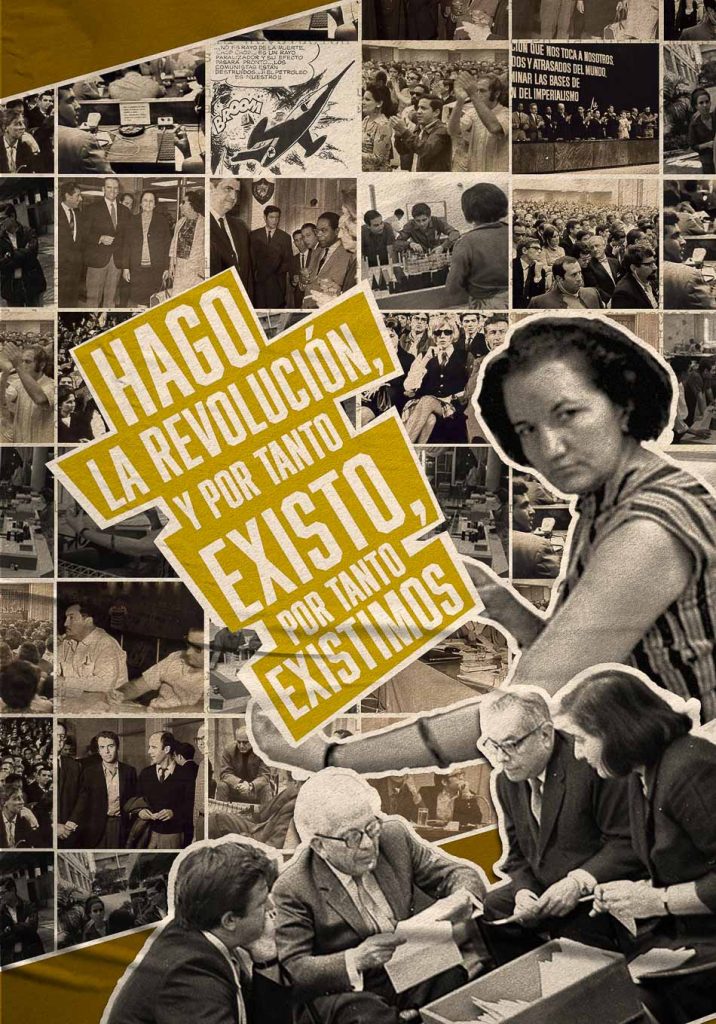
‘I make revolution, therefore I exist, therefore we exist’ – René Depestre, Commission I, Cultural Congress of Havana, 1968.
Building Towards the Cultural Congress of Havana
The congress was the third in a sequence of internationalist events held in Havana. The first was the Tricontinental Conference (January 1966), which brought together revolutionary forces from Africa, Asia, and Latin America to build a political-military alliance against imperialism and created the Organisation of Solidarity with the Peoples of Asia, Africa and Latin America (OSPAAAL). In August of the following year, the meeting of the Organisation of Latin American Solidarity institutionalised armed struggle as the principal strategy of continental liberation. In 1968, the Cultural Congress of Havana extended the strategy into an ideological and cultural terrain that had, for two decades, been the object of a massive and largely covert imperialist offensive.
The congress was shaped by a material necessity to combat not only direct military aggression led by the United States (such as the 1961 Bay of Pigs invasion) but also a longstanding cultural and information war. In fact, it was convened as the direct counter-formation to the Congress for Cultural Freedom (CCF), the US’s flagship cultural operation during the Cold War. With an express purpose of constructing cultural hegemony, the CCF promoted the ideas that there is no alternative to the Western capitalist order, that revolutionary movements are threats to ‘freedom’, and that intellectuals should be autonomous, apolitical critics. Founded in 1950 with operations in thirty-five countries, it published more than twenty prestigious literary and political journals (Encounter in London, Preuves in Paris, and Cuadernos in Latin America, among others), sponsored conferences, funded academic exchanges, and cultivated an international network of intellectuals committed, whether knowingly or not, to a liberal anti-communist consensus.9 Though the revelation in 1967 that the CCF was funded by the Central Intelligence Agency (CIA) discredited the organisation, the infrastructure it had built remained intact, from journals, foundations, and academic networks to habits of thought. Eric Hobsbawm, a British Marxist historian and a delegate, later described the Cultural Congress of Havana as the CCF’s ‘exact opposite’: where the CCF presented itself as a defender of intellectual autonomy while operating under imperial patronage, the Cultural Congress of Havana sought to establish the cultural infrastructure and programme for those fighting against imperialism.10
The idea for the Havana congress was born from Casa de las Américas (House of the Americas), an institution founded in April 1959 that had become Cuba’s principal cultural bridge to Latin America and the Caribbean through its journal and annual literary prize. In January 1967, the journal’s collaboration committee issued a declaration to gather intellectuals from across Asia, Africa, and Latin America in response to the 1966 Tricontinental Conference’s call for an active front against cultural intervention in the Third World. This proposed gathering became the 1968 Cultural Congress of Havana. Between October and November 1967, a National Preparatory Seminar brought together 1,343 Cuban writers, artists, scientists, and technicians in the same five-commission structure that the international congress would later adopt, with months of collective intellectual and organisational work taking place before a single international delegate arrived.11
The congress’s invitation strategy was deliberately broad: Trotskyists and surrealists sat alongside members of communist parties; editors of New Left Review sat with militants of the People’s Movement for the Liberation of Angola (MPLA); existentialists and anti-psychiatrists sat alongside dependency economists and liberation theologians; and the 212 delegates from ‘developed’ nations sat alongside the 205 delegates from underdeveloped nations, including 53 from socialist countries.12 Though the Cuban strategy sought to build an anti-imperialist front that reached the progressive sectors of the imperial centre, structural decisions ensured that Third World perspectives set the direction of the proceedings. To this end, the heads of all commissions were delegates from Third World socialist and national liberation projects. The testimony of delegates speaking from active liberation struggles carried a political and moral weight that framed the entire congress.13
The congress convened at a moment of sharp contradictions. Two days before the opening, Fidel Castro announced that the Soviet Union would reduce petroleum supplies to the island. Days after the closing, the Central Committee of the Communist Party of Cuba convened to act against a ‘microfaction’ of party members accused of seeking to subordinate Cuba’s revolutionary strategy to Moscow’s line.14 After the conference, the Organisation of American States (OAS) compiled an extensive classified report that called the congress a ‘subversive action of international communism’, detailing the attendees as well as their political affiliations, travel histories, and interventions at the congress.15
The Diagnosis: How Imperialism Operates Through Culture
Though the delegates came from a broad range of colonial histories and stages of struggle, they shared a diagnosis of cultural imperialism in their time. Imperialism, they argued, operates through a systematic offensive across every dimension of society and culture, including the colonisation of consciousness, control of information, extraction of intellectual labour, ‘brain drain’ of doctors and scientists from the Third World, and control of knowledge production.
During the congress, Roberto Fernández Retamar, a Cuban poet who would later lead Casa de las Américas, offered a structural account of the global order and the intellectuals it produced. The world, he argued, is divided not into ‘developed’ and ‘underdeveloped’ countries but into underdeveloped countries (países subdesarrollados) and what he called ‘underdeveloping’ countries, or countries that underdevelop (países subdesarrollantes) – countries whose own development depends on actively producing underdevelopment elsewhere. For Retamar, intellectuals in these ‘underdeveloping’ countries acquired knowledge through the same system: one built on the exploited labour and wealth of the Third World. Western science and art, he argued, ‘also belong to the exploited countries upon which they have been built’. Returning them, he said, would be ‘not a form of paternalism but a way of restoring to them what had been torn away’. For Retamar, this meant that left intellectuals from imperial centres have a responsibility to place their knowledge – scientific, economic, linguistic, and technical – at the service of the liberation movements whose peoples made that knowledge possible. If reparation was what Retamar demanded of intellectuals in countries that underdevelop, what he demanded of those in underdeveloped countries was the inverse: to seize the coloniser’s knowledge and its products and use them for their own liberation.
In 1971, three years after the congress, Retamar’s formulation would crystallise in his landmark essay Calibán. In it, he claimed the figure of Caliban – the enslaved subject in Shakespeare’s The Tempest, whose island Prospero has colonised – as a symbol of Latin America and the Caribbean: ‘Prospero invaded the islands, killed our ancestors, enslaved Caliban, and taught him his language in order to understand him: what else can Caliban do but use that same language – today he has no other – to curse him?’16
In the years that followed, Caliban became a shared figure through which intellectuals across Latin America and the Caribbean explored colonial domination, language, revolt, and historical agency. The congress helped to consolidate this reworking by bringing Caribbean anti-colonial thinkers including Retamar, C. L. R. James, and Aimé Césaire into dialogue in Havana.17 In 1969, for instance, Césaire published Une Tempête (A Tempest), an anti-colonial rewriting of Shakespeare’s play, and the Barbadian poet Kamau Brathwaite published his poem ‘Caliban’. Together with Retamar’s essay, these works contributed to an important cultural and political inversion, placing the Third World – as the collective colonised subject – at the global centre, not periphery, of history.
This struggle over language, representation, and historical agency was part of the congress’s broader diagnosis of cultural imperialism. At the congress, Fernando Martínez Heredia, who had founded the leading journal Pensamiento Crítico (Critical Thought), argued that the most insidious layer of imperialist domination was cultural colonisation.18 This form of colonisation, he said, ‘penetrates every order of life and influences even those who are fighting against it’, producing a ‘mental mould of castration’ – an inability to envisage a future attainable through their own efforts.19 This ‘mental castration’ is produced over a long period of time and across several fronts, among which is the media apparatus. During the congress, the Cuban historian Moreno Fraginals described a vast imperial communications system: 850 hours per week of US shortwave broadcasting to Latin America, two radio networks controlling more than ninety per cent of listeners, and single-frequency radios preset to US stations that circulated across the region. For Cuban writer Edmundo Desnoes, mass media was imperialism’s ‘secret weapon’ – effective precisely because it was invisible.20
The Indian economist Lajpat Rai showed how educational and cultural institutions had also been dominated by imperialist interests. In his country, he said, ‘The universities, institutes, schools, [and] social and cultural organisations… are infested today with North American cultural agents in the guise of visiting professors, education experts, [the] Peace Corps, and even CIA agents’.21 He documented a ‘programme of political castration of intellectuals’, echoing the words of Martínez Heredia, with the Asia, Ford, and Rockefeller Foundations, and the now-exposed CCF, operating openly inside the Indian academy.22
A third front of the imperialist cultural offensive operated through the historical record and the physical archive. Delegates from the Arab world, the Korean peninsula, and southern Africa brought testimonies of cultural erasure. Gisèle Halimi, a Tunisian-born lawyer who had defended Algerian National Liberation Front (FLN) members during the war of independence, brought her own testimony of cultural colonisation to the congress. Raised under the French colonial education system in Tunisia, she described the exclusion of Arab history and culture and how ‘beauty, intelligence, [and] freedom could only be French values; the source of all culture, civilisation, was France’.23
Speaking from a country still reconstructing itself, Kim Youn Seun and Pak Hai Chin of the Democratic People’s Republic of Korea (DPRK), barely fifteen years removed from a war in which US bombing destroyed virtually every standing structure in the north, offered the congress the concept of juche (주체). Often translated as ‘self-reliance’, juche refers to the capacity of a colonised people to become the subject of their own history rather than the passive object of imperial domination. ‘Without the complete liberation and independence of the country’, the DPRK delegates told the congress, ‘no hope can be had of a true national culture, nor can one speak of the integral formation of man’, capturing, in a single sentence, the link between the congress’s diagnosis of cultural imperialism and its horizon of the new human being.24
What these testimonies described, across continents, was a single integrated colonial apparatus that captures how a society narrates itself to itself – its broadcasts, its universities, its language, its archives. Various delegates pointed out that this apparatus is also inextricably linked to the economic structure and extractivist logic of imperialism. As Alex La Guma, a novelist and former political prisoner of South African apartheid, put it: ‘We are the world’s leading gold producers, but our miners earn forty cents for eight hours of work’. While South African surgeons had performed the world’s first heart transplant in Cape Town just weeks before the Havana congress, eighty per cent of the population lived at starvation level. La Guma’s point was not to condemn scientific achievement itself but to expose the contradiction of apartheid society: immense wealth and technical capacity existed alongside mass deprivation and racial domination. The Bantu Education Act (1953) gave this system an explicitly cultural form, imposing inferior, segregated education on Black South Africans and preparing them for subordinate labour under apartheid.25
The Havana congress also discussed imperialism’s material extraction of human capacity. Dr. Horacio Zalce, a Mexican doctor who presented at three of the congress’s five commissions, traced the pipeline of brain drain in his field: doctors trained at public expense in underdeveloped countries were drawn to the United States, subjected to ‘transculturation’ (the gradual adoption of another culture’s values, habits, and ways of life), and either absorbed into the imperial centre or sent back to societies where no work matched their specialisation. In Dr. Zalce’s words, ‘raw material has been exported, processed abroad, and then stolen’.26 Similarly, the Cuban delegate José Fernández-Britto Rodríguez reported that between 1956 and 1965, some 40,000 Latin American scientists and technicians emigrated to the United States.27 Meanwhile, Cuban researchers Aníbal Rodríguez and Fernando Barral described the colonisation of the production of knowledge about the Third World itself, in which Latin America supplied ‘scientific raw material’ – data and researchers – to US think tanks, such as the RAND Corporation, the Special Operations Research Office, and the Hudson Institute. Those institutions then returned the ‘finished products’ of that research to the region in the form of political, economic, intelligence, and military intervention.28
Across the five commissions, delegates described the colonised intellectual, the colonised doctor, and the colonised scientist as raw material that is extracted, processed, and stolen. Every doctor in the periphery who is trained in the public sphere and ends up practising in the imperial centre represents a transfer of economic value – years of social investment captured through the structure of imperial dependence itself. As the resolution of Commission IV (Culture and Mass Media), concluded, ‘the mass culture industry is not limited to superstructural functions; it is today an integral part of the economic production system’.29
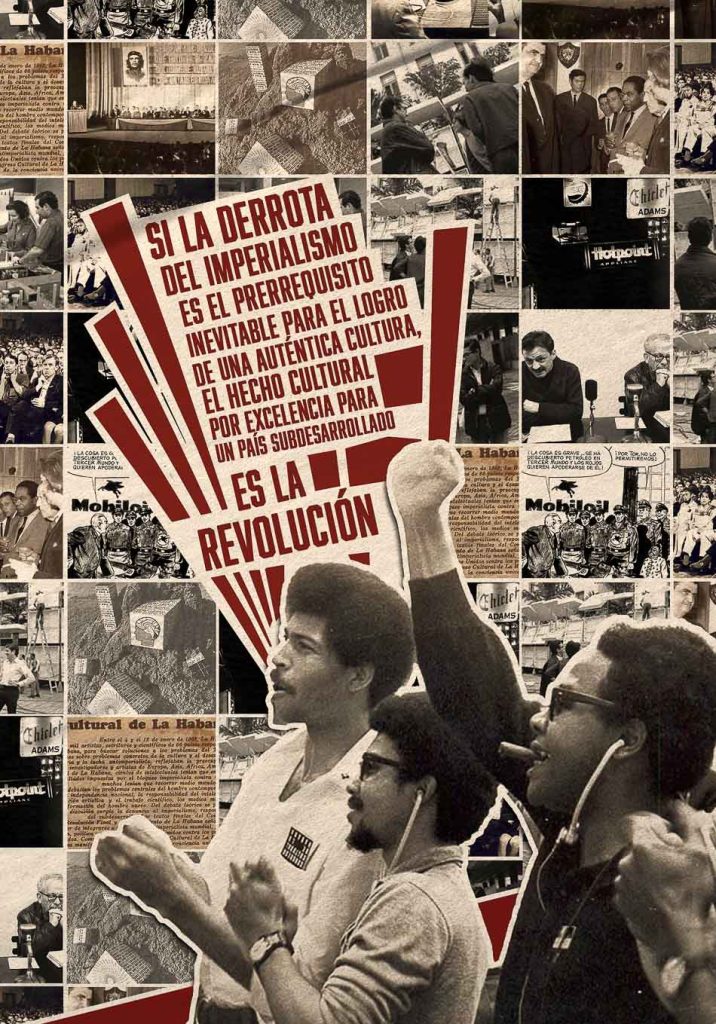
‘If the defeat of imperialism is the unavoidable prerequisite for the achievement of an authentic culture, the cultural fact par excellence for an underdeveloped country is the revolution’. – General Declaration of the Cultural Congress of Havana, 1968.
Praxis: Liberation as an Act of Culture
The congress rejected the notion that culture is something to be restored or created only after liberation has been won. On the contrary, delegates speaking from inside the wars of national liberation argued that culture is the substance through which liberation is built, creating, in the process of struggle, new subjects, languages, institutions, and knowledge. National liberation, in this view, is not the precondition for cultural renewal – it is itself an act of culture.
Vietnam, then divided between the Democratic Republic of Vietnam in the North and the US-backed Republic of Vietnam in the South, was represented at the congress by two delegations: one from the Democratic Republic of Vietnam and one from the National Liberation Front of South Vietnam (NLF), the revolutionary front fighting the southern regime and its US backers. Cù Huy Cận, the vice-minister of culture of the Democratic Republic of Vietnam (North Vietnam) and one of the country’s most celebrated poets, reported on the importance of building cultural life despite US bombardment. ‘The suppression of the peoples’ national culture’, he warned, ‘is the watchword of conquerors’. Tư Huỳnh, a renowned painter and representative of the NLF, described how the NLF’s monthly reports recorded the number of inhabitants freed from illiteracy alongside the number of enemy soldiers killed.30 In a territory where an underground tunnel could serve as both school and shelter, culture and liberation were inextricably linked. In the resolution of commission IV (Culture and Mass Media), delegates noted that Vietnamese cinema teams worked from cellars in the most heavily bombed provinces. ‘Song drowns out the sound of the bombs’, they wrote.31
From the liberated zones of Portuguese-occupied Africa, where Angola’s armed struggle against colonialism had entered its seventh year and the wars in Guinea-Bissau and Mozambique were also advancing, the Angolan poet Mário Pinto de Andrade – co-founder and first president of the People’s Movement for the Liberation of Angola – spoke of the cultural transformation underway in the liberated zones, where schools, printing presses, artists’ workshops, and revolutionary songs were emerging.32 A ‘semantic revolution’, he said, was breaking open colonial Portuguese, reshaping it through African linguistic structures, and generating new literary forms. Similarly, Abílio Duarte, a Cape Verdean leader of the PAIGC (African Party for the Independence of Guinea and Cape Verde), spoke of the foundational blocks of the new society within the shell of the old. ‘The armed struggle’, Duarte declared, ‘is the most important cultural event that has taken place in our country since the beginning of colonisation’.33
From Cape Verde to Cuba to Vietnam, across continents and distinct national liberation traditions, cultural life was seen not as something merely to be preserved against destruction or postponed until victory but the very medium through which liberation was being built. What linked these struggles was a shared understanding drawn from lived practice: that culture is the substance of struggle itself and that national liberation is, indeed, an act of culture. As the resolution of commission III declared, ‘Every struggle against imperialism and neocolonialism automatically becomes a struggle for the people’s access to culture: national liberation struggles thus take the beautiful and heroic form of the defence of knowledge and beauty’.34
The Synthesis: Revolution as a Total Phenomenon
Alongside the diagnoses of imperialism and testimonies from active struggles, the Havana congress generated theoretical formulations for understanding culture, revolution, and the human subject. The debates at the congress were as far-reaching as the delegates that attended it, ranging from dependency theory and the relationship between science and culture to the terms on which anti-imperialist solidarity could be built. Among the interventions that generated the sharpest debate was a reckoning with négritude, a literary, philosophical, and political movement that asserted that Black peoples possessed a distinct cultural identity forged in the experience of slavery and colonialism that demanded recognition against the universalism of the West. The Havana debate spoke directly to questions still relevant today about the relationship between racial and cultural identity and class struggle.
At the congress, the Haitian poet René Depestre traced the origins of négritude as ‘the cultural operation through which Black intellectuals of Africa and the two Americas became conscious of the validity and originality of Black-African cultures’. At its origin, it reflected a double alienation of Black people, both as workers on the capitalist market and as the subjects of racialised dehumanisation. For Depestre, it expressed ‘the consciousness of this double alienation and of the historical necessity of overcoming it through revolutionary praxis’.35 But separated from class analysis, négritude would soon be appropriated for counter-revolutionary uses.
In Haiti, Depestre said, ‘pseudo-sociologists’ like then dictator François Duvalier, commonly known as ‘Papa Doc’, isolated the racial question from economic development, reducing Haitian history to ‘a chaotic succession of conflicts solely between mulattoes and Blacks’.36 The Black petty bourgeoisie had used this interpretation to convince the masses that they were now in power when reality could not have been further from the truth. Depestre saw what happened when négritude moved from an anti-colonial literary revolt into state ideology in the form of what became known as noirisme, the essentialist racial ideology employed by Duvalier that turned négritude’s defence of Black culture into the justification for dictatorship, terrorising the Haitian people and the left in the name of Black authenticity. Placed under house arrest, Depestre left for Cuba in 1959 at Che Guevara’s invitation.37
Depestre also pointed to the well-known formulation of Léopold Senghor, Senegal’s first president and a founding thinker of négritude, that ‘emotion is Black, as reason is white’. For Depestre, the problem was not négritude’s original affirmation of Black cultures but the way such formulations could essentialise racial identity when separated from class analysis, opening the door for Black bourgeoisies across Africa and the Americas to exploit Black workers ‘in the name of a common spirituality’.38 Separated from the concrete demands of revolution, négritude had become what Depestre called ‘an unacceptable Black Zionism’.39 Rather, Depestre asserted, the struggle against racism must be grounded in revolutionary practice. Only by doing so, and only through revolution, he said, could négritude be ‘incorporated into the socialist revolution’ and find ‘its transcendence’ through a historical process in which ‘white and Black and mulatto cease each day more to be opposed to one another’. The new Black Orpheus, he continued, ‘will be revolutionary or will not be at all, for he is a contemporary and an ally of Ho Chi Minh, Fidel Castro, and Che Guevara’.40
Where Depestre had traced négritude’s historical capture, Guinean writer and delegate Condetto Nénékhaly-Camara made a sharper philosophical claim: the values that négritude attributed to Blackness – courage, creativity, and spiritual depth – were not racial properties at all but part of ‘the common patrimony of Humanity’. To essentialise them was to hand the ruling elites of newly independent Africa the same mystifying instrument that colonial racism had used. The Havana debate was, in effect, a warning against the cultural nationalisms that would gain traction across newly independent Africa and the Caribbean. The work of building an anti-imperialist culture, therefore, requires a class analysis at its centre, without which any cultural front could dissolve into the very identities imperialism had constructed.
At the congress, the testimony of the South African poet Dennis Brutus pointed to the same problem in another form. Whereas Depestre and Nénékhaly-Camara warned against racial essentialism, Brutus showed how racial domination organised every sphere in which human beings develop. Shot in the back by police in Johannesburg in 1963 and later imprisoned on Robben Island for eighteen months beside Nelson Mandela, Brutus, a co-founder of the South African Non-Racial Olympic Committee, showed how apartheid extended its dehumanisation even into sport. In the lead up to the 1964 Tokyo Olympics, Brutus and others successfully campaigned for apartheid-era South Africa to be banned from participating. Apartheid’s racial contradictions were visible elsewhere in sport and public life, as evidenced by South African-born weightlifter Precious McKenzie being prevented from representing his own country at the Commonwealth Games, where he instead won three gold medals for England and then a fourth for New Zealand. ‘There can be no discussion of the broad development of man’, Brutus concluded, ‘while racism is permitted and tolerated in sport’.41
Taken together, these interventions showed that racism could not be overcome either by liberal inclusion or by cultural essentialism. To resist the reduction of social struggle to fixed identities, culture had to be understood in its totality. The Syrian philosopher Antun Maqdisi, a co-founder of the Arab Socialist Movement, provided a framework within which the congress’s diverse interventions found common ground.42 Revolution, he argued, is a ‘total phenomenon’ that must transform ‘the meaning of existence’ and ‘man as man’. He continued: ‘A revolution and a revolutionary education is a future that makes itself present, that incarnates itself, and by that very fact casts a new light on the past’.43 His insistence on totality – on revolution as a transformation encompassing consciousness, the body, institutions, knowledge systems, and every dimension of social life – gave philosophical expression to the fact that culture, in its full breadth, is an essential front where liberation is won or lost.
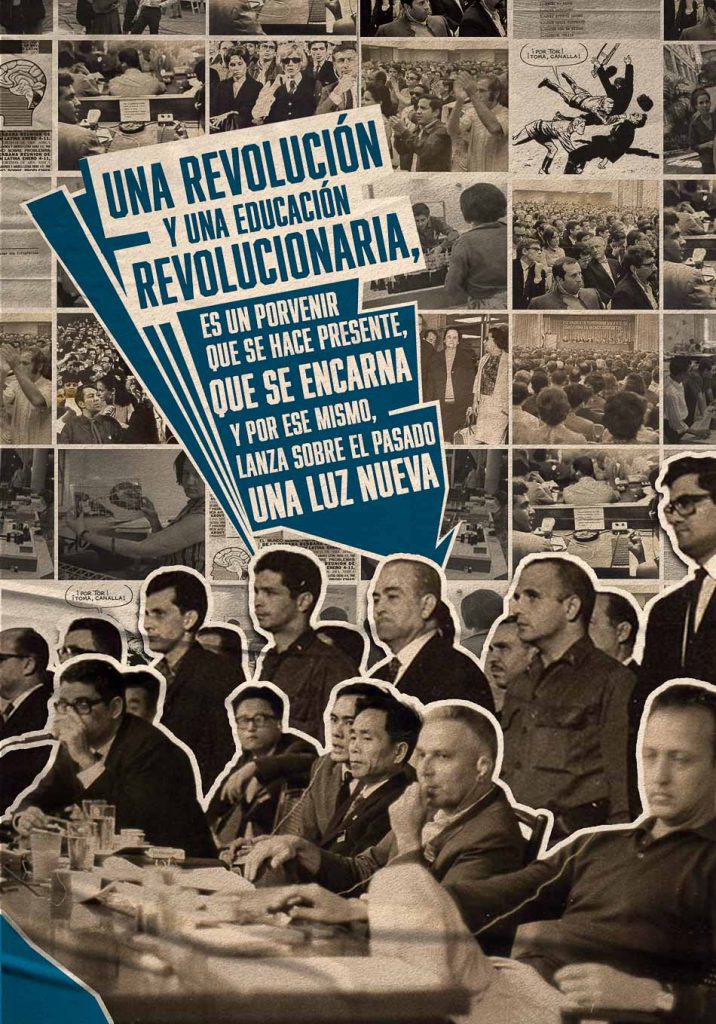
‘A revolution and a revolutionary education is a future that makes itself present, that incarnates itself, and by that very fact casts a new light on the past’. – Antun Maqdisi, Commission II, Cultural Congress of Havana, 1968.
The Horizon: The New Human Being
If revolution is a total phenomenon, then its horizon is the formation of the new human being through revolutionary practice. This was the topic of commission II, whose title, Integral Formation of Man, announced a programme that Che Guevara had outlined in ‘Socialism and Man in Cuba’ in 1965. In his closing speech to the congress, Fidel Castro called it ‘the magnificent pamphlet that Che left us… where he expressed his idea of how the new man must be, the man of tomorrow, the man of the twenty-first century’.44
The Havana congress translated Che’s vision into concrete terms. Along these lines, the Cuban delegate Eduardo Lara described work not only as an economic necessity but as a means of forming the new human being, citing both Che’s characterisation of work as a process that ‘purifies the best in man’ and Marx’s perspective that work is ‘the only method of producing complete men’.45 Under Cuba’s revolutionary government, Che’s vision became praxis in the form of voluntary labour, mass participation in agricultural work, and brigades organised to clear thousands of hectares of unproductive land. These were not simply productive measures but instruments of human transformation intended to break down the division between manual and intellectual labour and the social hierarchies and prejudices associated with it. Other Cuban interventions extended this argument into the scientific, technical, and other fields, insisting that the formation of the new human being could not be separated from the development of technology. In a collective paper entitled ‘The New Man’ presented to commission II, the Cuban delegation named Che as the clearest embodiment of this ideal: ‘a worker not driven by the physical necessity of selling himself as a commodity, capable of acquiring the qualities of the human being of the future, free from the burdens of the past, who gives everything of himself without expecting any material reward, guiding each of his actions with the deepest feelings of love for the people and the oppressed of the whole world and with eternal hatred for the oppressive and criminal enemy’.46
The resolution of commission II defined the new human being in terms that exceeded any narrow conception of culture: someone who was ‘ideologically, scientifically, technically, and culturally prepared to participate actively and consciously in the construction of the new society’ and ‘capable of carrying out productive manual tasks or intellectual activities without distinction’.47 Health, sport, science, manual labour, military defence, and artistic appreciation were not supplementary to this vision but constitutive of it and essential to the defence of any revolution. Rather than suggesting a fixed blueprint, in its general declaration the congress insisted that the new human being ‘will change with the epochs, will transform with the pace of science and technology and of ceaseless imagination’.48 This transformative and dynamic vision of the new human being necessitated a continual process of rehumanisation.
That process also had to confront the gendered subordination embedded in bourgeois social relations. Cuban delegates Elena Díaz and Natasha Klein pointed out that the formation of the new human being required the liberation of women from the objectification and subordination inherent in bourgeois social relations. Their intervention extended the congress’s broader argument about human transformation into a terrain that had been raised but not fully elaborated: ‘Real and effective women’s liberation can begin only from one premise: the removal of the bourgeois socio-economic structure that eliminates the oppression of man by man, of which discrimination against women is an inherent consequence’.49 Women’s liberation was not an addendum to the revolutionary programme but a structural precondition of the integral human being the congress envisioned.
Intellectual Workers and the Revolution
Fidel Castro’s closing address raised a question that had run through every commission: what role should intellectuals – or ‘intellectual workers’, as he called them – play in the revolution? In the commission dedicated to this question, ‘responsibility of the intellectual’, many delegates challenged the tendency to demand that intellectuals become guerrillas while asking nothing equivalent of workers, technicians, teachers, or athletes. The Uruguayan poet Mario Benedetti criticised the assumption that other professions fulfilled ‘a necessary function within the revolutionary sphere… [whereas] the writer or the artist only occupies the role of artículos suntuarios [luxury goods]’. The commission’s resolution developed the same argument, insisting that ‘the artist’s work is not a luxury but a social necessity’ and linking it to the congress’s vision of forming the new human being. 50Revolution, the resolution asserted, ‘creates the conditions for the concept of the “intellectual” as a member of a cultural elite to be extinguished. A sustained and multifaceted effort will make it possible, in the future, for every person to become an integral human being – that is, an intellectual in the broadest sense of the term’.51
The view of the ‘luxury’ intellectual would not disappear by subordinating the intellectual to military action. Rather, the distinction between intellectual and non-intellectual would be overcome as the people as a whole gained access to intellectual life. In the same commission, C. L. R. James – a Trinidadian intellectual who had spent decades at the centre of Pan-African, Marxist, and anti-colonial debates – pushed the argument further. The function of the congress, he declared, should be to ‘prepare the way for the extinction of intellectuals as the personification of culture’. 52 In other words, the intellectual as a separate social category had to be abolished and knowledge had to return to the people who produced the material conditions that made it possible.
In his closing speech, Fidel drew these arguments together. He began by noting that the strongest response to Che Guevara’s death had come not from organisations or parties but from ‘intellectual workers’, who he described as ‘honest, sensitive men and women who had the attitude to assimilate, to understand, to admire’. Intellectuals had shown greater combativity than ‘other organisations from which greater militancy was expected’. The intellectual, then, was not a ‘luxury good’ – a notion Benedetti had criticised – but neither was it a figure to be elevated above the struggle. In his closing address, Fidel read in full a statement that had been delivered by a group of Catholic priests in commission III declaring that ‘it is Marxism that provides the most exact scientific analysis of imperialist reality’ and that Camilo Torres Restrepo, killed fighting with the Colombian guerrilla, ‘gave the highest example of a Christian intellectual committed to the people’. ‘How’, Fidel continued, ‘when we see sectors of the clergy becoming revolutionary forces, can we resign ourselves to seeing sectors of Marxism becoming ecclesiastical forces?’53
‘Marxism’, he continued ‘needs to develop, to emerge from a certain rigidity, to interpret with objective and scientific sense the realities of today, to behave as a revolutionary force and not as a pseudo-revolutionary church’.54 This image served as a synthesis of many of the testimonies shared throughout the congress: Marxism had to be interpreted and applied according to the concrete conditions and necessities of each struggle in order to realise its revolutionary potential. Culture, on this account, cannot be seen as a domain administered by bureaucracies, whether capitalist or socialist, nor constructed as a ‘pseudo-revolutionary church’. As Fidel put it in his closing speech, it had to be understood as a site of active struggle – ‘a Vietnam in the field of culture’ – and such struggle demanded a permanent revolution in thought within and across revolutionary movements and the institutions of culture themselves.55
In fact, the delegates refused to let the congress end as a record of analysis alone. Through the Appeal of Havana, they translated the congress’s conclusions into a programme of practical anti-imperialist action.56 This appeal called intellectuals, artists, scientists, teachers, and students to break institutional ties with US imperialism, refusing scholarships, invitations, and other forms of cooperation against what it identified as the enemy’s method: ‘A systematic effort tends to mobilise technicians, men of science, and intellectuals in general in the service of capitalist and neocolonialist interests and objectives’.57 When the delegates left the Hotel Habana Libre, they carried with them a diagnosis, a body of theory, a vision of the new human being, and a programme of action. They returned to countries at war, under occupation, building socialism, or fighting to breathe within the institutions of the imperial centre.
The Echoes of Havana ’68
The Cultural Congress of Havana did not end when delegates left the Hotel Habana Libre. The energy of those nine days was channelled into a decade of revolutionary cultural production that constituted, in practice if not in name, the anti-imperialist front that the congress had called for. In March 1968, just weeks after the Havana congress closed, the Afro-Asian Writers’ Association published the first issue of Afro-Asian Writings, later renamed Lotus, a trilingual journal that, until 1991, would carry forward the kind of literary solidarities the congress had embodied. Cabral’s ‘National Liberation and Culture’ (1968) extended the framework that the PAIGC delegates had brought to Havana to a broader theorisation on national liberation. The Brazilian educator Paulo Freire’s Pedagogy of the Oppressed (1970) elaborated the vision of the formation of the new human being into a method. The Uruguayan writer Eduardo Galeano’s Open Veins of Latin America (1971) became the continent’s counter-history. Retamar’s Calibán (1971) helped invert the existing political paradigm, placing the Third World at the centre of history and cultural production. The Guyanese historian Walter Rodney’s How Europe Underdeveloped Africa (1972) later developed, in historical and materialist terms, one of the congress’s central diagnoses: that colonialism had not merely exploited Africa but actively produced its underdevelopment.
This wave spread across artistic fields and traditions. In the realm of cinema, Argentine filmmakers Fernando Solanas and Octavio Getino released La hora de los hornos (The Hour of the Furnaces, 1968) and issued their manifesto ‘Hacia un tercer cine’ (Towards a Third Cinema, 1969), which had an explicitly anti-imperialist cinematic programme. In the realm of theatre, the Brazilian playwright Augusto Boal’s Técnicas Latino-americanas de teatro popular (Latin American Techniques of Popular Theatre, 1975) declared that Latin American nations, previously ‘satellites of metropolitan art’, must become ‘the centre of our artistic universe’ and that the goal was not to distribute finished cultural products but to ‘popularise the means of production’ of art itself.58 Nueva Canción (New Song), a Latin American movement of politically committed music rooted in popular and folk traditions, carried the struggle into song through the work of Chile’s Víctor Jara, Argentina’s Mercedes Sosa, and Cuba’s Silvio Rodríguez and Pablo Milanés. In southern Africa, inspired by Ramona Parra Brigade exiles of the 1973 coup in Chile, the cultural brigades of Mozambique Liberation Front (FRELIMO) and the paintings of the Mozambican artist Malangatana Ngwenya fused artistic production with armed liberation.59 OSPAAAL’s poster art, designed in Havana and distributed worldwide through the Tricontinental magazine, gave the Tricontinental movement its visual language. The wave spread across the world of literature, from Ghassan Kanafani writing on literature and resistance in Palestine to Ngũgĩ wa Thiong’o turning to the indigenous language of Gĩkũyũ to write against neocolonialism in Kenya. These projects, and many others like them, show the breadth of the cultural front that Havana helped consolidate. Across the world, they each carried forward the congress’s central insight: that culture was not a secondary reflection of political struggle but one of its decisive fronts.
The Cultural Congress of Havana took place in January 1968, months before the student revolt in Paris’s Latin Quarter became the most famous symbol of global 1968. Yet the cultural front that exploded in the years that followed was rooted not in the university occupations of the European metropole but in the liberation struggles of the Third World. In this sense, it was Havana ’68, not the more acclaimed Paris ’68, where a ‘Vietnam in the field of culture’ was sparked. Despite this, it largely receded from the historical record along with the world that had produced it. Why, then, return to it now?
The questions the congress posed are no less urgent today. Can we develop a national culture under colonial and neocolonial domination? Is it possible to consider the formation of the new human being without a radical transformation of society? What is the responsibility of the intellectual to their medium and to the world? What should be the role of mass media and communication in relation to anti-imperialist struggle?60
As imperialism has reached the dangerous and decadent stage of hyper-imperialism, the mechanisms that the congress identified have metastasised with the New Cold War on the Global South.61 The media apparatus exposed at the congress has become a platform monopoly, algorithmically colonising attention and desire and manufacturing consent for the imperial order. The brain drain that the congress diagnosed has been compounded by the extraction of data and digital labour, the raw material of Silicon Valley’s war economy. The ‘cultural agents’ of the CIA-backed Congress for Cultural Freedom have reappeared in the NGO-isation of knowledge production. This includes the academic networks that seek to demonise or discredit alternative political and economic systems to the Western capitalist order, from the socialist projects in China, Cuba, and Venezuela to the countries asserting their sovereignty from Western domination in Iran, Russia, the Sahel, and beyond.
The Havana congress diagnosed cultural production as part of the economic system itself. Today, as US economic hegemony enters relative decline, Washington seeks to offset that decline through intensifying militarism. The cultural front is increasingly drawn into the same logic, as culture wars, manufactured consent for confrontation, and the war machine itself operate as a single integrated apparatus.
The Havana congress was an intervention in the cultural Cold War. If the Congress for Cultural Freedom sought to produce a global intelligentsia committed to the idea that there is no alternative to the Western order, the Havana congress sought to produce the opposite: an international front of new intellectuals, scientists, doctors, educators, and artists committed to the construction of sovereign alternatives, building towards socialism. How can that example provoke us today and push people’s movements to think broadly and strategically about culture as a terrain of political struggle and to build an anti-imperialist cultural front adequate to our moment? What would it mean to do this now – to refuse the compartmentalisation that relegates ‘cultural work’ to art and propaganda while treating health, science, education, sport, and knowledge production as separate, technical domains outside the scope of political strategy? What would it mean to build institutions, networks, and forms of collective intellectual production that are embedded in the movements of the present, as the congress was embedded in the liberation struggles of its time? Tricontinental: Institute for Social Research has sought to carry this tradition forward, accompanying the political struggles of today, cultivating the new intellectuals that these struggles demand, and working from within the trenches of the battle of ideas and emotions.62 The work of recovering the Cultural Congress of Havana is part of this effort, not as an exercise in historical nostalgia but as a contribution to the strategic thinking that movements need now.
Dorticós opened the congress by declaring that to create in a country undergoing revolutionary development ‘is not only to create a literary or artistic, scientific or technical work. It is to create a more beautiful whole – one that, in the final analysis, benefits from that scientific, literary, or artistic creation. It is to create a new people, a new country, a new society!’63 To return to the Cultural Congress of Havana is to return to that proposition – and to insist that every dimension of human life is a front of imperialism and therefore a front of resistance. The battle of ideas and emotions continues, and the cultural front – in its totality – remains to be built.
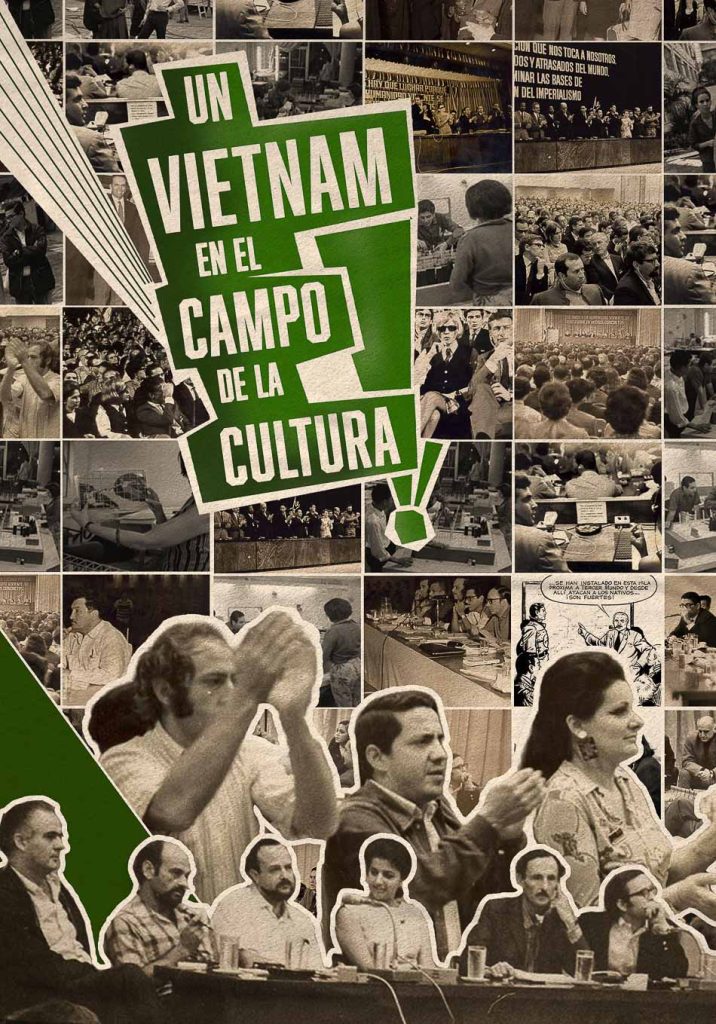
‘A Vietnam in the field of culture!’ – Fidel Castro, closing speech, Cultural Congress of Havana, 12 January 1968.
Notes
1 Fidel Castro, closing speech (Cultural Congress of Havana, 12 January 1968), in Reunión de intelectuales de todo el mundo sobre problemas de Asia, África y América Latina [Meeting of Intellectuals from Around the World on Problems of Asia, Africa and Latin America] (Havana: Instituto del Libro, 1968), 57–71.
2 René Depestre, ‘Las aventuras de la negritud’ [The Adventures of Négritude] (speech, commission I, Cultural Congress of Havana, January 1968), 42–46.
3 The attendance figures vary according to different accounts, but the numbers used here appear in the congress’s concluding documents, in CCH 1968, 46, 48, 57.
4 For more on the PAIGC’s cultural programme, see Tricontinental: Institute for Social Research, The PAIGC’s Political Education for Liberation in Guinea-Bissau, 1963–74, Studies on National Liberation no. 1, 1 July 2022, https://thetricontinental.org/studies-1-national-liberation-paigc-education/.
5 The Spanish hombre (man) and formación integral del hombre (integral formation of man), as used in the congress documents, are rendered here as ‘man’ and ‘integral formation of man’ to preserve the original language. Though gendered, hombre in this context referred not only to men but to the human being in its totality. ‘Formation’ is used in this context throughout the dossier to reflect the Spanish formación and the congress’s understanding of the new human being as developing through revolutionary practice, education, labour, and collective social transformation. Unlike ‘creation’, which can suggest a more absolute or instantaneous act, ‘formation’ preserves the emphasis on an ongoing process.
6 CCH 1968, 4.
7 María Berríos, ‘“Now History Happens Here”: Del Tercer Mundo’, in The East Was Read: Socialist Culture in the Third World, ed. Vijay Prashad (New Delhi: LeftWord Books, 2019), 101–19.
8 ‘Declaración General del Congreso Cultural de La Habana’ [General Declaration of the Cultural Congress of Havana], in CCH 1968, 49–50.
9 For more on the Congress for Cultural Freedom, see Frances Stonor Saunders, The Cultural Cold War: The CIA and the World of Arts and Letters (New York: New Press, 2000).
10 Cited in Michele Hardesty, ‘The Appeal of Cuba: The 1968 Havana Cultural Congress and US Intellectuals’, in Neocolonial Fictions of the Global Cold War, eds. Steven Belletto and Joseph Keith (Iowa City: University of Iowa Press, 2019), 61.
11 OSPAAAL, Primera Conferencia Tricontinental: Documentos y Resoluciones [First Tricontinental Conference: Documents and Resolutions] (Havana: OSPAAAL, 1966), 127–40; Valeria González Lage, ‘Objetivos, discursos y protagonistas del Congreso Cultural de La Habana (1968)’ [Objectives, Discourses, and Protagonists of the Cultural Congress of Havana (1968)], SÉMATA 31 (2019): 276–77.
12 González Lage, ‘Objetivos, discursos y protagonistas’, 283–84.
13 CCH 1968; Hélène Parmelin, ‘Au congrès culturel de La Havane’ [At the Cultural Congress in Havana], Raison présente 6 (April–June 1968): 3–20.
14 González Lage, ‘Objetivos’, 276, citing Fidel Castro, Discurso pronunciado en la conmemoración del IX Aniversario del triunfo de la Revolución [Speech Delivered on the Ninth Anniversary of the Triumph of the Revolution], 2 January 1968; and Comité Central del Partido Comunista de Cuba, Informaciones del Comité Central del Partido Comunista de Cuba acerca de las actividades de la microfacción [Reports of the Central Committee of the Communist Party of Cuba Concerning the Activities of the Microfaction] (Havana: Instituto del Libro, 1968).
15 Organisation of American States, Special Consultative Committee on Security, Cultural Congress of Havana (Washington, DC: Pan American Union, ca. 1968).
16 Roberto Fernández Retamar, Calibán (1971; Mexico City: Editorial Diógenes, 1974), 34–35.
17 Katerina González Seligmann, ‘Calibán, Why?’, Small Axe 23, no. 3 (2019): 49–54, 76–77.
18 Rafael Magdiel Sánchez Quiroz, comp., Fernando Martínez Heredia: Pensar en tiempo de Revolución; Antología esencial [Fernando Martínez Heredia: Thinking in a Time of Revolution: Essential Anthology] (Buenos Aires: CLACSO, 2018).
19 Fernando Martínez Heredia, ‘Colonialismo y cultura nacional’ [Colonialism and National Culture] (speech, commission I, Cultural Congress of Havana, January 1968), 15–19; for our thesis on the future as militant orientation see Tricontinental: Institute for Social Research, The Future, dossier no. 100, 5 May 2026, https://thetricontinental.org/dossier-the-future/.
20 Moreno Fraginals, ‘Algunos aspectos del mensaje radial’ [Some Aspects of the Radio Message] (speech, commission IV, Cultural Congress of Havana, January 1968), 71–74; Edmundo Desnoes, ‘Las armas secretas’ [The Secret Weapons] (speech, commission IV, Cultural Congress of Havana, January 1968), 13–17.
21 Lajpat Rai befriended the Pakistani delegate Abdullah Malik at the congress. Malik, a communist journalist based in London, was invited because Pakistan’s most prominent poet, Faiz Ahmed Faiz, was prevented from attending by the military dictatorship. See Ali Raza, ‘Dispatches from Havana: The Cold War, Afro-Asian Solidarities, and Culture Wars in Pakistan’, Journal of World History 30, nos. 1–2 (June 2019): 223–46.
22 Lajpat Rai, ‘El “Tercer Mundo” y la responsabilidad de los intelectuales’ [The ‘Third World’ and the Responsibility of Intellectuals] (speech, commission III, Cultural Congress of Havana, January 1968), 10–17.
23 Gisèle Halimi, ‘De la cultura de opresión a la cultura de emancipación’ [From the Culture of Oppression to the Culture of Emancipation] (speech, commission III, Cultural Congress of Havana, January 1968), 136–44.
24 Kim Youn Seun and Pak Hai Chin, ‘Problemas sobre la cultura y la independencia nacional’ [Problems of Culture and National Independence] (speech, commission I, Cultural Congress of Havana, January 1968), 172–81.
25 Alex La Guma, ‘Literatura y resistencia en África del Sur’ [Literature and Resistance in South Africa] (speech, commission I, Cultural Congress of Havana, January 1968), 20–29; English translation in Silber, Voices, 48–53.
26 Horacio Zalce, ‘Penetración del imperialismo en la medicina en los países subdesarrollados’ [Imperialist Penetration of Medicine in the Underdeveloped Countries] (speech, commission I, Cultural Congress of Havana, January 1968), 30–31.
27 ‘Subcommission I Resolution, Commission V’, in CCH 1968, 34–39.
28 Aníbal Rodríguez and Fernando Barral, ‘Sociología, investigaciones sociales y subdesarrollo en América Latina’ [Sociology, Social Research, and Underdevelopment in Latin America] (speech, commission V, Cultural Congress of Havana, January 1968), 2–6.
29 ‘Resolution of Commission IV’, in CCH 1968, 30.
30 Tu Huynh, co-president of commission V, quoted in Silber, Voices, 102.
31 ‘Resolution of Commission IV’, in CCH 1968, 30.
32 For more on Mário Pinto de Andrade, see ROAPE, ‘Documenting the Life of Mário Coelho Pinto de Andrade’ (2025).
33 Abílio Duarte, ‘Responsabilidades del intelectual frente a los problemas del Tercer Mundo’ [Responsibilities of the Intellectual Facing the Problems of the Third World] (speech, commission III, Cultural Congress of Havana, January 1968), 104–7; English translation in Silber, Voices, 145–48.
34 ‘Resolution of Commission III’, in CCH 1968, 28.
35 René Depestre, ‘Las aventuras de la negritud’ [The Adventures of Négritude] (speech, commission I, Cultural Congress of Havana, January 1968), 42–46.
36 Depestre, ‘Las aventuras de la negritud’, CCH 1968, 42–46.
37 Depestre, see Paul B. Miller, ‘¿Un cubano más?: An Interview with René Depestre about his Cuban Experience’, Afro-Hispanic Review 34, no. 2 (Fall 2015): 159–78.
38 Differing slightly from Depestre’s CCH speech cited here, Senghor’s original formulation uses ‘hellène’ (Hellenic) rather than ‘blanche’ (white) and appears in Ce que l’homme noir apporte [What the Black Man Brings] (Paris: Plon, 1939).
39 Depestre, ‘Las aventuras de la negritud’, CCH 1968, 46.
40 Depestre, ‘Las aventuras de la negritud’, CCH 1968, 46.
41 For more on Dennis Brutus, see South African History Online, ‘Dennis Brutus’, sahistory.org.za/people/dennis-brutus; Dennis Brutus, ‘El racismo en el deporte: un obstáculo en el desarrollo del hombre integral’ [Racism in Sport: An Obstacle to the Integral Development of Man] (speech, commission II, Cultural Congress of Havana, January 1968), 34–37, own translation.
42 For more on Makdissi Antoun (Antun Maqdisi, 1914–2005), see the Prince Claus Fund, https://princeclausfund.nl/awardees/antun-maqdesi.
43 Makdissi Antoun, ‘Revolución y cultura’ [Revolution and Culture] (speech, commission II, Cultural Congress of Havana, January 1968), 99–102, own translation.
44 Fidel Castro, closing speech, in CCH 1968, 57–71; Ernesto ‘Che’ Guevara, ‘Socialism and Man in Cuba’, in On Socialism and Internationalism (New Delhi: LeftWord Books, 2020), p. 63, https://thetricontinental.org/wp-content/uploads/2020/10/Che_Guevara_On_Socialism_and_Internationalism_EN.pdf.
45 Eduardo Lara, ‘El papel del trabajo en la educación integral del hombre’ [The Role of Work in the Integral Formation of Man] (speech, commission II, Cultural Congress of Havana, January 1968), 62–65, own translation.
46 ‘El Hombre Nuevo’ [The New Man] (collective text, Información de Cuba, commission II, Cultural Congress of Havana, January 1968), 73–79, own translation.
47 ‘Resolution of Commission II’, in CCH 1968, 22–25, own translation.
48 ‘Declaración General del Congreso Cultural de La Habana’ [General Declaration of the Cultural Congress of Havana], in CCH 1968, 54, own translation.
49 Elena Díaz and Natasha Klein, ‘La mujer en Cuba revolucionaria’ [Women in Revolutionary Cuba] (speech, commission II, Cultural Congress of Havana, January 1968), 116–32, own translation.
50 Mario Benedetti, ‘Sobre las relaciones entre el hombre de acción y el intelectual’ [On the Relations between the Man of Action and the Intellectual] (speech, commission III, Cultural Congress of Havana, January 1968), 5–9, own translation; cited in González Lage, ‘Objetivos’, 287; for more on the role of intellectuals, see Tricontinental: Institute for Social Research, ‘A Revolution Can Only Be the Child of Culture and Ideas’, Art Bulletin no. 27, 31 May 2026, https://thetricontinental.org/art-bulletin-culture-and-ideas-in-revolution/.
51 ‘Resolution of Commission III’, in CCH 1968, 29–30, own translation.
52 C. L. R. James, ‘La responsabilidad de los intelectuales’ [The Responsibility of the Intellectuals] (speech, commission III, Cultural Congress of Havana, January 1968), 67–68; English translation in Silber, Voices, 118. On James at the Congress, see González Seligmann, ‘Calibán, Why?’.
53 Castro, closing speech, in CCH 1968, 62–63, own translation.
54 Castro, closing speech, in CCH 1968, 65–66, own translation.
55 Castro, closing speech, in CCH 1968, 67, own translation.
56 Andrew Salkey, Havana Journal (Harmondsworth: Penguin, 1971), 217–18.
57 ‘Llamamiento de La Habana’ [The Havana Appeal], in CCH 1968, 46–47, own translation.
58 For more on Augusto Boal’s approach, see Tricontinental: Institute for Social Research, ‘Augusto Boal’s Copernican Revolution in Reverse’, art bulletin no. 17, 27 July 2025, https://thetricontinental.org/augusto-boals-copernican-revolution-in-reverse/.
59 For more on the 1973 coup, see Tricontinental: Institute for Social Research, The Coup Against the Third World: Chile, 1973, dossier no. 68, 5 September 2023, https://thetricontinental.org/dossier-68-the-coup-against-the-third-world-chile-1973/.
60 CCH 1968, 16–17, own translation.
61 For more on hyper-imperialism, see Tricontinental: Institute for Social Research, Hyper-Imperialism: A Dangerous Decadent New Stage, Contemporary Dilemmas no. 4, 23 January 2024, https://thetricontinental.org/studies-on-contemporary-dilemmas-4-hyper-imperialism/.
62 For more on the new intellectual, see Tricontinental: Institute for Social Research, The New Intellectual, dossier no. 12, February 2019, https://thetricontinental.org/the-new-intellectual/; for more on the battle of emotions, see Ten Theses on Marxism and Decolonisation, dossier no. 56, 20 September 2022, https://thetricontinental.org/dossier-ten-theses-on-marxism-and-decolonisation/.
63 Dorticós, opening speech, in CCH 1968, 10, own translation.
Bibliography
Acosta, R. ‘El Congreso olvidado’ [The Forgotten Congress]. In MINCULT, Multimedia Congreso Cultural de La Habana [Multimedia Cultural Congress of Havana]. Havana: Cubarte, 2015.
Berríos, María. ‘“Now History Happens Here”: Del Tercer Mundo’, in The East Was Read: Socialist Culture in the Third World, ed. Vijay Prashad (New Delhi: LeftWord Books, 2019), 101–19.
Campuzano, Luisa. ‘La revista Casa de las Américas, 1960–1995’ [The Casa de las Américas Journal, 1960–1995]. In A. Fornet and L. Campuzano, La revista Casa de las Américas: un proyecto continental [A Continental Project], 33–70. Havana: ICIC, 2001.
Congreso Cultural de La Habana. Reunión de intelectuales de todo el mundo sobre problemas de Asia, África y América Latina [Meeting of Intellectuals from Around the World on the Problems of Asia, Africa, and Latin America]. Havana: Instituto del Libro, 1968.
Dorticós Torrado, Osvaldo. Opening speech, Cultural Congress of Havana, 4 January 1968.
Comité Central del Partido Comunista de Cuba. Informaciones del Comité Central del Partido Comunista de Cuba acerca de las actividades de la microfacción [Reports of the Central Committee of the Communist Party of Cuba on the Activities of the Microfaction]. Havana: Instituto del Libro, 1968.
Commission transcription archives: Comisión I–V. Cultural Congress of Havana, January 1968.
González Lage, Valeria. ‘Objetivos, discursos y protagonistas del Congreso Cultural de La Habana (1968)’ [Objectives, Discourses, and Protagonists of the Cultural Congress of Havana (1968)]. SÉMATA, Ciencias Sociais e Humanidades 31 (2019): 273–296.
González Seligmann, Katerina. ‘Calibán, Why? The 1968 Cultural Congress of Havana, C. L. R. James, and the Role of the Caribbean Intellectual’. Small Axe 23, no. 3 (2019).
Hardesty, Michele. ‘The Appeal of Cuba: The 1968 Havana Cultural Congress and US Intellectuals’. In Neocolonial Fictions of the Global Cold War, edited by Steven Belletto and Joseph Keith, 57–75. Iowa City: University of Iowa Press, 2019.
Hội Nhà Văn Việt Nam [Vietnamese Writers’ Association]. ‘Nhà thơ Huy Cận (1919–2005) – Tiểu sử văn học’ [Poet Huy Cận (1919–2005) – Literary Biography]. Accessed 3 April 2026. https://vanvn.vn/nha-tho-huy-can-1919-2005-tieu-su-van-hoc/.
Karol, K.S. Los guerrilleros en el poder: Itinerario político de la Revolución cubana [Guerrillas in Power: The Political Itinerary of the Cuban Revolution]. Barcelona: Seix Barral, 1972.
Miller, Paul B. ‘¿Un cubano más? [One More Cuban?]: An Interview with René Depestre about his Cuban Experience’. Afro-Hispanic Review 34, no. 2 (Fall 2015): 159-178.
Organisation of American States, Special Consultative Committee on Security. Cultural Congress of Havana: Study Prepared by the Special Consultative Committee on Security against the Subversive Action on International Communism at Its Tenth Regular Meeting. Washington, DC: Pan American Union, ca. 1968.
Organización de Solidaridad de los Pueblos de Asia, África y América Latina (OSPAAAL). Primera Conferencia Tricontinental: Documentos y Resoluciones [First Tricontinental Conference: Documents and Resolutions]. Havana: Secretaría General de la OSPAAAL, 1966.
Parmelin, Hélène. ‘Au congrès culturel de La Havane’ [At the Cultural Congress of Havana]. Raison présente 6 (April–June 1968): 3–20.
Raza, Ali. ‘Dispatches from Havana: The Cold War, Afro-Asian Solidarities, and Culture Wars in Pakistan’. Journal of World History 30, nos. 1–2 (June 2019): 223-246.
Fernández Retamar, Roberto. Calibán: Apuntes sobre la cultura en nuestra América [Caliban: Notes on Culture in Our America]. First published in Casa de las Américas, no. 68 (September–October 1971). Book edition, Mexico City: Editorial Diógenes, 1974.
Salkey, Andrew. Havana Journal. Harmondsworth: Penguin, 1971.
Sánchez Quiroz, Rafael Magdiel, comp. Fernando Martínez Heredia: Pensar en tiempo de Revolución. Antología esencial [Fernando Martínez Heredia: Thinking in a Time of Revolution: Essential Anthology]. Buenos Aires: CLACSO, 2018.
Silber, Irwin, ed. Voices of National Liberation: The Revolutionary Ideology of the Third World as Expressed by Intellectuals and Artists at the Cultural Congress of Havana. New York: Central Book Company, 1970.
Stonor Saunders, Frances. The Cultural Cold War: The CIA and the World of Arts and Letters. New York: New Press, 2000.