The Argentine Dilemma: Data-Exporter Model or Digital Sovereignty
Milei and Thiel design ‘non-human corporations’ and eliminate limits on foreign-owned land. From the Agro-Exporter Model to the Data-Exporter Model. The dilemma: colony or digital sovereignty. Marx already explained it.
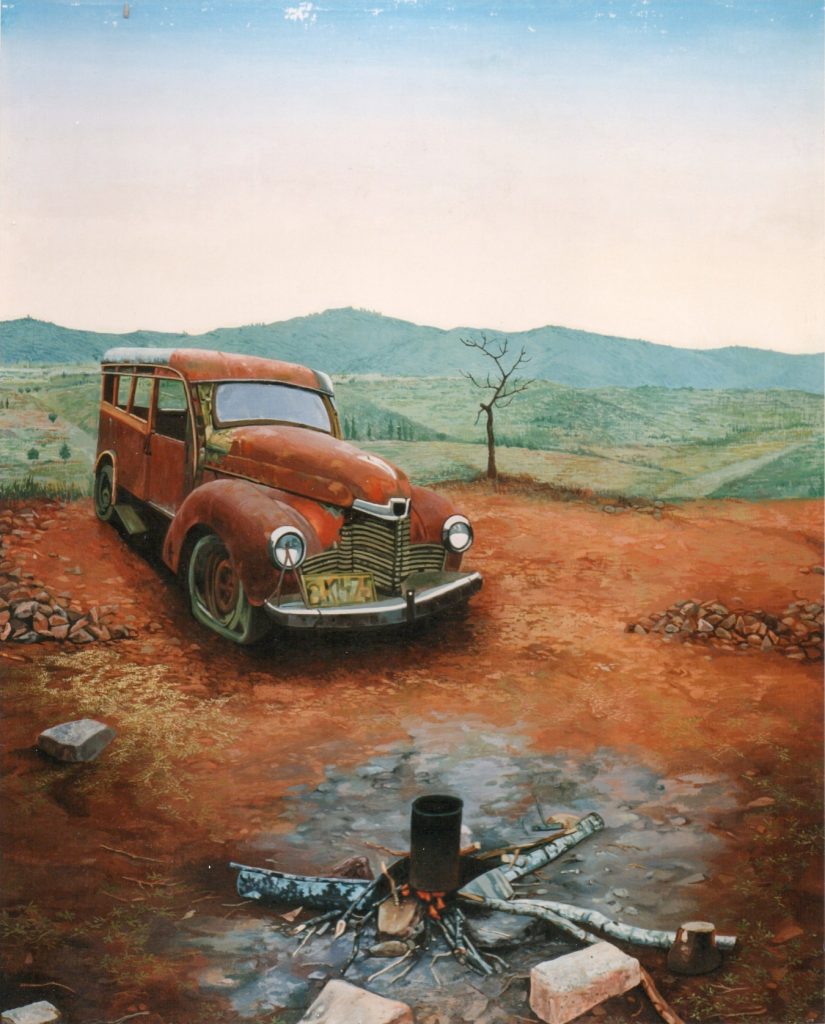
Enrique Sobisch (Argentina), Dawn, 1989.
Dear friends:
Greetings from the Nuestra América office at Tricontinental: Institute for Social Research.
This month found us in Quixotic quests that are by no means comparable, which have taken us from one extreme to another on the emotional scale. We are still suffering alongside our compatriots in Venezuela, who continue struggling to remake themselves after the devastating double earthquake with its epicentre in La Guaira. The World Cup would have been an unbeatable stage to promote a solidarity campaign with an unquestionable humanistic spirit, but it is the World Cup of millionaires, who steamroll the world with tickets costing thousands of dollars, their online betting systems, and the individualism typical of runaway capitalism.
Yet Russia has not participated due to the sanctions weighing on it over the war with Ukraine, but the genocidal Trump has strutted around, shining his shoes on the head of the FIFA president while announcing new bombings in Iran. The outstanding performance of the countries of the Global South, the championship for a young Lamine Yamal, who has not forgotten Palestine, and the snub by the Argentine centre-back pair towards Trump during the medal ceremony, among other events, accompany the defiant message of resistance shown by the Argentine players after their epic victory over England: ‘The Malvinas are Argentine.’

Luisa Vernet (Argentina), Puerto Soledad, Malvinas, 1829. Currently at the Malvinas Museum, Núñez, Buenos Aires, Argentina.
Meanwhile, in Brazil and Argentina, Tricontinental has been driving the Artificial Intelligence agenda, with its eyes set on the Future, as we indicated in our Dossier No. 100. The visit of comrade Jeff Xiong from China has allowed us to explain why it is relevant to put ourselves at the forefront of this inevitable development, but also why it is fundamental to go beyond the tentacles of Silicon Valley. The model of U.S. corporations seeks to take us to the abyss of the past, to the moment when our countries fell prey to imperialism and the devastating capitalism of our common goods. That Agro-Exporter Model forged at the end of the 19th century — and by no means ever completely buried — seeks to reinvent itself a century and a half later as the Data-Exporter Model. Yes, data, the increasingly valued production factor in the era of platforms and tech capitalism. At every meeting we went to with Jeff, with university authorities, congress members, officials, trade unions, and journalists, the sceptical question was never missing: ‘isn’t it just changing one master for another?’
Still on Argentina, a country that never ceases to surprise: on the same day that the streets were filled with young people shouting, ‘whoever doesn’t jump is an Englishman!’, President Javier Milei’s La Libertad Avanza was trying to push through Congress a bill that would eliminate limits on foreign ownership of land, particularly in border areas. Opposition to the bill was fragmented and weak, yet its debate was postponed until August 6th. While celebrations over the national team’s advance continued, fellow researchers who promoted the Land Observatory took on the task of teaching the pedagogy of libertarian colonialism: they explain that the current discussion over the elimination of articles from the Land and Glacier laws stems from a country that has already left some 13 million hectares in foreign hands — 5% of its territory, an area similar to that of England. But they add that the real magnitude of the phenomenon appears at the local level, in regions where water courses, aquifers, or areas with strategic minerals are located. In departments like General Lamadrid, in La Rioja, more than half of their territories are in foreign hands. What would happen once even those limits were gone?
And what does land have to do with Artificial Intelligence? The answer is: Peter Thiel. It seems strange, but it makes sense. Thiel is the most powerful investor in Silicon Valley, co-founder of PayPal, the first outside investor in Facebook, and founder of Palantir, the surveillance and data analysis company that handles databases containing information on all 45 million Argentines. But he is also an ideologue: of extreme libertarianism, the anti-state, and the radical divorce between democracy and freedom. That’s why he embraced Milei in Davos and California, calling him a ‘true libertarian.’ For Thiel, Milei’s Argentina presents itself as a laboratory for his dystopia of territorial and digital occupation. That is also why he embraced him in Buenos Aires a few weeks ago. He arrived, bought one of the city’s most expensive mansions, and went on to dictate to the president and his Minister of Deregulation, Federico Sturzenegger, a bill to reform the General Companies Law that includes so-called ‘automated companies’ and ‘non-human corporations.’ DAOs — Decentralized Autonomous Organizations — are entities governed by blockchain without human intervention. And this pro-government project seeks to grant these entities full legal personality.
But the imperialist design is more complex. Days earlier, Milei presented another bill — we are now referring to at least three — dubbed the ‘Super RIGI.’ It is an expanded incentive scheme specifically for tech infrastructure, data centres, and AI investment. The so-called ‘Bases Law’ approved in 2024 had created the original RIGI, already exempting data centre projects from the restrictions of the Land Law through its Article 174. The logic of the chain is clear: land — data centres — non-human corporations. This is the core of the 21st-century Data-Exporter model.

Roberto Aizenberg (Argentina), Figures on Landscape, 1953.
Unashamedly, this is how Milei and Sturzenegger presented it in an op-ed published last month in the Financial Times, London’s leading newspaper. In it, these big tech agents in charge of the Argentine government argued that it was necessary to free oneself from the ‘mortal hand’ of state regulation, advocated for a management model of the country in the hands of companies ‘without responsible humans,’ and in their unbridled fascination with the historical injustices of capitalism, launched the slogan: ‘May Buenos Aires become to AI what Amsterdam was to the age of navigation — the place where the legal imagination met the technological moment, and the world changed,’ they wrote. The machine and the legal person were ‘the double helix of modern prosperity.’
In taking us back to the past, these ‘true libertarians’ have not deprived us of examples: the Dutch East India Company is the beacon that illuminates their path to the future. But what exactly was this company, which competed in ambition and cruelty with the English and French companies for West and East? In the 19th century, Karl Marx used the case of the East India Company — the English one — to study the way in which commercial capital and the monarchical State merged into a monopolistic braid that first transformed the company from a commercial enterprise into a territorial and military corporate power, with its own army and navy, only to later succumb to internal corruption, costly wars, and over-indebtedness. He did so on several occasions, particularly when he spoke of violence as an ‘economic power’ and when he recalled that the Dutch colonial system was nothing but ‘an unsurpassed picture of treachery, bribery, murder, and infamies.’
It is no coincidence that, today, while some choose to raise the flags of this history of abuse and violence, others recall that even Adam Smith harshly attacked the role of these companies and that they now represent not-so-distant precedents for companies that currently violate human rights. Ultimately, it was colonial plunder, the return of slavery on a global-scale, and the development of war — not legal innovation — that drove capitalism at the time.
Is there an alternative? Always.
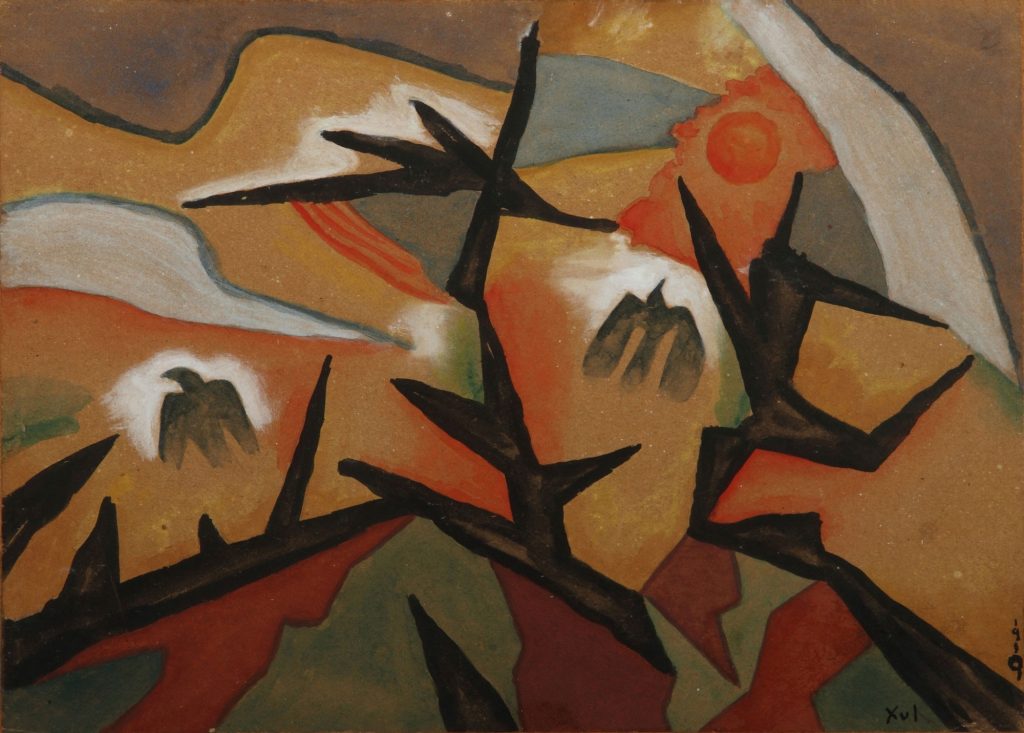
Xul Solar (Argentina), Other Logs [Otros Troncos], 1919.
We must remember that the Agro-Exporter Model was replaced, following a process of economic transformation and social struggle, by the Industrialist Model. We already know what that is about. Must we exchange one master for another? AI technology is not a purely technical phenomenon or a neutral tool for ‘modernization’: it is a process of global transformation that cries out for state intervention, infrastructure, regulation, and a fight against opacity in data management and the creation of racist, warmongering, and consumerist biases. It also — as Jeff Xiong points out — demands specialized training and a massive campaign for digital literacy. In short, ‘digital sovereignty.’
Is Latin America up to the challenge? If the cry ‘The Malvinas are Argentine’ can transcend an unforgettable football victory, then let it serve as a beacon for the defence of our lands, our data, and the construction of a sovereign digital life: the human being always comes first.
Greetings,
Alejandro Jasinski
 | Alejandro Jasinski |