The World’s Silence on Gaza Once Headlines Fade: The Thirty-First Newsletter (2026)
The tapering off of news coverage on the US-Israeli genocide has done little to abate the violence. In fact, its permanence is precisely what allows the world to look away.
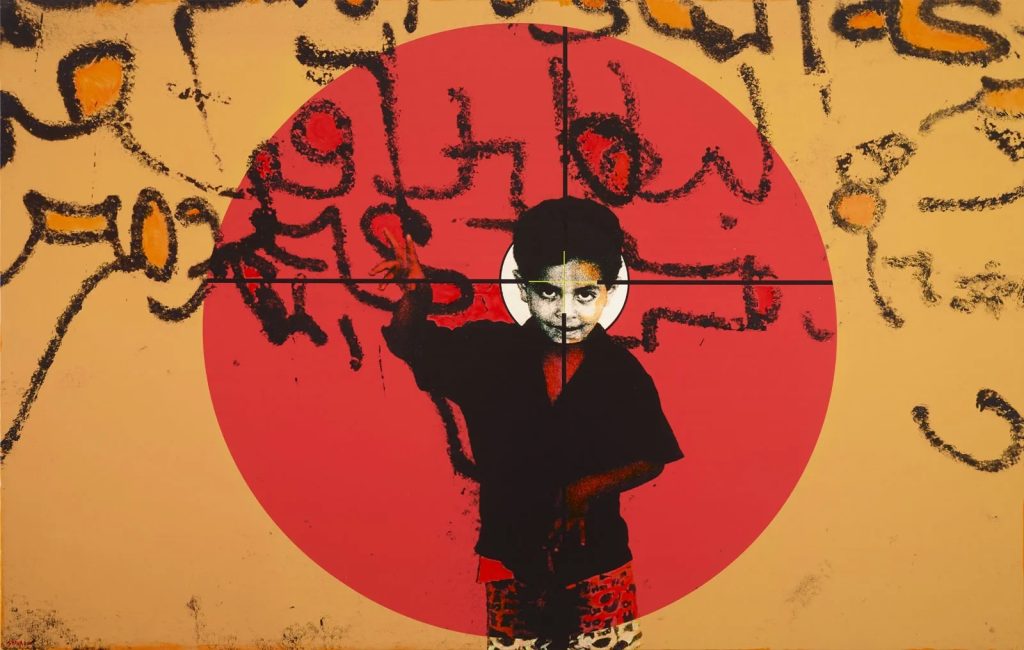
Laila Shawa (Palestine), Target, 2013.
Dear friends,
Greetings from the desk of Tricontinental: Institute for Social Research.
Some catastrophes disappear because they end. Others disappear because they continue for so long that the world grows accustomed to them. They cease to interrupt television schedules and Instagram reels, just as they no longer command the front pages of newspapers. Financial markets return to their ordinary calculations, the daily machinery of political and economic life resumes its familiar rhythm, and diplomats are asked to put away their briefing books on that tired but painful subject. Yet, the catastrophe remains intact: the US-Israeli genocide of Palestinians in Gaza has not disappeared because of a new peace but because the permanence of the genocide makes it unmarketable news.
There was a time when every explosion in Gaza flashed across my phone – horrible images of children being pulled from rubble, medical workers trying to help patients as the hospital itself gets bombed, and families howling in grief as Israeli bombs obliterated entire Palestinian lineages. Israel’s attacks continue as families flee from one temporary shelter to another and children search through shattered concrete for fragments of lives they once knew. But the world’s attention has shifted elsewhere as the genocide has become routine. We have become comfortably numb.
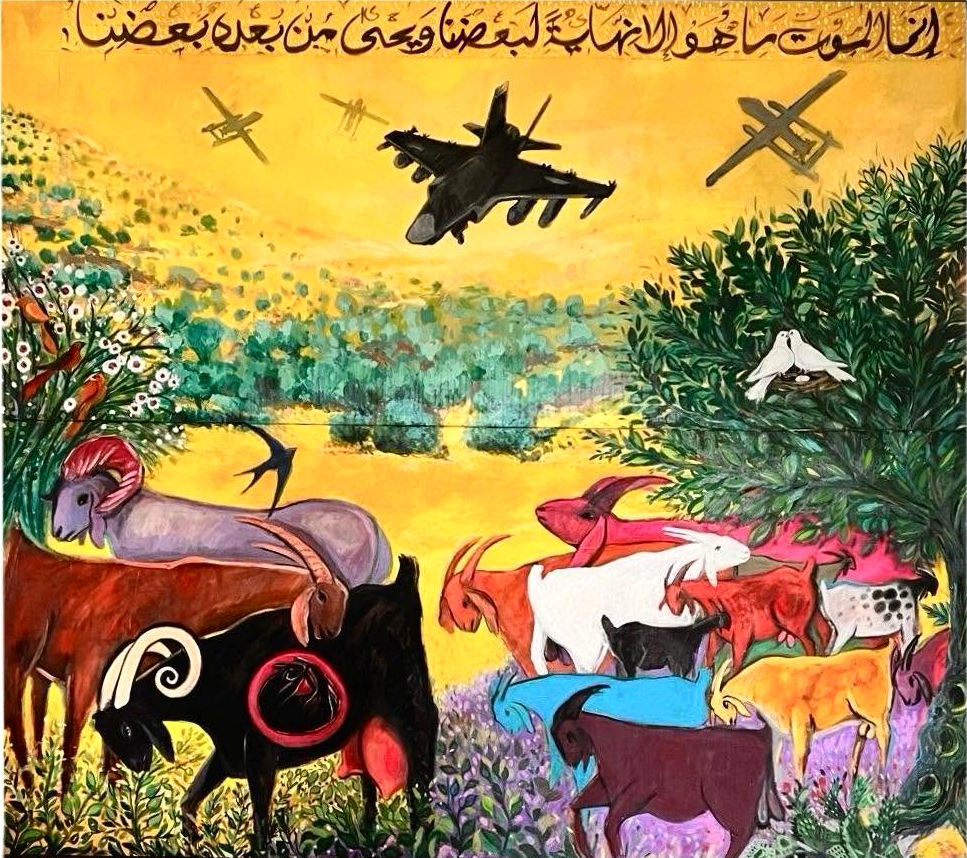
Mohammed Al-Hawajri (Palestine), Death Is Only the End for Some among Us; After them, Others Continue to Live, 2022.
The scale of death and destruction is impossible to comprehend. The Palestinian Ministry of Health reports that since October 2023, Israeli violence has killed at least 73,221 Palestinians (half of whom are women and children) and wounded 173,654 others. By February 2026, at least 21,289 children had been killed and 44,500 injured in Gaza. Even after the so-called ceasefire took effect on 11 October 2025, Israeli violence has killed 1,100 Palestinians, including at least 260 children, and injured 3,546 others. That means that, on average, the Israelis have killed four Palestinians every single day since then.
There are moments in history when words lose their meaning. Not because dictionaries are rewritten, nor because language itself changes, but because political power empties words of the realities they once described. The word ‘ceasefire’ has increasingly acquired this desolate quality when used by Israeli and US officials. What was once understood to mean the suspension of violence, the silencing of guns, and the creation of political space for peace has become something else entirely: a managerial term for the continuation of bombardment, displacement, siege, and military control in the name of peace.
Statistics attempt to quantify the horrific destruction, but numbers cannot capture absence. Behind every number lies a family with a broken history and a child who will always remember a home that no longer exists, or, in many cases, an entire family lineage erased. These figures are horrifying enough on their own, as reflected in United Nations Relief and Works Agency for Palestine Refugees in the Near East (UNRWA) reports, for which a donation is overdue. Each report from the UN reads less like an emergency bulletin and more like an archive of permanent catastrophe.
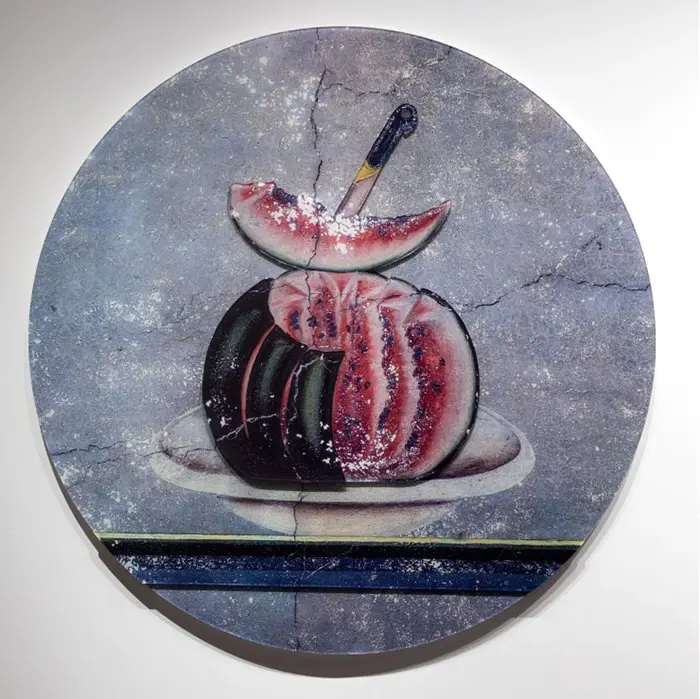
Hazem Harb (Palestine), Watermelon (1917), 2024.
What is the meaning of outrage when it seems to carry no political cost for Israel’s total violation of international law? Beyond the ruins of Gaza, the map of Palestine continues to be rewritten in the Occupied West Bank and East Jerusalem. Not a day goes by without reports of land confiscations and settler expansion, the demolition of Palestinian homes and violent attacks by settlers, and the steady fragmentation of Palestinian territory. Ir Amim (City of Peoples), a public and legal advocacy group from Jerusalem, reports that Israeli planning authorities have voted to destroy 800 houses from the Palestinian neighbourhood of Umm Lison in occupied East Jerusalem and build 450 homes for illegal settlers – part of a broader policy of expulsion and annexation. As Gaza is being devastated by overwhelming military force, East Jerusalem and the West Bank are being transformed through bureaucratic annexation, legalistic pretexts, permanent settlements, and the brutality inflicted upon the Palestinian population by administrative detention and home demolition. These attacks on the Occupied Palestinian Territory are expressions of the same project: the genocide of the Palestinian people and the seizure of their land in the name of building a so-called ‘Greater Israel’.
While groups such as Ir Amim continue to painstakingly document settlement expansion and dispossession, moral decay in Israeli society has metastasised with a new intensity. In 2014, Haaretz columnist Carolina Landsmann wrote with clarity that Israeli military rule over Palestinians is not a hidden mechanism operated by the army alone but ‘the largest, most visible project, with broader participation than any other endeavour in Israel’. In other words, the occupation is sustained not only by its military presence but also by the institutions, resources, habits, and everyday participation of Israeli society itself.
More than a decade later, Landsmann returned to the question of Israeli society’s internal transformation, arguing in a 10 July 2026 column that the language of ‘Israeli’ identity has been increasingly displaced by ‘Zionist’ identity – and therefore by Zionist-military identity. While Israeli identity has been wedded to Zionism since its inception, this shift is significant because it indicates that even the limited possibility of a civic identity – one not wholly organised around occupation, militarisation, and Jewish supremacy – has been pushed further from view.
The psychological consequences of this social order are visible within Israeli society. As a recent report from the Israeli Centre for Addiction and Mental Health showed, one in four Israelis have turned to hard drugs to cope with the psychosocial strain produced by this Zionist-military society and its genocide against Palestinians. Such data should never be used to create a false equivalence between the occupier and the occupied, nor should it distract from the incomparable devastation inflicted upon Palestinians. However, it reveals something important: a society organised around permanent militarisation cannot remain untouched by the violence it inflicts. Fear, trauma, addiction, moral injury, and isolation have become woven into the fabric of everyday life in Israel.
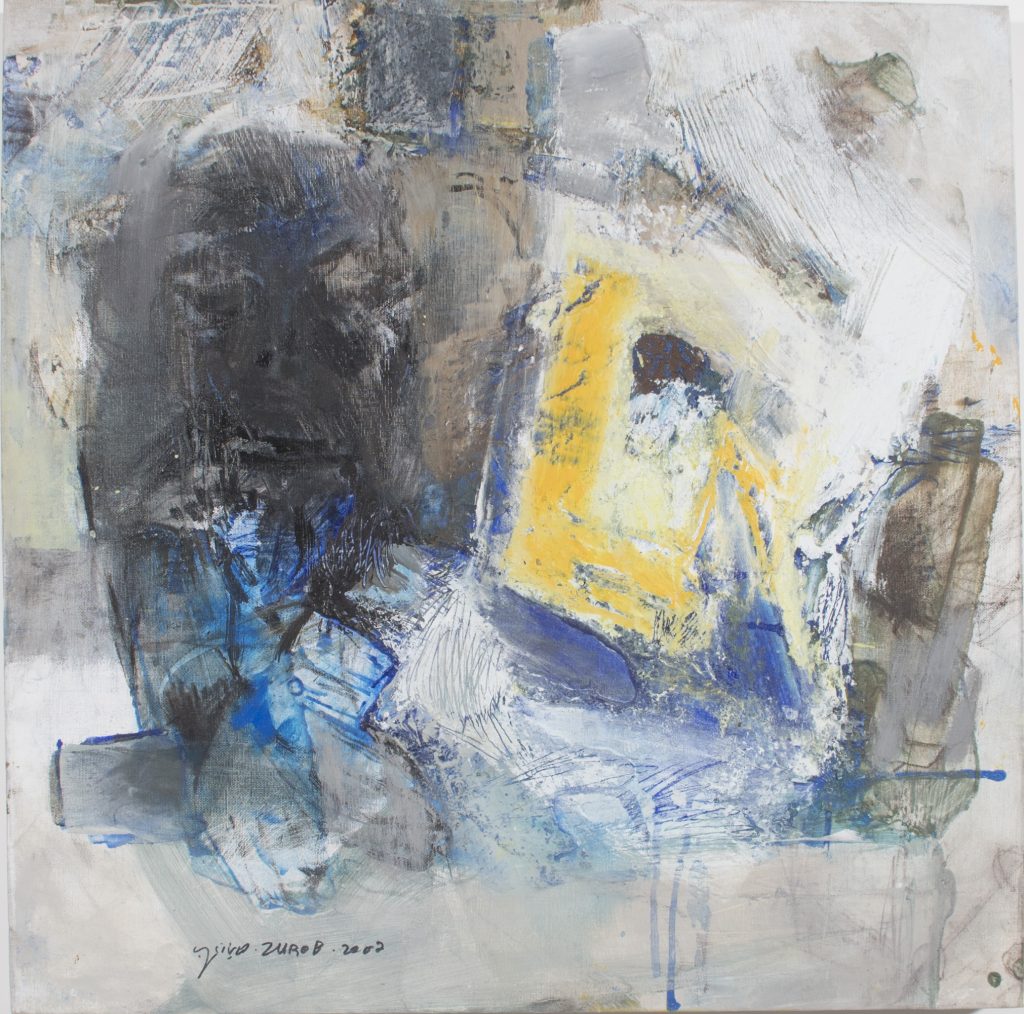
Hani Zurob (Palestine), Marble’s War #05, 2007.
My Palestinian friends in Gaza, meanwhile, tell me that they have survived bombardment before, and that they are sure they will be able to rebuild their homes. What is harder to rebuild, they said, is the Palestinian people’s confidence in their collective political life and the hope that it will lead to a better future. Interrupted education, untreated illnesses, repeated displacement, rampant hunger, and the loss of family networks leave scars that extend far beyond concrete walls. So too does the psychological violence inflicted on Gaza’s children, almost all of whom, according to UNICEF estimates, will require mental health and psychosocial support for decades to come.
Buildings can be reconstructed, but Gaza’s people require the reconstruction not only of place but of historical time itself: the time needed to learn, heal, mourn, organise, and imagine a future. To recover that future, they will also have to rebuild political confidence and the political instruments through which collective hope becomes collective power.
In an attempt to foreclose the future of the Palestinian people, Israel also attacks their past. The ferocious assault on Gaza alongside the continued displacement campaign in East Jerusalem and the West Bank is accompanied by the systematic destruction of memory. Israeli violence surgically targets archives, cemeteries, family photographs, galleries, libraries, municipal records, museums, neighbourhood landmarks, and theatres. Violence against these institutions tries to erase the material foundations through which a people remember themselves, allowing historical denial to become fact. There are the dead, and there are the injured, but there is also the terrible violence inflicted upon Palestinian consciousness.
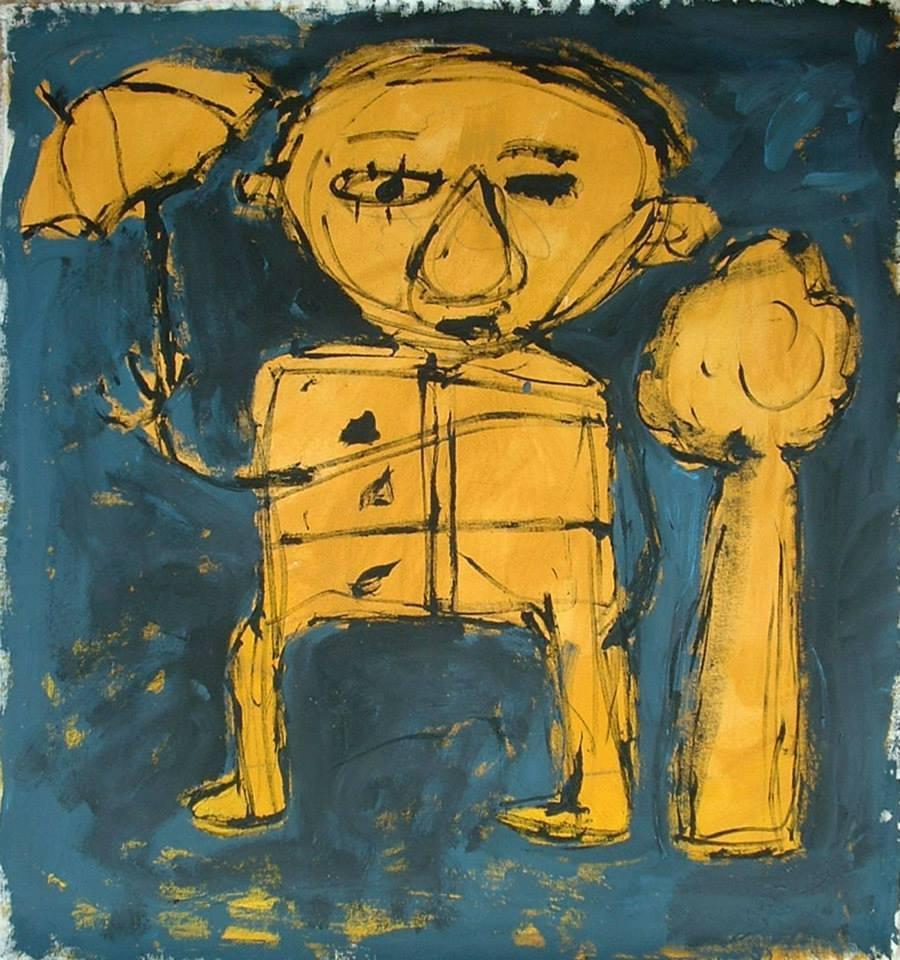
Mohammed Joha (Palestine), A Man and a Tree, 2003.
Perhaps this is one of the reasons why the international conversation on Gaza has become quieter. Not because the violence has diminished in any way, but because its implications are too awful for the world to confront honestly. To confront this violence would mean reckoning with the absolute collapse of a moral order that still claims to speak in the language of human rights. It would mean asking uncomfortable questions about arms sales and transfers, diplomatic protection, media censorship, military alliances, and the unequal value assigned to different human lives. Because of that discomfort, some names disappear before their graves have settled while others become etched in public memory and destruction is forgotten before it unsettles dinner party conversations above the sound of cutlery working its way through the best cuts of meat.
Writers and artists cannot clear rubble with the efficiency of trained rescue teams or lead the reconstruction of hospitals and schools. But we can refuse silence and insist that history is measured not only by treaties and military campaigns but by the lullabies that are interrupted, the poems left unfinished, and the voices that continue to sing through the ruins. Tricontinental: Institute for Social Research has been very clear from our inception a decade ago that the systematic violence inflicted on the Palestinian people and the amnesia about that violence are unacceptable and that we will never allow forgetting to become normal.
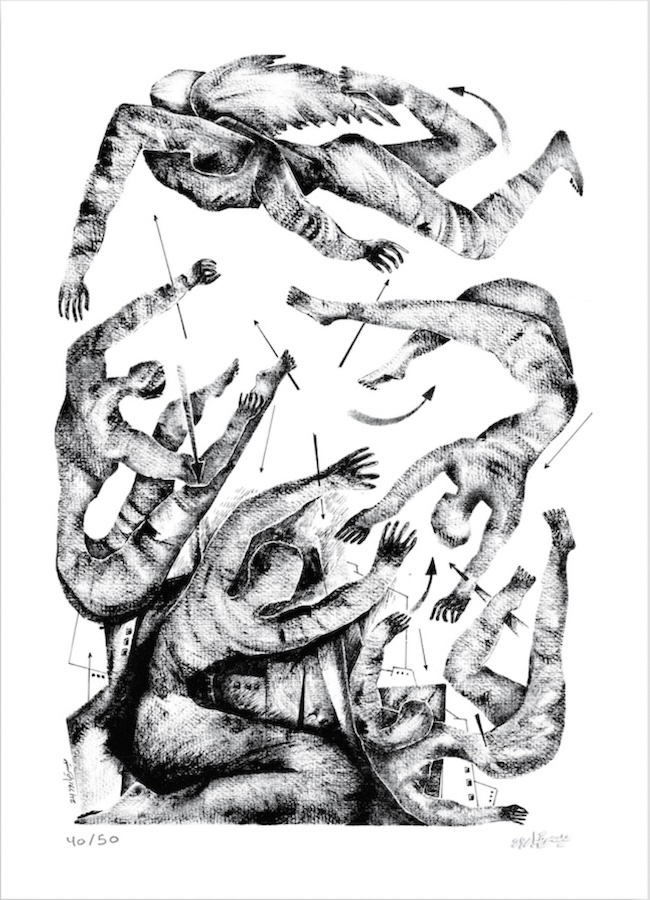
Maisara Baroud (Palestine), I’m Still Alive, 2024.
Watching the new music video from our friends Roger Waters and acclaimed Palestinian singer-songwriter Mona Miari reminds us of this refusal. Their song ‘Comfortably Numb Re-imagined’ does not pretend that music can overcome catastrophe but sets for itself a quieter task: to prevent Gaza’s suffering from becoming ordinary. In a world that is being trained to look away, their song asks us to keep looking and to insist upon remembering as the basis of struggle for a better world. Every imperialist formation seeks not only obedience but forgetfulness. ‘Comfortably Numb Re-imagined’, whose proceeds go to the Palestine Children’s Relief Fund, offers the fragile yet indispensable persistence of human solidarity and a refusal to let the stories of the victims disappear from our moral imagination.
At the centre of the song is ‘Hind’s Lullaby’, a segment written by Mona Miari in honour of Hind Rajab, a six-year-old Palestinian girl killed in Gaza while pleading for rescuers to reach her. The lullaby turns that unbearable memory into a promise of liberation:
| أسمع صوت ملاكٍ يناديني باسمي أحرار باقين أحرار.. باقيين لو من الأرض للسما.. طالعين لابد ان تتحرّر فلسطين | I hear an angel’s voice Calling out my name We remain the free We remain the free Even if exiled from earth to the sky Palestine must be free |
Warmly,
Vijay