

President Xi hosts North Korean premier marking 65th anniversary of mutual defence treaty
Chinese President Xi Jinping met North Korean Premier Pak Thae Song during his 10–12 July official visit to China, marking the 65th anniversary of the Treaty of Friendship, Cooperation and Mutual Assistance. Xi urged both countries to maintain strategic resolve, strengthen strategic coordination and accelerate implementation of the consensus reached with Kim Jong Un during his June visit to Pyongyang. Pak also met Premier Li Qiang and conveyed Kim’s commitment to developing bilateral ties into ‘the strongest strategic relationship,’ while Xi said relations should continue serving both countries’ socialist causes and modernization drives.
Read More:
China, Russia launch joint Pacific patrols after Joint Sea-2026 drills
The week-long China-Russia Joint Sea-2026 naval exercise, held from 6 to 13 July, concluded at a military port in Qingdao, Shandong Province. The twelfth edition of the annual drills since 2012 involved 10 vessels, including surface warships, a submarine, aircraft and support units, focusing on joint responses to maritime security risks. Following a closing ceremony, participating forces formed a joint detachment in the Yellow Sea before beginning annual joint patrols in the Pacific. China said the exercise strengthened strategic mutual trust and both militaries’ capacity to respond jointly to maritime crises.
Read More:

Lithium Battery and Radar Pioneers Win China’s Highest Science Honour as Xi Sets Course for 2035
At an 8 July ceremony in Beijing recognizing 258 projects and 11 experts, Chen Liquan, 86, whose solid-state research helped make China a global leader in the lithium battery industry, and Ben De, whose airborne fire-control radar gave Chinese fighter jets over-the-horizon eyes, each received the country’s top science prize worth 5 million yuan (about US$700,000). Xi Jinping declared the 15th Five-Year Plan period (2026–2030) a critical phase for achieving high-level scientific and technological self-reliance.
Read More:
Medical Paper Fraud Crackdown Names 28 Cases as Two Celebrity Writers Lose Master’s Degrees
The National Health Commission’s 10 July notification detailed penalties for 28 cases of medical research misconduct involving data fabrication, paper trading and guest authorship, with sanctions ranging from multi-year to lifetime bans on state-funded research. Separately, Northwest University and Renmin University of China revoked the master’s degrees of Jia Qianqian and Jiang Fangzhou after internet sleuths exposed systematic copying, extending China’s academic integrity campaign under 2022 investigation rules from medical research into the humanities and celebrity publishing.
Read More:

Five-Year Retail Modernization Guideline Aims to Boost Consumption and Jobs by 2030
Issued by the Ministry of Commerce and eight other departments on 9 July, the guideline promotes community ’15-minute life circles,’ online-offline integration, full-chain digitalization including drone delivery, and support for retailers expanding overseas. The measures form part of China’s broader 2026–2030 economic strategy, which includes maintaining the urban surveyed unemployment rate around 5.5 percent. Four days later, the State Council released China’s first dedicated five-year consumption plan, targeting around 60 trillion yuan (US$8.85 trillion) in annual retail sales by 2030 and positioning domestic consumption as a key driver of long-term economic growth.
Read More:
Bali Breaks Ground on Chinese-Built Waste-to-Energy Plant Set to Power 100,000 Households
Designed to process 1,500 tons of waste daily from the first half of 2028, the US$166 million Denpasar Raya facility will cut carbon emissions by around 640,000 tons annually and create about 1,200 green jobs. Invested in, built and operated by China’s Zhejiang Weiming Environment Protection, the plant is Bali’s first waste-to-energy project and launches the nationwide rollout of Indonesia’s sovereign wealth fund Danantara, planned across 34 urban agglomerations.
Read More:

Grassland Protection Drive Lifts Healthy and Sub-Healthy Area to 180 Million Hectares, 70% of China’s Total
Figures released in Hohhot on 13 July during an event marking the UN-designated International Year of Rangelands and Pastoralists showed that China’s healthy and sub-healthy grasslands have reached 180 million hectares, over 70 percent of the country’s total. During the 14th Five-Year Plan (2021–2025), ecological projects, stronger supervision and subsidy-and-reward policies for sustainable grazing restored more than 3 million hectares of degraded pasture annually, while fresh-grass output exceeded 600 million tons across nearly 267 million hectares of grassland.
Read More:
China Issues Nationwide Heat Alerts as Temperatures Exceed 40 C
On 13 July, China’s National Disease Control and Prevention Administration and Meteorological Administration issued nationwide heat-health alerts as parts of Hubei, Chongqing and Inner Mongolia faced high to extreme risks from Monday night to Tuesday night. The top red-level warning was issued under the national joint health-risk system launched in July 2025. Chongqing opened 44 free cooling shelters and suspended outdoor construction at 40 C, while Wuhan’s power grid hit a record load of 18.11 million kilowatts amid soaring demand.
Read More:

FAST Telescope Reveals First Evidence Low-Energy Cosmic Rays Originate in Star-Forming Regions
The discovery sheds new light on low-energy cosmic rays, particles that play a key role in heating and ionizing dense interstellar gas but are difficult to study directly near Earth. Using hydrogen observations of the Orion molecular cloud and data from NASA’s Fermi gamma-ray satellite, researchers applied a self-absorption technique developed by Tsinghua University’s Li Di to show these particles are produced locally by star-forming activity. The world’s largest single-dish radio telescope also reserves about 10% of observing time for foreign scientists free of charge.
Read More:
Humanoid Robots Perform First Live-Animal Surgeries, Offering Low-Cost Path to Surgical Access
Published in Nature on 8 July, a University of California San Diego preclinical trial showed surgeons remotely controlling two Chinese-made general-purpose humanoid robots to perform two complete gallbladder removals on live pigs. The smaller platforms, a fraction of the size and cost of specialized surgical systems weighing around 1,800 pounds, could help expand robotic surgery to rural and remote communities, potentially improving access to safe and affordable care for underserved populations worldwide.
Read More:
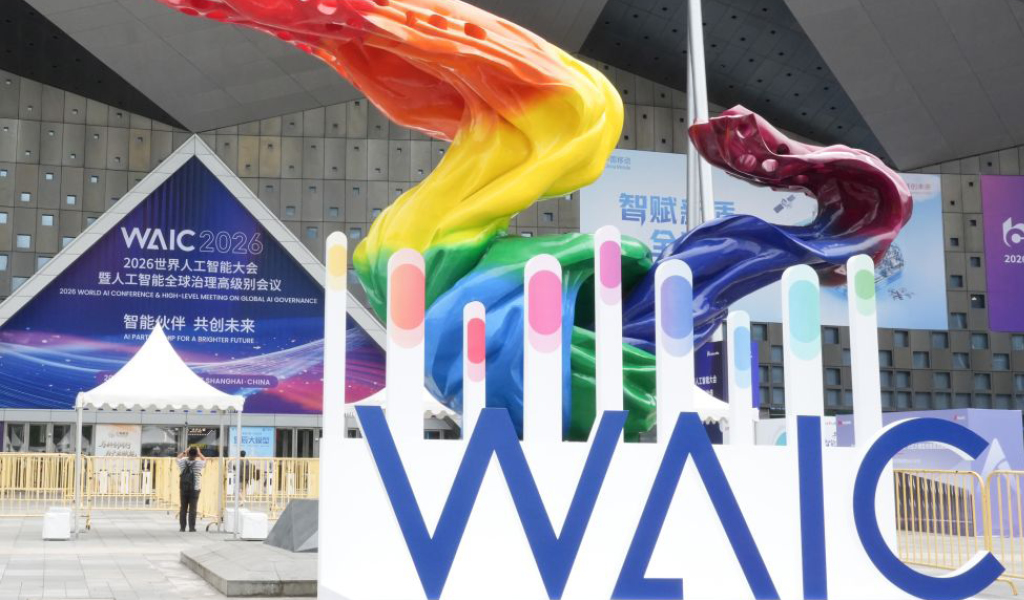
Xi Jinping Presents AI Vision at Shanghai Forum as 29 Countries Back Cooperation Body
Speaking at the World Artificial Intelligence Conference and High-Level Meeting on Global AI Governance in Shanghai from 17 to 20 July, President Xi Jinping, attending the event for the first time, outlined China’s proposals for AI development and governance under the theme “Intelligent Partners, Co-create the Future.” The conference brought together international organizations, governments and researchers, with 29 countries signing an agreement to establish the World AI Cooperation Organization (WAICO). China also highlighted AI training and cooperation initiatives with Global South partners.
Read More:

Nearly 3,000 Treasures from Mexico and Peru Meet Chinese Relics in Largest Americas Exhibition
Opened on 9 July for a 16-month run, the Shanghai Museum’s ‘On Top of the World Tree’ pairs Olmec, Maya, Aztec and Inca masterpieces with Chinese artifacts, a curatorial choice the deputy director of Mexico’s National Institute of Anthropology and History calls ‘a dialogue between two of humanity’s most ancient, intricate civilizations’, carrying China-Latin America cultural exchange to unprecedented scale after the museum’s Egypt show drew a world-record 2.77 million visitors.
Read More:
New Five-Year Health Plan Targets Average Life Expectancy of 80 by 2030, Up from 79.25
Issued by the State Council on 13 July, the blueprint builds on an increase of 1.3 years over the past five years, pursuing further gains through fair access to healthcare, stronger primary-level disease prevention and treatment, and a national smart healthcare platform sharing medical records across provinces – seeking to bring core health indicators in line with high-income economies at the stage beyond 75 years where international experience shows progress slows markedly.
Read More: