Learning from Vietnam’s Struggle for Sovereignty
Fifty-one years after victory over Washington’s war machine, Vietnam faces a subtler assault – sanctions, debt, and covert subversion – and answers with a commitment to peace and development.
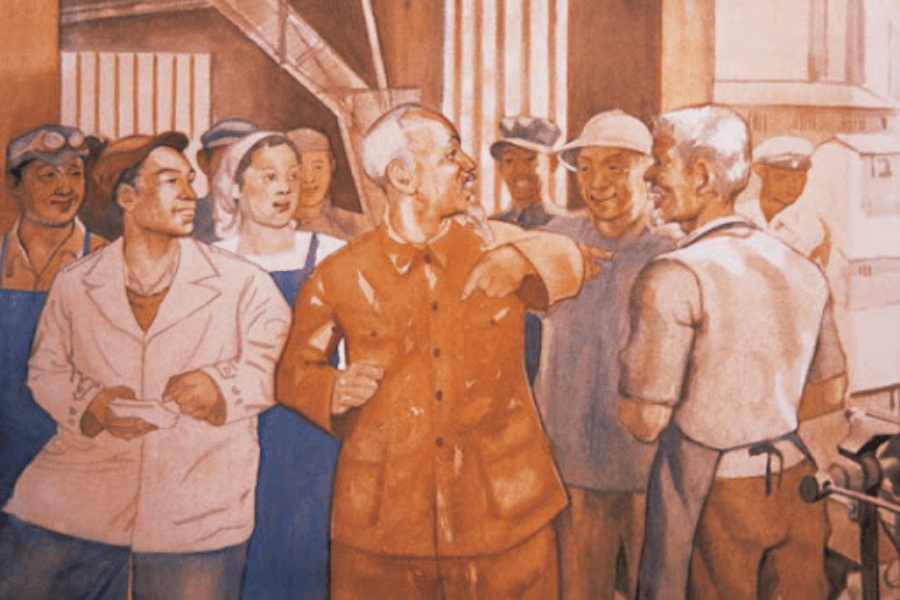
Nguyễn Đỗ Cung (Vietnam), Uncle Ho visiting the Gia Lam machinery factory, 1960.
Dear friends,
On 30 April 1975, Vietnamese communist forces won a great victory in the war of resistance against United States imperialism. Fifty-one years later, the celebration of the liberation of Vietnam and the reunification of our people remains one of the most important days in our calendar – not only for what it commemorates, but for what it continues to teach us.
From 1965 to 1972, the US sent nearly three million troops to Vietnam. By the end of the war, over two million Vietnamese civilians and over one million Vietnamese soldiers had died in the conflict. The brutality and inhumanity of the US against the people of Vietnam is legendary, and we still suffer the consequences. There are over four million victims of the chemical weapon Agent Orange in Vietnam, Laos, and Cambodia – a crime for which the US has never been held accountable.
Economic Coercion
US hegemony is not only built on a sprawling network of military bases, armed conflict, and invasion. It is primarily built through soft power, economic pressure, and diplomatic manipulation. Today, Vietnam is threatened far more by the soft power of Western empire than by the threat of military invasion. This year, the Communist Party of Vietnam officially declared that foreign diplomacy is now as important as military defence to our national security. We know too well that the US, its allies, and its puppets do not need to shoot a gun or launch missiles to interfere in a sovereign nation. Tariffs, sanctions, and fomenting unrest through clandestine counter-revolutionary activity are just as effective as bullets and bombs.
Even though the war ended in 1975, the struggle against US imperialism continues to this day. Right after the war, the US imposed severe sanctions on Vietnam and we became economically isolated, especially as the Soviet Union began to weaken and eventually collapsed. Vietnam was devastated by war. Our civil infrastructure and industry had been bombed into non-existence and we could not trade with most nations. By the late 1980s, Vietnam was on the verge of nationwide famine. Millions of lives were at stake. The USSR was no longer in a position to help.
For these reasons, in 1986, Vietnam launched the policy of Đổi Mới (Renovation). In order to secure financing from the International Monetary Fund, Vietnam allowed limited privatisation and developed a market economy. It was during this time that the US stepped up economic intervention and sanctions against Vietnam. This has been the primary weapon that Western imperialism has used against my people ever since.
In order to normalise relations with the US, Vietnam was forced to pay off the huge debt accrued by the fascist puppet regime that had occupied South Vietnam until 1975. We had to pay the US more than $145 million to compensate them for the very money and weapons used to massacre Vietnamese civilians during the war. Vietnam had no choice but to accept the terms of the empire. It took us over twenty years to pay off that debt. We were paying this unjust war debt to the US until just seven years ago.
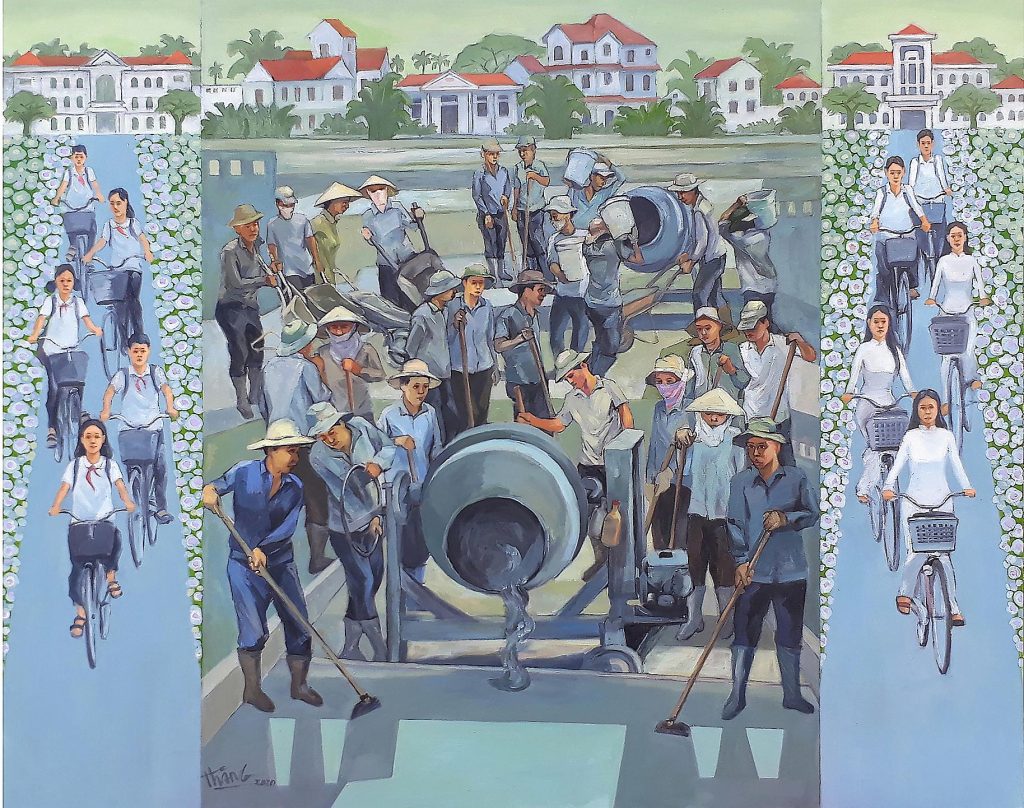
Trần Văn Thăng (Vietnam), Joining hands to build a new countryside, n.d.
Political Subversion
In addition to such economic attacks, the US has also built up its soft power to sabotage Vietnam politically. The US has spent billions, openly and covertly, to back NGOs and outlets such as USAID, Human Rights Watch, Radio Free Asia, and Voice of America to spread misinformation about Vietnam and to seed counter-revolution inside the country. Vietnam is hardly the only nation to suffer such intervention. We all know the chains of colour revolutions in Asia and Eastern Europe in the 2010s, such as the Arab Spring in West Asia and Maidan in Ukraine. These interventions completely changed the political economies of the affected nations and in many cases led to social collapse and devastation. The US would love nothing more than for the socialist government of Vietnam to collapse. From 2014 to 2019, the US backed protests and political sabotage campaigns across Vietnam. Despite the hardship and chaos, all of these colour revolutionary attempts have been defeated due to the solidarity between the people of Vietnam and our socialist government.
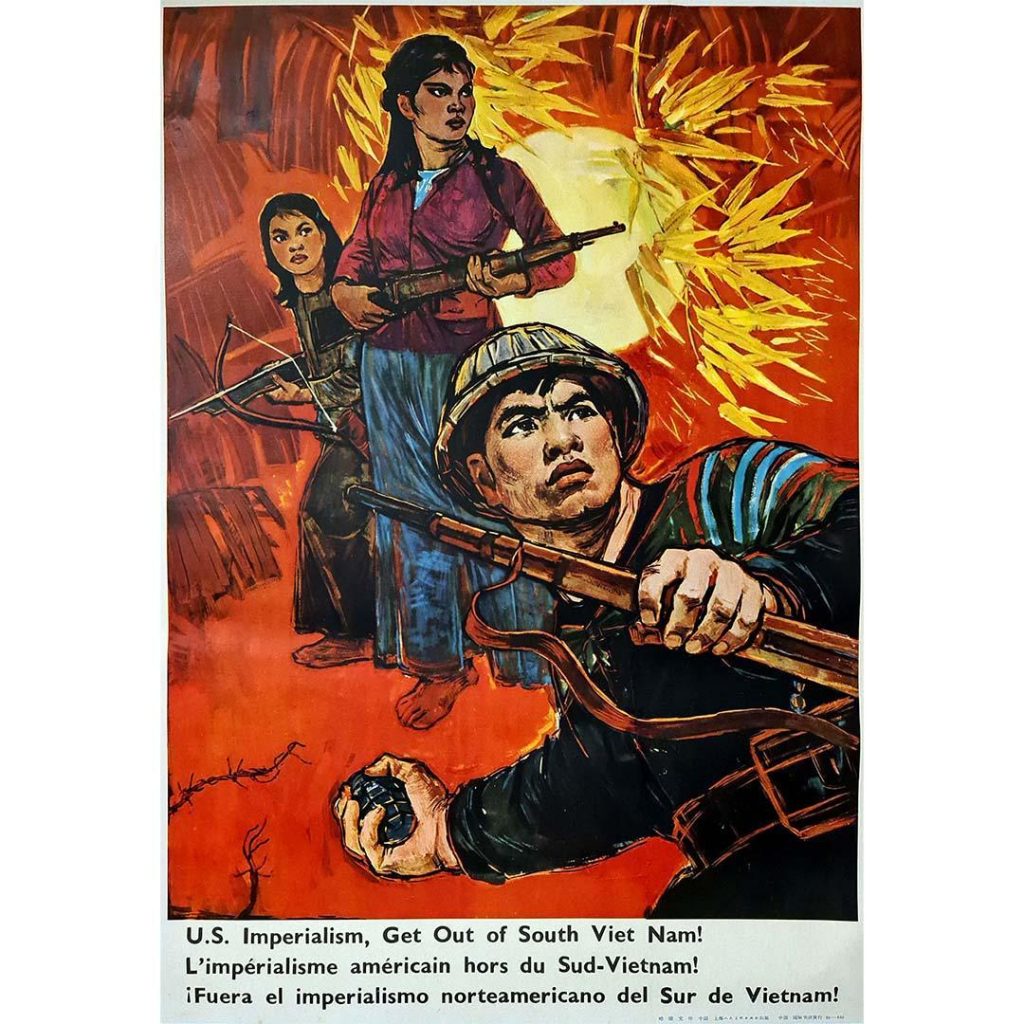
Ha Qiongwen (China), US imperialism, get out of South Vietnam!, 1963.
The Four No’s
Vietnam has had to be resilient and creative in responding to decades of economic warfare and constant schemes from the West. US imperialism is not just about invasions and military force. Economic and political might are also major coercive instruments, every bit as destructive as tanks and aircraft carriers. Because we are constantly under attack, both politically and economically, Vietnam cannot afford to be dragged into a conflict with any other country. In many ways, we are still recovering from the devastation of the war and the comprehensive embargoes, so it is vital that we spend our limited resources on helping our people and developing our economy.
This need for stability and peace has led to a comprehensive package of diplomatic strategies and policies refined since the 1990s, taken together known as Vietnam’s ‘Four No’s’ policy, codified in the Defence White Paper (2019):
- No military alliance with any country. Vietnam has had enough war. We know better than most nations how destructive war is, and we will do everything to avoid being dragged into another.
- No alignment with one country against another. Vietnam does not want to become a puppet of any country, and we do not want to bully any country. Vietnam wants to be a friend to every nation on earth as much as possible.
- No foreign military bases on our territory. Vietnam does not allow any country to put military bases on our territory, and does not allow any country to use part of our territory to wage war on another. As history, and especially the US aggression against Iran, clearly shows, foreign military bases turn host countries into the targets of hostile forces, or at the very least make it difficult to avoid being drawn into wars between other countries. Bases can also become headquarters for intelligence operations used to destabilise nations from within. The fact is that the United States has been pressing us to allow it to put military bases in Vietnam for years, especially naval bases along our coastline. Our answer will always be no.
- No use or threat of force in international relations. Vietnam does not speak with violence; we use negotiation and communication to resolve conflicts of interest. This does not contradict modernising the military or the primary mission of the Vietnamese armed forces, which is to defend the country, including by force when necessary.
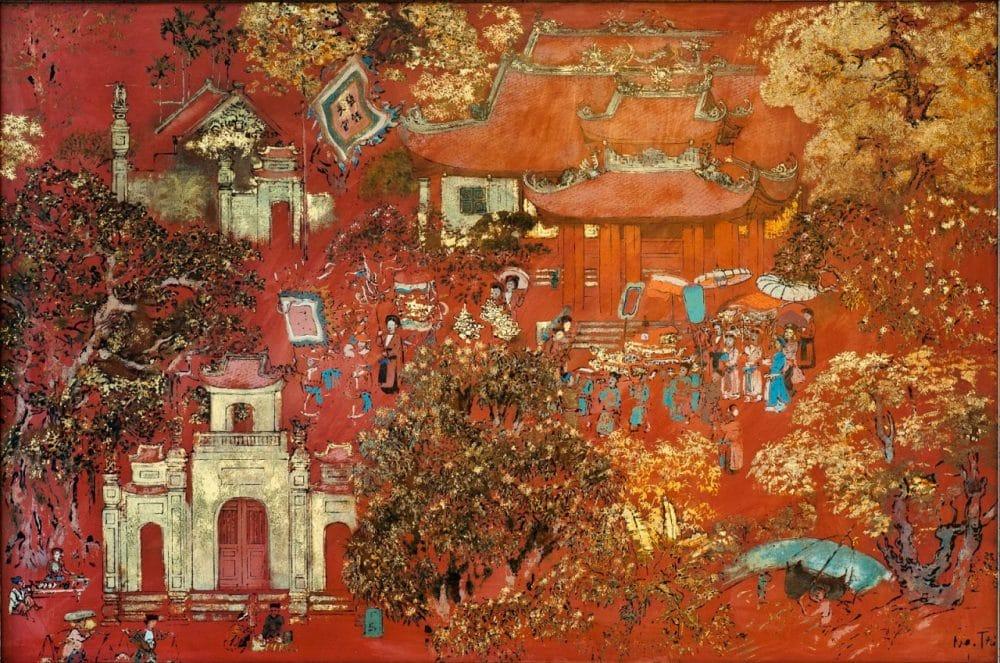
Nguyễn Gia Trí (Vietnam), Northern Spring festival, n.d
The Struggle Continues
Over the past century, so much conflict between our nations in Asia has been stoked by the West. War and conflict are not new to Asia, and some of our nations have had tensions long before the US was even founded. But it is undeniable that the US has leveraged existing conflicts and manufactured new ones to keep Asian nations at each other’s throats instead of working together to build a stronger, more peaceful region. Vietnam is one of the few nations in Asia that has, for the most part, managed to avoid conflict with our neighbours since the 1990s. Things are not perfect, but our ‘Four No’s’ policy has been a relative success, and it is a formula that can be adapted to any nation.
The most important thing for anti-war movements everywhere is to understand the economic base: capital, money, and natural resources. This is the core insight of Marxism-Leninism – once you understand the economic base, you can see through the curtain of lies. The US uses freedom and democracy to dress up aggression. The war on Iran is not about saving anyone; it was about oil and US control of the region.
As Hồ Chí Minh taught us, theory must always come with practice. Step one: learn the truth of capitalism and imperialism. Step two: build your action and your plan. Vietnam did it, Laos did it, Cuba did it, China did it. The struggle continues.
Wherever you are in Asia, whichever nation and culture you come from, I hope you will study Vietnam’s ‘Four No’s’ policy and consider advocating that your own country develop a similar programme. Every nation in Asia should come together to push the US military and intelligence apparatus out of our region. We must not allow ourselves to be further divided and weaponised against one another for the benefit of empire. Hands off Asia!
Warmly,
Luna Nguyễn
Luna Nguyễn (known online as Luna Oi) is a Marxist-Leninist content creator and translator based in Vietnam, where she produces educational content on Vietnamese socialism and anti-imperialism.
Disclaimer: The views expressed by the authors do not necessarily reflect the views of Tricontinental: Institute for Social Research.