

Xi’s First Pyongyang Visit in Seven Years Reaffirms Socialist Ties with Four-Point Plan
Coinciding with the 65th anniversary of the 1961 Treaty of Friendship, Cooperation and Mutual Assistance – the only mutual-defence pact either country maintains – talks in Pyongyang between the two Marxist ruling parties produced a four-point framework spanning high-level exchanges, party and military ties, and practical cooperation in trade, agriculture and science. Xi Jinping pledged that China’s backing for the socialist cause of the Democratic People’s Republic of Korea (DPRK) would remain unchanged.
Read More:
Vice President Han Zheng Promotes Global Governance Reform at St. Petersburg Forum, Backed by 160 Countries
Addressing the plenary of the 29th St. Petersburg International Economic Forum (SPIEF) in Russia on 5 June 2026, the Chinese vice president set out four proposals to advance the Global Governance Initiative (GGI) – genuine multilateralism, stronger United Nations authority, common development under the 2030 Agenda, and coordinated action – framing the reform as a means to expand developing countries’ representation in global affairs. On the sidelines, he also reaffirmed China–Russia coordination during a meeting with President Vladimir Putin.
Read More:

Old House Reclamation Plan Turns 214 Rural Dwellings into Homestays in Henan
Launched in 2018 in Checun, a mountain township in Song County near Luoyang in central Henan province, an old-house reclamation policy channels idle rural dwellings through village cooperatives before leasing them to returning entrepreneurs who convert them into themed homestays. The pilot zone now attracts over 35,000 visitors annually and generates around 20 million yuan (US $2.95 million) in tourism revenue, contributing to rural revitalization efforts through collective management and cultural tourism development.
Read More:
Transport Ministry Conducts Maritime Survey East of Taiwan in Shift to Integrated Waters Management
A four-vessel fleet from maritime safety and rescue agencies in Fujian and Guangdong, together with the Eastern Navigation Service Center and the East China Sea Rescue Bureau, conducted a maritime operation from 6 to 10 June covering 1,030 nautical miles east of Taiwan, China. The mission inspected 198 vessels, surveyed 1,025 nautical miles of seabed and submarine-cable corridors, and checked navigation aids. Authorities described the operation as part of a shift toward integrated maritime management combining traffic enforcement, shipping support, and rescue coordination in the region’s waters.
Read More:

China’s Flexible Employment to Reach 320 Million in 2026, Covering Over 44% of Workforce
Spanning platform and gig work, freelancing, self-employment and a growing segment of digital content creators and micro-entrepreneurs, China’s flexibly employed workforce is projected to reach 320 million workers in 2026, according to analysis by Nanyang Technological University. This would account for over 44% of total employment. Authorities currently describe the sector as an “employment reservoir” that helps absorb labour-market pressures, supported by emerging national labour protection policies aimed at improving conditions across non-standard forms of employment in the expanding digital economy.
Read More:

Ocean Economy Reaches US $1.6 Trillion in 2025, Making Up 7.9% of China’s GDP
Observed around World Oceans Day on 8 June, the sector expanded 5.5% year-on-year in 2025 – outpacing the broader national economy – as intelligent deep-sea farms reached over 98% fish survival, newly connected offshore wind capacity rose more than 60%, and an International Seabed Authority training centre extended deep-sea expertise to 120 specialists from over 40 developing nations, with a sector development index climbing 2.2% to 128.8.
Read More:
Annual Bulletin Logs Record-Low PM2.5 of 28 Micrograms as 14th Five-Year Plan Closes
Released by the Ministry of Ecology and Environment on 5 June, the country’s annual ecological status report logged broad-based improvement across air, water and land in 2025, with good-quality surface-water sections reaching 91.4%, 246 cities meeting national air-quality standards and forest coverage at 25.09%, capping the environmental targets set under the 14th Five-Year Plan (2021–2025).
Read More:

China Reportedly Plans US $295 Billion Network of Green-Powered AI Data Centres by 2028
Agencies led by the National Development and Reform Commission (NDRC) are drafting a blueprint that would reportedly channel around 2 trillion yuan (about US $295 billion) over five years into a unified national computing system by 2028, building on existing green-data-centre rules requiring average power-usage effectiveness below 1.5 by 2025 and renewable-energy utilisation to rise 10% annually, steering compute toward renewable-rich western regions.
Read More:
World’s First AI Aerosol Forecasting System Open-Sourced, Predicting Sandstorms in 36 Seconds
Developed by the Chinese Academy of Meteorological Sciences under the China Meteorological Administration, the system generates a full five-day global forecast more than 100 times faster than traditional physics-based methods, running on graphics processing units rather than the supercomputer clusters those methods require, and has accurately predicted over ten major dust events across northern China since late 2025 before being released openly under a Creative Commons licence as a low-cost solution for developing countries.
Read More:

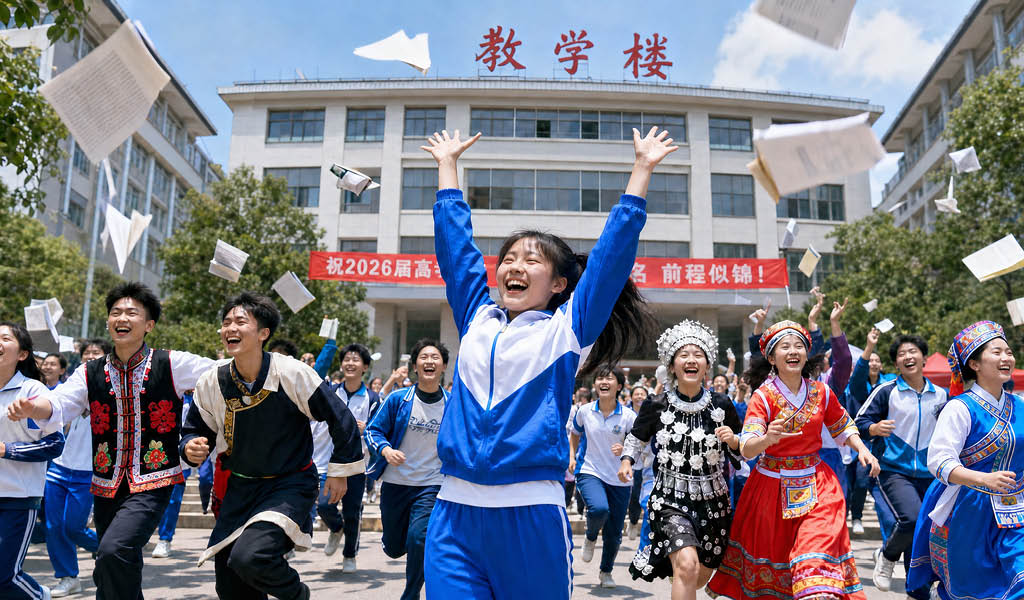
Gaokao (高考), China’s National University Entrance Exam, Offers Fair Path to Opportunity as 12.9 Million Sit Test
Opening nationwide on Sunday 7 June 2026 and running two-to-four days depending on the province, the standardised written exam tests three compulsory subjects – Chinese, mathematics and a foreign language, usually English – and decides admission largely by the provincial ranking of a candidate’s total score, an anonymous contest insulated from interviews, connections or ability to pay that hands rural and poverty-region students a fairer ladder, reinforced by a special-enrollment plan that lifted their key-university places to 131,000 by 2021.
Read More:
Ministry of Education Adds 38 Undergraduate Majors in AI, Chips and Low-Altitude Economy
The updated national catalogue, which now spans 883 majors across 13 disciplinary categories and for the first time establishes a standalone ‘Interdisciplinary’ grouping, maps emerging fields such as embodied intelligence, semiconductor process and equipment, and the low-altitude economy directly onto the 15th Five-Year Plan, with the revisions re-publicised days before 12.9 million candidates sat the gaokao on 7 June.
Read More: