Iran and the Shield That Became a Bullseye
The foreign military bases sold to Persian Gulf monarchies as protection have instead pulled them into a war they never chose – turning their own territory into the first target struck when retaliation arrives.
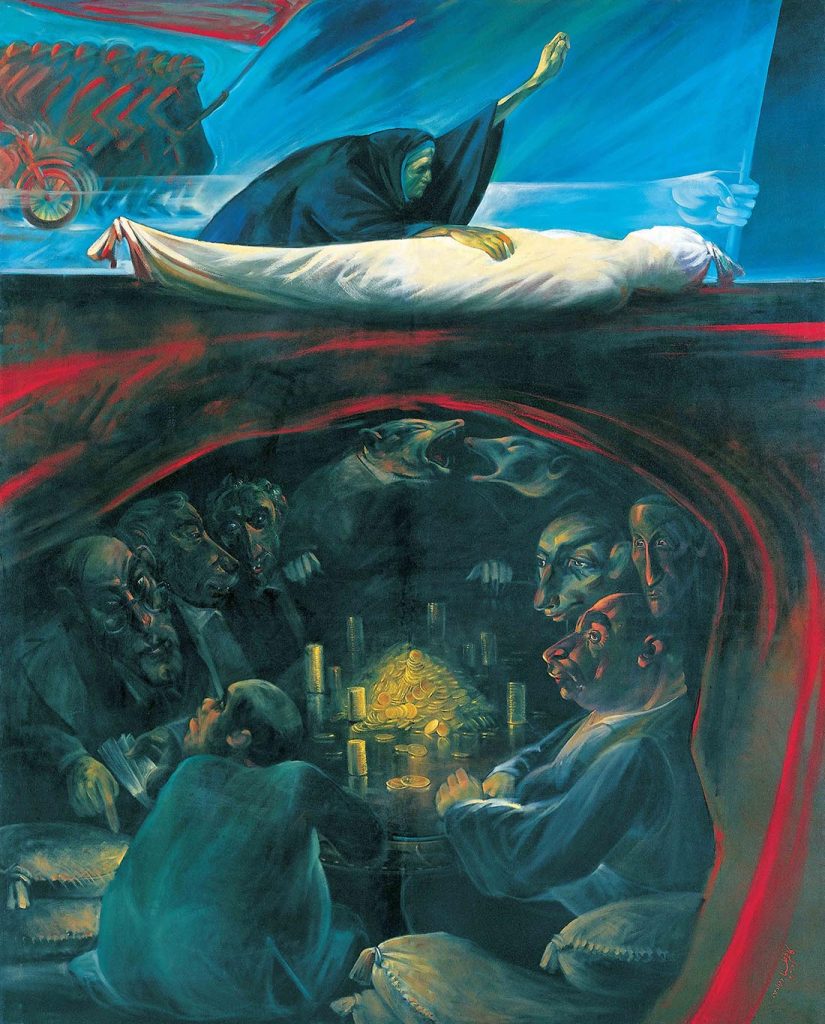
Kazem Chalipa (Iran), Desert, 1984.
Dear friends,
I write from Isfahan, the third-largest city in Iran and the second-most impacted by the recent war. Since the ceasefire on 8 April 2026, we Iranians finally got a break from fighter jets flying overhead and explosions through day and night, from wondering whether our loved ones were safe.
Iran came under attack from US military and occupation bases hosted by family monarchies around the Persian Gulf. The United Arab Emirates, Bahrain, Kuwait, Qatar, and Saudi Arabia provided their airspace and their land to US assets and military facilities. They have spent billions of dollars on so-called defence systems from the United States, wishfully thinking these would protect them from any potential attack. The way this has worked is that the US has always tried to divide and conquer by portraying Iran – both to the world and to the Persian Gulf countries – as a threat to security. By doing so, it has convinced these monarchies to buy weapons and defence systems and to enter into security pacts with the United States.
This war is a turning point in the history of not only the region but the history of the US as a hegemon and imperialist power. The myth of US bases as shields has been challenged in a way that cannot be ignored.
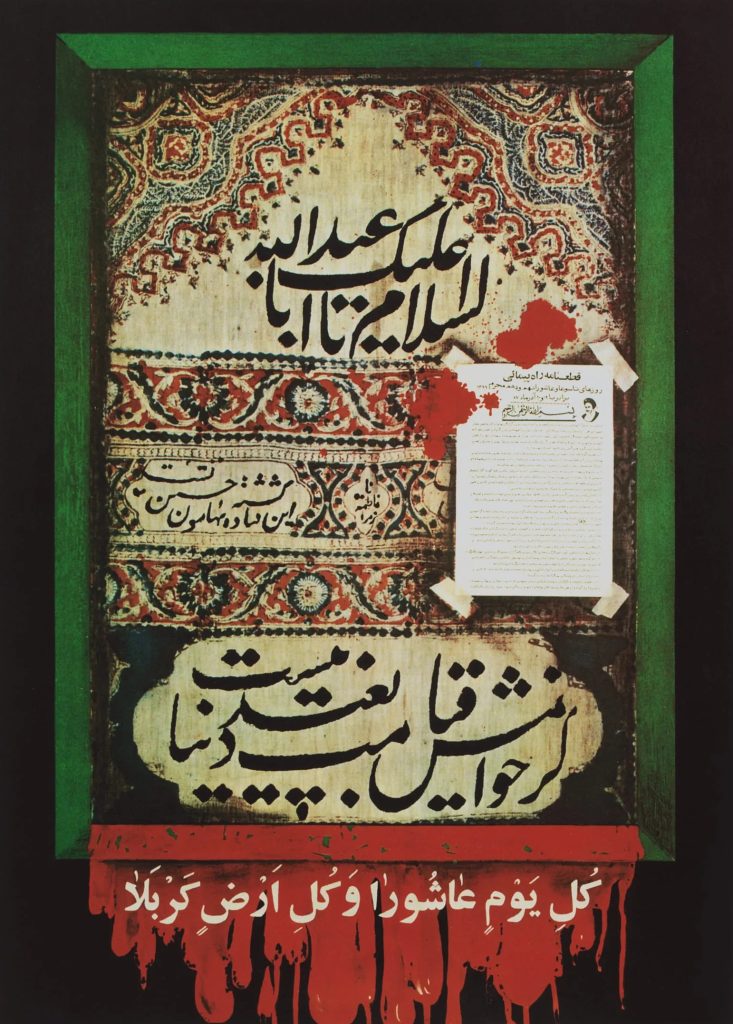
Mohammad Reza Ghaderi (Iran), Every day is Ashura and every land is Karbala, n.d.
Defence or Escalation?
Hosting US military facilities has been sold as protection. In practice, it transforms Persian Gulf states from ‘protected partners’ into exposed forward positions – high-value targets in any confrontation. This war has been about Iran, but the logic applies to any country the US desires to attack, whose retaliation then strikes those bases. Protection has turned into exposure. US bases do not simply deter conflict; they import conflict. By embedding Persian Gulf states in Washington’s military architecture, these facilities narrow diplomatic manoeuvre, invite retaliation, and make civilian infrastructure vulnerable to spillover. The promised shield – security guarantees, rapid response, deterrence – becomes a bullseye.
These fixed military facilities become visible targets, especially given Iran’s military doctrine, which relies on missiles and drones rather than fighter jets. Iran has produced and can continue to produce thousands of drones – affordable, easy to deploy, and capable of bypassing security and defence systems. The host states have lost their autonomy. They have lost their sovereignty. By hosting US bases, they became tied to US escalation choices. They did not have a choice about whether to take part in this war; by hosting those bases, they had already taken a side.
The Persian Gulf states host a dense network of US occupation facilities: Al Udeid Air Base in Qatar, the United States Fifth Fleet headquarters at the Naval Support Activity Bahrain, and installations in Kuwait, UAE, and Saudi Arabia. These bases and assets are framed as deterrents against Iran, yet their geography places host societies right beside command centres, runways, ports, radar systems, and fuel depots – precisely the assets that become initial targets when retaliation comes. These so-called allies, who are complicit in the killing of Iranian civilians, become legitimate targets. The host country does not merely host the shield; it hosts the target set.
US occupation facilities have endured more than 170 attacks since October 2023. The full damage sustained by the United States is far greater than initially acknowledged – US officials have privately estimated the true cost at closer to $50 billion, roughly double the Pentagon’s public figure. Censorship has been heavy. People – including Western citizens – have been arrested in the UAE, Kuwait, and elsewhere for filming the aftermath of Iran’s responses. The pattern is not accidental: foreign bases operate as tripwires. Specific targets have included Al Udeid in Qatar, the Fifth Fleet headquarters in Bahrain, and Prince Sultan Air Base in Saudi Arabia. Many of the radar systems the US had boasted about as invincible have become sources of vulnerability for these family monarchies.
A Chatham House analysis identifies the flawed bargain: Persian Gulf regimes trade sovereignty and flexibility for a security umbrella that asymmetric threats can easily bypass. When Iranian drones and missiles started hitting US targets, the US could barely defend itself, let alone protect the hosting countries. That has been one of the complaints these regimes have voiced – that the US has, in effect, abandoned them. Because of these security pacts, they have neither the sovereignty nor the capability to defend themselves. The structure of the base bargain produces a strategic inversion: what appears as insurance functions as a liability when the country targeted by the US strikes the infrastructure that enables US operations. The slogan ‘a pact with the US will save you’ has been shattered. These bases have become massive bullseyes, and they have created a problem for the region in which host governments cannot de-escalate independently while hosting and facilitating escalation against other suffering nations.
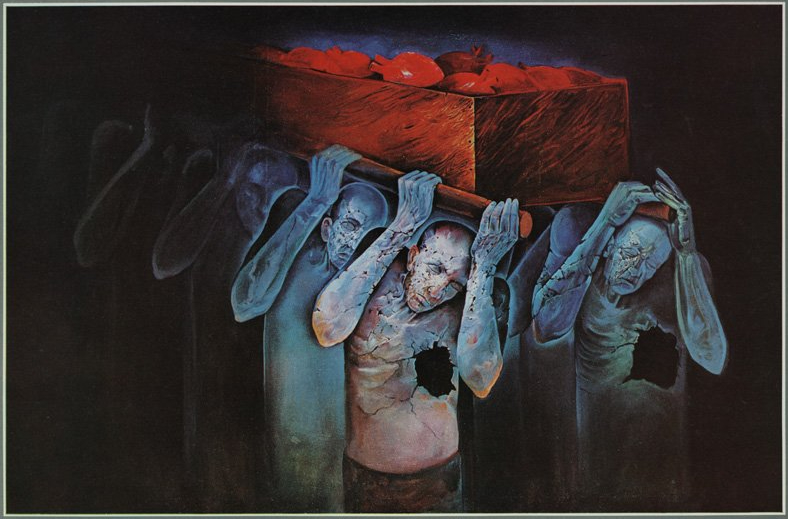
Habib Sadeghi (Iran), A Funeral for Hearts, n.d.
Orientalism and Hyperreal Enemies
The foundation of all of this is ideological. In an article I wrote with Christopher Weaver, ‘Hyperreal Warriors and Orientalist Foes’, published in Middle East Critique just after the 12-day war of June 2025, we observed how the orientalist depiction of Iran portrays it as an irrational actor who is a permanent threat to the US, the Zionist entity, and the Persian Gulf states. In fact, these orientalist tropes serve the imperialist depiction of Iran in order to convince countries in the same region to enter into pacts and become complicit partners in US crimes. On the other side of this orientalist depiction is a ‘hyperreal enemy’ who cannot be defeated, who is invincible, and from whom only a pact with Washington can save you. Both sides of that spectrum serve the same narrative war.
The imperial playbook is repetitive and predictable. They keep saying that ‘Iranians chant death to America’, or that the US wants to liberate women. In fact, US animosity towards Iran did not start with the 1979 revolution. It started well before, when in 1953 the CIA orchestrated a coup d’état against the democratically elected Prime Minister Mohammad Mossadegh – not because he was an ayatollah or chanted against the US (he was secular) but because he wanted to nationalise Iran’s oil. That is the true source of US hostility to other nations.
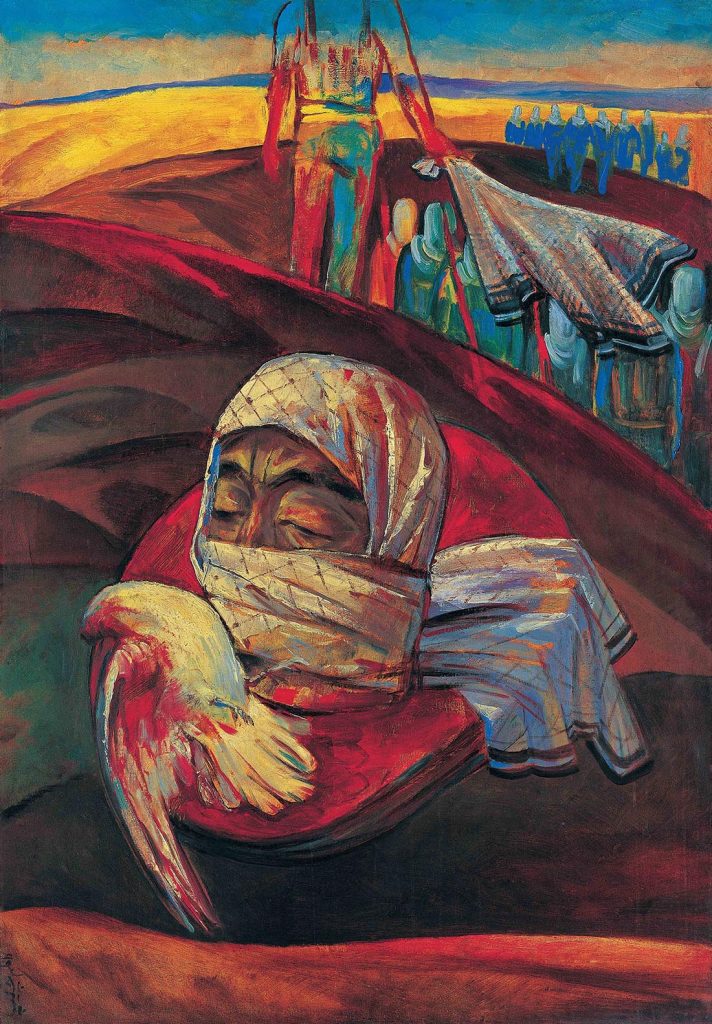
Kazem Chalipa (Iran), Untitled, n.d.
From Dependency to Sovereignty
There is no single response to capitalism and imperialism. Iran is an example of incorporating indigenous cultural values and ideology into a strong response. To understand the resistance coming from Iran, it is necessary to learn about Shia theology, with its tenets of social justice and dignity. Iran has made it clear: we will not negotiate at gunpoint, and we will fight to the last Iranian, but we will never surrender to imperial power. Our slogan is no to humiliation. The reason Imam Ruhollah Khomeini called the US regime the ‘Great Satan’ is not only rhetorical. It comes from lived experience: Satan is deceptive, evil, and breaks promises. We have seen how the US attacks Iran during negotiations and breaches international deals. The world is waking up. We must educate people about different models of resistance and find indigenous responses rooted in our own values. Iran has been under brutal sanctions for four decades, and still it is bringing the imperialist power to its knees.
US bases import war. They make host territories militarily relevant in confrontations that the host may not control. Deterrence myths obscure vulnerability. Missiles, drones, and asymmetric tactics bypass the supposed shield. Neutrality is the real strategic asset. Persian Gulf security requires de-escalation, sovereignty, and regional diplomacy – not deeper dependence on forward basing. Security requires distance from the imperialist power, not dependency on it. Who benefits from this base architecture, and who absorbs the consequences? Once we answer that, it becomes clear who actually benefits from any pact with the US. These bases must be removed from the region, and the peoples of the Persian Gulf and Asia should join hands with the Iranian people to ensure their removal.
Warmly,
Dr. Setareh Sadeqi
Dr. Setareh Sadeqi is an assistant professor at the Faculty of World Studies, University of Tehran. She writes on orientalism, US imperialism, and the geopolitics of West Asia.
Disclaimer: The views expressed by the authors do not necessarily reflect the views of Tricontinental: Institute for Social Research.