
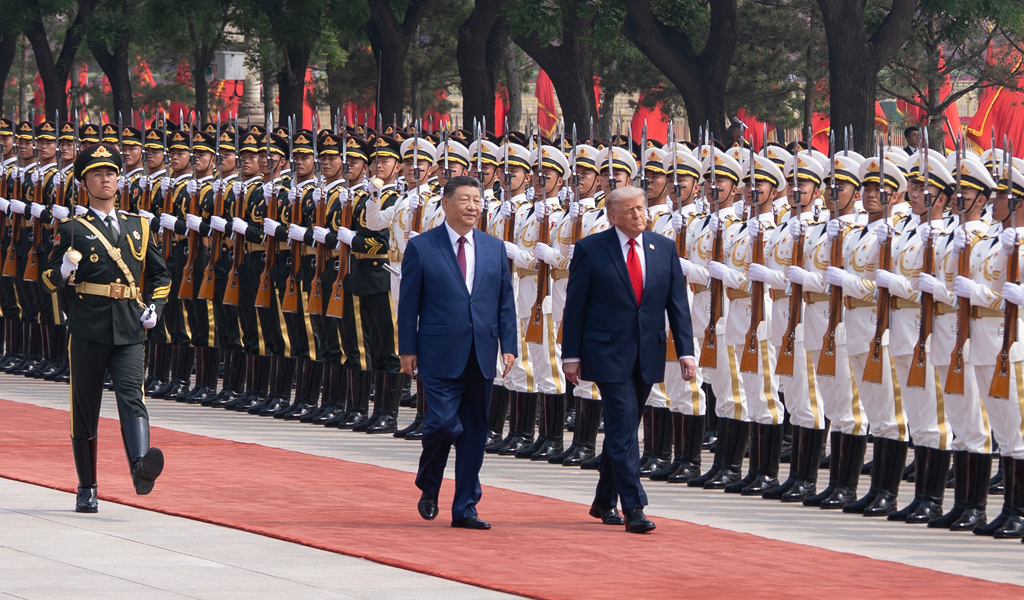

Xi Warns Taiwan Could Trigger Conflict During Beijing Summit With Trump
During a summit held on 14 May 2026 at the Great Hall of the People in Beijing, Chinese President Xi Jinping warned U.S. President Donald Trump that the Taiwan question remains the most dangerous issue in bilateral relations and could lead to “clashes and even conflicts” if mishandled. While both sides expressed support for a more “constructive and strategically stable” relationship, major disagreements persisted over sanctions, military activity in the Asia-Pacific and restrictions targeting Chinese technology companies. The meeting also exposed tensions surrounding Iran and the Strait of Hormuz amid growing instability in the Middle East.
Read More:
US Sanctions Chinese Firms Days before Xi-Trump Summit
On May 8 and 9, days before U.S. President Donald Trump’s visit to China from May 13 to 15, Washington announced new sanctions and export restrictions targeting Chinese companies, increasing pressure on the country’s technology sector. The measures affected firms linked to semiconductors, satellite technologies, and trade networks associated with sensitive exports, including operations related to Iran. Combined with existing U.S. technology restrictions, these actions intensified pressure on Chinese firms. Beijing criticized the sanctions as unilateral. The issue was one of the main topics discussed during the meeting between Xi Jinping and Donald Trump in Beijing.
Read More:

From Wenchuan to Xizang: BeiDou and Wing Loong UAVs Mark China’s Saturated-Rescue Era
Memorial ceremonies on 12 May 2026 at the Xuankou Middle School ruins in Sichuan marked 18 years since the 2008 Wenchuan disaster, with the intervening years transforming improvised mobilisation into a saturated, technology-enabled rescue posture: when a magnitude-6.8 quake struck Xizang in January 2025, the Wing Loong-2H drone surveyed the epicentre and helped pull 407 trapped people out within 24 hours, while a BeiDou satellite messaging service launched in February 2026 across the three Chinese telecoms and 60 smartphone models.
Read More:

Xi–Trump Summit Sees Boeing China Order Reduced to 200 Jets, Sending Shares Down 4%
Vice Premier He Lifeng and U.S. Treasury Secretary Scott Bessent held around three hours of closed-door consultations in Seoul on 13 May ahead of the meeting between Xi Jinping and Donald Trump in Beijing. The talks addressed a potential managed-trade framework still under negotiation, with references to a reciprocal package of around US$30 billion in non-sensitive goods, alongside continued restrictions on advanced semiconductors and strategic sectors. Trump told Fox News that Xi had agreed to purchase 200 aircraft, below earlier reports of up to 500 jets, prompting Boeing shares to fall about 4% as investors reassessed expectations around the deal.
Read More:
CCTV Secures 2026 World Cup Rights with FIFA at US$60 Million, Below Asian Benchmarks
On 15 May, China Media Group (CMG), the state broadcaster controlling CCTV, and FIFA signed a broadcast rights deal for the 2026 World Cup worth US$60 million, below Japan’s level and the previously reported US$80 million ceiling cited by CCTV itself. The agreement comes as FIFA reviews its pricing strategy in China following the exit of major streaming platforms from premium sports distribution. The withdrawal of players such as Tencent and iQiyi has reduced domestic capacity to absorb sublicensed fees, weakening the market structure. Asian benchmarks show Japan paying up to US$200 million and Thailand around US$14 million.
Read More:

Solar-Drip System Triples Cotton Yields and Cuts Water Use by 30% in Uzbekistan’s Aral Sea Region
Researchers from the Chinese Academy of Sciences’ Xinjiang Institute of Ecology and Geography (XIEG) have spent three years deploying photovoltaic-powered fertigation systems on cotton plots near Nukus in Uzbekistan’s Aral Sea region. The system combines solar panels with drip irrigation, using solar-generated electricity to pump and deliver water and fertilizer directly to plant roots, improving efficiency in arid conditions. The project has tripled yields to nearly five tonnes per hectare while reducing water use by around 30%. It also includes the transfer of more than 200 salt- and drought-resistant plant species to Uzbekistan. The cooperation began after a 2018 request following a severe salt-dust storm and is framed under the Global Development Initiative.
Read More:
Xining Launches Cold-Climate Vegetable Brand to Supply 200,000 Tonnes to Greater Bay Area
Xining, capital of Qinghai province on the northeastern Tibetan Plateau in western China, has launched a cold-climate vegetable brand aimed at supplying around 200,000 tonnes to China’s Greater Bay Area. The initiative marks a shift from raw-product exports to higher-value branded agricultural supply chains. In 2025, plateau cultivation reached 17,467 hectares, up 6.6% year-on-year, with output of 714,600 tonnes, an increase of 8.1%. The expansion was supported by more than 800 million yuan (US$111 million) invested in greenhouses, water-fertiliser systems and cold-chain logistics. The initiative was launched on 8 May with distribution hubs in Dongguan.
Read More:

China and UNESCO Launch Three-Year Plan to Train Global South Teachers in Digital Skills
China has launched a three-year plan aimed at strengthening the digital skills of Global South teachers in cooperation with UNESCO. The initiative was unveiled on the closing day of the 2026 World Digital Education Conference in Hangzhou by the Africa division of Zhejiang Normal University’s Institute of Global Teacher Development. It is aligned with UNESCO’s Global Teacher Campus and will be delivered through Confucius Institutes and Luban Workshops, with pilot “lighthouse schools” established in two to three host countries. The program is positioned as an initial response to UNESCO’s projection of a global shortage of 44 million teachers by 2030.
Read More:
Tianzhou-10 Launches First In-Orbit Study of Stem-Cell Embryo Models in Space
Tianzhou-10, a Chinese cargo spacecraft used to resupply the Tiangong space station, has begun what is described as the first in-orbit culture of stem-cell-derived human embryo-like models aboard China’s orbital laboratory. The experiment, led by Yu Leqian of the Chinese Academy of Sciences’ Institute of Zoology, was launched from Wenchang on 11 May. It does not involve fertilised embryos, but stem-cell structures that mimic early human development stages between days 14 and 21 after fertilisation. Samples will be cryogenically returned after five days to study how microgravity and cosmic radiation affect early cellular development in space conditions and biological processes.
Read More:

Pang Dong Lai Worker Ballots Turn “Fairness” Into Operational Governance System
Pang Dong Lai, a privately owned retail chain based in Henan province in central China, has used worker ballots to redefine its internal governance by turning its stated principle of “justice” into an operational system. The retailer says the model allows frontline employees to continuously raise the thinking, competence and governance quality of their superiors. In the April 2026 appraisal cycle, anonymous ballots cast by 16,675 of 16,676 eligible workers resulted in the demotion of 19 out of 1,455 managers and the dismissal of one. Conducted twice a year, the process frames managerial authority as a continuously verified responsibility within the company’s internal accountability structure and governance framework.
Read More:
Sino-German Police Cooperation Helps Dismantle Telegram Abuse Network; Ringleader Jailed in Frankfurt
A Sino-German police cooperation channel helped dismantle a drug-facilitated sexual abuse network operating via Telegram, resulting in the sentencing of its ringleader to 14 years in prison in Frankfurt. Between 2020 and 2024, the group allegedly used fake rental listings on WeChat and Xiaohongshu to recruit Chinese women into a Telegram network with around 4,500 peripheral members. German investigators received verified leads in November 2024 through China’s Ministry of Public Security International Cooperation Bureau, following an alert from the Chinese Consulate in Frankfurt, which contributed to the subsequent arrest of the suspect.
Read More: