Africa Was Not the Periphery of the Anti-Fascist War
Africa was not the periphery of the anti-fascist war. From Ethiopia’s defiance of Mussolini to the Thiaroye massacre, Africans fought fascism abroad and empire at home — laying the foundations of post-war liberation and sovereignty.
Ousmane Sembène’s 1988 classic Camp de Thiaroye opens with a scene that encapsulates colonial contradiction. It is 1944. African soldiers – the Tirailleurs Sénégalais – return home from the battlefronts of Europe, having fought to liberate France from fascism. Crowds cheer, drums beat, families strain to glimpse their sons. Yet when Sergeant-Major Diatta asks after Effok, his Casamance village in Senegal, the silence that greets him is devastating. His relatives turn away. A French general steps forward with a practised smile, speaking a phrase in the local tongue as he extends his hand to Diatta’s uncle. The old man refuses to take it.
In that moment – a single, withheld gesture – Sembène captures the moral ledger of empire. The war had ended in Europe, but its logic persisted in Africa. Effok was not merely a village; it was a ledger of wartime requisitions, beatings, and disappearances. The general’s smile is a mask; the uncle’s refusal, a political act. From this quiet defiance to the Thiaroye Massacre that follows, Sembène charts the journey from passive to active resistance against French colonialism – from fighting fascism abroad to confronting it at home.
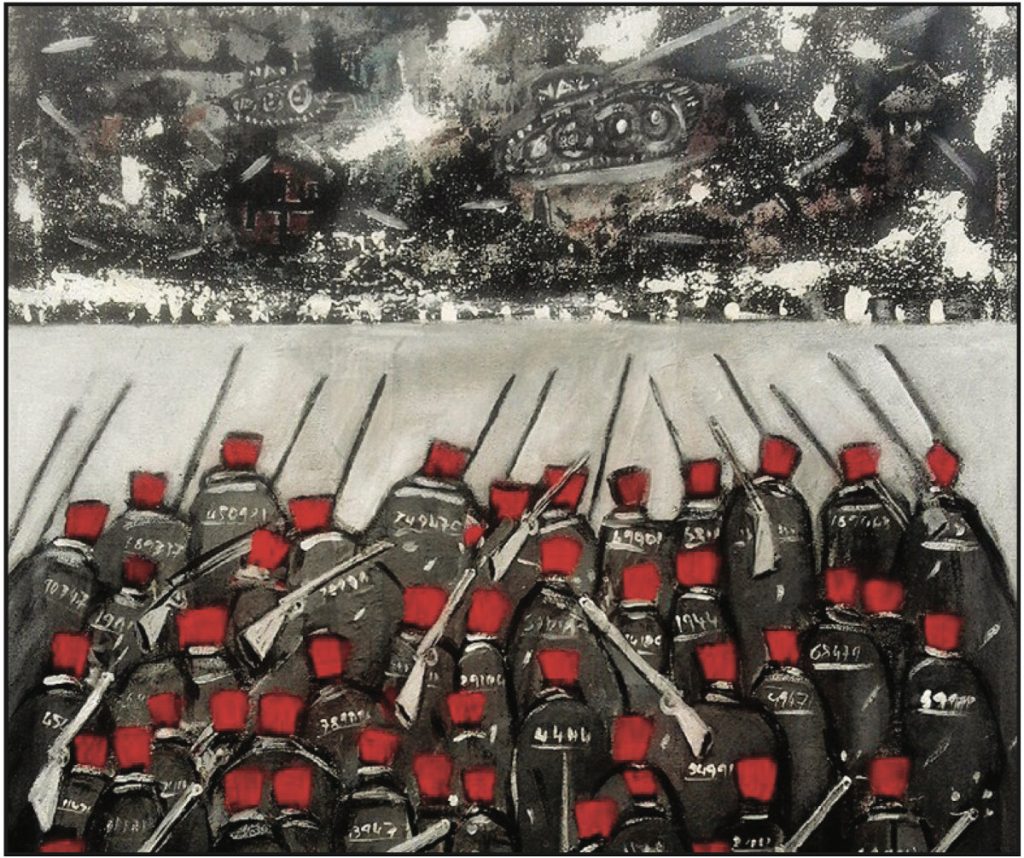
Djime Diakite (Senegal), Apothéose des tranchées (Apotheosis of the Trenches), 2016.
The First Front: Ethiopia Stands Alone
To bring Africa into the story of the World Anti-Fascist War – commonly referred to as World War II, 1939–1945 – is not to add a decorative footnote; it is to correct the record. Long before the Normandy landings, major armed stands against rising fascism took place outside of Europe, as early as 18 September 1931 with the Japan’s imperial invasion of China. The global fight against fascism began not in 1939 in Europe, but years earlier on continents too often marginalised in the historical narrative.
In 1935–36, as Mussolini’s army invaded, raining down mustard gas and chemical bombs in open violation of the Geneva Protocol, Ethiopian patriots – men and women alike -waged a multi-year guerrilla war that exposed fascism as colonialism without disguise. These arbegna (patriots) embodied a refusal that transcended gender, class, and region.
The human cost was immense: more than 750,000 Ethiopian combatants and civilians were killed during the invasion and occupation. In 1937, following an assassination attempt on the Italian viceroy, Italian forces unleashed the Yekatit 12 massacre, killing 30,000 civilians in three days of collective punishment. In the caves of Ametsegna Washa, they gassed and machine-gunned more than 5,500 Ethiopians– one of the largest single massacres of the African theatre and a methodical exercise in terror. Still, resistance never ceased. A third of recorded patriots were women – organisers, fighters, and commanders whose defiance echoed across the continent. Their five-year stand opened a school of resistance, seeded political geography and became a template for anti-fascist and anti-colonial movements that followed.
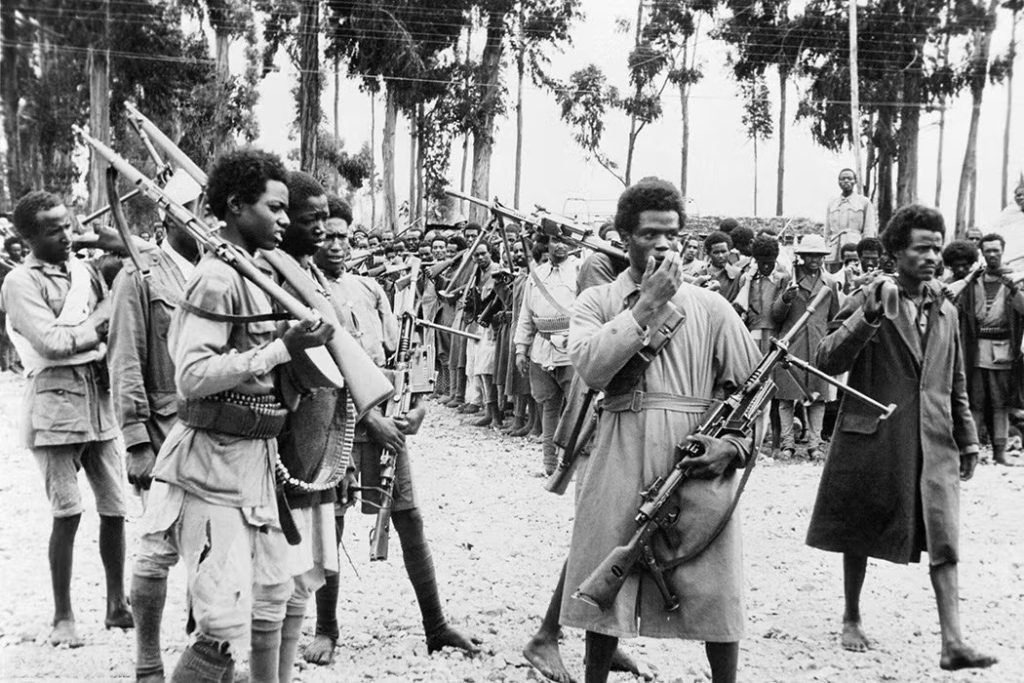
Ethiopians gather in Addis Ababa, heavily armed with captured Italian weapons, to hear the proclamation announcing the return to the capital of the Emperor Haile Selassie in May 1941 via Wikimedia Commons.

The Infrastructure of Victory
As the war spread, Africa became its logistical heart. Its coasts guarded sea lanes; its mines fed the war machine; its workers built the ports, rails, and airstrips that sustained the Allied fronts and enabled ultimate victory. Across the continent, convoys, aircraft, and fuel flowed – powered by African labour, resources, and sacrifice.
African and Commonwealth soldiers broke Italian East Africa at Keren and Amba Alagi, reopening the Red Sea and shattering the Axis empire on African soil. Free French and African troops captured Kufra in Libya, securing a southern flank for the desert war. In the west, Gabon and Dakar became staging grounds for French Africa and gave de Gaulle a territorial backbone and logistics base. Freetown and Takoradi ferried aircraft and guarded convoys that sustained the Middle East and North Africa fronts, even as U-boats hunted those sea lanes. In the Indian Ocean, the seizure of key islands denied the Axis a submarine springboard that could have threatened the Suez Canal and the Mozambique Channel.
Over a million African soldiers served; millions more laboured under coercive and hazardous conditions. In the Congo, uranium extracted from the Shinkolobwe mine – by African workers, many of whom suffered disastrous health effects – fuelled the atomic bombs dropped on Hiroshima and Nagasaki. Africa’s contribution was decisive – material, strategic, and human – yet its people were denied recognition and reward. The empires that claimed to fight fascism abroad maintained its methods at home: racial hierarchy, forced labour, collective punishment.
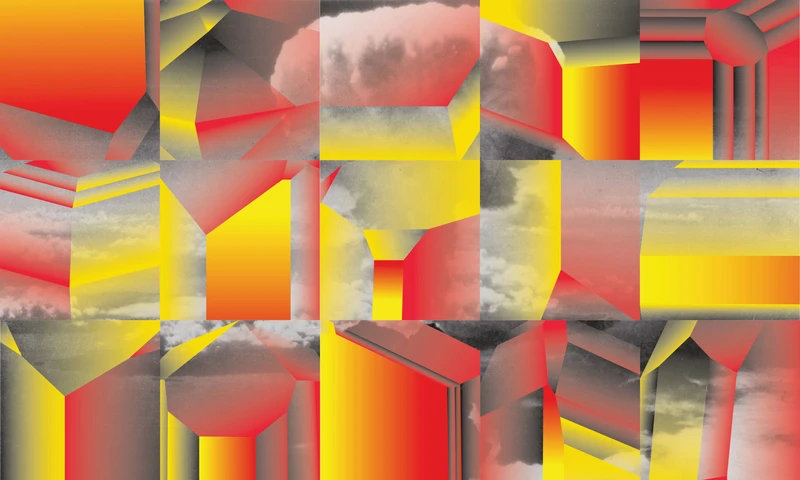
Sammy Baloji (DR Congo), Shinkolobwe’s Abstraction, 2022.
Thiaroye: Victory and Violence
Sembène’s Camp de Thiaroye recounts what happened when the front lines shifted home. The Tirailleurs who had bled for France were herded into a transit camp near Dakar to await demobilisation. When their promised back pay is devalued, their political consciousness – tempered on foreign battlefields – hardens into a collective demand for economic justice. They went on strike – not for charity, but for dignity. The colonial answer came at dawn: tanks and artillery against sleeping, unarmed men. Among them was Pays, the survivor of Nazi camps, wearing an SS helmet – he sensed what was coming but, broken by trauma, could not warn them that fascism had only changed its uniform, not its victims.
The Thiaroye massacre of 1 December 1944 is not an aberration; it is the colonial state speaking in its clearest voice. Less than six months later, on 8 May 1945 (V-E Day) the very day Europe celebrated victory over fascism – French troops massacred thousands of Algerians in Sétif and Guelma for demanding independence. Two years later, veterans of the anti-fascist war and politicised Malagasy youth rose for independence and met the same fate. For the colonised, ‘liberation’ meant the restoration of the whip, the camp, and the gun. Eighty years on, the death toll and burial sites remain contested, and the search for full truth is still obstructed – proof that the war over memory continues.
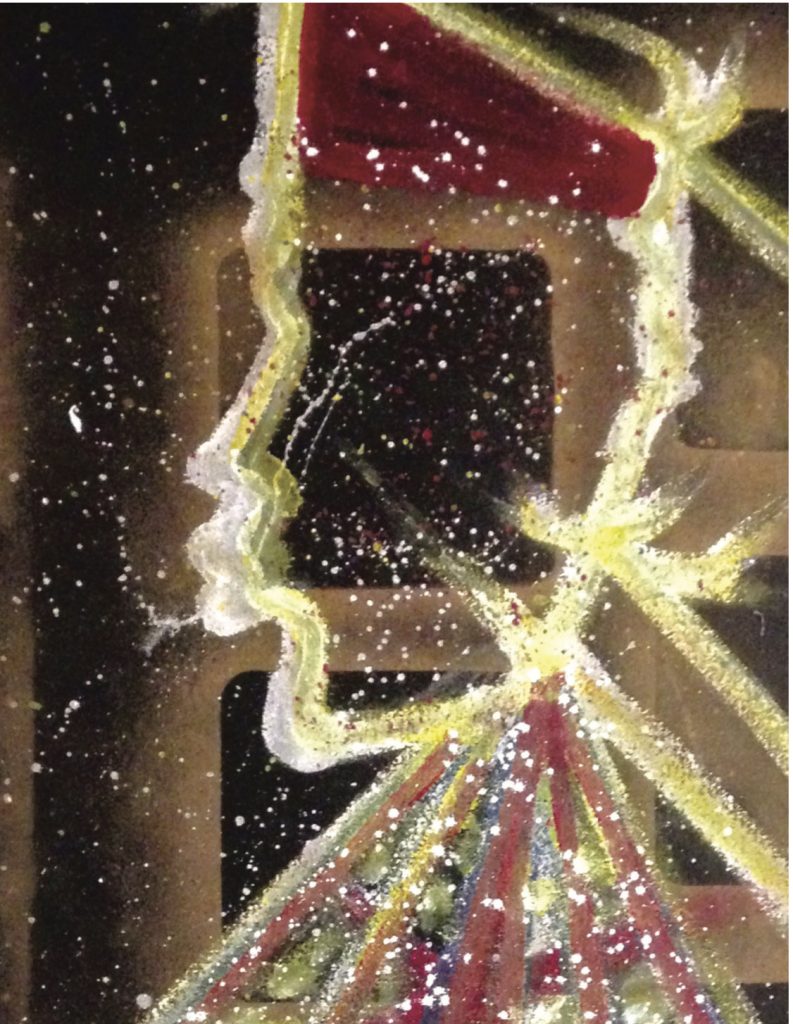
Hassane Sar (Senegal), Thiaroye Dem Dik (‘Go to Thiaroye and Come Back’), 2016.
From Wartime Service to Postwar Struggle
Yet the war changed Africa. The experience of fighting fascism and sustaining the Allied war effort transformed ordinary workers and soldiers into political subjects. They asserted that anti-fascist promises of freedom and social justice must apply in the colonies too, fusing labour and anticolonial fronts.
In June 1945, Nigerian workers – who had fed and supplied the Allied front – launched a general strike for living wages and dignity. The following year, 70,000 South African mineworkers who had powered the Allied wartime economy – gold for reserves, coal for industry – launched a strike against the ‘fascistic’ labour regime of apartheid capitalism: starvation wages and racist labour laws. By 1947–48, the momentum was continent-wide. Across French West Africa, railway workers drew on their wartime discipline to stage a sustained strike that linked the struggle for fair pay to the broader demand for freedom.
In 1948, in Accra, unarmed ex-servicemen marching to demand pensions were gunned down by a British officer. The killings ignited riots and radicalised a generation. Among those arrested in the aftermath of the riots was Kwame Nkrumah, who would soon lead Ghana to independence. Where he had once worked within a moderate nationalist party, he broke away to form his own movement demanding immediate self-government, recognising – as his biographer later wrote – that, after the war ended, the African Revolution had begun.
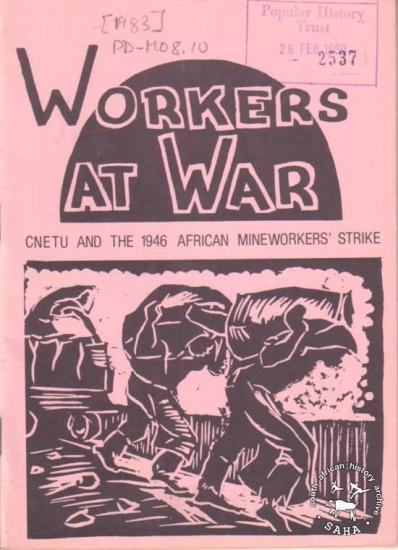
Front cover of the booklet, titled ‘Workers at War – CNETU and the 1946 African Mineworkers’ Strike’, South Africa.
Precision, Not Piety
Sembène refuses easy consolation. After the massacre, in his closing scene, a new group of young African soldiers boards a ship for Europe – just as the veterans of Thiaroye once did. History, it seems, is preparing to repeat itself.
To remember Africa’s role in the World Anti-Fascist War is not an act of charity but of truth-telling. The continent’s battlefields were not peripheral; they were central to the defeat of fascism and the birth of the post-war world. Their struggle against fascism was inseparable from their struggle against the architecture of imperialism. But they also revealed something deeper: that fascism’s core logics – racial hierarchy, expropriation, collective punishment – were native to empire itself.
Eighty years later, the fight continues in new forms: against debt regimes, ecological plunder, militarised borders, and the weaponisation of memory. To commemorate the great victory of the World Anti-Fascist War, resist the resurgence of neo-fascism, and address the intertwined crises confronting the Global South, the Global South Academic Forum (2025) will convene in Shanghai on 13–14 November 2025 under the theme ‘The Victory of the World Anti-Fascist War and the Postwar International Order: Past and Future’.
A new generation of thinkers, artists and organisers across the Global South are reclaiming this history – not to romanticise the past, but to understand the world we have inherited. As Sembène reminds us, resistance begins with precision: to see clearly what was done, who paid the price, and what still remains to be won.
Warmly,
Mika
 | Mikaela Nhondo Erskog |